

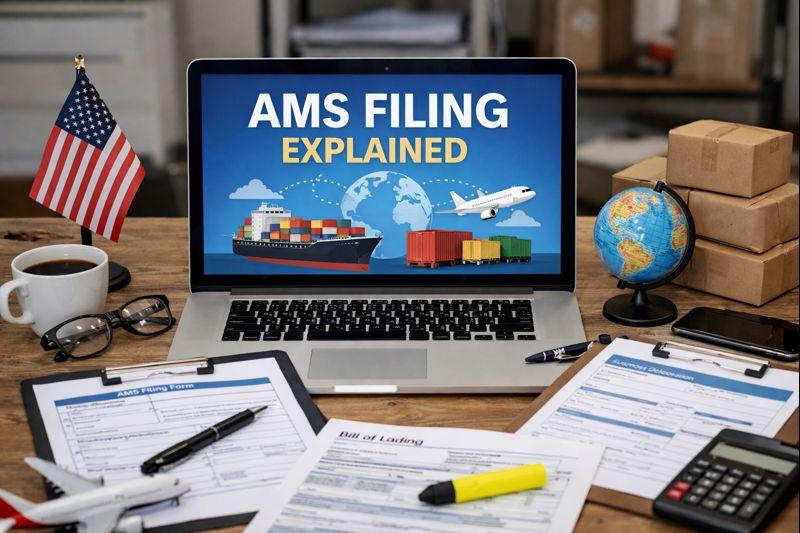
AMS Filing Explained
- Verified & Reviewed · Last updated January 2026
AMS filing is the required pre-arrival electronic submission of shipment and cargo data into the Automated Manifest System so U.S. Customs and Border Protection can screen import cargo before arrival. It is essentially an early data check on the bill chain, parties, routing, and cargo descriptions tied to a shipment.
This updated 2026 guide explains how AMS works in real operations, who is responsible for filing, which shipments require AMS, when to file, and which data fields matter most. You’ll also learn the common mismatch errors that trigger holds and delays, plus a practical checklist to ensure compliance and keep U.S.-bound cargo moving predictably.
Who Files & When
Required Data & Common Errors
Holds, Penalties & Compliance
- Experienced China-based logistics specialists
Table of Contents
AMS Filing Overview
AMS filing is the pre-arrival electronic submission of shipment details and cargo information to U.S. Customs and Border Protection (CBP). Once accepted, it becomes part of the AMS manifest record in the AMS system and is used to review shipments before the cargo arrives.
What the Automated Manifest System (AMS) Is
The automated manifest system ams is a CBP-managed electronic system for early cargo reporting. It collects shipment data and cargo manifests so customs officials can screen shipments under U.S. import laws before arrival.
Where AMS Fits in Customs Clearance
AMS is reviewed early, often before the full customs entry is completed. If shipment data is vague or inconsistent, it can trigger holds and shipment delays. Clean, consistent data reduces disruption and supports smoother clearance.
A practical way to think about it is timing. The closer a vessel is to loading or a flight is to arrival, the less time there is to correct errors. Filing early creates room for fixes without disrupting the move.
Why the Automated Manifest System Matters for Border Protection
The Automated Manifest System exists primarily to support border protection and national security objectives. CBP uses AMS data to identify potential security threats and broader security threats before cargo enters U.S. territory.
By reviewing shipment data in advance, customs officials can apply risk-based controls rather than random intervention. This approach supports enhancing border security while allowing compliant shipments to move with fewer disruptions.
From a commercial standpoint, AMS improves predictability. Clean AMS data reduces manual review, supports efficient processing, and lowers the likelihood of unnecessary inspections.
Who Files AMS: Freight Forwarders, NVOCCs, Ocean Carriers, and Customs Brokers
Responsibility for AMS filing depends on shipment structure and transport mode.
In practice, freight forwarders often coordinate the AMS filing process. They collect documents, validate shipment data, and ensure the correct party submits AMS on time. For many lanes, freight forwarders act as the operational owner of AMS compliance.
NVOCCs commonly file AMS at the house level when a house bill exists. For direct shipments, ocean carriers usually transmit master-level manifest data as part of carrier cargo reporting obligations.
Importers and customs brokers work closely with freight forwarders and shipping carriers to ensure regulatory compliance. While shipping carriers transmit manifest data, customs brokers focus on aligning AMS data with entry filings and meeting applicable customs regulations and import regulations.
Clear role definition is critical. If responsibility is unclear, AMS filing failures are far more likely.
Which Shipments Require AMS Filing
Most U.S.-bound imports require AMS filing, including:
Ocean shipments moving as FCL or LCL
Ocean cargo shipped under NVOCC or consolidated structures
Shipments moving under carrier or NVOCC bills
Many air and ocean shipments subject to carrier reporting rules
If cargo is moving to the United States under a carrier-controlled transport document, AMS filing should be treated as mandatory unless a confirmed exception applies.
Assuming AMS is optional is one of the most common causes of late filing and downstream delays.
Practical exception handling
Treat AMS as required unless you have written confirmation from the carrier or NVOCC that a specific move is exempt. In real operations, confusion usually comes from unusual routings, last-minute rebooking, or changes to the transport document.
If the port of loading changes, the bill reference changes, or a consolidation is reworked, re-check AMS responsibility and resubmit corrections early. Small changes in routing or bill chain are common triggers for data mismatch and downstream delays.
AMS Filing Deadlines: Ocean Freight and Air AMS
Ocean freight deadline
For ocean freight, AMS filing must be submitted at least 24 hours before cargo is loaded onto the vessel at the foreign port of departure.
This timing requirement exists because CBP performs pre-loading risk screening. If AMS data is submitted too close to cutoff, there may be no opportunity to correct errors in shipment details or cargo information.
Once cargo is loaded, late or inaccurate filings significantly increase the risk of holds and inspections.
Air AMS timing
For air shipments, Air AMS data is typically required at least 4 hours before the cargo arrives in the United States. The air transport industry operates on compressed timelines, making early validation essential.
Operational impact of missing AMS deadlines
Missing AMS deadlines often causes operational disruption before penalties are issued. Late filings can lead to vessel loading delays, document revalidation, or additional review by customs authorities.
Once cargo is delayed, recovery options are limited. Filing ahead of the minimum cutoff provides the flexibility needed to resolve issues without affecting transit schedules.
AMS Filing vs Importer Security Filing
AMS filing and Importer Security Filing are both part of the U.S. import process, but they serve different purposes and are handled by different parties.
AMS filing is carrier-side cargo reporting. It sends advance manifest and shipment data to U.S. Customs and Border Protection so cargo can be screened before arrival. In most ocean moves, AMS is filed by the ocean carrier, the NVOCC, or an authorized agent.
Importer Security Filing is importer-driven. It requires the importer or the importer’s agent to submit security-related supply chain information tied to the shipment. The goal is to improve visibility into the import supply chain and support risk assessment.
Quick comparison
| Item | AMS filing | Importer Security Filing |
|---|---|---|
| Main purpose | Pre-arrival manifest and shipment reporting for screening | Importer-side security and supply chain information |
| Who submits | Carrier, NVOCC, or their agent | Importer or their agent |
| Data focus | Bills, cargo description, routing, shipment details | Supply chain parties and security-related data |
| Common problems | Vague cargo description, bill mismatch, name inconsistencies | Missing party data, mismatch with AMS or documents |
| Best practice | Keep manifest data aligned with documents | Use the same master dataset as AMS and entry |
AMS Filing Requirements: Cargo Details and Shipment Data
To meet AMS filing requirements and broader AMS requirements, the filing party must provide complete and consistent data, including:
Legal shipper and consignee names and addresses
Routing details, including export port and foreign port
Bill references, including master bill and house bill
Package count, weight, and marks
Clear cargo details and cargo information
A detailed description of the goods
Standard Carrier Alpha Code where required
Cargo control number where applicable
Special fields such as hazardous material code for regulated cargo
All the necessary data must match across the invoice, packing list, and transport documents. Inconsistent shipment data is one of the most frequent triggers of AMS intervention.
Why data consistency matters
AMS compliance is not about submitting more data. It is about submitting consistent data. Even complete datasets can be flagged if shipment details differ between documents.
Using one verified source of shipment data reduces correction cycles and improves filing reliability.

AMS Filing Process: Step by Step
A disciplined AMS filing process reduces rework, prevents data mismatches, and lowers the risk of shipment delays. In practice, the goal is to lock accurate shipment data early and keep it consistent through submission and acceptance.
Step 1: Confirm filing responsibility
Identify who files AMS for the shipment, carrier, NVOCC, or authorized agent, and confirm the internal cutoff time. Clear ownership prevents late or duplicate filings.
Step 2: Lock a master shipment dataset
Create one verified dataset covering shipper and consignee details, routing, bill references, cargo description, and package data. This dataset should match the invoice, packing list, and transport documents.
Step 3: Validate cargo details before submission
Check cargo descriptions for clarity, confirm bill numbers including house bill where used, and review party names for consistency. Most AMS issues come from small data conflicts, not missing fields.
Step 4: File AMS early
Submit AMS ahead of the legal deadline to allow time for corrections. Filing early is one of the most effective ways to avoid delays and last-minute fixes.
Step 5: Confirm acceptance and monitor status
Submission is not completion. Always confirm filing acceptance and monitor filing status or AMS status until cargo arrives. Address rejects or correction requests immediately.
Following this structured process supports accurate filing, smoother customs clearance, and predictable transit outcomes.
Common AMS Filing Mistakes That Cause Shipment Delays
Most AMS-related shipment delays come from avoidable data problems that trigger extra screening rather than automatic release. The most common issues include:
Vague cargo descriptions that do not clearly identify the goods
Inconsistent shipper or consignee names across documents and filings
Missing or incorrect Standard Carrier Alpha Code where required
Incorrect AMS bill references, including master bill and house bill mismatches
Errors in cargo manifests for consolidated shipments and multi-house structures
Late filing close to the foreign port cutoff, leaving no time to correct rejects
Mismatched data between AMS and Importer Security Filing, especially party names, routing, and cargo descriptions
Most holds are not caused by no data. They happen when the data conflicts across the bill chain, commercial documents, and filings. The fastest prevention method is a single verified master dataset and a controlled change process.
AMS Fees, AMS Charges, and Compliance Risk
AMS fees and AMS charges are usually modest. The larger cost comes from disruption when a filing is late, rejected, or flagged. AMS-related delays can trigger demurrage, detention, terminal storage, exam fees, and missed delivery windows, and these downstream costs can quickly exceed the original freight cost.
Compliance risk also matters. Under CBP requirements, late or inaccurate filings may lead to penalties, shipment detention, and increased scrutiny. Over time, repeated filing issues can create long-term friction, including a higher likelihood of holds or exams on future shipments.
How to Avoid Delays: Checklist, Tracking, and House Bill Controls
Use a consistent workflow to reduce delays and keep filings review-ready:
Confirm who files AMS and the internal cutoff time
Standardize shipper and consignee data across documents
Validate cargo description quality and key cargo reporting fields
Confirm bill references, including master bill and house bill when used
Ensure AMS and Importer Security Filing match
Confirm filing acceptance and retain proof for review
Operational visibility matters. Ask for confirmation that the filing was accepted, not only submitted, and track updates through freight status notification or freight status information until arrival.
For consolidated shipments, add one extra control: verify that house-level data aligns with master-level data and the commercial documents. Many avoidable holds happen when the bill chain is inconsistent, even if each individual record looks “mostly correct.”
Frequently Asked Questions
AMS filing is the electronic submission of shipment data to CBP before import cargo arrives, allowing pre-arrival security screening.
Most ocean imports, including FCL, LCL, and consolidated shipments, require AMS filing. Many air shipments also require AMS.
Ocean AMS must be filed at least 24 hours before loading at the foreign port. Air AMS is typically required at least 4 hours before arrival.
Required data includes shipper and consignee details, routing, bill references, package count, weight, and a clear cargo description.
Late or inaccurate AMS filings can cause shipment delays, holds, exams, penalties, and significant downstream costs.
Related Shipping & Customs Guides
Get Your AMS Filing Checked Before Departure
Verify AMS data against your bill and invoice
Reduce holds, exams, and late-filing penalties
Faster, smoother U.S. customs clearance
Send your draft B/L details and we’ll flag common AMS mismatch risks.