Related Guide
Shipping from China to Canada
Shipping from China / Shipping from China to Canada China–Canada Shipping Guide · Updated August 2026 Shipping from China to Canada Compare sea f...
Read guide →

Sea freight from China to Canada offers a cost-effective solution for bulk cargo, heavy goods, and regular commercial shipments.
This guide explains sea freight costs, FCL and LCL shipping, transit times, major routes to Vancouver, Prince Rupert, Montreal, and Halifax, plus customs clearance and door-to-door delivery options.
FCL / LCL Shipping
Transit time range
DDP / Door to Door
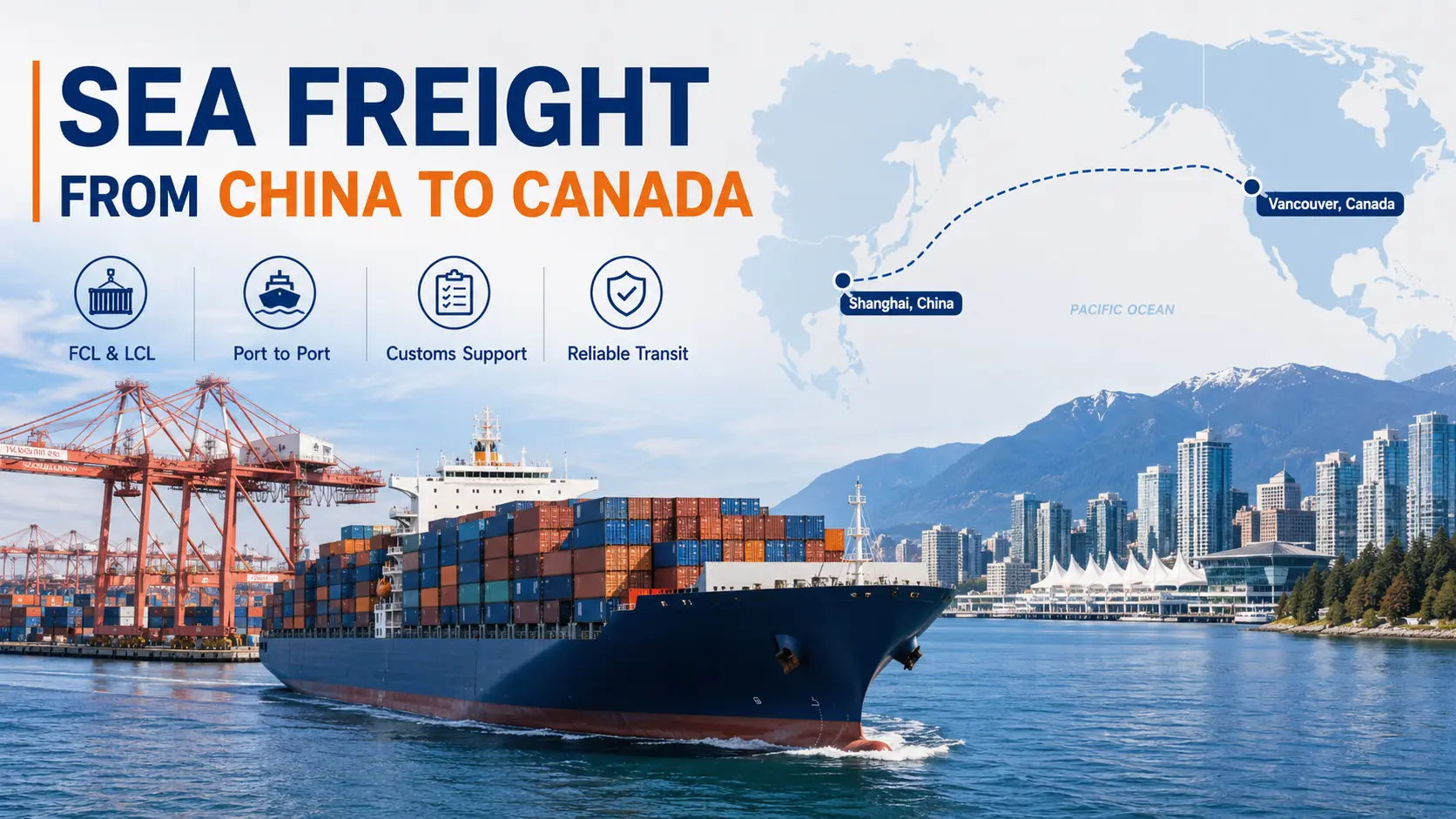
Shipping from China to Canada by sea is usually slower than air freight or express shipping, but it provides a much lower cost per unit for heavy cargo and regular inventory. The following table gives importers a practical overview before they compare individual shipping rates.
| Shipping Item | Typical Planning Range |
|---|---|
| Port-to-port sea freight | Approximately 20–40 days |
| Door-to-door sea shipping | Approximately 5–8 weeks |
| FCL shipping | Best for large or regular shipments |
| LCL shipping | Best for smaller commercial cargo |
| Main Chinese ports | Shanghai, Ningbo, Shenzhen, Nansha, Qingdao and Xiamen |
| Main Canadian ports | Vancouver, Prince Rupert, Montreal and Halifax |
| Common inland destinations | Toronto, Calgary, Edmonton, Winnipeg and Ottawa |
| Main cost factors | Route, container type, season, cargo volume and final delivery |
These figures are planning estimates rather than guaranteed schedules. Vessel changes, transshipment, severe weather, port congestion, customs inspections, and inland rail capacity can all affect the final Canada transit time.
A successful sea shipment begins before the goods reach the port. The freight forwarder needs accurate product, packing, and delivery information to choose the correct container load, reserve vessel space, and calculate the complete shipping cost.
The normal shipping process includes the following stages:
Confirm the cargo information. The supplier provides the product name, HS code, carton count, gross weight, dimensions, cargo volume, and cargo-ready date.
Choose FCL or LCL shipping. The shipping agent compares the cost of a dedicated container with the cost of sharing container space.
Arrange pickup and export handling. Depending on the Incoterm, the supplier or freight forwarder transports the goods to the port or consolidation warehouse.
Complete export customs procedures. The commercial invoice, packing list, export declaration, and product-specific documents are checked before departure.
Load and ship the cargo. FCL cargo is loaded into a dedicated container, while LCL cargo is consolidated with international shipments from other exporters.
Complete Canadian customs clearance. The importer or customs broker submits the required product classification, value, origin, and import information.
Arrange inland and final delivery. Released cargo moves by truck, rail, or a combination of both to the consignee’s address.
The shipping process becomes more complex when the cargo contains batteries, chemicals, food, medical products, untreated wood, or other regulated goods. These products should be reviewed before space is booked rather than after the container reaches the terminal.
The two main container options are full container load and less than container load shipping. The correct choice depends on cargo volume, product value, handling risk, delivery urgency, and the total charges at both origin and destination.
FCL is not automatically better for every shipment, and LCL is not always the cheapest option for smaller cargo. Importers should compare the complete shipping solution rather than choosing only by the number of cubic metres.
Full container load shipping means one shipper books the entire container. The goods do not need to fill every available cubic metre, but no unrelated cargo is loaded into the same container.
FCL shipping is commonly used for large quantities, heavy cargo, regular inventory, and products that require greater control during loading. Because the cargo avoids consolidation and deconsolidation warehouses, it normally has fewer handling points than LCL shipping.
The main advantages of shipping FCL are:
Faster handling at origin and destination
Lower risk of damage from repeated movement
Greater control over container loading
More predictable charges for large shipments
No delay caused by another shipper’s consolidation documents
A 20-foot container is often suitable for dense and heavy cargo, while a 40-foot or 40-foot high-cube container provides more internal space for lighter, higher-volume goods. Weight limits, road restrictions, and product loading requirements should be checked before selecting the container equipment.
Less than container load shipping allows multiple exporters to share one container. The shipping company normally charges according to cargo volume or chargeable measurement, subject to a minimum rate.
LCL shipping is suitable when the cargo does not justify the cost of an entire container. It allows importers to move smaller orders more frequently and avoid paying for unused container space.
However, an LCL shipment passes through more operational stages. Goods are delivered to a consolidation warehouse in China, loaded with other shipments, unloaded at a Canadian container freight station, and released individually after customs clearance.
This additional handling can result in:
A longer transit time than FCL
Higher destination warehouse charges
Greater packaging requirements
More consolidation documentation
Increased exposure to handling damage
For this reason, the lowest LCL ocean freight rate does not always produce the lowest total shipping cost.
The best container load depends on more than cargo volume. Importers should also consider product value, shipment frequency, destination charges, and the risk of delaying an urgent order.
| Factor | FCL Shipping | LCL Shipping |
|---|---|---|
| Container use | Exclusive container | Shared container |
| Pricing basis | Rate per container | Volume or chargeable measurement |
| Best for | Large quantities | Smaller commercial shipments |
| Handling | Fewer handling points | More warehouse handling |
| Transit time | Usually faster | Usually longer |
| Damage risk | Generally lower | Higher due to repeated handling |
| Destination costs | More predictable | CFS and deconsolidation fees apply |
When the volume approaches the practical break-even point, the freight forwarder should quote both FCL and LCL for the same route. Comparing only the ocean freight component can produce a misleading result.
Sea freight costs from China to Canada vary according to the container type, route, cargo volume, season, and final delivery address. Rates to Vancouver and Prince Rupert are often lower than routes to Eastern Canada because the ocean journey is shorter, although rail or truck delivery may increase the total cost for inland destinations such as Toronto, Calgary, or Edmonton.
The figures below are general market references. Actual shipping rates should be confirmed according to the cargo-ready date and current carrier capacity.
| Shipping Option | Estimated Rate | Pricing Basis |
|---|---|---|
| 20ft FCL to Vancouver | USD 2,000–7,500+ | Per container |
| 20ft FCL to Toronto or Montreal | USD 3,200–9,200+ | Per container |
| 40ft FCL to Vancouver | USD 2,600–9,400+ | Per container |
| 40ft FCL to Toronto or Montreal | USD 4,000–11,500+ | Per container |
| LCL shipping | USD 65–180 per CBM | Volume or chargeable weight |
These ranges can change significantly during peak seasons, port congestion, equipment shortages, or periods of limited vessel capacity.
FCL shipping is charged by container rather than by the exact amount of space used. It is normally more economical for larger shipments and provides simpler handling because the goods remain in one dedicated container.
LCL shipping is charged by cargo volume or chargeable weight. It is suitable for smaller shipments, but consolidation and destination warehouse fees can increase the final cost.
As a general guideline:
LCL is practical for small and occasional shipments.
FCL becomes more competitive as cargo volume approaches 12–15 CBM.
Heavy, fragile, or high-value cargo may benefit from FCL even at a lower volume.
The break-even point varies by route, cargo density, and destination charges, so both options should be compared before booking.
A China to Canada sea freight quote may include port-to-port transport only, or it may cover the complete door-to-door shipping process. Importers should confirm the service scope before comparing prices.
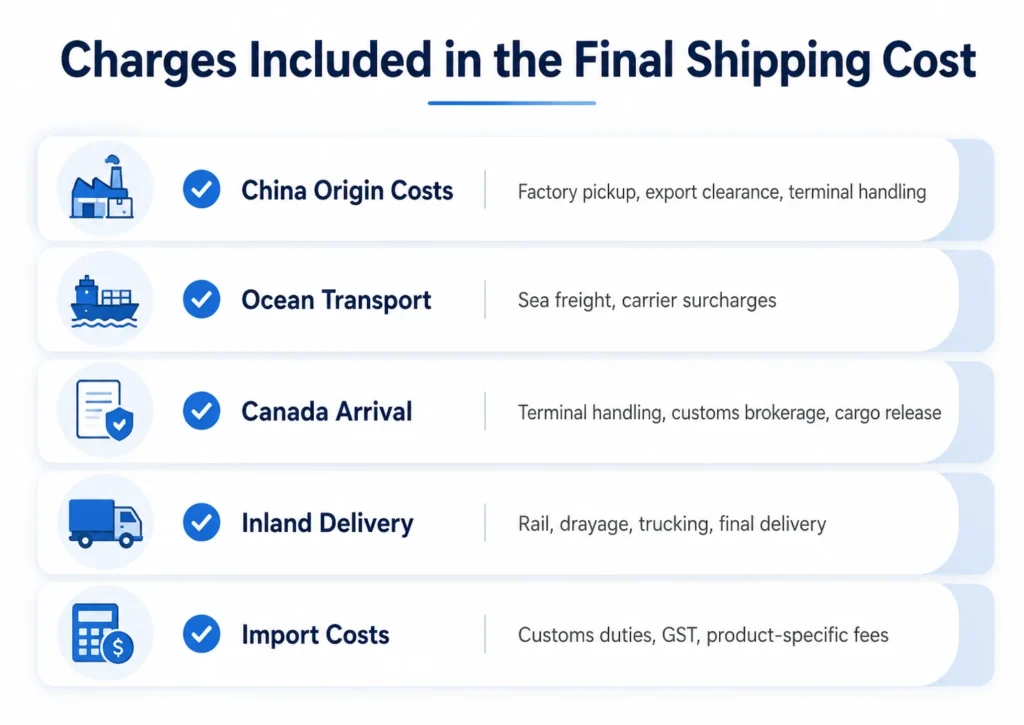
DDP shipping may combine these charges into one quotation, but the final price depends on the HS code, declared value, cargo weight, volume, and delivery postal code. There is no universal DDP rate that applies to every shipment.
To receive an accurate quote, provide the product description, HS code, carton dimensions, gross weight, total CBM, supplier address, and final Canadian destination.
The transit time for ocean freight depends heavily on the specific origin and destination ports. China to Canada West Coast services are normally shorter than all-water shipping routes to Eastern Canada.
Direct services are generally faster and easier to predict than routes involving transshipment. Carrier networks also change, so sailing schedules should be confirmed at the time of booking. Current carrier services connect major Chinese ports with Vancouver and Prince Rupert, although the exact port rotation and transit time can change.
The following ranges can be used for initial shipping planning. They do not include factory pickup, consolidation, customs clearance, rail transport, or final delivery.
| Origin Port | Canadian Destination | Estimated Port-to-Port Time |
|---|---|---|
| Shanghai or Ningbo | Vancouver | 15–25 days |
| Shenzhen, Yantian or Hong Kong | Vancouver | 18–25 days |
| Major Chinese ports | Prince Rupert | 14–24 days |
| Shanghai or Shenzhen | Montreal by all-water service | 35–45 days |
| West Coast port plus rail | Toronto | 25–40 days total routing |
A published CMA CGM service, for example, shows a 19-day sequence from Hong Kong to Vancouver, while another service shows Shanghai and Vancouver in the same Pacific Northwest rotation. These examples demonstrate why the actual timing must be checked against the selected carrier and sailing rather than treated as a permanent route standard.
Port-to-port transit measures the vessel movement between the origin and destination ports. It does not include the operational time before departure or after arrival.
Door-to-door sea shipping normally requires additional time for:
Supplier pickup and export customs procedures
LCL consolidation or FCL container loading
Canadian customs clearance
Rail or truck transport
Delivery appointments and unloading
As a result, a shipment with a 20-day ocean transit may still require five or six weeks from the supplier’s factory to the final Canadian destination.
Port selection affects both delivery speed and shipping costs. The closest origin port may reduce inland transport in China, but carrier schedules and direct vessel services must also be considered.
In Canada, the lowest sea freight rate is not always connected to the lowest total delivery cost. Inland rail distance, terminal handling, and truck capacity can change the final result.
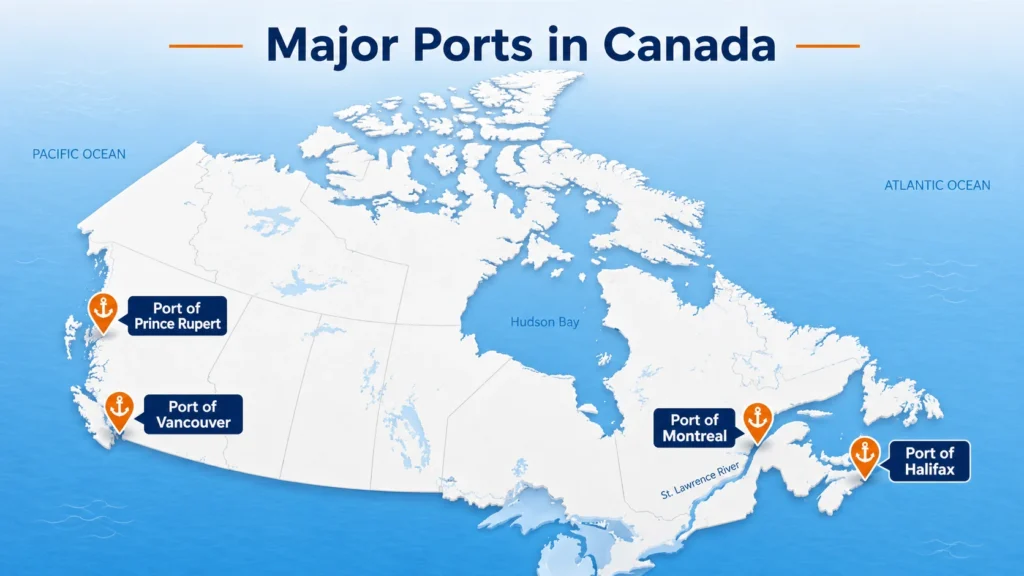
China has several major export gateways serving different manufacturing regions. Freight forwarders normally select the port by balancing domestic pickup costs against available shipping routes.
Shanghai and Ningbo serve the Yangtze River Delta, including suppliers in Shanghai, Jiangsu, and Zhejiang. Both ports handle large volumes of international shipping and provide regular connections to Canada’s West Coast.
Shenzhen, Yantian, Nansha and Hong Kong are common choices for cargo manufactured in Guangdong and the wider Pearl River Delta. Hong Kong may also be used for selected air freight and specialized international shipments.
Qingdao and Tianjin serve exporters in North and Northeast China, while Xiamen is a practical origin for suppliers in Fujian and nearby provinces.
The Port of Vancouver is Canada’s largest port and the country’s leading gateway for many Asia–Canada shipping routes. Transport Canada reported that the port handled 158 million tonnes of cargo and approximately 3.5 million TEUs in 2024.
Vancouver is frequently used for cargo delivered to British Columbia, Alberta, Saskatchewan, Manitoba, and Ontario. Containers may continue by rail to Calgary, Edmonton, Winnipeg, Toronto, and other inland markets.
Prince Rupert provides a short transpacific route and direct access to Canada’s inland rail network. The port authority describes Prince Rupert as the closest North American West Coast port to Asia, approximately 500 nautical miles closer than other Pacific Northwest ports and capable of saving up to around 60 hours of sailing time.
The route can be especially attractive when the carrier schedule, rail connection, and final destination align. However, importers should compare actual departure frequency and total inland costs rather than choosing the port based on sailing distance alone.
The Port of Montreal is the largest container port in Eastern Canada and provides access to Quebec, Ontario, the northeastern United States, and the Midwest. The port states that cargo can reach a market of approximately 110 million consumers within two days by rail or truck.
An all-water route from China to Montreal normally takes longer than shipping to Canada’s West Coast. It may still provide an efficient solution for cargo with a final destination in Quebec or Eastern Canada.
Halifax is another option for selected all-water and transshipment services. It is most relevant for shipments destined for Nova Scotia, New Brunswick, Newfoundland and Labrador, or other locations in Atlantic Canada.
For cargo moving to Central Canada, the freight forwarder should compare Halifax or Montreal with a West Coast arrival followed by rail transport.
Customs clearance is a critical stage of shipping from China to Canada. Incorrect tariff classification, vague product descriptions, inconsistent values, or missing permits can lead to examinations, reassessment, storage fees, and significant shipping delays.
Commercial importers generally need a Canadian Business Number and an import-export program account. New importers can register an RM account through the CARM Client Portal, and importers using a customs broker must delegate the appropriate authority in the portal.
The required documents depend on the product, but most commercial ocean freight shipments need a consistent set of core records.
The main documents are:
Commercial invoice or Canada Customs Invoice
Bill of lading
HS classification and detailed product description
Permits or certificates required for regulated goods
The commercial invoice should identify the vendor, purchaser, consignee, product origin, quantities, values, currency, and transportation details. CBSA allows a standard commercial invoice when it contains the information required for a Canada Customs Invoice.
The invoice, packing list, bill of lading, and customs declaration should show consistent quantities, weights, product descriptions, and parties. Documentation preparation should be completed before arrival so the customs broker can review the shipment in advance.
Every imported product must be classified under the Canadian Customs Tariff. Canadian commercial imports use a 10-digit tariff classification number, which determines the applicable duty treatment and supports accurate import reporting.
Customs duties vary according to:
Product classification
Value for duty
Tariff treatment
Special import measures
Some products from China may also be subject to anti-dumping duties, countervailing duties, surtaxes, or other trade measures. Importers should confirm these requirements before shipping goods rather than relying only on the HS code provided by the supplier.
Most commercial goods imported into Canada are subject to 5% GST, calculated on the value for duty plus any applicable customs duty. Customs duty is separate and depends on the product’s HS code, country of origin, and declared value.
Before shipping, confirm:
Duty rates vary by product, so they should be checked before calculating the total landed cost.
Door-to-door shipping combines the international freight movement with origin handling, customs coordination, and final delivery. It can simplify the supply chain because the importer does not need to appoint a different shipping company for every stage.
The exact responsibilities still depend on the agreed Incoterm. A door-to-door quotation does not automatically mean that customs duties and taxes are included.
Under EXW terms, the buyer takes responsibility from the supplier’s premises. The freight forwarder normally arranges factory pickup, export customs handling, ocean freight, Canadian customs clearance, and final delivery.
EXW can provide the importer with greater control over the shipping process, but the quote must account for the additional pickup and export costs in China.
Under FOB terms, the Chinese supplier normally delivers the goods to the named port and completes the export customs procedures. The buyer then controls the ocean freight, Canadian import clearance, and destination delivery.
FOB is widely used for commercial shipping from China because the origin responsibilities are relatively clear. Importers should still confirm which terminal, documentation, loading, and local charges remain payable.
DDP shipping is intended to place most transportation and import responsibilities on the seller. In practice, the quotation should clearly identify the importer of record, customs broker, HS code, declared value, duties, taxes, and proof of import.
DDP can be convenient for first-time importers, but an unclear arrangement can create compliance and accounting risks. The freight forwarder should explain how the shipment will be entered through CARM and who will retain the customs documents.
Sea freight is the best shipping solution for many bulk shipments, but it is not suitable for every order. Delivery speed, product value, cargo volume, and the financial effect of a stock shortage should all be considered.
Some importers use a combined strategy: ocean freight for normal inventory, air freight for urgent replenishment, and express shipping for samples or replacement parts.
| Shipping Method | Typical Planning Time | Best For | Relative Cost |
|---|---|---|---|
| Sea freight | 20–40 days port to port | Heavy cargo and large quantities | Lowest |
| Standard air freight | Around 8–10 days door to door | Medium-sized urgent shipments | High |
| Faster air freight | Around 3–7 days | High-value or time-sensitive cargo | Higher |
| Express shipping | Around 2–7 days | Samples and small parcels | Highest per kilogram |
Air freight from China to Canada is appropriate when delayed inventory would cost more than the higher transportation rate. It is often used for electronics, replacement parts, product launches, medical items, samples, and high-value goods.
China to Canada air freight costs are based mainly on chargeable weight, dimensions, route, airline capacity, and required delivery speed. Standard air freight is normally cheaper than courier express for larger commercial cargo, while express shipping is easier for small parcels.
Hong Kong International Airport is a major international cargo hub and is widely used for cargo originating in the Pearl River Delta. In Canada, Toronto Pearson processes more than 45% of the country’s air cargo, while Vancouver International Airport supports air-to-ground and sea-to-air cargo connections on Canada’s West Coast.
Canada express shipping is useful for documents, samples, small spare parts, and lightweight urgent shipments. It generally offers faster pickup, integrated customs processing, and final delivery through one courier network.
As the chargeable weight increases, express shipping prices can become significantly higher. A shipping agent should compare courier services with standard air freight before booking a larger urgent shipment.
The cheapest shipping method is not simply the option with the lowest base rate. Importers should reduce the complete landed cost while protecting delivery reliability and product condition.
A well-planned shipping strategy normally focuses on the following actions:
Book before peak periods. Carrier capacity becomes tighter before major holidays, which can increase freight rates and reduce sailing choices.
Choose the right container option. Compare the complete FCL and LCL costs when the cargo volume is close to the break-even point.
Prepare customs documents early. A correct commercial invoice, packing list, HS code, and product description can reduce clearance delays.
Compare complete quotations. Confirm whether the price covers origin handling, ocean freight, Canadian destination fees, customs clearance, and final delivery.
Select the right Canadian gateway. A higher sea freight rate may produce a lower total cost when it reduces rail or truck distance.
Allow realistic lead time. Last-minute shipping often forces the importer to use expensive air freight or express shipping.
The most effective cost reduction usually comes from better planning rather than choosing the lowest-priced shipping company.
Ocean freight exposes cargo to factory handling, trucking, terminal movement, container loading, vibration, humidity, and inland delivery. Export packaging should therefore be designed for the complete route rather than only for storage at the supplier’s warehouse.
LCL cargo generally needs stronger packaging because it is handled more frequently than a full container load. Heavy cargo should also be packed so that forklifts and lifting equipment can move it safely.
Useful protective measures include:
Strong export cartons or crates
Pallets suitable for international shipping
Internal cushioning and edge protection
Moisture barriers and desiccants
Clear handling and shipping marks
Wood packaging may need approved treatment and markings. The freight forwarder should confirm the applicable requirements before the goods reach the warehouse.
Cargo insurance is also advisable for high-value goods, machinery, fragile products, and custom-made cargo. Carrier liability may be limited and may not cover the full commercial value of loss or damage.
Insurance costs are normally influenced by the cargo value, product type, route, packing method, and level of coverage. The insured party and insured value should match the sales contract and Incoterm.
A reputable freight forwarder should manage more than the ocean freight booking. The company should understand export handling in China, Canada ocean freight routes, customs clearance, destination charges, rail transport, and final truck delivery.
Before booking, confirm:
Tonlexing Logistics provides FCL, LCL, air freight, customs coordination, and door-to-door shipping from major Chinese cities to Canada. We help importers compare routes, clarify origin and destination charges, prepare shipping documents, and arrange delivery to Vancouver, Toronto, Montreal, Calgary, and other Canadian destinations.
A professional freight forwarder should provide a complete shipping plan rather than only a low freight rate. With the cargo details, pickup address, and final postal code, Tonlexing can recommend a suitable route and prepare a clear China to Canada shipping quote.
Sea freight from China to Canada generally takes around 20 to 40 days from port to port. Shipping to Vancouver or Prince Rupert is normally faster than an all-water service to Eastern Canada.
Door-to-door delivery commonly takes five to eight weeks after factory pickup, export handling, customs clearance, and inland transportation are included.
As of July 2026, a 20ft container may cost around USD 2,000–9,200, while a 40ft container may range from USD 2,600–11,500, depending on the destination, season, and carrier capacity.
Rates to Vancouver are usually lower than rates to Toronto or Montreal. These estimates may exclude customs clearance, Canadian terminal charges, rail transport, and final delivery, so a current door-to-door quote is recommended.
LCL shipping is normally more economical for small cargo volumes because the importer pays only for part of the container.
FCL becomes more competitive as the shipment grows. It also provides fewer handling points, faster processing, and a lower risk of damage. The correct choice should be based on a complete comparison for the same final destination.
Vancouver and Prince Rupert are the main gateways for shipments moving from China to Canada’s West Coast and inland markets. Montreal may be suitable for Quebec and parts of Eastern Canada, while Halifax can serve Atlantic destinations.
The best port depends on the vessel schedule, rail connection, final delivery city, and total landed cost.
Air freight is better for urgent shipments, high-value goods, samples, and inventory shortages. It normally takes much less time than ocean freight but costs significantly more.
Sea freight remains the more economical option for heavy cargo, large quantities, regular inventory, and full container load shipments.
Useful freight, customs and importing resources related to this shipping guide.
Shipping from China / Shipping from China to Canada China–Canada Shipping Guide · Updated August 2026 Shipping from China to Canada Compare sea f...
Read guide →
Shipping Cost from China to Canada (2026 Guide) Verified & Reviewed · Last updated April 2026 Shipping cost from China to Canada in 2026 typicall...
Read guide →
Shipping Costs for 20FT and 40FT Containers from China to Canada Verified & Reviewed · Last updated June 2026 Shipping costs for 20FT and 40FT co...
Read guide →
How long does it take to ship from China to Canada? This is one of the most common questions asked by importers and supply chain managers. Shippi...
Read guide →Freight Forwarder From China to Canada (2026 Guide) Verified & Reviewed · Last updated January 2026 Choosing a freight forwarder from China to Ca...
Learn more → Useful Resource Customs Clearance in CanadaCustoms Clearance in Canada (2026 Guide) Verified & Reviewed · Last updated January 2026 Customs clearance in Canada varies by shipment type, but...
Learn more →WhatsApp us