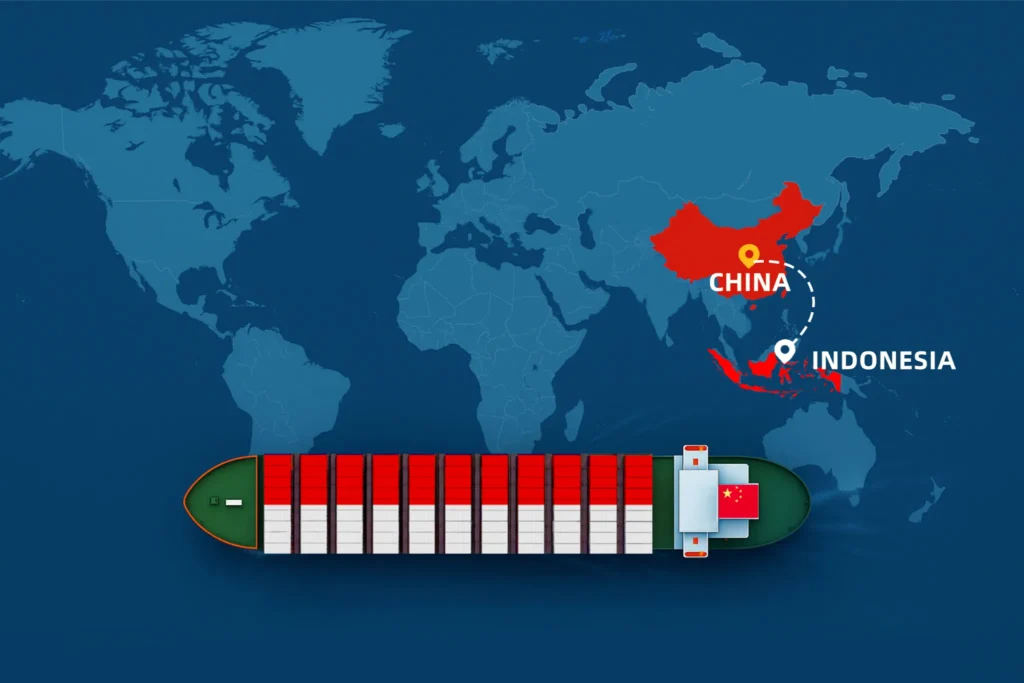
Sea Freight
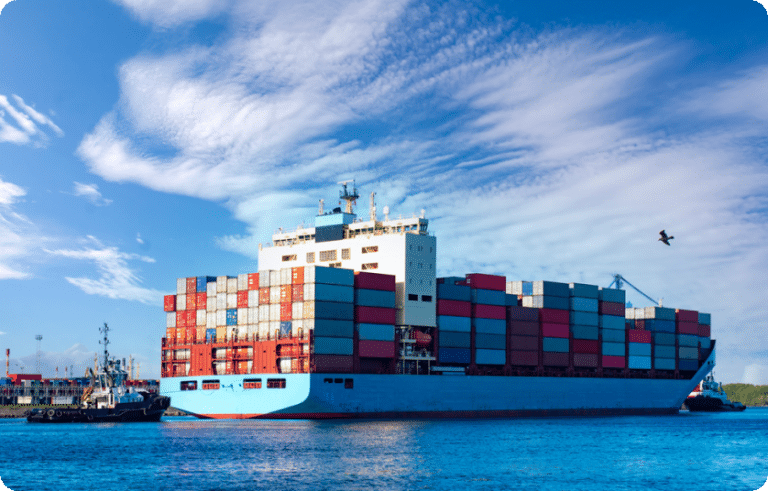
FCL and LCL sea freight are commonly used for commercial shipments, pallets, machinery and larger orders moving from Chinese ports to Indonesia.
China–Indonesia Freight Guide · Updated August 2026
Shipping from China to Indonesia can involve sea freight, air freight, express courier or door-to-door service. This guide compares freight options, costs, transit times and Indonesian customs requirements, with practical planning for cargo moving through Jakarta, Surabaya and destinations that require an additional domestic delivery leg.
For an accurate quote, provide the cargo details, China pickup location and final delivery city in Indonesia.
China–Indonesia Freight Options
The right shipping method depends on cargo volume, urgency and the final destination in Indonesia. Jakarta and Surabaya are common international gateways, while deliveries to Sumatra or other islands may require a different port or an additional domestic transport leg.
Cargo for Jakarta or West Java can be planned differently from shipments for Surabaya, Medan or destinations beyond the main gateways. The destination city should therefore be confirmed before comparing sea freight, air freight or door-to-door quotes.
FCL and LCL sea freight are commonly used for commercial shipments, pallets, machinery and larger orders moving from Chinese ports to Indonesia.
Air freight is more suitable when inventory, production schedules or cargo value make a longer ocean transit impractical.
Express courier is useful for samples, documents, replacement parts and smaller urgent cartons that do not justify a conventional freight booking.
Door-to-door service combines the China origin leg, international freight, customs coordination and delivery to the agreed destination in Indonesia.
Important entry point for cargo serving Jakarta and surrounding markets.
Key option for cargo serving Surabaya and East Java.
Relevant for shipments serving Medan and northern Sumatra.
Exact freight cost and transit time depend on the China origin, Indonesian gateway, cargo details and final delivery location. The following sections compare these factors separately.
2026 Freight Rate Guide
Shipping costs from China to Indonesia depend on the freight method, cargo size, China origin, Indonesian destination and service scope. The rates below can be used as a starting point when comparing sea freight, air freight, express and door-to-door shipping.
| Shipping Method | Indicative Rate | Rate Basis |
|---|---|---|
| LCL Sea Freight Less than Container Load | USD 3/CBM | Shared-container sea freight charged by cargo volume. Origin, destination and special handling charges depend on the shipment. |
| 20GP FCL Full Container Load | USD 500/container | Indicative ocean freight for a standard 20GP container moving on common China–Indonesia routes. |
| 40GP FCL Full Container Load | USD 1,000/container | Indicative ocean freight for a standard 40GP container before additional inland or inter-island delivery. |
| Air Freight Commercial Air Cargo | USD 2–4/kg | Calculated from chargeable weight. Rate varies with shipment weight, dimensions, airport, cargo type and available airline capacity. |
| Express Courier DHL, FedEx, UPS or Similar | USD 4–6/kg | Suitable for smaller urgent shipments. Final cost can change according to chargeable weight, destination postcode and courier surcharge. |
| Door-to-Door / DDP Combined Logistics Service | USD 280–330/CBM | Indicative volume-based rate for coordinated delivery service. Actual scope depends on cargo type, customs requirements and the final destination in Indonesia. |
Freight arriving in Jakarta or Surabaya may require only a relatively short inland delivery after customs clearance. Cargo destined for Medan, Bali, Kalimantan, Sulawesi or other islands can require additional trucking, domestic feeder or inter-island transportation, which should be included when comparing the total logistics cost.
Information needed for an accurate quote
Rate scope: These are indicative planning rates rather than guaranteed quotations. Final freight charges can change with carrier capacity, route, shipment date, cargo characteristics and the agreed service scope. Import duties, taxes, inspection, storage, permits or additional destination charges should only be treated as included when they are specifically stated in the quotation.
Transit Time Guide
Shipping time depends on the Chinese origin, Indonesian gateway, carrier schedule and final destination. Sea freight should be compared by route, while air and express services are better planned around the arrival airport and last-mile delivery area.
Cargo arriving in Jakarta or Surabaya may still need customs clearance and inland delivery. Shipments for Bali, Kalimantan, Sulawesi or other islands can require an additional domestic transport leg, so the international transit time should not be treated as the final delivery time.
Typical China–Indonesia Transit Times
Planning Ranges| Shipping Method | Example Route | Main Transit | Planning Note |
|---|---|---|---|
| Sea Freight FCL / scheduled ocean service | Shanghai → Jakarta Tanjung Priok gateway | 15–20 days Port-to-port planning | Add destination handling, customs clearance and final delivery after vessel arrival. |
| Sea Freight FCL / scheduled ocean service | Shenzhen → Surabaya Tanjung Perak gateway | 18–22 days Port-to-port planning | Actual timing depends on the carrier schedule and whether the sailing is direct or uses transshipment. |
| Air Freight Standard commercial air cargo | China → Jakarta Soekarno-Hatta / CGK | 1–3 days Main air movement | Airport handling, customs clearance and final delivery are additional to the main flight time. |
| Express Courier DHL, FedEx, UPS or similar | China → Jakarta Major-city courier network | 3–5 days Typical major-city delivery | Remote postcodes and destinations outside the main courier network may require additional delivery time. |
| LCL Sea Freight Consolidated cargo | China → Indonesia Depends on consolidation route | Schedule-based Route must be confirmed | Allow additional time for consolidation before departure and deconsolidation after arrival. |
These ranges are for shipment planning rather than guaranteed delivery dates. Sailing schedules, flight availability, customs review and the Indonesian destination can change the final timeline.
Direct vs. Transshipment A direct sailing is generally easier to predict than a route requiring a vessel connection.
Port & Airport Handling Congestion or cargo-handling queues can extend the time after arrival.
Indonesian Customs Document discrepancies, permits or physical inspection can delay release.
Inter-Island Delivery Destinations beyond the main gateway may need another domestic sea, road or air movement.
Ocean Shipping
Ocean freight is widely used for commercial cargo moving from China to Indonesia. The main decision is whether to book a full container or share container space, followed by selecting the Indonesian gateway that best fits the final destination.
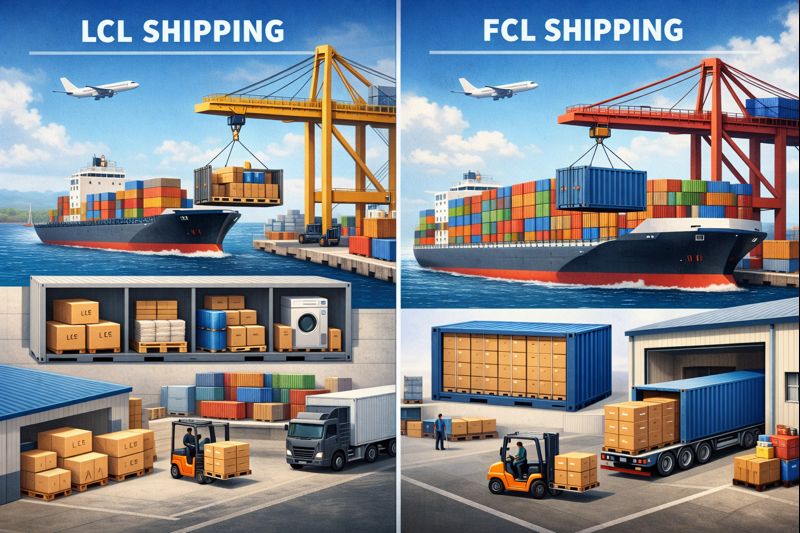
FCL gives one shipment the use of a full container and is commonly chosen for larger commercial orders, machinery, palletized cargo or shipments where container control is important.
LCL allows smaller commercial shipments to share container space with other cargo. It can be useful when an order does not require a full container but is too large or too cost-sensitive for air freight.
The nearest or most appropriate port depends on the final delivery area. A low ocean rate is not necessarily the lowest total option if the cargo then requires a long domestic leg.
Common gateway for shipments serving Jakarta and surrounding areas in western Java.
Important option for shipments serving Surabaya and destinations in East Java.
Relevant gateway when the final cargo destination is in Medan or northern Sumatra.
Accurate cargo information helps determine whether FCL or LCL is more practical and which China–Indonesia route should be checked with the carrier.
Product description
Number of packages
Gross weight
Cargo dimensions or CBM
China pickup location
Final destination in Indonesia
Container availability, carrier schedules and routing can change. Confirm the sailing and service scope before booking.
Air Cargo
Air freight is used for time-sensitive commercial cargo, replenishment orders, components and higher-value shipments. For Indonesia, the arrival airport should be selected together with the final delivery location rather than by flight cost alone.
Based on chargeable weight and shipment conditions.
Customs and final delivery are additional to flight time.
CGK and SUB are the main airports covered in this guide.
Air freight can be more practical than ocean shipping when cargo value, stock availability or production deadlines make a longer transit unsuitable. The decision should be based on the complete landed logistics plan, not only the flight rate.
The airline compares actual gross weight with volumetric weight and charges whichever is higher. Package dimensions are therefore required together with the total shipment weight before the air freight rate can be confirmed.
A lower flight rate into Jakarta does not always mean a lower total logistics cost for cargo ultimately destined for Surabaya or another island. For shipments outside the main arrival area, compare customs clearance, domestic transport and final delivery together with the international air freight rate.
Providing complete cargo information helps determine chargeable weight, flight availability and whether any special handling or regulatory check is required before booking.
Airline capacity, cargo acceptance and flight schedules can change. Confirm the final air freight rate and routing before shipment.
Final Delivery Options
Express courier and door-to-door freight solve different shipping needs. Courier services are usually used for smaller urgent shipments, while door-to-door service coordinates more of the logistics chain through to the agreed destination in Indonesia.
International express courier is useful for samples, replacement parts, documents and smaller urgent cartons moving from China to customers or businesses in Indonesia.
Courier coverage is generally easier in major cities. Deliveries to remote districts or islands can take longer and may involve extended-area or last-mile surcharges.
Door-to-door shipping and Delivered Duty Paid (DDP) services can coordinate supplier pickup in China, export handling, international transportation, customs-related arrangements and delivery to the agreed Indonesian destination under one logistics plan.
Delivery to Jakarta or Surabaya can involve a different logistics plan from delivery to Bali, Kalimantan, Sulawesi or another island where an additional domestic leg may be required.
Indonesia's geography makes the final delivery stage especially important. A shipment cleared near Jakarta or Surabaya may still need trucking, domestic feeder service or another transport leg before reaching the consignee. For door-to-door quotations, provide the exact destination so the domestic movement can be included from the beginning.
DDP scope: Do not assume every quoted door-to-door or DDP rate includes the same items. The quotation should clearly state the freight mode, customs arrangement, duties or taxes where applicable, destination charges and final delivery coverage before booking.
Indonesian Customs
Commercial imports into Indonesia should be checked for HS classification, customs value, import restrictions and required supporting documents before shipment. The importer or appointed customs broker normally completes the Indonesian import declaration and customs procedures after arrival.
Confirm the product description and HS code first. Check whether the goods are subject to Indonesian import restrictions, permits, product registration or another technical requirement before the cargo leaves China.
For normal commercial imports, the importer or customs broker prepares the Pemberitahuan Impor Barang (PIB) using the shipment, invoice, transport, origin and valuation information required for customs declaration.
Customs duty depends on the HS classification, customs value and any valid preferential tariff treatment. Indonesia uses CIF customs value for import-duty calculation, while applicable import taxes are assessed under the current tax rules.
Indonesian Customs applies risk-based processing. Selected shipments may require document review or physical inspection before release, while other entries can follow a lower-intervention clearance route.
Import duty is not one fixed percentage for all goods. The applicable tariff depends on the HS code, origin and whether a valid preferential tariff is available. Customs duty is calculated using the applicable customs value.
Some goods are prohibited or restricted under Indonesia's import-control system. Depending on the commodity, the importer may need permits, registrations, conformity evidence or approval from the relevant government agency.
Goods originating in China may qualify for a preferential import-duty rate under an applicable trade agreement such as RCEP when the product satisfies the relevant rules of origin and the required origin evidence is provided.
Customs requirements are product-specific and can change. Confirm the HS code, importer setup, current Indonesian import controls and required permits before booking regulated cargo.
China–Indonesia Gateway Planning
The most practical route depends on where the cargo starts in China and where it ultimately needs to be delivered in Indonesia. Jakarta and Surabaya are major gateways, while Medan can be more practical for northern Sumatra.
| China Origin | Indonesia Gateway | Mode | Best For |
|---|---|---|---|
| Shanghai / Ningbo | Tanjung Priok Jakarta | Sea | Jakarta, Greater Jakarta and many destinations in western Java. |
| Shenzhen / Guangzhou | Tanjung Priok Jakarta | Sea | South China shipments serving Jakarta and western Java. |
| Shanghai / Shenzhen | Tanjung Perak Surabaya | Sea | Surabaya, East Java and cargo distributed from eastern Java. |
| Major China Ports | Belawan Medan · North Sumatra | Sea | Medan and northern Sumatra when routing through Java would add unnecessary domestic transport. |
| Shanghai / Guangzhou / Shenzhen | Soekarno-Hatta International Airport Jakarta · CGK | Air | Urgent commercial cargo serving Jakarta and western Java. |
| Major China Airports | Juanda International Airport Surabaya · SUB | Air | Urgent cargo serving Surabaya, East Java and nearby markets. |
Indonesia is an archipelago, so the international arrival gateway is only part of the route. Cargo for Bali, Kalimantan, Sulawesi or other islands may require an additional domestic feeder, truck or air leg after customs clearance. The final city and postcode should therefore be confirmed before selecting the international route.
Actual port pairs, flight options and carrier routings depend on the shipment date, cargo type and available service. Confirm the route before booking.
Step-by-Step Shipping
A freight forwarder coordinating shipments from China to Indonesia should confirm the cargo, route, customs requirements and final delivery location before booking. A typical commercial shipment follows the six stages below.
Provide the product description, number of packages, gross weight, dimensions, supplier location and final destination in Indonesia.
Compare sea freight, air freight, express or door-to-door service according to cargo size, urgency and the final Indonesian delivery area.
Cargo is collected from the supplier or delivered to the appointed warehouse. Multiple supplier orders can be consolidated before export when required.
Shipping documents are checked, cargo is prepared for the selected service and export procedures are completed before the vessel, flight or courier movement begins.
The importer or appointed customs broker submits the required import information and supporting documents. Customs may review documents or inspect selected shipments before release.
After release, the shipment moves to the agreed consignee location. Deliveries outside the main gateway area may require trucking, feeder service or another domestic leg.
Quoting only to “Indonesia” is not precise enough for many shipments. Delivery to Jakarta, Surabaya or Medan can involve a different route from cargo moving to Bali, Kalimantan, Sulawesi or another island. Providing the final city and postcode at the beginning helps avoid changing the logistics plan after arrival.
Before the shipment is booked, confirm:
Why Tonlexing
Tonlexing is a China-based freight forwarder coordinating sea freight, air freight and door-to-door shipping. For shipments to Indonesia, the focus is on matching the freight method, gateway, customs scope and final delivery plan to the cargo.
China-side operations can coordinate supplier collection, consolidation, export handling and international freight before the shipment moves to its selected Indonesian gateway.
Pickup can be arranged from factories or suppliers in China, with consolidation when several orders need to move together before export.
FCL, LCL, air freight, express and door-to-door solutions can be compared according to cargo volume, urgency and the required delivery scope.
The shipping plan can account for Jakarta, Surabaya, Medan or destinations that require additional domestic transport after arrival in Indonesia.
Quotations can be reviewed by freight mode, origin handling, destination requirements and final delivery scope so the customer knows what is included before booking.
Tonlexing can evaluate the shipment from the China pickup point through the Indonesian gateway and onward delivery requirement. Providing the product, packing details and final city at the beginning makes it easier to compare a practical freight solution rather than quoting only the international transport leg.
Frequently Asked Questions
These answers cover the questions importers most often ask about freight costs, transit time, customs clearance and delivery planning between China and Indonesia.
The cost depends on the shipping method, cargo volume or chargeable weight, China origin and final destination in Indonesia. Current indicative planning rates include:
Final quotations depend on the actual cargo and service scope and should be confirmed before booking.
Transit time depends on the route and freight mode. Shanghai to Jakarta sea freight can be planned at around 15–20 days, while Shenzhen to Surabaya can take around 18–22 days. Air freight main movement can take around 1–3 days, and express courier delivery to major cities is typically around 3–5 days.
These ranges do not guarantee the complete door-to-door delivery time. Customs clearance, destination handling and domestic delivery in Indonesia can add additional time.
Sea freight is generally the most practical option for larger or less urgent commercial shipments. LCL allows smaller cargo to share container space, while FCL gives the shipment use of a complete container.
The lowest international freight rate is not always the lowest total logistics cost. The Indonesian arrival port, destination charges and any inland or inter-island delivery should also be included when comparing options.
A standard commercial import normally starts with a commercial invoice, packing list and bill of lading or air waybill. The importer or customs broker also prepares the Indonesian import declaration, commonly known as the PIB.
Depending on the HS code and product, additional permits, conformity documents or regulatory approvals may be required. Product-specific requirements should therefore be checked before the cargo leaves China.
Yes. Door-to-door shipping can combine China pickup, export handling, international freight, customs-related coordination and delivery to the agreed destination in Indonesia.
The current indicative Door-to-Door / DDP planning rate is USD 280–330/CBM. However, the quotation should clearly state whether duties, taxes, permits, destination charges and final delivery are included because the scope of DDP or door-to-door quotations can differ.
Tanjung Priok in Jakarta is commonly used for cargo serving Jakarta and western Java. Tanjung Perak in Surabaya is useful for East Java, while Belawan can be relevant for Medan and northern Sumatra.
For air freight, the main gateways covered in this guide are Soekarno-Hatta International Airport (CGK) in Jakarta and Juanda International Airport (SUB) in Surabaya. For destinations on other islands, the domestic transport leg should be considered before selecting the international gateway.
Planning note: Freight rates, carrier schedules and customs requirements can change. Confirm the current route, cargo requirements and complete service scope before shipment.
Further Reading
Continue with focused resources covering sea freight, shipping costs, transit times, air cargo, DDP delivery and container planning for shipments from China to Indonesia.
Ocean Shipping
Review FCL and LCL services, container options, ocean-freight planning and the factors that affect port-to-port shipping from China.
View sea freight
Cost & Pricing
Review Indonesia-focused FCL, LCL, air freight and DDP rate planning, plus the factors that affect the total shipping cost.
Compare costs
Delivery Planning
Compare sea, air and express shipping timelines from China and the factors that can extend customs clearance and final delivery.
View transit times
Door to Door
Understand pickup, international freight, customs coordination and final delivery for DDP shipments moving from China to Indonesia.
Explore DDP
Air Cargo
Compare chargeable weight, air cargo rates, major China airports and shipping considerations for urgent commercial cargo.
View air freight
Container Planning
Compare full-container and shared-container shipping, including cost factors, handling differences and when each option is more practical.
Compare LCL and FCLWhatsApp us