Related Guide
International Shipping Documents Checklist
International Shipping Documents Checklist Verified & Reviewed · Last updated January 2026 International shipping fails for boring reasons: a shi...
Read guide →

Commercial invoice vs packing list vs bill of lading is an important topic for importers, exporters, freight forwarders, and customs brokers involved in international shipping.
These three shipping documents are often used for the same shipment, but they serve different purposes. A commercial invoice shows the value and transaction details of the goods, a packing list explains how the cargo is packed, and a bill of lading confirms cargo receipt, transport details, and cargo release control.
This guide explains the key differences between a commercial invoice, packing list, and bill of lading, including their roles in customs clearance, freight shipping, document consistency, and destination cargo release.
Commercial Invoice
Packing List
Bill of Lading
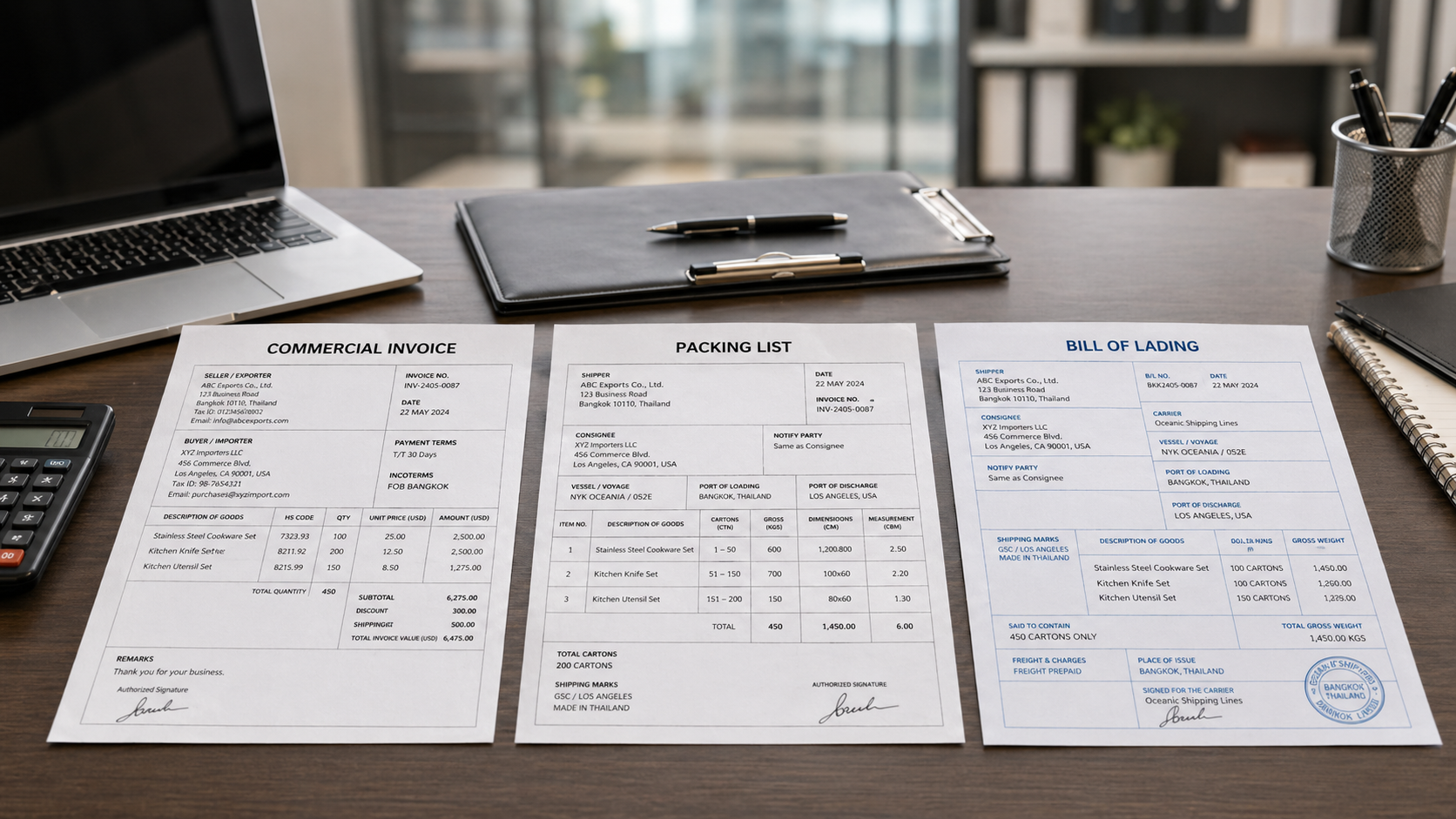
The main difference between a commercial invoice, packing list, and bill of lading is simple:
The commercial invoice explains what was sold and how much it is worth.
The packing list explains how the goods are packed.
The bill of lading explains who controls the shipment and how it is transported.
| Document | What It Shows | Issued By | Main Use |
|---|---|---|---|
| Commercial Invoice | Value, product details, unit price, HS code, and payment terms | Seller or exporter | Customs clearance and duty calculation |
| Packing List | Cartons, pallets, weight, dimensions, CBM, and shipping marks | Seller, exporter, or supplier | Cargo checking and freight handling |
| Bill of Lading | Shipper, consignee, route, container number, and release method | Carrier, shipping line, or freight forwarder | Cargo receipt, transport proof, and cargo release |
These three documents are not interchangeable. A commercial invoice cannot replace a bill of lading. A packing list cannot replace a commercial invoice. A bill of lading cannot replace detailed customs documents.
Shipping documents are not just administrative paperwork. They connect the buyer, seller, freight forwarder, customs broker, carrier, warehouse, shipping company, and customs authorities.
In international logistics, each party relies on these documents for a different reason.
Customs clearance depends heavily on accurate documentation. Customs officials may review the commercial invoice, packing list, and bill of lading to confirm:
What the goods are
How much the goods are worth
Where the goods come from
Who is importing the goods
Which HS code or Harmonized System code applies
Whether customs duties and taxes are calculated correctly
Whether import regulations are met
If the information is incomplete or inconsistent, customs officers may request corrections, supporting documents, or cargo inspection.
Freight forwarders and shipping lines also need accurate documents to move the cargo correctly.
The packing list helps the logistics partner understand cargo size, weight, package quantity, and loading requirements. The bill of lading works as a transport document and confirms cargo receipt after the carrier receives the goods.
At the destination port, the bill of lading or air waybill helps determine whether the consignee can release the cargo. This is why document accuracy affects not only customs clearance, but also final delivery and cost control.
A commercial invoice is a customs document and trade document issued by the seller or exporter to the buyer or importer. It records the actual international transaction between both parties.
The commercial invoice tells customs authorities what the goods are, how much they are worth, who sold them, who bought them, and which trade terms apply.
A commercial invoice should provide enough information for customs clearance, tax calculation, and payment verification. It normally includes four types of details:
Transaction details: seller, buyer, invoice number, invoice date, currency, and payment terms
Product details: product description, quantity, unit price, total invoice value, HS code, and country of origin
Shipping details: Incoterms, port of loading, destination country, and destination port
Verification details: company stamp or signature when required
The product description should be specific. Generic descriptions such as “parts,” “accessories,” “samples,” or “goods” may trigger customs delays because customs authorities need to understand what the product actually is.
Customs authorities use the commercial invoice to determine the declared customs value of the goods. This customs value affects customs duties, import duties, taxes, and other applicable duties in the destination country.
If the invoice value appears too low or does not match the purchase order, payment record, or actual product value, customs officials may request additional proof. In some cases, they may adjust the customs value or delay the shipment for further review.
For importers, the commercial invoice is also important for accounting, payment verification, tax records, and supplier settlement.
A packing list is a supporting shipping document that shows how the goods are physically packed. Instead of focusing on invoice value or payment terms, it explains the cargo structure, including cartons, pallets, weight, dimensions, CBM, and shipping marks.
In international shipping, the packing list helps freight forwarders, customs brokers, warehouses, customs officers, and buyers verify the actual shipment. It is especially important for LCL shipping, FCL shipping, air freight, customs inspection, warehouse receiving, and final delivery.
A packing list should explain how the goods are physically packed and how much space they take during transportation. It normally includes three types of information:
Cargo details: product description, quantity, carton count, pallet count, and package type
Weight and volume details: gross weight, net weight, carton dimensions, pallet dimensions, and total CBM
Handling details: shipping marks, container loading information, and special handling notes when needed
The packing list should match the commercial invoice, but it provides more detailed cargo information for freight forwarders, warehouses, customs brokers, and customs officers.
For example, if the commercial invoice shows 1,000 LED lights with a total value of USD 5,000, the packing list should show how those goods are packed, such as 50 cartons, 2 pallets, 680 kg gross weight, and 3.2 CBM.
Freight forwarders use the packing list to calculate freight charges, confirm cargo volume, arrange pickup, book space, and prepare loading plans.
For air freight, the packing list helps calculate chargeable weight. For sea freight, it helps determine CBM and container space. For LCL shipping, it helps the warehouse consolidate cargo with other shipments.
Warehouses also use the packing list to check whether the actual cargo matches the documents. If customs officials inspect the shipment, the packing list helps them locate specific cartons or pallets quickly.
A bill of lading is a transport document issued by a carrier, shipping line, or freight forwarder after the cargo has been received for shipment. In ocean freight, it confirms cargo receipt, transport details, and cargo release control.
Unlike a commercial invoice, it does not focus on the value of the goods. Unlike a packing list, it does not show detailed carton or pallet information. Its main role is to prove that the goods were received by the carrier and are being transported under agreed shipping terms.
A bill of lading should clearly show the transport and release details of the shipment. The most important information usually includes:
Parties involved: shipper, consignee, notify party, carrier, or freight forwarder
Transport details: vessel name, voyage number, port of loading, port of discharge, and place of delivery
Cargo details: cargo description, number of packages, gross weight, measurement, container number, and seal number
Release details: freight terms, original bill of lading status, telex release, or sea waybill information
Before the bill of lading is finalized, importers should carefully check the draft. Wrong consignee details, incorrect destination port, wrong container number, wrong seal number, or unclear cargo description may delay cargo release.
An original bill of lading requires the consignee to present or surrender the original document before the cargo can be released. This method provides stronger document control but may cause delays if the original document is lost or arrives late.
A telex release allows cargo to be released without presenting the physical original bill of lading at destination. The origin side confirms that the original bill has been surrendered, and the destination agent releases the cargo based on the release instruction.
A sea waybill is usually used when there is no need for title document control. It can make cargo release faster because the consignee does not need to surrender an original bill of lading.
For air freight, the main transport document is usually an air waybill. An air waybill confirms that the international carrier has received the cargo, but it is normally not used as a title document like some ocean bills of lading.
These three documents work together across different stages of the shipping process.
They do not repeat the same information. Instead, they describe the same international shipment from different angles: transaction value, packing details, and transport control.
Before the cargo leaves the supplier’s warehouse, the seller usually prepares the commercial invoice and packing list.
The freight forwarder uses these documents to arrange pickup, check cargo details, book freight shipping, confirm package quantity, and prepare export declaration.
At this stage, the freight forwarder may check:
Product descriptions
Net weight
Number of cartons or pallets
Destination country
Destination port
Special handling requirements
If the commercial invoice or packing list is incomplete, the shipment may be delayed before loading.
When the cargo arrives at the destination country, the customs broker usually uses the commercial invoice, packing list, and bill of lading or air waybill to prepare customs filing.
The commercial invoice supports customs value and duty calculation. The packing list supports cargo verification. The bill of lading supports transport confirmation.
Customs authorities may compare all three documents to confirm that the declared goods match the actual shipment.
After customs clearance, the consignee still needs to release the cargo from the carrier, terminal, warehouse, or destination agent.
For ocean freight, the bill of lading release status is critical. The cargo may require an original bill of lading, telex release, or sea waybill release.
The packing list may then be used by the warehouse or consignee to check whether the entire shipment has arrived correctly.
This is why customs clearance and cargo release are related, but not the same.

Many importers confuse customs clearance with cargo release. They are connected, but they are different processes.
Customs clearance is about declaring the goods to customs authorities. Cargo release is about getting permission to pick up the goods from the carrier, warehouse, or terminal.
For customs clearance, the customs broker may request:
Commercial invoice
Packing list
Bill of lading or air waybill
Arrival notice
Import license, if required
Product certificate, if required
Purchase order, if needed
Insurance document, if needed
Customs bond, when required
Other supporting documents based on import regulations
The commercial invoice is usually the most important document for customs clearance because it shows product descriptions, unit price, invoice value, HS code, payment terms, and country of origin.
For cargo release, the bill of lading is usually the key document in ocean freight.
Depending on the release method, the consignee may need:
Original bill of lading
Telex release confirmation
Sea waybill
House bill release instruction
Master bill release confirmation
Delivery order from the destination agent
For air freight, the air waybill is the main transport document, and cargo release depends on customs clearance, airline handling, destination agent procedures, and consignee verification.
A shipment may clear customs but still not be released.
This can happen when the original bill of lading has not been surrendered, the telex release has not been confirmed, the consignee information is wrong, or local destination charges remain unpaid.
For importers, this distinction is important. Smooth customs clearance does not automatically mean the cargo is ready for pickup.
Most customs delays are not caused by the shipping route itself, but by unclear or inconsistent documents. The commercial invoice, packing list, and bill of lading must be accurate before the cargo leaves the origin country.
The commercial invoice is the main basis for customs value and duty calculation, so errors often appear in price, trade terms, and product descriptions.
Common mistakes include:
Wrong unit price or invoice value: The unit price, quantity, and total invoice value do not match.
Missing or unclear Incoterms: Terms such as FOB, CIF, DAP, or DDP are missing or inconsistent.
Vague product descriptions: Descriptions such as “gift,” “hardware,” “parts,” or “accessories” do not explain the material, use, or product type.
Incorrect HS code: The declared HS code does not match the actual product.
Buyer or seller details do not match: Company names, addresses, or payment details are inconsistent with other trade documents.
A clear commercial invoice should help customs authorities understand what the goods are, how much they are worth, and which import duties may apply.
The packing list is used to verify the physical cargo. Mistakes usually happen in weight, package quantity, dimensions, and shipping marks.
Common mistakes include:
Gross weight and net weight are mixed up: The net weight is higher than the gross weight, or the weight does not match the actual cargo.
Cartons and pallets are confused: The packing list shows pallets while the customs declaration or bill of lading shows cartons.
Package quantity is inconsistent: The number of cartons, pallets, or pieces does not match the commercial invoice or actual shipment.
Dimensions or CBM are missing: Freight forwarders and warehouses cannot confirm the cargo volume accurately.
Shipping marks are unclear or different: The marks on the packing list do not match the marks on the outer cartons.
A good packing list should make it easy for customs officers, warehouses, and freight forwarders to identify and check the cargo.
The bill of lading controls transport and cargo release, so errors can create serious problems at the destination port.
Common mistakes include:
Wrong consignee information: Even a small spelling error in the consignee name may delay cargo release.
Wrong notify party: The destination agent or shipping line may not be able to contact the correct party after arrival.
Incorrect destination port: The cargo may be routed, released, or declared incorrectly.
Wrong container number or seal number: The shipment may require correction before customs clearance or release.
Release method not confirmed: The shipment may be held if the original bill of lading, telex release, or sea waybill arrangement is unclear.
Before the bill of lading is finalized, importers should always review the draft carefully. Once the document is issued, corrections may take time and create extra charges.
Before the cargo leaves the supplier’s warehouse, importers should review the details that may affect customs clearance, cost control, and cargo release. A few checks before shipment can prevent many problems after the goods arrive.
The commercial invoice, packing list, and bill of lading should tell the same story. The product name, quantity, weight, consignee, and destination details should not conflict.
Key details to review include:
Commercial invoice: invoice value, unit price, payment terms, Incoterms, HS code, and country of origin
Packing list: carton quantity, pallet quantity, gross weight, dimensions, CBM, and shipping marks
Bill of lading: shipper, consignee, destination port, container number, seal number, and release method
If these details do not match, customs clearance or cargo release may be delayed.
Start with the basic compliance details. The HS code, product description, material, use, and country of origin should be clear before booking the shipment.
For regulated cargo, extra documents may be required, especially for:
Batteries and electronics
Chemicals or liquids
Food-contact products
Branded goods
Medical or safety-related products
Checking these requirements early helps avoid customs delays and unexpected document requests.
Importers should confirm who is responsible for freight, insurance, customs clearance, import duties, destination charges, and final delivery.
This is especially important under FOB, CIF, DAP, DDU, and DDP terms, where buyers and sellers may misunderstand who should pay for each part of the shipping process.
Before pickup or loading, ask the supplier to confirm the final packing details. This should include carton quantity, pallet quantity, gross weight, dimensions, shipping marks, and cargo photos.
For container shipping, loading photos, container number, and seal number are also useful. For wooden pallets or crates, confirm whether IPPC or fumigation marks are required.
A reliable freight forwarder or customs broker can review the documents before shipment departure and identify problems early.
They can help check whether the HS code is reasonable, the cargo description is clear, the three core shipping documents match, and extra import documents may be required.
Correcting document problems before loading is much easier than fixing them after the cargo arrives.
A commercial invoice shows the sales value and transaction details of the goods, including unit price, invoice value, payment terms, product descriptions, and HS code. A packing list shows how the goods are packed, including cartons, pallets, gross weight, net weight, dimensions, and CBM.
No. A commercial invoice is issued by the seller and used for customs clearance, customs value, import duties, and payment records. A bill of lading is issued by the carrier, shipping line, or freight forwarder and is used as a cargo receipt, transport contract, and cargo release document.
No. A packing list provides detailed packing information. A bill of lading confirms that the carrier has received the goods and shows transport details such as shipper, consignee, vessel, container number, seal number, port of loading, and destination port.
The commercial invoice is usually the most important document for customs clearance because it shows customs value, product descriptions, unit price, invoice value, HS code, country of origin, and payment terms. The packing list and bill of lading or air waybill are also commonly required.
For ocean freight, the bill of lading is usually the key document for cargo release. Depending on the release method, the consignee may need an original bill of lading, telex release, or sea waybill.
Useful freight, customs and importing resources related to this shipping guide.
International Shipping Documents Checklist Verified & Reviewed · Last updated January 2026 International shipping fails for boring reasons: a shi...
Read guide →
Commercial Invoice Template for Importing from China to the USA Verified & Reviewed · Last updated May 2026 A commercial invoice template for imp...
Read guide →
Importing goods from China can be highly profitable—but only when you understand the necessary documents and import requirements. Whether you’re...
Read guide →
What Is a Certificate of Origin COO in Shipping? Verified & Reviewed · Last updated April 2026 A Certificate of Origin COO in shipping is an offi...
Read guide →Customs Clearance Step by Step: The Complete Process Verified & Reviewed · Last updated February 2026 Customs clearance step by step helps intern...
Learn more → Useful Resource Customs Broker vs Freight ForwarderCustoms Broker vs Freight Forwarder Verified & Reviewed · Last updated April 2026 Customs broker vs freight forwarder is a common question for im...
Learn more →WhatsApp us