Cargo Best Suited to Air Freight
Suitable for production parts, electronics, samples, approved medical supplies, seasonal inventory and other cargo that cannot wait for ocean freight.
Compare speed, cargo value and delivery certainty.


International Air Cargo Guide · Updated August 2026
Compare international air freight services, rates, transit times and chargeable weight from China’s major cargo airports to the USA, Europe, the Middle East and worldwide destinations.
Standard air freight is typically planned from 45 kg. Final rates depend on route, cargo type, chargeable weight and current airline capacity.
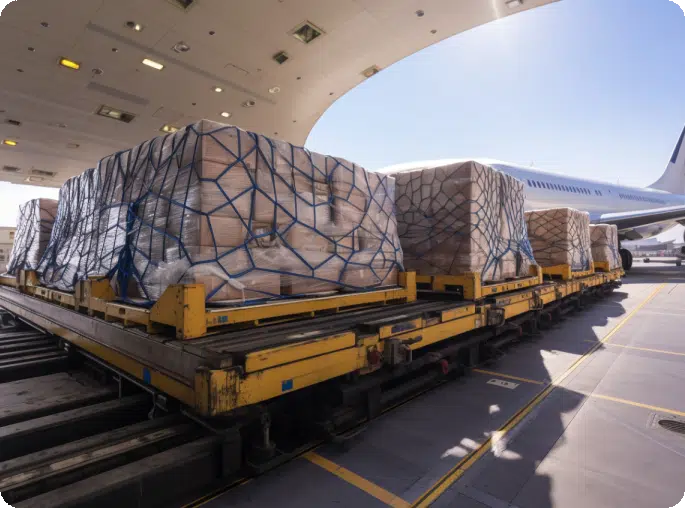
Quick air freight overview
Air shipping from China is usually the fastest option for urgent, higher-value or time-sensitive commercial cargo. The right air freight plan depends on shipment size, chargeable weight, route, cargo type and required delivery scope.
Suitable for production parts, electronics, samples, approved medical supplies, seasonal inventory and other cargo that cannot wait for ocean freight.
Compare speed, cargo value and delivery certainty.
Standard air freight generally starts from 45 kg. Air express from China may be more practical for smaller parcels, samples and documents.
Provide pieces, dimensions, gross weight and packaging.
Direct and connecting flights have different schedules. Export handling, customs clearance and final delivery must also be included.
Confirm the cargo-ready date and required delivery date.
Airlines charge the higher of actual weight or volumetric weight. Route, cargo type, handling needs and airline capacity also affect rates.
Calculate chargeable weight and the complete service scope.
Planning information only. Final routing, cargo acceptance, transit time and pricing depend on complete shipment details and current airline capacity.
Air freight service options
Choose the service according to shipment size, urgency, delivery scope and cargo acceptance requirements. Standard air freight is not the same as express courier, while door-to-door describes the full service scope.
The main option for commercial cargo that needs faster delivery than ocean freight but does not require a dedicated express courier service.
Cartons, pallets, production parts, electronics and urgent replenishment shipments generally starting from 45 kg.
Origin, destination, pieces, dimensions, gross weight, cargo type, Incoterm and required delivery scope.
A simplified fast service for documents, samples, spare parts and compact parcels, normally combining pickup, tracking and final delivery.
Smaller urgent shipments that may not justify a separate airline cargo booking or airport handling arrangement.
Dimensional weight, oversize pieces, remote-area charges, restricted goods and destination import charges.
Combines origin pickup, export handling, air freight, customs coordination and delivery to the consignee’s agreed address.
Importers who prefer one coordinator and a clearly defined pickup-to-delivery service scope.
Importer of record, customs entry, duties and taxes, delivery address and any excluded destination charges.
Lithium batteries, liquids, powders, magnets, dangerous goods and temperature-sensitive cargo must be screened before quotation and booking because airline acceptance, documents and handling controls vary by shipment.
Cargo that requires airline review, compliant packing, special labels, certificates or controlled handling.
Confirm the cargo name, composition, packing, labels and airline acceptance. Depending on the cargo, documents may include SDS/MSDS, a UN38.3 test summary for batteries, a DGD, or magnetic and air-transport inspection reports.
Door-to-door describes the service scope rather than the airline service itself. DDP or duties-unpaid delivery may be available depending on the destination, cargo type, importer requirements and agreed quotation scope.
Rates & cost structure
The air freight cost from China is based on chargeable weight, route, service level, cargo type and current airline capacity. Compare the framework below, then request a shipment-specific rate with clear inclusions and exclusions.
Air freight pricing framework
| Service | Charging basis | Pricing approach | Main cost drivers |
|---|---|---|---|
| Standard Air Freight | Per chargeable kg Actual or volumetric weight, whichever is higher | Generally from 45 kg, subject to route and airline minimums | Weight tier, route, flight type, fuel and security surcharges, season and available capacity |
| Air Express from China | Courier chargeable weight Carrier dimensional-weight rules apply | Carrier tariff and minimum charge; often used for smaller parcels | Parcel dimensions, service speed, remote area, oversize pieces, clearance fees, import duties and taxes, and carrier surcharges |
| Door-to-Door Air Freight | Shipment-specific quote Built around the air chargeable weight | Based on pickup city, destination address and agreed delivery scope | Pickup, origin handling, customs scope, duties and taxes, destination charges and final delivery |
| Special Cargo Air Freight | Weight plus handling Subject to airline acceptance | Quoted after cargo classification and document review | Cargo classification, packing, labels, certificates, screening, DG handling where applicable, and approved carrier options |
Rates apply to chargeable weight rather than gross weight alone. See the chargeable weight guide next. When comparing cheap air freight from China, review the complete quoted scope rather than only the airline rate. Excluded pickup, handling, duties, taxes, storage and destination fees can change the final cost.
Air freight charges are based on whichever is greater: the shipment's actual gross weight or its volumetric weight. This calculator gives the comparison weight before carrier-specific measurement and rounding rules are applied.
Actual weight is the total gross weight of the cargo and packaging. Volumetric weight converts the space occupied by the shipment into kilograms.
Pieces × Length × Width × Height (cm) ÷ divisor
Higher of actual weight or volumetric weight
10 cartons × 50 × 40 × 30 cm, with a total actual weight of 80 kg and a 6,000 divisor.
Accuracy note: Airlines and express carriers may remeasure each piece, round dimensions, round billable weight, or apply a minimum chargeable weight. Tonlexing confirms the applicable rule before booking. For mixed-size cartons, use our full CBM calculator or send us your packing list.
For identical cartons only. Enter the outside dimensions of one packed carton and the total gross weight of all cartons.
For many major routes, standard air freight shipments from China typically take 5–10 business days door to door. The final schedule depends on the service level, departure airport, flight availability, customs clearance, and delivery location.
Courier networks for urgent samples, documents, and smaller shipments.
Faster flight options for time-sensitive commercial cargo.
A practical balance of speed, capacity, and cost for regular shipments.
Flexible departures for non-urgent cargo that can wait for consolidation.
Door-to-door timing includes more than the flight. Pickup, handling, customs, and final delivery all affect the total lead time.
Do not add every stage together: several stages can overlap. Connecting flights, customs inspections, remote delivery areas, and restricted cargo may add time.
Direct services are usually faster and involve fewer handling points.
PVG, CAN, SZX, and HKG offer different routes, capacity, and cut-off times.
Holiday demand, weather, and limited space can delay the planned departure.
Accurate invoices, packing lists, HS codes, and permits help prevent clearance delays.
Batteries, chemicals, oversized cargo, and temperature-sensitive goods need extra checks.
Remote areas and appointment deliveries normally require additional transit time.
Explore country-specific air freight guides covering shipping costs, transit times, customs requirements, major airports, and door-to-door delivery options from China.
Start with our most requested routes from China.
LAX · JFK · ORD · DFW
YYZ · YVR · YUL
LHR · MAN · BHX
FRA · MUC · LEJ
DXB · DWC · AUH
RUH · JED · DMM
SVO · DME · LED
SYD · MEL · BNE
Browse additional routes by region. Every link opens a dedicated guide for shipping air cargo from China.
If your destination is not listed, send us the airport or delivery postcode. We will check the available route, cargo acceptance, and door-to-door options.
The best departure airport is not always the closest one. Cargo type, airline capacity, flight frequency, and local handling costs can make a nearby alternative faster or more economical.
Tonlexing compares available space and schedules across China's main cargo gateways before recommending a route.
PVG · CAN · SZX
HKG · PEK · CGO
The final airport and flight are selected according to cargo acceptance, available space, schedule, and total routing cost.
Select an airport guide for cargo strengths, nearby sourcing regions, routes, handling, costs, and transit planning.
Best positioned for suppliers in Shanghai, Suzhou, Hangzhou, Ningbo, and the wider Yangtze River Delta.
A major export hub for Guangzhou, Foshan, Dongguan, Zhongshan, and Pearl River Delta manufacturers.
Ideal for Shenzhen, Dongguan, and cross-border e-commerce cargo from southern China.
Broad airline choice and frequent global services for southern China exports.
A practical gateway for Beijing, Tianjin, Hebei, and suppliers across northern China.
A growing freighter hub with useful access to factories and consolidation in central China.
A lower base rate does not always produce the lowest landed cost. We compare the complete movement before recommending an airport and service.
Check supplier location, pickup cost, and the nearest practical gateways.
Review dimensions, weight, batteries, liquids, powders, magnets, dangerous goods, and airline restrictions.
Evaluate direct and connecting services, cut-off times, available space, and handling.
Match the arrival airport with customs clearance and final-mile requirements.
The supplier address, destination, cargo details, cargo-ready date, and delivery scope are needed before the departure airport and flight can be confirmed.
Air cargo must meet airline acceptance, security screening, export requirements in China, and import rules at the destination. Documentation should be checked before pickup to avoid rejected bookings or customs delays.
Ordinary cargo is usually straightforward. Batteries, liquids, powders, magnets, and other regulated products need classification and acceptance checks before booking.
Garments, non-powered parts, household goods, machinery components, and other non-restricted products.
Electronics, medical devices, replacement parts, samples, and time-sensitive commercial shipments.
Pharmaceuticals, selected food products, laboratory materials, and cargo requiring controlled handling.
Lithium batteries, chemicals, aerosols, liquids, powders, magnets, and other airline-restricted products.
The exact set varies by commodity, origin, destination, Incoterm, and airline.
Who handles each step depends on the Incoterm and the selected airport-to-airport or door-to-door service.
Commodity details, invoice, packing list, export eligibility, security screening, and permits when required.
Booking details, air waybill, cargo acceptance, packaging, labeling, and special-cargo declarations.
Importer or IOR details, final classification, duties and taxes, permits, customs release, and final delivery.
Do not describe cargo only as “parts,” “samples,” or “accessories.” Precise product descriptions and declared values reduce customs questions and clearance delays.
Batteries, chemicals, aerosols, liquids, powders, magnets, compressed gas, dry ice, medical products, and food must be identified and reviewed before booking. Branded goods may require authorization or additional customs evidence. Requirements vary by classification, packing method, airline, route, and destination.
Use these guides to review customs steps, restricted goods, and documentation for special cargo.
A successful air shipment starts before the cargo reaches the airport. Cargo details, documents, service level, and airline acceptance are confirmed first, followed by pickup, export handling, flight, customs clearance, and delivery.
Confirm the route, dimensions, weight, commodity, ready date, and whether the cargo contains batteries, liquids, powders, chemicals, magnets, aerosols, compressed gas, or dry ice.
Confirm the departure airport, carrier and service, schedule, available space, and chargeable weight before booking.
Collect or receive the cargo, check packaging and labels, prepare documents, and complete export clearance.
Deliver cargo to the airline terminal for security screening, acceptance, loading, and departure.
Coordinate destination terminal procedures, import clearance, applicable duties and taxes, cargo release, and local handover.
Arrange local transport to the consignee when door-to-door service is included and confirm delivery.
Complete details allow us to confirm cargo acceptance and prepare a reliable quotation.
We coordinate the shipment across suppliers, warehouses, airlines, customs partners, and delivery providers.
Declare batteries, liquids, powders, chemicals, magnets, aerosols, compressed gas, dry ice, and temperature-sensitive products before booking. We first verify classification, airline acceptance, packaging, marks and labels, and the required supporting documents.
Choosing an air freight forwarder based only on the lowest rate per kilogram can increase the total shipping cost. Tonlexing compares routing, capacity, chargeable weight, handling requirements, and delivery scope before recommending an air freight plan.
We coordinate suppliers, warehouses, airlines, customs partners, and local delivery providers through one point of contact. Final delivery is coordinated when it is included in the selected service, with the complete scope confirmed before booking.
Cost control starts before the cargo is delivered to the airline terminal.
Reduce avoidable volumetric weight while keeping packaging strong enough for air handling.
Combine compatible supplier shipments when this reduces repeated pickup and handling costs without delaying the required schedule.
Balance direct and connecting services, available capacity, cut-off time, and total route cost.
Confirm documents, labels, cargo acceptance, and importer readiness before cargo movement begins.
Include the commodity, carton dimensions, total weight, pickup city, destination, and target delivery date.
Quick answers about air freight rates, transit times, chargeable weight, customs, documents, restricted cargo, and door-to-door delivery.
Air freight rates are normally quoted per kilogram of chargeable weight. The final cost depends on the route, shipment size, service level, airline capacity, fuel surcharges, season, cargo type, origin handling, customs services, and destination delivery. A complete quote should state what is included rather than showing only the airport-to-airport rate.
Typical airport-to-airport transit is about 3–7 days for standard air freight. Standard door-to-door shipping usually takes around 5–10 days, while express courier services can take about 3–5 days door to door. Flight availability, transfers, customs clearance, and the final delivery location can change the schedule. See the air freight transit time comparison.
The carrier compares actual gross weight with volumetric weight and charges whichever is higher. Standard air freight commonly uses length × width × height in centimeters ÷ 6,000; express and selected services may use 5,000. For multiple cartons, add the volumetric weight of each carton or identical carton group, then compare the total with the shipment's total gross weight. Carriers may remeasure and apply their own rounding rules. Use the chargeable weight calculator for a planning estimate.
Standard air cargo is generally more practical for shipments of about 45 kg or more. For smaller cartons and samples, DHL, FedEx, UPS, or another express courier may be more economical and easier to arrange. Tonlexing generally handles standard air freight enquiries from 45 kg.
Most shipments require a commercial invoice, packing list, accurate commodity description, HS code information, and an air waybill prepared after booking. Depending on the cargo and destination, additional certificates, permits, SDS, test reports, or a Shipper's Declaration for Dangerous Goods (DGD) may be required. Review the air cargo document checklist.
Some can be shipped, but they must be declared before booking. Acceptance depends on classification, quantity, packaging, marks and labels, carrier rules, and routing. Supporting files may include a Safety Data Sheet (SDS), UN38.3 test summary, air transport condition report, magnetic inspection report, product specifications, or a Shipper's Declaration for Dangerous Goods when applicable.
Airport-to-airport service covers the main air transport between the departure and destination airports. Door-to-door service can also include supplier pickup, export handling, air freight, import customs coordination, destination charges, and final delivery. The exact scope depends on the Incoterm and quotation.
Responsibility depends on the agreed Incoterm and service. Export clearance is normally arranged in China, while the destination importer or importer of record usually provides import information and pays applicable duties and taxes. For door-to-door or DDP services where available, Tonlexing can coordinate more of the destination process.
Yes. After airline acceptance, the master or house air waybill number is used to follow key milestones such as departure, transfer, arrival, customs release, and delivery. Air cargo tracking is milestone-based, so updates may not appear continuously while the shipment is in transit.
Provide the product name, carton count, carton dimensions, total gross weight, pickup city, destination airport or delivery postcode, Incoterm, cargo-ready date, and target delivery date. Also disclose batteries, liquids, powders, magnets, chemicals, oversized pieces, or temperature-control requirements before quotation.
We will review the shipment, required documents, suitable service, and quotation scope before booking.
Continue planning with practical resources for freight costs, shipping method comparisons, customs, battery compliance, and a real air freight case study.
WhatsApp us