Related Guide
Shipping from China to Japan
Shipping from China to Japan – Sea, Air & DDP in 2026 Fast, reliable shipping from China to Japan for B2B importers,eCommerce sellers, and projec...
Read guide →

Air freight from China to Japan is one of the fastest ways to ship commercial cargo, samples, electronics, machinery parts, eCommerce parcels, and urgent goods between the two countries.
This guide explains 2026 air freight costs from China to Japan, average transit times, major airport routes, chargeable weight calculation, customs clearance requirements, DDP options, and how to reduce your total shipping cost.
Air Freight Rates
Transit time
Customs Clearance
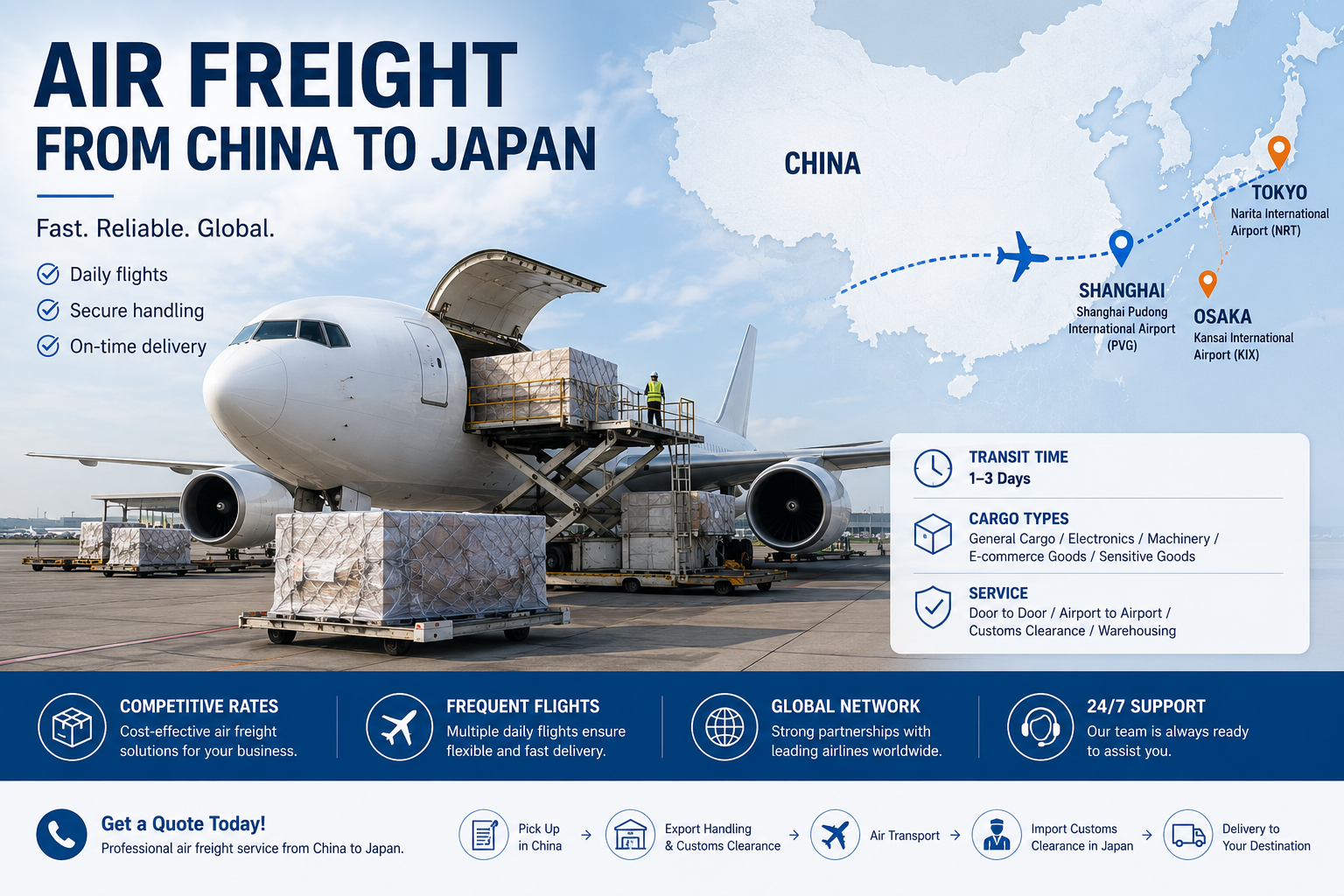
Air freight rates from China to Japan are normally charged by chargeable weight, not simply by actual gross weight. The final cost depends on cargo weight, dimensions, route, airline capacity, fuel surcharge, service type, customs requirements, and delivery terms.
As a 2026 market reference, standard air freight from China to Japan usually costs around:
| Air Freight Service | Estimated Cost Range | Suitable For |
|---|---|---|
| Standard Air Cargo | USD 2.20–4.80 per kg | Shipments over 100 kg |
| Economy Consolidated Air Freight | USD 2.00–4.20 per kg | Flexible delivery, non-urgent cargo |
| Door-to-Door Air Freight | USD 3.20–6.50 per | Factory pickup + Japan delivery |
| DDP Air Freight | USD 4.50–8.50 per kg | Tax-paid door delivery |
| Express Courier | USD 5.50–12.00 per kg | Samples, parcels, urgent orders |
These are estimated market ranges only. Actual air freight rates may change weekly because airlines adjust prices based on available cargo space, fuel costs, holiday demand, and airport handling capacity.
Air freight prices are not fixed. Different shipping methods also have different cost structures, so the suitable shipping method depends on urgency, cargo type, and budget, even on the same route.
The most important cost factors include:
Chargeable weight: Airlines charge based on the higher value between actual weight and volumetric weight.
Cargo volume: Large but lightweight goods may be billed by dimensional weight.
Departure airport: Shanghai, Shenzhen, Guangzhou, Hong Kong, and Beijing often have stronger flight capacity.
Destination airport: Tokyo Narita, Tokyo Haneda, Osaka Kansai, Nagoya Chubu, and Fukuoka may have different handling costs.
Service type: Airport-to-airport is cheaper than door-to-door or DDP air freight.
Cargo category: Batteries, liquids, powders, magnets, cosmetics, and medical goods may require extra checks.
Season: Rates often rise before Chinese New Year, Golden Week, Christmas, and major eCommerce sales periods.
Customs requirements: Regulated goods may need permits, certificates, inspection, or additional brokerage support.
For accurate pricing, a freight forwarder needs the cargo name, HS code, carton dimensions, gross weight, pickup city, delivery address in Japan, and required Incoterms, since they affect responsibility across the entire shipping process.
China and Japan are connected by one of Asia’s busiest air cargo networks, with dozens of scheduled cargo and passenger flights operating every day. Most air cargo between China and Japan moves through a few high-frequency routes connecting China’s manufacturing regions with Japan’s major consumption and distribution centers.
The highest volume of air cargo flows directly between China’s eastern manufacturing zones and Japan’s primary economic regions (Kanto and Kansai).
The Golden Route: Shanghai Pudong (PVG) → Tokyo Narita (NRT). This is the busiest cargo lane, offering multiple daily flights and the most competitive rates.
The Tech Corridor: Shenzhen (SZX) / Guangzhou (CAN) → Osaka Kansai (KIX). This route heavily services electronics, automotive components, and fast-fashion supply chains.
The Northern Connection: Beijing Capital (PEK) → Tokyo Haneda (HND). This route handles high-priority corporate freight, diplomatic cargo, and express parcels due to its proximity to capital cities.
Direct flights on this corridor are operated by carriers such as China Cargo Airlines and Nippon Cargo Airlines, depending on route and schedule.
China’s leading international airports provide daily air freight services to Japan, allowing exporters to choose the nearest cargo hub and reduce domestic transportation costs before international departure.
Shanghai Pudong (PVG): China’s largest international cargo airport with extensive airline coverage and frequent flights to Japan.
Shenzhen Bao’an (SZX): A major gateway for electronics, cross-border eCommerce, and express air freight.
Guangzhou Baiyun (CAN): Well suited for commercial cargo, textiles, machinery, and general exports from southern China.
Beijing Capital / Daxing (PEK / PKX): The preferred choice for cargo originating from northern China.
Hong Kong (HKG): An important international transshipment hub with strong capacity for urgent and high-value shipments.
Japan’s international air cargo network is concentrated around several major airports, each serving a different economic region.
Narita International Airport (NRT): Japan’s largest international cargo gateway and the primary entry point for freight destined for the Tokyo metropolitan area.
Haneda Airport (HND): Located closer to central Tokyo, making it suitable for urgent deliveries and time-sensitive shipments.
Kansai International Airport (KIX): The main cargo hub for Osaka, Kyoto, Kobe, and western Japan.
Chubu Centrair International Airport (NGO): Supports manufacturers and distributors across Nagoya and central Japan.
Fukuoka Airport (FUK): Handles air freight serving Kyushu and southern Japan.
Actual flight time between China and Japan is short, but total logistics time includes pickup, warehouse handling, export customs clearance, flight departure, arrival handling, import customs clearance, and final delivery. In practice, overall shipping time is usually more predictable with air transport because it is less prone to port congestion than sea freight, although weather and cargo handling can still affect schedules.
Route | Airport-to-Airport | Door-to-Door |
|---|---|---|
Shanghai to Tokyo | 1–2 days | 2–4 days |
Shenzhen to Osaka | 2–3 days | 3–5 days |
Guangzhou to Nagoya | 2–4 days | 3–5 days |
Hong Kong to Tokyo | 1–3 days | 2–4 days |
Beijing to Tokyo | 1–3 days | 2–5 days |
Qingdao to Osaka | 2–4 days | 3–6 days |
These typical transit times mean most commercial air shipments take about 4–6 days door-to-door overall, while in limited best-case situations, tightly coordinated airport-adjacent deliveries can be as short as 6 hours.
For urgent shipments, express courier may deliver faster because customs clearance and last-mile delivery are integrated into one service. For commercial cargo, standard air freight is usually more cost-effective, especially when the shipment is over 100 kg.
Many importers are unsure whether to choose express courier, standard air freight, or DDP air freight. The best option depends on cargo size, delivery urgency, customs responsibility, and budget, and when comparing air or sea freight, urgency and budget usually decide the choice because air freight often costs around 4–6 times more per kilogram than sea freight.
Option | Best For | Advantages | Limitations |
|---|---|---|---|
Express Courier | Small parcels, samples, documents | Fast, simple, door-to-door tracking | Higher cost per kg |
Standard Air Freight | 100 kg+ commercial shipments | Lower cost per kg, flexible routing | Customs and delivery must be arranged |
Door-to-Door Air Freight | Importers needing full logistics support | Pickup, air freight, customs, delivery included | More expensive than airport-to-airport |
DDP Air Freight | Buyers who want tax-paid delivery | Duties, taxes, customs, delivery included | Needs accurate product declaration |
For eCommerce sellers and first-time importers, DDP air freight from China to Japan is often the easiest option because the freight forwarder handles customs clearance, import duties, consumption tax, and final delivery.
For experienced importers with their own customs broker in Japan, standard air freight may be more cost-effective, while express freight is usually the better fit for extremely urgent, small shipments that can justify the premium.
Air freight charges are based on chargeable weight, which is the higher value between the shipment’s actual gross weight and its volumetric (dimensional) weight. This pricing method ensures that both heavy cargo and bulky lightweight cargo are charged fairly, since oversized shipments occupy valuable aircraft space even if they do not weigh much.
For most international air freight shipments, airlines calculate volumetric weight using the following formula:
Volumetric Weight (kg) = Length (cm) × Width (cm) × Height (cm) ÷ 6000
If the volumetric weight is higher than the actual gross weight, the airline will charge based on the volumetric weight. If the actual weight is greater, the shipment is charged by its actual weight.
Suppose you are shipping 10 cartons, each measuring 60 × 50 × 40 cm and weighing 12 kg.
Actual weight: 10 × 12 kg = 120 kg
Volumetric weight per carton: 60 × 50 × 40 ÷ 6000 = 20 kg
Total volumetric weight: 20 × 10 = 200 kg
Since 200 kg is greater than 120 kg, the airline will charge the shipment based on 200 kg.
Reducing volumetric weight can significantly lower your air freight costs. Consider the following:
Use compact packaging and eliminate unnecessary empty space.
Choose cartons that closely match the size of the products.
Consolidate multiple small shipments into one larger shipment where possible.
Work with a freight forwarder to optimize packing and pallet configuration before shipping.
For accurate freight quotations, provide your freight forwarder with the carton dimensions, gross weight, quantity, and cargo description so the correct chargeable weight can be calculated before booking.

All air freight shipments arriving in Japan must complete import customs clearance before they can be released for final delivery. To avoid delays, importers should prepare accurate shipping documents and ensure that the declared cargo information matches the actual shipment. Incorrect HS codes, inaccurate cargo descriptions, or undervalued invoices may result in customs inspections or additional charges.
Most commercial shipments from China to Japan require the following documents:
Commercial Invoice: Including the product description, HS code, declared value, quantity, and Incoterms.
Packing List: Showing the number of cartons or pallets, dimensions, gross weight, and net weight.
Air Waybill (AWB): The transport document issued by the airline or freight forwarder.
Certificate of Origin (if required): May be requested for certain products or preferential trade arrangements.
Import Permits or Certificates: Required for regulated products such as food, cosmetics, pharmaceuticals, chemicals, or wireless communication equipment.
Preparing complete and consistent documentation before departure helps reduce customs clearance time and minimizes the risk of cargo being held for inspection.
Import duties in Japan depend on the product’s HS code, customs value, and applicable tariff rate. In addition to customs duty, most imported goods are subject to Japan’s 10% Consumption Tax, which is generally calculated based on the customs value plus any applicable import duty.
If you choose DDP (Delivered Duty Paid) shipping, your freight forwarder will usually arrange customs clearance, pay the import duties and taxes on your behalf, and deliver the cargo directly to the final destination.
To ensure a smooth customs clearance process, consider the following recommendations:
Use accurate product descriptions instead of general terms such as “parts” or “samples.”
Declare the correct customs value to avoid penalties or shipment delays.
Verify the HS code before shipping to ensure the correct duty rate is applied.
Confirm whether your products require import licenses, inspections, or special certifications before departure.
Use ISPM 15-compliant wooden packaging if shipping goods on wooden pallets or in wooden crates.
Working with a reliable freight forwarder or customs broker that can handle customs clearance and compliance checks efficiently can help simplify the import process, reduce clearance delays, and ensure compliance with Japanese customs regulations.
The quoted air freight rate is only one part of the total shipping cost. Depending on your shipment and service terms, additional charges may apply before or after the cargo arrives in Japan. Understanding these costs in advance can help you compare quotations more accurately and avoid unexpected expenses.
Some of the most common additional costs include:
Fuel and Security Surcharges: These charges are adjusted periodically by airlines and may change with fuel prices and market conditions.
Airport Handling Charges: Fees for cargo handling, security screening, warehouse operations, and terminal processing at the departure or arrival airport.
Customs Clearance Fees: Import customs clearance in Japan may involve brokerage or documentation fees, depending on the shipment and customs requirements.
Import Duties and Consumption Tax: These charges depend on the product’s HS code, customs value, and applicable duty rate. Japan’s standard consumption tax is 10% for most imported goods.
Local Delivery Charges: If you choose door-to-door service, the quotation may also include delivery from the airport to the consignee’s warehouse, office, or business address.
Storage Charges: If customs clearance or document verification is delayed, storage fees may be charged by the airport warehouse.
Insurance Costs: cargo insurance protects against transit risks such as damage, loss, theft, and some delay-related financial exposure, while basic carrier liability is often minimal and may cover only limited negligence. Broader ICC(A) cover typically costs around 0.5-1.0% of the shipment’s value.
Before confirming your shipment, ask your freight forwarder exactly what is included in the quotation. A transparent breakdown of freight charges, customs costs, taxes, delivery fees, and insurance makes it much easier to compare different logistics providers and control your overall shipping budget. This is also useful when comparing air with sea, since sea freight usually involves more handling, damage rates are often cited at around 1-2% of shipments, and a vessel emergency can trigger General Average contributions of roughly $5,000-15,000.
Air shipping from China to Japan is usually straightforward when the cargo details and documents are prepared in advance. The process starts before the goods reach the airport, and the full shipping freight workflow depends on timely documents and booking coordination because each step affects the final delivery time.
The first step is to confirm the product name, quantity, carton size, gross weight, pickup address, and delivery address in Japan. If the goods are batteries, liquids, cosmetics, chemicals, or other sensitive items, the freight forwarder should check airline acceptance before booking.
Before departure, the exporter needs to prepare the commercial invoice, packing list, and other required documents. These details should match the actual cargo, including product description, quantity, weight, and declared value.
After the quote is confirmed, the cargo is collected from the supplier’s factory or warehouse. For shipments from multiple suppliers, the goods can be consolidated at one warehouse before export. This is often part of door shipping when the forwarder handles pickup through to delivery in Japan.
The shipment is declared to China Customs before it can be loaded onto the aircraft. Once export clearance is completed, freight booking coordination is finalized to secure airline space so the cargo can be loaded on schedule, then it is handed over to the airline and shipped to Japan.
After arrival in Japan, the shipment must clear customs before release. Japan Customs may review the invoice, HS code, declared value, and any required permits or certificates. If everything is correct, clearance is usually completed quickly.
Once released, the cargo is delivered to the consignee’s address, warehouse, shop, factory, or Amazon FBA facility. For door-to-door or DDP shipments, the freight forwarder handles this final delivery directly.
A smooth process depends on accurate cargo information, complete documents, and early confirmation of any special shipping requirements.
DDP (Delivered Duty Paid) air freight is a convenient shipping solution for businesses that want a simple, all-inclusive service. Instead of coordinating multiple logistics providers, the freight forwarder manages the shipment from the supplier in China to the final delivery address in Japan.
For many first-time importers and small businesses, DDP helps simplify the import process because customs procedures, duties, and local delivery are handled as part of the service. This reduces the amount of coordination required after the cargo arrives in Japan.
A typical DDP air freight service includes:
Pickup from the supplier or factory in China
Export customs clearance
International air transportation
Import customs clearance in Japan
Payment of applicable duties and taxes
Final delivery to the consignee’s address
The exact scope may vary between logistics providers, so it is always worth confirming what is included in the quotation before booking.
DDP air freight is often a good option if you:
Are importing into Japan for the first time
Do not have a local customs broker
Prefer a single shipping quote instead of multiple invoices
Need delivery directly to a warehouse, office, shop, or Amazon FBA fulfillment center
Want to reduce the time spent managing customs procedures
For experienced importers who already have their own customs clearance arrangements in Japan, FOB or airport-to-airport shipping may provide greater flexibility and lower overall costs.
Before confirming a DDP shipment, ask your freight forwarder whether the quotation includes customs duties, Japan’s consumption tax, customs clearance fees, and local delivery charges. It is also important to provide an accurate product description, HS code, and declared value, as incorrect information can delay customs clearance or lead to additional charges.
Choosing an experienced freight forwarder with clear pricing and transparent communication can help ensure that the shipment arrives smoothly and without unexpected costs.
Choosing the right logistics partner can make a significant difference to shipping costs, transit times, and customs efficiency. At Tonlexing, we provide tailored air freight solutions for businesses of all sizes, from small eCommerce shipments to regular commercial cargo and urgent industrial orders.
With years of experience in international logistics, we help importers find the most suitable shipping solution based on their cargo, budget, and delivery schedule. Whether you need airport-to-airport, door-to-door, or DDP shipping, our team manages every stage of the shipment and keeps you informed throughout the process.
Air freight services from major Chinese cities, including Shanghai, Shenzhen, Guangzhou, Beijing, Qingdao, Ningbo, Xiamen, and Hong Kong.
Flexible shipping options, including airport-to-airport, door-to-door, and DDP delivery.
Cargo consolidation for shipments from multiple suppliers.
Customs clearance support and document preparation.
Delivery to warehouses, factories, retail stores, and Amazon FBA fulfillment centers across Japan.
Real-time shipment tracking and responsive customer support.
We focus on practical logistics solutions rather than one-size-fits-all services. Before every shipment, we review the cargo details, recommend the most appropriate transport option, and provide transparent quotations without unnecessary complications.
Our goal is to help customers reduce shipping costs where possible, avoid customs delays, and keep shipments moving on schedule. Whether you are importing samples, electronics, machinery parts, consumer goods, or regular commercial cargo, Tonlexing can provide a reliable shipping solution from China to Japan.
It depends on your shipment. Air freight is the better choice for urgent, high-value, or time-sensitive goods because it offers much faster delivery. Sea freight is more economical for bulky or heavy cargo when transit time is less important.
As a general reference, standard air freight usually costs between USD 2.20 and USD 4.80 per kg for commercial shipments over 100 kg. The final rate depends on the cargo weight, dimensions, departure airport, airline, and service type.
Airport-to-airport air freight typically takes 1 to 3 days, while door-to-door delivery usually takes 2 to 5 days. Sea freight generally requires around 9 to 18 days for sea transit, depending on the route, service level, and whether the shipment is FCL or LCL, though some lanes on slower schedules, such as Shanghai to Nagoya, can take up to around 21 days.
Airlines calculate charges based on the higher value between the actual weight and the volumetric weight of the shipment. Lightweight but bulky cargo is usually billed according to its volume rather than its gross weight.
Most commercial shipments require a commercial invoice, packing list, and air waybill. Depending on the product, Japan Customs may also require certificates, import permits, or other supporting documents.
Useful freight, customs and importing resources related to this shipping guide.
Shipping from China to Japan – Sea, Air & DDP in 2026 Fast, reliable shipping from China to Japan for B2B importers,eCommerce sellers, and projec...
Read guide →
Shipping Cost from China to Japan (2026 Guide) Verified & Reviewed · Last updated April 2026 Shipping cost from China to Japan in 2026 typically...
Read guide →
Sea freight is the most cost effective shipping method for large volumes and container load cargo. It is ideal for businesses looking to reduce s...
Read guide →
China and Japan have one of the most active maritime trade routes in Asia, facilitating high trade volumes for various industries, including elec...
Read guide →DDP Shipping from China to Japan Guide (2026) Verified & Reviewed · Last updated June 2026 DDP shipping from China to Japan is a convenient door-...
Learn more → Useful Resource Documents Required to Import from China (2025 Guide)Importing goods from China can be highly profitable—but only when you understand the necessary documents and import requirements. Whether you’re...
Learn more →WhatsApp us