Related Guide
Shipping from China to Japan
Shipping from China to Japan – Sea, Air & DDP in 2026 Fast, reliable shipping from China to Japan for B2B importers,eCommerce sellers, and projec...
Read guide →

DDP shipping from China to Japan is a convenient door-to-door logistics solution that includes freight, customs clearance, import duties, consumption tax, and final delivery.
This guide explains DDP shipping from China to Japan, covering air freight, sea freight, express courier, shipping costs, transit time, Japan customs clearance, and how importers can choose the right freight forwarder.
Shipping Methods
Transit Time & Costs
Customs Clearance
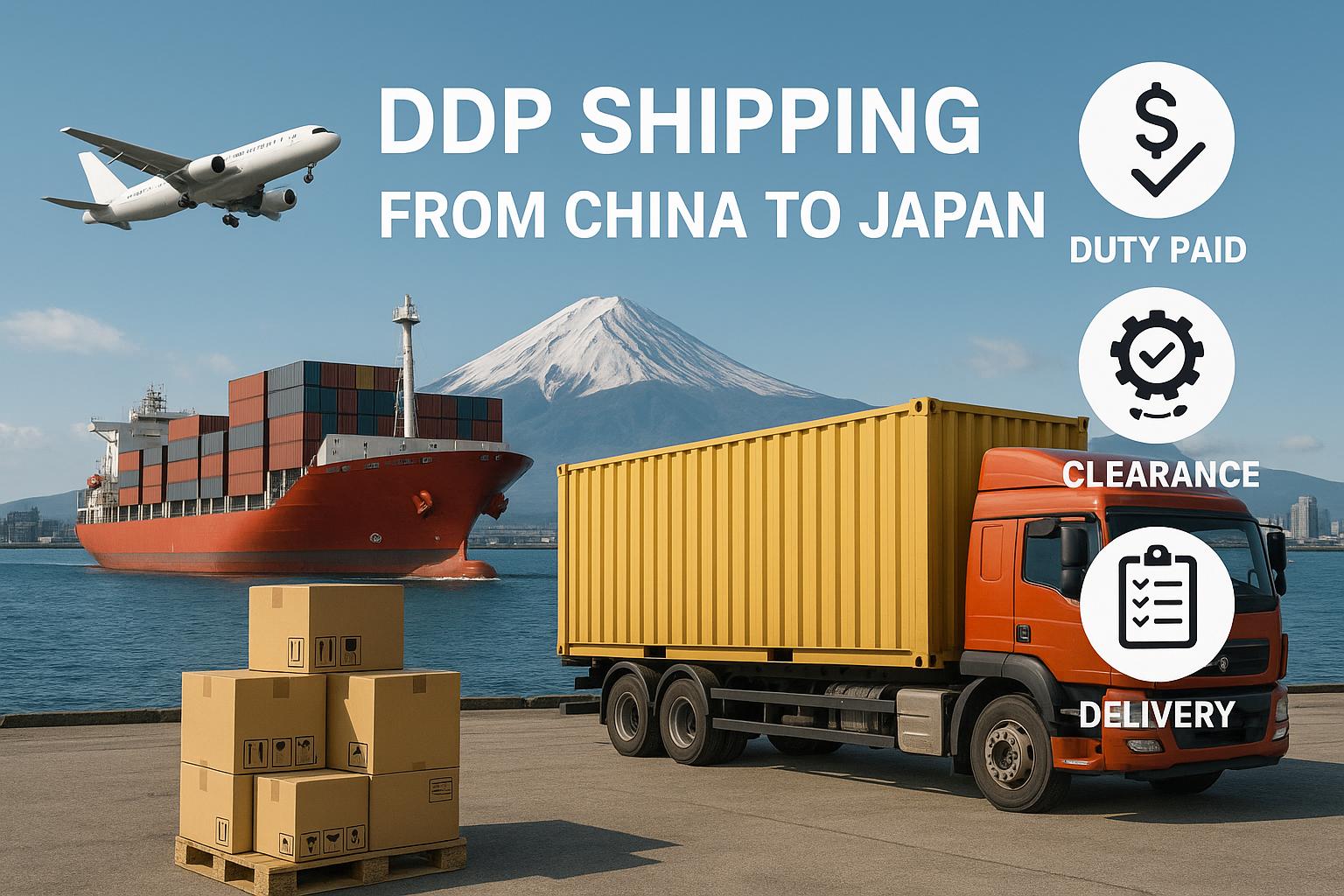
DDP shipping from China to Japan is a door to door delivery service where the freight forwarder or seller takes responsibility for moving cargo from China to the destination country. The buyer does not need to arrange customs clearance separately or pay import duties after the goods arrive.
A standard DDP service usually includes:
Pickup from supplier or warehouse in China
Export clearance in China
Air freight, sea freight, ocean freight, or express courier service
Japan customs declaration
Customs duty and consumption tax handling
Import clearance by a customs broker
Final delivery to the buyer’s final address
DDP is different from port to port shipping. With port to port sea shipping, the buyer still needs to handle Japan customs, pay taxes, and arrange local delivery. With DDP shipping, the freight forwarder coordinates the full shipping process until the goods reach the final delivery point.
DDP is not just “tax included.” It also requires correct import documents, accurate declared value, proper HS codes, and a reliable customs broker in Japan.
DDP shipping is suitable for businesses that want a simple and predictable supply chain. Instead of working with several different companies for international freight, customs clearance, tax calculation, and local delivery, the importer can use one freight forwarder to manage the whole process.
Main advantages include:
One all-inclusive shipping cost
Easier customs clearance
Import duties and consumption tax included
Less risk of hidden costs
Better control over total cost
Suitable for first shipment importers
Flexible shipping methods for small and large shipments
Final delivery to business address or private address
For e-commerce sellers and Amazon Japan sellers, DDP shipping from China is especially useful because it reduces the workload of importing goods into Japan.
There are three main shipping methods for DDP shipping from China to Japan: air freight, sea freight, and express courier. The best option depends on cargo weight, cargo size, delivery deadline, cargo value, and budget.
DDP air freight is the fastest option for commercial cargo. It is suitable for urgent goods, high-value products, e-commerce inventory, spare parts, samples, and time-sensitive shipments.
Air freight from China to Japan is usually charged per kilogram. The freight forwarder calculates chargeable weight based on actual weight or volumetric weight, whichever is higher. This means bulky but light cargo may cost more than expected.
Japan air freight DDP is commonly used for shipments from Shenzhen, Shanghai, Ningbo, Guangzhou China, Yiwu, and other China shipping hubs to Tokyo, Osaka, Nagoya, Fukuoka, and Western Japan.
Typical DDP air freight transit time is about 1–7 working days. Airport-to-airport air freight may take only 1–2 days, but full DDP shipping includes pickup, export clearance, customs clearance, and final delivery, so the total door to door delivery time is usually longer.
DDP air freight is best for:
Urgent stock replenishment
Small and medium shipments
High-value cargo
Amazon Japan inventory
Samples and spare parts
E-commerce sellers who need fast delivery
Air freight is usually 4–8 times more expensive than ocean freight, but it provides faster transit time and better schedule control.
DDP sea freight is the most cost-effective solution for heavy cargo, bulky goods, LCL shipping, full container cargo, and large shipments. Because China and Japan are close, sea shipping can be faster than many other international routes.
Japan sea freight DDP is commonly arranged from Shanghai, Ningbo, Qingdao, Shenzhen, Guangzhou, Xiamen, and other ports in China to Tokyo, Yokohama, Osaka, Kobe, Nagoya, and Western Japan.
Sea freight from Shanghai to Tokyo may take around 3–5 days for port to port movement. However, DDP shipping includes consolidation, export clearance, customs clearance, and final delivery, so LCL shipping transit time is usually around 7–12 days or longer. In many cases, full door to door delivery by sea freight takes about 10–20 days.
DDP sea freight is suitable for:
Heavy cargo
Large shipments
LCL shipping
Full container load cargo
Warehouse replenishment
Furniture, machinery, tools, and household goods
Importers looking for lower cost per cubic meter
Sea freight costs for DDP shipping often range from $70 to $200 per cubic meter, depending on route, cargo type, delivery address, customs duty, and consumption tax. Sea freight costs also depend on container size and weight when shipping a full container or one container.
Express courier DDP shipping is used for small urgent shipments, samples, documents, and lightweight parcels. Express shipping usually takes about 3–7 days from China to Japan, depending on service level and delivery location.
This method is convenient for small parcels, but it is not always the cheapest option. For cargo above 100 kg, DDP air freight may offer better value than express courier.
Express courier DDP is suitable for:
Samples
Documents
Small parcels
Urgent replacement parts
Lightweight e-commerce goods
Private address delivery
DDP shipping costs from China to Japan depend on cargo details, shipping methods, customs duty, consumption tax, destination address, and service requirements. There is no fixed price for every shipment because different products have different HS codes, declared value, and import rules.
Estimated 2026 DDP shipping costs:
| Shipping Method | Transit Time | Reference Cost | Best For |
|---|---|---|---|
| DDP Air Freight | 1–7 working days | $6–$20/kg | Urgent cargo, small and medium shipments |
| DDP Sea Freight LCL | 10–20 days | $70–$200/CBM | Heavy cargo, bulky goods, large shipments |
| Express Courier DDP | 3–7 working days | Quoted by kg | Small urgent parcels and samples |
These prices are only market references. Final DDP shipping costs depend on cargo weight, cargo size, HS codes, declared value, delivery address, and current freight market conditions.
Several factors affect the final shipping costs when importing goods from China to Japan.
For air freight and express courier shipments, cost is based on chargeable weight. The freight forwarder compares actual weight and volumetric weight, then uses the higher number.
For sea freight and LCL shipping, cargo volume is usually calculated by CBM. You can use our CBM Calculator to estimate cargo volume before requesting a DDP shipping quote.
For LCL shipping and sea freight, cost is usually calculated by cubic meter. Large-volume cargo can benefit from ocean freight because the cost per unit is lower than air freight.
If the shipment grows into a full container load, the freight forwarder may suggest FCL instead of LCL shipping. A full container can be more cost-effective when the importer has enough cargo to fill most of the container load.
HS codes directly affect customs duty, consumption tax, and Japan customs review. Incorrect HS codes may lead to delays, reclassification, extra tax calculation, or customs inspection.
Before booking DDP shipping from China, importers should provide a clear product name, material, function, usage, and product photos if needed.
Declared value is important for customs clearance. If goods are undervalued or misclassified, Japan customs may request additional proof or delay import clearance.
For e-commerce sellers, customs may compare the declared value with the actual selling price or market value. This is especially important for Amazon Japan shipments.
Final delivery cost also depends on the delivery address. A business address, warehouse, or Amazon facility is usually easier to arrange. A private address may require parcel delivery, extra handling, or local courier service.
Remote areas, islands, appointment delivery, and Western Japan delivery may also affect the final delivery cost.
Cargo insurance is recommended for valuable goods, fragile products, electronics, and high-value shipments. An insurance policy can reduce financial risk if cargo is damaged or lost during international shipping.
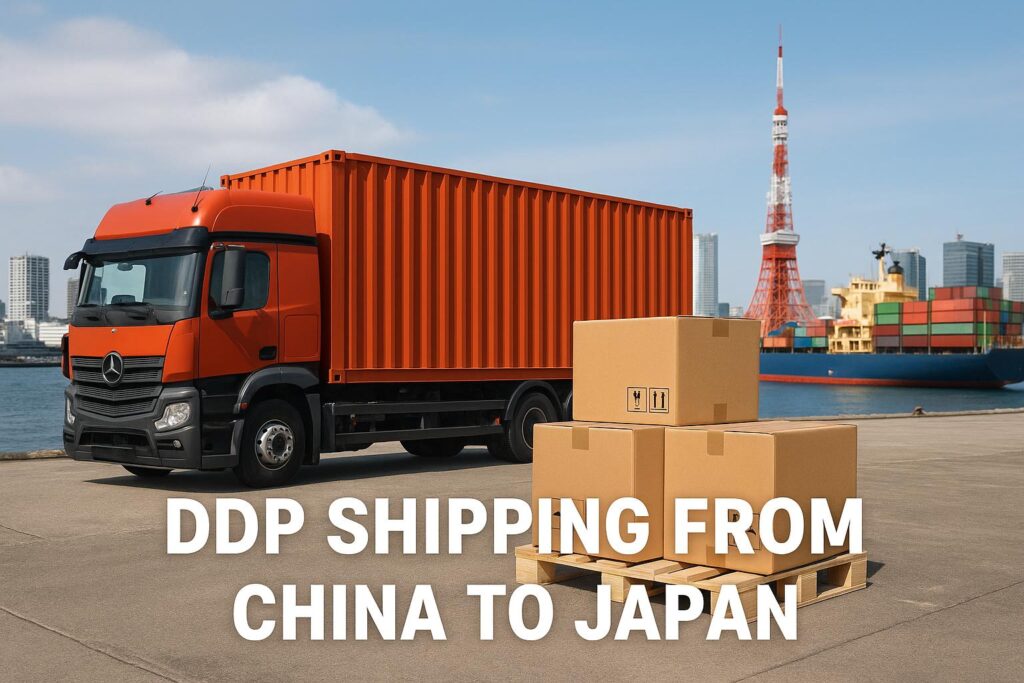
Customs clearance is a key part of DDP shipping from China to Japan. Under Delivered Duty Paid terms, the freight forwarder or seller is responsible for arranging import clearance, paying customs duty and consumption tax, and delivering the goods to the final address after customs release.
For the buyer, this means there is no need to contact Japan customs directly or hire a customs broker separately. However, DDP shipping still depends on accurate product information. Incorrect HS codes, unclear product descriptions, or unrealistic declared values can still cause customs delays.
Japan customs requires clear and consistent import documents. The commercial invoice and packing list must match the actual cargo, including product name, quantity, value, weight, carton number, and HS codes.
Common documents include:
Commercial invoice
Bill of lading or air waybill
Product description
Declared value
Country of origin
Import permits or certificates if required
The commercial invoice should show the supplier, buyer, product details, unit price, total value, and currency. If the shipment contains regulated goods, additional certificates may be required before customs clearance.
When your DDP shipment arrives at Japanese ports (like Tokyo, Yokohama, or Osaka), your forwarder must calculate and pay two separate charges to customs:
Import Customs Duty: Based on the Harmonized System (HS) code of the product. Rates range from 0% (electronics, IT equipment) to over 10% (certain textiles, leather goods, footwear).
Import Consumption Tax (JCT): A flat rate of 10% applied to the total import value. The import value is calculated as: CIF Value (Cost of Goods + Insurance + Freight) + Import Duties.
Declared value is one of the most common reasons for customs clearance problems. If the declared value is too low, Japan customs may request proof of value, such as purchase records, payment proof, product links, or sales information.
This is especially important for e-commerce goods, Amazon Japan shipments, branded products, and high-value items. Japan customs may compare the declared value with market prices or online selling prices.
To reduce risk, importers should provide accurate product names, materials, usage, HS codes, and realistic values before shipment. False or unclear declarations may lead to delays, extra tax calculation, penalties, or shipment rejection.
Some shipments require extra attention before booking. If wooden pallets or crates are used, the wood packaging must comply with ISPM 15 standards and carry the proper treatment mark. Non-compliant wood packaging may cause inspection, treatment fees, or delays.
Japan also has strict rules for certain sensitive or regulated products. These goods should be checked with the freight forwarder before shipment:
Food and tableware
Cosmetics and skincare products
Medical devices
Pharmaceuticals
Baby products
Batteries
Liquids, powders, and chemicals
Branded goods
Products with intellectual property concerns
A reliable freight forwarder should confirm whether the goods are suitable for DDP shipping before they leave China. This helps avoid customs issues after arrival in Japan.
Most customs delays can be avoided before shipment. Importers should prepare accurate documents, confirm HS codes, use a reasonable declared value, and clearly describe the product’s material and function.
For sensitive goods, the requirements should be checked in advance. Once the cargo arrives in Japan, correcting documents or changing declarations can take more time and may create extra costs.
Working with an experienced freight forwarder and customs broker helps make the DDP shipping process smoother. They can review documents, estimate import duties and consumption tax, check product restrictions, and arrange final delivery after customs release.
A normal DDP shipping process includes several steps.
Step 1: Confirm Cargo Details
The importer provides cargo details, including product name, HS codes, quantity, carton size, cargo weight, declared value, pickup address in China, and final address in Japan.
Step 2: Factory Pickup in China
The freight forwarder arranges factory pickup from the supplier. If goods are from multiple suppliers, multiple shipments can be consolidated into one shipment before export.
Step 3: Export Clearance
The China shipping agent prepares export documents and arranges export clearance. For air freight, an air waybill is issued. For sea freight, cargo is moved to the port or warehouse for consolidation.
Step 4: International Transportation
The goods move by air freight, sea freight, ocean freight, or express courier. The selected shipping methods depend on transit time, cargo size, budget, and product type.
Step 5: Import Clearance in Japan
After arrival, the customs broker arranges import clearance with Japan customs. Import duties, customs duty, and consumption tax are handled under DDP terms.
Step 6: Final Delivery
After customs release, the shipment is delivered to the business address, warehouse, Amazon Japan facility, or private address. This final delivery stage is important because local delivery rules can affect both cost and timing.
DDP shipping from China to Japan is widely used by Amazon Japan sellers. It allows sellers to ship goods directly to Amazon warehouses without managing import clearance themselves.
For Amazon Japan shipments, sellers should prepare:
FBA shipment ID
Carton labels
Product labels
Packing list
Commercial invoice
Accurate declared value
Correct HS codes
Delivery appointment details if required
DDP shipping helps e-commerce sellers simplify their supply chain and control landed cost. However, Amazon warehouse delivery rules must be followed carefully.
Tonlexing provides DDP shipping from China to Japan for importers, e-commerce sellers, Amazon Japan sellers, wholesalers, and companies managing regular China shipping needs.
Our services include:
DDP air freight from China to Japan
DDP sea freight and ocean freight
LCL shipping and full container solutions
Express courier options
Factory pickup in China
Export clearance
Customs clearance in Japan
Import duties and consumption tax handling
Cargo consolidation from multiple suppliers
Final delivery to business address or private address
Whether this is your first shipment or a regular supply chain route, Tonlexing can help you compare air freight, sea freight, and express courier options based on cargo weight, cargo size, transit time, and total cost.
If you need to ship DDP from China to Japan, our team can check your cargo details and provide a suitable solution.
DDP shipping from China to Japan usually includes pickup in China, export clearance, international freight, customs clearance in Japan, import duties, consumption tax, and final delivery to the buyer’s address.
DDP air freight usually takes 1–7 working days. DDP sea freight usually takes 10–20 days door to door. Express courier shipping usually takes 3–7 days for small urgent parcels.
Air freight costs for DDP shipping usually range from $6 to $20 per kilogram. Sea freight costs for DDP shipping range from about $70 to $200 per cubic meter. Final shipping costs depend on cargo size, cargo weight, HS codes, declared value, and delivery address.
Yes. DDP shipping is commonly used for Amazon Japan because customs clearance, import duties, consumption tax, and final delivery can be included in one service. Sellers still need correct FBA labels and shipment information.
Yes. Japan applies a 10% consumption tax on most imported goods. Under DDP terms, the consumption tax is normally included in the DDP price.
Useful freight, customs and importing resources related to this shipping guide.
Shipping from China to Japan – Sea, Air & DDP in 2026 Fast, reliable shipping from China to Japan for B2B importers,eCommerce sellers, and projec...
Read guide →
Shipping Cost from China to Japan (2026 Guide) Verified & Reviewed · Last updated April 2026 Shipping cost from China to Japan in 2026 typically...
Read guide →
Sea freight is the most cost effective shipping method for large volumes and container load cargo. It is ideal for businesses looking to reduce s...
Read guide →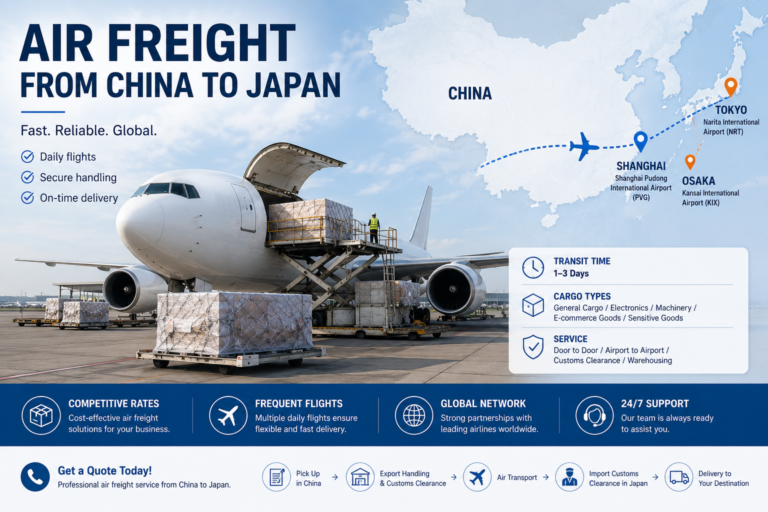
Air Freight from China to Japan Verified & Reviewed · Last updated June 2026 Air freight from China to Japan is one of the fastest ways to ship c...
Read guide →China and Japan have one of the most active maritime trade routes in Asia, facilitating high trade volumes for various industries, including elec...
Learn more → Useful Resource Documents Required to Import from China (2025 Guide)Importing goods from China can be highly profitable—but only when you understand the necessary documents and import requirements. Whether you’re...
Learn more →WhatsApp us