Sea Freight
FCL and LCL shipping to Port Klang, Penang, Johor and East Malaysia for regular commercial cargo.
Usually best for Shipments from 1 CBM or full containers

China–Malaysia Shipping Guide · Updated August 2026
Compare sea freight, air freight, express and DDP shipping from China to Malaysia for commercial cargo. Sea freight to major West Malaysia ports typically takes about 5–15 days port to port, while air freight usually takes 1–3 days airport to airport. Delivery to Sabah, Sarawak or a final address requires additional time.
Quotes are based on cargo details, China origin, destination in Malaysia and current carrier capacity.
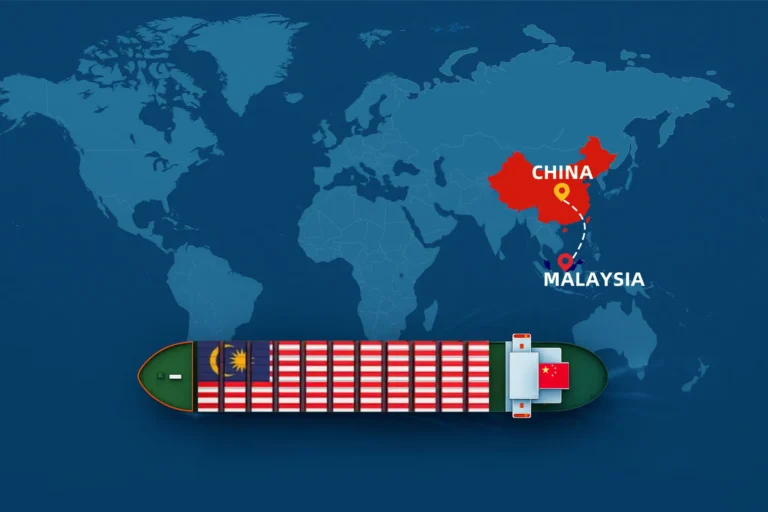
Quick shipping overview
Choose between sea freight, air freight, express shipping and door-to-door delivery according to cargo volume, delivery deadline and destination. Shipments to Sabah and Sarawak may require more transit time than deliveries within West Malaysia.
FCL and LCL shipping to Port Klang, Penang, Johor and East Malaysia for regular commercial cargo.
Usually best for Shipments from 1 CBM or full containersFast airport-to-airport transport to Kuala Lumpur and other Malaysian gateways for urgent commercial cargo.
Usually best for Time-sensitive shipments from 45 kgCourier-style delivery for urgent cartons and compact commercial shipments when speed is the main priority.
Usually best for Urgent commercial cargo from 45 kgCoordinated pickup in China, international freight, customs support and final delivery to the confirmed address in Malaysia.
Usually best for Importers wanting one managed shipmentPlanning ranges only. Actual transit time depends on the Chinese origin, carrier schedule, customs clearance and final delivery address. Shipments to Sabah and Sarawak generally require additional time.
Cost & Pricing
Use these August 2026 reference shipping rates to compare sea freight, air freight, express and door-to-door shipping. Final pricing depends on the cargo type, chargeable weight, Chinese origin and destination postcode in Malaysia.
China to Malaysia indicative freight rates
Checked August 2026| Shipping method | Pricing basis | Indicative rate | Rate scope |
|---|---|---|---|
| International Express | Chargeable weight | USD 5–8/kg DHL, FedEx or UPS | Commercial cargo from 45 kg |
| Air Freight | Chargeable weight | USD 2.30–3.00/kg General cargo | West Malaysia, from 45 kg |
| Sea LCL | Per CBM or W/M | General: USD 101–104/CBM Sensitive: USD 111–119/CBM | West Malaysia, from 1 CBM |
| Sea FCL | Per container | 20GP: USD 450–550 40GP: USD 855–1,045 | Indicative port-to-port rates |
| Door-to-Door & DDP | Shipment-specific | Custom quote Based on cargo and final postcode | West or East Malaysia |
Sea FCL figures are indicative port-to-port rates. LCL and air references are based on West Malaysia services. Rates do not automatically include pickup, final delivery, customs clearance, import duty, sales tax, inspections, storage or other charges unless confirmed in the freight quotation.
Transit Time Guide
Sea shipping from China to Malaysia generally takes about 5–15 days port to port for FCL services to major West Malaysia ports. LCL, door-to-door delivery and shipments to Sabah or Sarawak require additional handling time.
Typical China to Malaysia transit times
Planning ranges| Shipping method | Main transit | Door-to-door planning | Usually suitable for |
|---|---|---|---|
| Sea FCL | 5–15 days Port to port | 10–20 days Major West Malaysia destinations | Full-container and larger-volume cargo |
| Sea LCL | 7–18 days Port to port | 15–25 days Consolidation and deconsolidation included | Commercial cargo from 1 CBM |
| Air Freight | 1–3 days Airport to airport | 3–6 days West Malaysia general cargo | Urgent commercial cargo from 45 kg |
| International Express | 1–2 days Courier network | 2–4 days Major Malaysian cities | Urgent commercial cargo from 45 kg |
These are indicative planning ranges rather than guaranteed delivery times. Shipments to Sabah, Sarawak, islands and remote postcodes usually require additional transit or local delivery time.
Origin & routing South China routes are often faster than northern origins.
Consolidation & schedule LCL handling, transshipment and rollovers can add time.
Customs & documents Incorrect cargo details or documents can delay release.
West vs East Malaysia Sabah, Sarawak and remote postcodes usually take longer.
Shipping Methods
Choose between sea freight, air freight, international express and door-to-door shipping according to cargo size, urgency and the Malaysian destination. West Malaysia generally offers more direct services, while Sabah and Sarawak may require additional connections or local delivery time.
Sea freight is usually the most economical option for machinery, pallets, wholesale orders and other larger commercial shipments. FCL and LCL services are available to major gateways in West and East Malaysia.
LCL shipments from 1 CBM and larger cargo that can fill part or all of a shipping container.
LCL shares container space. FCL gives one shipper use of the container and usually involves fewer handling stages.
Air freight is suitable for urgent replenishment, higher-value goods and time-sensitive commercial cargo. Kuala Lumpur is the primary air gateway, with Penang and other airports available according to the selected route.
Commercial shipments from 45 kg that require faster and more predictable transport than sea freight.
The higher of actual weight and volumetric weight is used. Air volumetric weight is calculated with a 6000 divisor.
International express provides pickup, tracking, customs handling and delivery through one courier network. It is generally the simplest option for compact, urgent commercial shipments.
Urgent commercial cargo from 45 kg when speed is more important than obtaining the lowest freight rate.
Check dimensional weight, remote-area surcharges, oversize limits and cargo acceptance before booking.
Door-to-door shipping can combine pickup in China, export handling, international freight, Malaysian customs support and final delivery. DDP service is available for eligible cargo and supported Malaysian postcodes.
Importers who want one coordinator for pickup, freight, customs arrangements and delivery.
Confirm the Incoterm, customs entry, duty and tax handling, consignee requirements and any excluded destination fees.
Door-to-door does not automatically mean DDP. Under a confirmed DDP service, import clearance, applicable duty and tax handling are included within the agreed scope. Under other door-delivery terms, the Malaysian consignee may still need to clear the goods and pay import charges.
Freight Network
Cargo can move from major Chinese manufacturing regions to gateways in West Malaysia, Sabah and Sarawak. The appropriate port or airport depends on the supplier location, cargo type, carrier schedule and final Malaysian delivery address.
Common planning lanes include Shenzhen or Guangzhou to Port Klang, Shanghai or Ningbo to Port Klang and Penang, and Qingdao to Johor gateways. Services to Sabah and Sarawak may use transshipment or feeder connections depending on the carrier schedule.
Kuala Lumpur is the primary air gateway for many shipments. Penang can suit cargo for northern West Malaysia, while Kota Kinabalu and Kuching are selected according to the Sabah or Sarawak destination and available direct or connecting space.
The principal gateway for Kuala Lumpur, Selangor and central West Malaysia.
A practical gateway for Penang and northern Malaysian industrial and commercial areas.
Southern gateways serving Johor, nearby industrial areas and suitable carrier connections.
Sapangar Bay serves Sabah, while Kuching Port is used for cargo destined for Sarawak.
The actual port, airport and routing are confirmed with the quotation. Direct service, transshipment, cut-off dates and available carrier capacity can change by shipment.
Border Compliance
Commercial imports are reviewed by the Royal Malaysian Customs Department. The HS code, customs value, country of origin, product controls and supporting documents determine the import duty, sales tax and conditions for customs release.
Confirm the product description, Malaysian HS code, country of origin and whether an import permit, registration or regulator approval is required.
The importer or appointed customs agent submits Customs Form No. 1 (K1). Supporting documents are provided through the Malaysian Customs Import/Export Document System.
Customs calculates applicable import duty and sales tax according to the HS code, origin, customs value and any valid preferential tariff claim or exemption.
Customs or the relevant regulator may review, inspect or request additional evidence. Cargo is released after the requirements and applicable charges are satisfied.
Import duty depends on the HS code and country of origin. Imported goods may be exempt from sales tax or subject to 5%, 10% or a specific rate under the applicable Malaysian sales tax orders. Confirm the tariff treatment before quoting the landed cost.
Qualifying China-origin goods may receive preferential import duty treatment under ACFTA or RCEP. The proof of origin must satisfy the relevant rules, and its details must match the K1, invoice, packing list and transport document.
Electrical products may require an Energy Commission Certificate of Approval and applicable SIRIM compliance. Food, plants, animals and agricultural products may require MAQIS or other authority approval. Batteries, chemicals, medicines and vehicles can also require additional documents.
The party named as importer in the Malaysian customs entry remains responsible for product admissibility, accurate declarations and required approvals. Tonlexing can coordinate transport documents and customs support according to the confirmed service and Incoterm.
Review booking requirements →Shipment Readiness
Accurate cargo information and a complete Malaysian delivery postcode are required to select the correct route, calculate chargeable weight and confirm whether customs permits or product approvals are needed.
Provide the exact commodity name, HS code if available, cargo value, intended use and clear cargo photographs.
Confirm the package count, dimensions, gross weight, total CBM, packing method and whether pallets or wooden packing are used.
Provide the Chinese pickup city or supplier address and the complete Malaysian delivery address and postcode, including whether it is in West Malaysia, Sabah or Sarawak.
Confirm whether the quotation is required for port, airport, door delivery or DDP and whether the supplier uses EXW, FOB or another trade term.
Provide the expected factory completion date and required arrival date. Rates, schedules and available space must be reconfirmed when the cargo is ready.
Declare any battery, magnet, liquid, powder, chemical, brand or other sensitive feature and confirm whether Form E, permits, COA or other approvals are available.
From booking to delivery
Tonlexing coordinates cargo collection in China, export handling, international transport, Malaysian customs support and final delivery under the confirmed service scope.
We review the commodity, pickup city, Malaysian destination, cargo size, delivery requirement and preferred shipping method.
Cargo is collected from the supplier or received at the Tonlexing warehouse for checking and consolidation when required.
Carrier space, final shipping documents, China export clearance and cargo loading are coordinated before departure.
Shipment milestones are monitored during international transport while the responsible importer or customs agent prepares the K1 declaration and supporting documents for Malaysian customs clearance.
After customs release, the shipment is collected from the port, airport or depot and delivered to the confirmed Malaysian address.
Why Tonlexing
As a China-based freight forwarder and shipping agent, Tonlexing coordinates suppliers, cargo collection, export handling and international shipping through to the agreed handover or delivery point in Malaysia.
The shipping method is selected according to cargo size, urgency, commodity requirements, destination and the customer’s preferred delivery scope.
One plan based on the actual shipmentWe coordinate supplier pickup, warehouse receiving, consolidation and final cargo data before the shipment leaves China.
Suitable for single or multiple suppliersRouting is planned around the final postcode, whether the cargo is destined for West Malaysia, Sabah or Sarawak.
Port, airport and delivery route matched to destinationShipping documents and cargo information are organized for handover to the Malaysian importer, customs agent or DDP service provider.
Clear responsibilities before the cargo departsClear quotation scope: the route, chargeable basis, included services, exclusions and customs responsibilities are confirmed before booking.
Practical shipping answers
Quick answers about shipping methods, freight costs, transit times, Malaysian customs clearance and door-to-door delivery.
Current indicative rates are USD 5–8/kg for international express, USD 2.30–3.00/kg for general air cargo to West Malaysia and USD 101–104/CBM for general sea LCL. Sensitive LCL cargo is approximately USD 111–119/CBM. Indicative FCL rates are USD 450–550 for a 20GP and USD 855–1,045 for a 40GP. Final pricing depends on the shipment and service scope.
FCL sea freight generally takes about 5–15 days port to port, while LCL commonly takes about 7–18 days port to port. Consolidation, customs clearance and final delivery add additional time. Shipments to Sabah or Sarawak may also require a longer schedule than shipments to West Malaysia.
Sea freight normally provides the lowest unit cost for larger shipments. LCL is suitable when the cargo does not fill a container, while FCL can become more economical as volume increases. The cheapest option should be compared using the total cost, including origin handling, freight, destination charges, clearance and delivery.
Yes. Tonlexing can arrange door-to-door and DDP shipping to Malaysia for suitable cargo and destinations. The service is quoted individually because customs responsibility, import taxes, permits, delivery postcode and included destination charges must be confirmed before booking.
Import duty depends on the HS code, origin and any available preferential treatment. Imported goods may be exempt from sales tax or subject to 5%, 10% or a specific rate depending on their classification. Commercial shipments normally require an invoice, packing list, bill of lading or air waybill, importer details and K1 declaration. Form E, RCEP origin evidence or product permits may also be required.
Sea freight consolidation is generally more suitable for commercial cargo from 1 CBM when cost is more important than speed. Express courier is better for urgent cargo, with Tonlexing quotations normally starting from 45 kg. Cargo collected from several suppliers can also be combined through our China warehousing and consolidation service before export.
Further reading
Continue with focused guides covering freight rates, transit times and air cargo shipping from China to Malaysia.
Cost and pricing
Review air, sea, container and express rates together with the main factors affecting the final shipping cost.
Compare shipping costs
Transit time
Compare sea, air, express and door-to-door transit times and the factors that can delay final delivery.
View transit times
Air cargo
Learn about chargeable weight, airport routes, customs preparation and delivery planning for urgent cargo.
View air freight guideA real shipment example showing how industrial cargo was moved from China to Malaysia.

Beijing, China → Malaysia
This case covers the air shipment of stainless steel and carbon steel components, including cargo preparation, documentation and delivery coordination.
View case studyWhatsApp us