Related Guide
Freight Forwarder Red Flags
Freight Forwarder Red Flags: How to Spot Risk Before You Ship Verified & Reviewed · Last updated July 2026 Freight forwarder red flags can appear...
Read guide →

Freight quotes from China can vary depending on shipping methods, service coverage, transit times, and included charges.
This practical guide explains how to compare freight quotes from China, identify hidden fees, review air and sea freight options, and calculate the total landed cost before booking your shipment.
Freight quote comparison
Total landed cost
Air freight / Sea freight
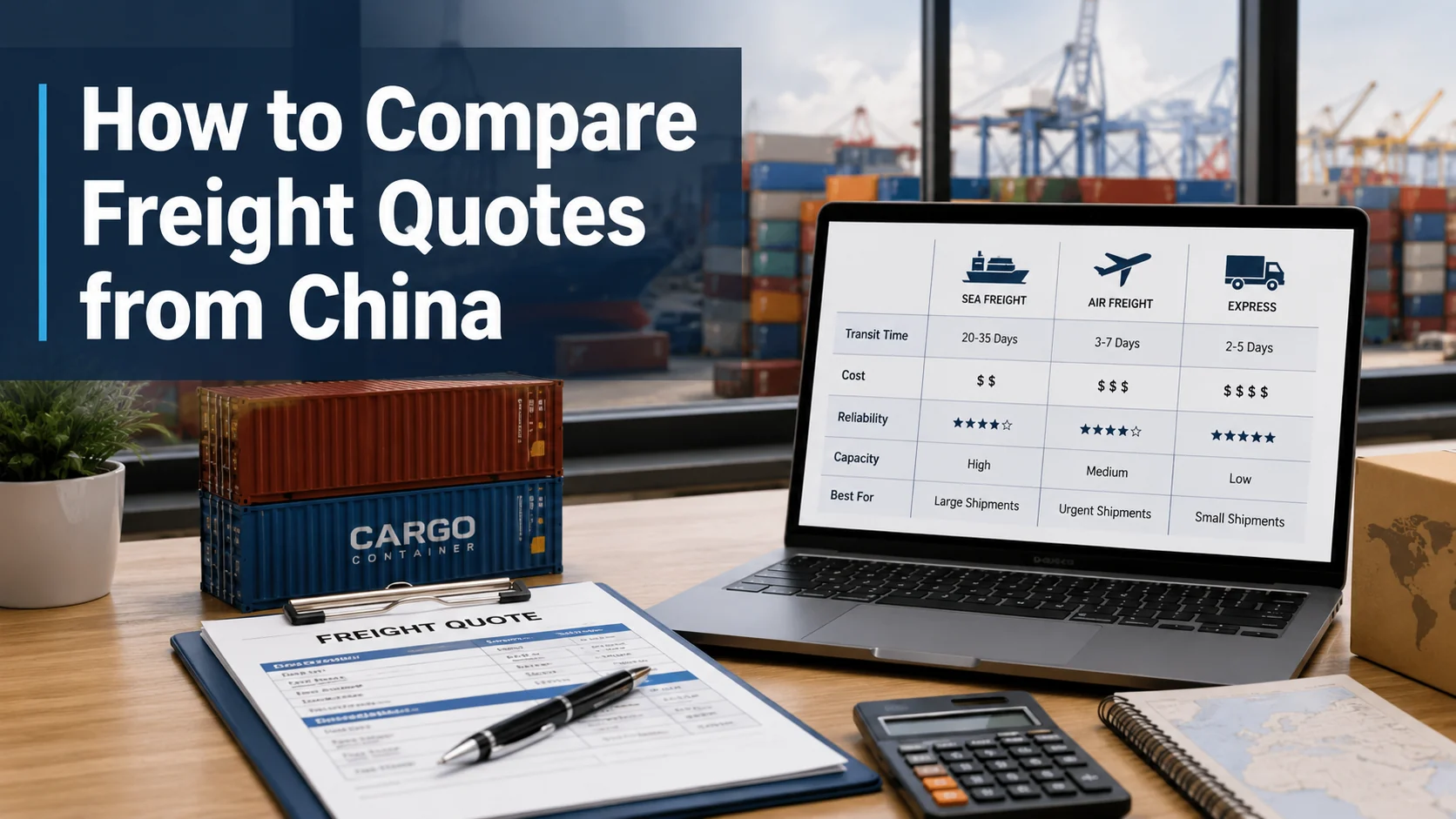
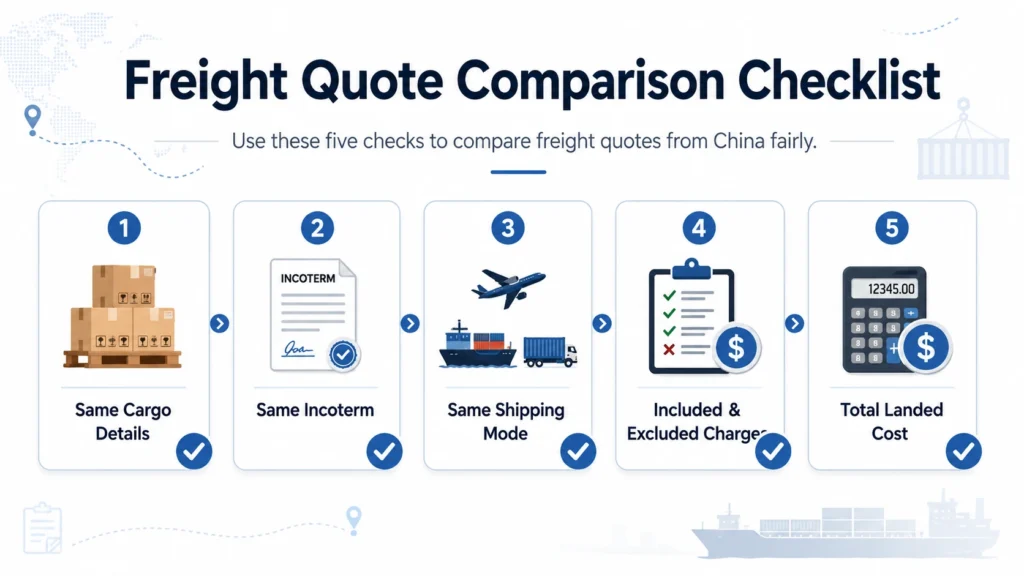
To compare quotes accurately, ask every freight forwarder to calculate the price from the same cargo details and under the same shipping conditions.
Use the following process:
Confirm the exact origin and final destination.
Provide identical package dimensions, actual weight, quantity, and product information.
Request the same shipping mode and Incoterm.
Ask for an itemized cost breakdown.
Compare the route, transit time, service scope, and quote validity.
Calculate the total landed cost before booking.
The best freight quote offers a suitable route, realistic delivery time, transparent charges, and reliable support.
Freight rates are only one part of the total shipping cost. A low port-to-port quote can become expensive when origin handling, destination port charges, customs clearance fees, or inland trucking are added later.
Lower prices may also involve:
Longer transit times
More transshipment points
Less frequent departures
Limited free days at the destination port
Higher destination handling charges
No cargo insurance or customs support
No final delivery
For example, Quote A may show USD 1,000 for ocean freight but exclude USD 700 in local charges. Quote B may show USD 1,500 with most standard services included. Although Quote B looks higher, its final cost is lower. Focus on what you will pay from the agreed origin to the final delivery point.
Accurate freight shipping quotes depend on accurate cargo details. If one forwarder receives estimated dimensions while another receives final measurements, the resulting prices cannot be compared fairly.
Provide the same information in every inquiry:
| Cargo detail | Information to provide |
|---|---|
| Product | Clear product name and intended use |
| Packaging | Cartons, pallets, crates, or machines |
| Dimensions | Length, width, and height of each package |
| Weight | Gross weight per package and total actual weight |
| Quantity | Number of packages and units |
| Cargo value | Commercial value and currency |
| Origin | Exact supplier or pickup address in China |
| Destination | Port, airport, or full delivery address and postal code |
| Ready date | Expected cargo readiness date |
| Special features | Battery, liquid, magnet, brand, wood, or dangerous goods |
Include the HS code if available. A commercial invoice and packing list help the forwarder check the product, package count, value, and customs requirements.
Update the cargo data after production. Small changes in carton size can affect volumetric weight, LCL volume, and trucking costs.
Incoterms divide transportation costs, risks, and responsibilities between the buyer and seller. Do not compare an EXW quote directly with an FOB, DAP, or DDP quote.
Under EXW, the buyer normally arranges transportation from the supplier’s premises, including pickup and export formalities.
Under FOB, the supplier delivers the cargo on board the vessel at the named port and completes export formalities. The buyer manages the main freight and import process.
Under DAP, transportation reaches the named destination, while the buyer normally handles import clearance and duties. Under DDP, the seller also handles import clearance, duties, and taxes under the agreed conditions.
Always include the named place when requesting a shipping quote:
EXW supplier address in Shenzhen
FOB Yantian Port
CIF Los Angeles
DAP buyer’s warehouse
DDP full address and postal code
Even under the same Incoterm, check the written exclusions. Unloading, inspections, storage, remote delivery, and waiting time may be separate.
Choosing the right shipping mode is a key part of comparing freight quotes from China. The cheapest quote is not always the most cost-effective option because each transportation method has different pricing rules, transit times, and service coverage.
| Shipping Mode | Best For | Main Cost Factor | Typical Transit Time |
|---|---|---|---|
| Express Shipping | Samples, urgent parcels, and smaller shipments | Chargeable weight | 2–5 days |
| Air Freight | High-value or time-sensitive cargo | Actual weight or volumetric weight | 3–10 days |
| LCL Sea Freight | Medium-volume shipments that do not need a full container | Cubic meter | 20–40 days |
| Full Container Load (FCL) | Large shipments and bulk cargo | Container type and shipping route | 15–35 days |
Different shipping modes are calculated differently:
Express shipping is usually priced by chargeable weight and is suitable for small shipments that need fast delivery.
Air freight is calculated based on the greater of actual weight or volumetric weight and works well for time-sensitive cargo.
LCL shipping is commonly charged by cubic meter and is suitable for shipments that do not fill a container.
Full container load (FCL) is priced by container type and route, making it more economical for larger shipments and large quantities.
A freight quote should be more than a single total price. To compare freight quotes from China accurately, importers need to understand what each charge covers and whether important costs are included or excluded.
Two quotes with different prices may actually represent different service scopes. One may only include international transportation, while another may include pickup, customs clearance, destination handling, and final delivery.
A clear freight shipping quote should normally be divided into the following cost categories:
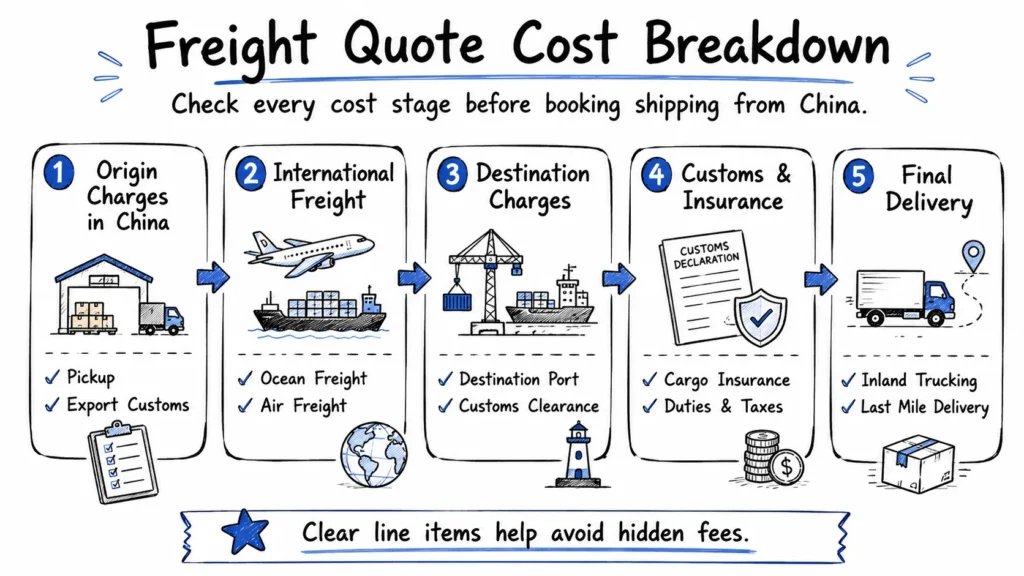
Origin charges cover the costs before the shipment leaves China. These fees vary depending on the pickup location, shipping mode, and service requirements.
Common origin costs include:
Supplier pickup or inland trucking
Warehouse receiving and cargo consolidation
Export customs declaration
Documentation charges
Terminal handling fees
Packaging or pallet services when required
For example, an EXW shipment usually requires the buyer to arrange more origin services because the cargo is collected directly from the supplier’s location. A FOB shipment normally includes export handling by the supplier, but buyers should still confirm what is included in the quote.
International freight is the main transportation cost between China and the destination country. The pricing method depends on the shipping mode.
When reviewing this section, check:
Shipping mode and route
Carrier or service type
Container type for ocean freight
Chargeable weight for air freight
Ocean freight rates or air freight rates
Transit times and estimated departure schedule
For ocean freight, confirm whether the quote is based on LCL shipping or full container load. For air freight, verify whether the calculation uses actual weight or volumetric weight.
Destination charges are often overlooked when comparing freight quotes. A low freight rate may not include costs after the cargo arrives at the destination port or airport.
Possible destination charges include:
Destination terminal handling
Customs clearance fees
Customs brokerage
Port or airport handling
Storage, demurrage, or detention
Inland trucking
Last mile delivery
These costs can vary significantly by country and destination port. Always ask whether the quote is port-to-port or door-to-door before making a decision.
Customs-related costs should be clearly identified in the quote. Import duties and taxes depend on the product type, HS codes, customs value, and destination regulations.
Confirm whether the quote includes:
Import duties and taxes
Customs bond or security requirements when applicable
Cargo insurance is usually optional but recommended for valuable shipments. Check the insured value, coverage scope, and exclusions before adding it to the total cost.
Before choosing a freight quote, ask the forwarder to clearly mark each charge as:
Included in the price
Estimated cost
Excluded from the quote
Additional charges if specific events occur
This makes it easier to compare multiple freight quotes and avoid unexpected costs after shipment departure.
A detailed cost breakdown helps importers calculate the real landed cost and choose the most suitable shipping solution instead of simply selecting the lowest initial price.
Chargeable weight is an important factor when comparing freight quotes from China, especially for air freight and express shipping. Different calculations can make two quotes appear different even when the shipment details are the same.
For air freight and express courier services, the chargeable weight is usually based on the higher value between actual weight and volumetric weight.
Volumetric weight = Length × Width × Height (cm) ÷ 6,000
For example, a large but lightweight carton may have a higher volumetric weight than its actual weight, meaning you may pay for the space the cargo occupies rather than its physical weight.
When comparing quotes, make sure every freight forwarder uses the same:
Package dimensions
Actual weight
Number of cartons or pallets
Shipment size
Volume calculation method
For LCL shipping, confirm that the cubic meter calculation is accurate because small changes in dimensions can affect the final freight costs. For full container load shipments, check the container type, loading details, and whether overweight charges may apply.
Providing consistent cargo details helps ensure that quote differences come from service scope, shipping routes, and freight rates instead of calculation errors.
A lower freight rate may involve a longer route or more transfers. Confirm whether the transit time covers port-to-port or the complete door-to-door journey.
Compare the following route details:
Port or airport of departure
Destination port or airport
Direct or transshipment service
Estimated departure and arrival
Sailing or flight frequency
Expected customs and delivery time
For US ocean freight, services to West Coast ports such as Los Angeles and Long Beach are generally faster from China than all-water services to the East Coast. However, a low rate to a distant port may create higher inland costs.
Transit times are estimates. Weather, schedule changes, port congestion, inspections, and peak-season capacity can cause delays. For urgent shipments, compare realistic door-to-door timelines.
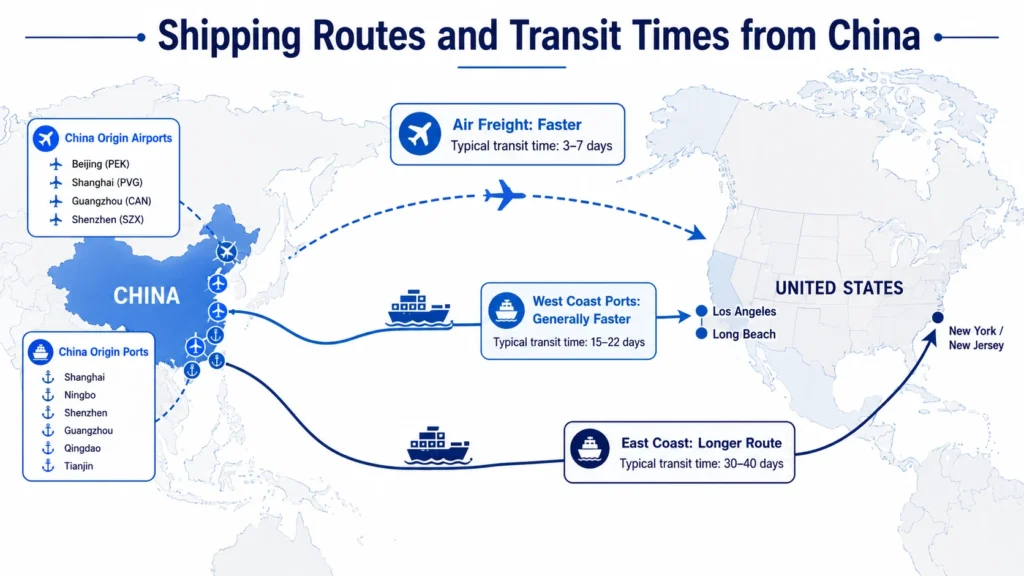
The lowest freight quote is not always the lowest overall cost. To compare shipping options accurately, calculate the total landed cost from the supplier to the final destination.
Total Landed Cost = Product Cost + Freight Costs + Origin Charges + Customs Duties and Taxes + Destination Charges + Final Delivery
When comparing freight quotes, make sure each option includes the same:
Shipping mode
Incoterm
Shipment size
Destination
Customs assumptions
A port-to-port quote may look cheaper than a door-to-door service because it excludes customs clearance, inland trucking, or last mile delivery.
By comparing the total landed cost instead of only the initial freight rate, importers can identify the most cost-effective shipping solution and avoid unexpected expenses.
Tonlexing is a freight forwarder in China providing international shipping solutions by sea, air, rail, truck, and express. We help importers arrange transportation, coordinate suppliers, handle shipping documents, and deliver cargo to the final destination.
Depending on the shipment requirements, our services include:
Supplier pickup and warehouse receiving in China
Cargo consolidation from multiple suppliers
Export customs clearance
Sea freight and air freight
LCL shipping and full container load shipping
Cargo insurance arrangement
Customs clearance support
DDP and DDU shipping solutions where available
Inland trucking and last mile delivery
Shipment tracking and document coordination
Before arranging shipment, Tonlexing reviews your cargo details, destination, and delivery requirements to recommend a suitable shipping solution. We provide clear quotations with included and excluded charges to help importers understand their freight costs.
Three freight quotes are usually enough to understand the market range. Make sure each quote uses the same cargo details, Incoterm, shipping mode, and destination before comparing prices.
Ocean freight quotes may use different shipping routes, carriers, transit times, destination agents, validity dates, or service scopes. One quote may be port to port, while another may include customs clearance and door to door delivery.
Air freight is better for urgent shipments, high-value goods, and inventory that must arrive quickly. Sea freight is more cost effective for heavy, bulky, or large-volume cargo when delivery time is flexible.
Express courier services are often convenient for small parcels, samples, and urgent shipments. They may be cost effective for shipments under 100 kg, but oversized packages, remote delivery, and fuel surcharges can make air freight or sea freight more suitable.
Request an itemized quote showing origin charges, international freight, destination charges, customs clearance fees, cargo insurance, and final delivery. Also ask for all exclusions, possible surcharges, and the quote validity period.
Useful freight, customs and importing resources related to this shipping guide.
Freight Forwarder Red Flags: How to Spot Risk Before You Ship Verified & Reviewed · Last updated July 2026 Freight forwarder red flags can appear...
Read guide →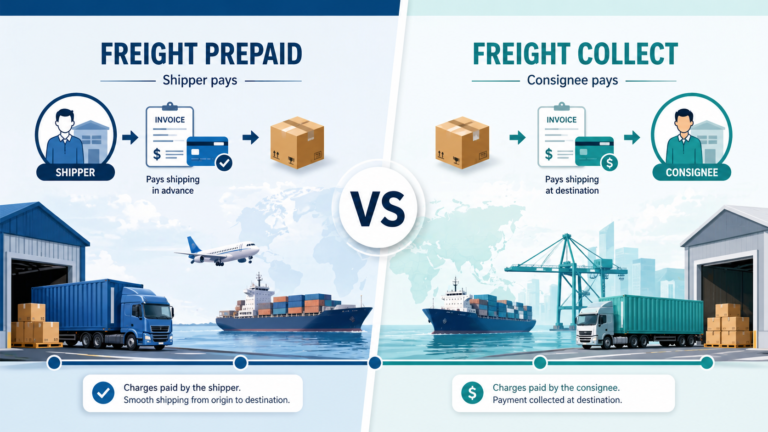
Freight Collect vs Prepaid: Meaning, Difference Verified & Reviewed · Last updated May 2026 Freight collect vs prepaid is one of the most importa...
Read guide →
EXW Container Shipping from China: Complete Guide for Importers Verified & Reviewed · Last updated April 2026 EXW container shipping from China m...
Read guide →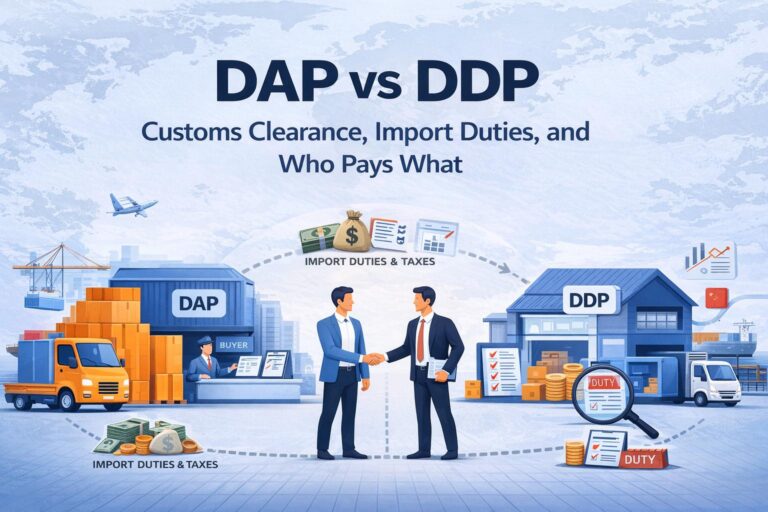
DAP vs DDP: Customs Clearance, Import Duties, and Who Pays What Verified & Reviewed · Last updated January 2026 Choosing between DAP and DDP dete...
Read guide →How to Calculate Landed Cost When Importing from China to the USA Verified & Reviewed · Last updated May 2026 When importing products from China...
Learn more → Useful Resource Demurrage vs Detention vs StorageDemurrage vs Detention vs Storage Verified & Reviewed · Last updated January 2026 Demurrage vs detention vs storage is one of the most expensive...
Learn more →WhatsApp us