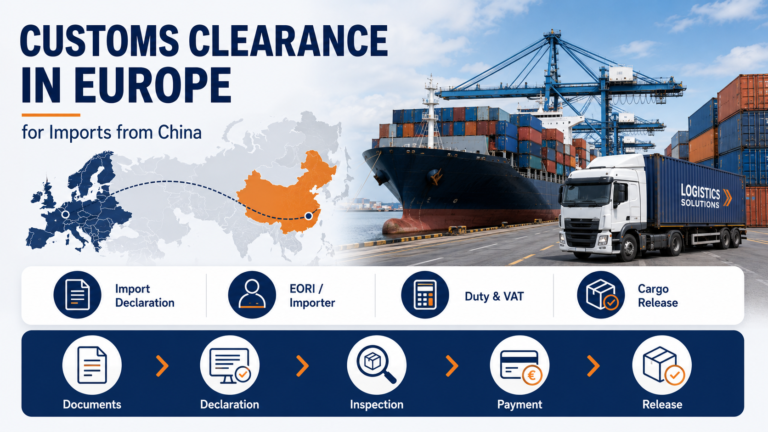
Related Guide
Customs Clearance in Europe for Imports from China
Customs Clearance in Europe for Imports from China Verified & Reviewed · Last updated July 2026 Customs clearance in Europe for imports from Chin...
Read guide →

Landed cost from China to Europe includes the product cost, freight cost, insurance, customs duties, import VAT, customs clearance fees, local charges, and final delivery costs.
This guide explains how to calculate landed cost when importing from China to Europe, covering the landed cost formula, CIF value, HS code, duty rate, VAT rate, freight charges, hidden costs, and total landed cost calculation for EU imports.
Landed Cost Formula
Customs Duty & Import VAT
Insurance & Delivery
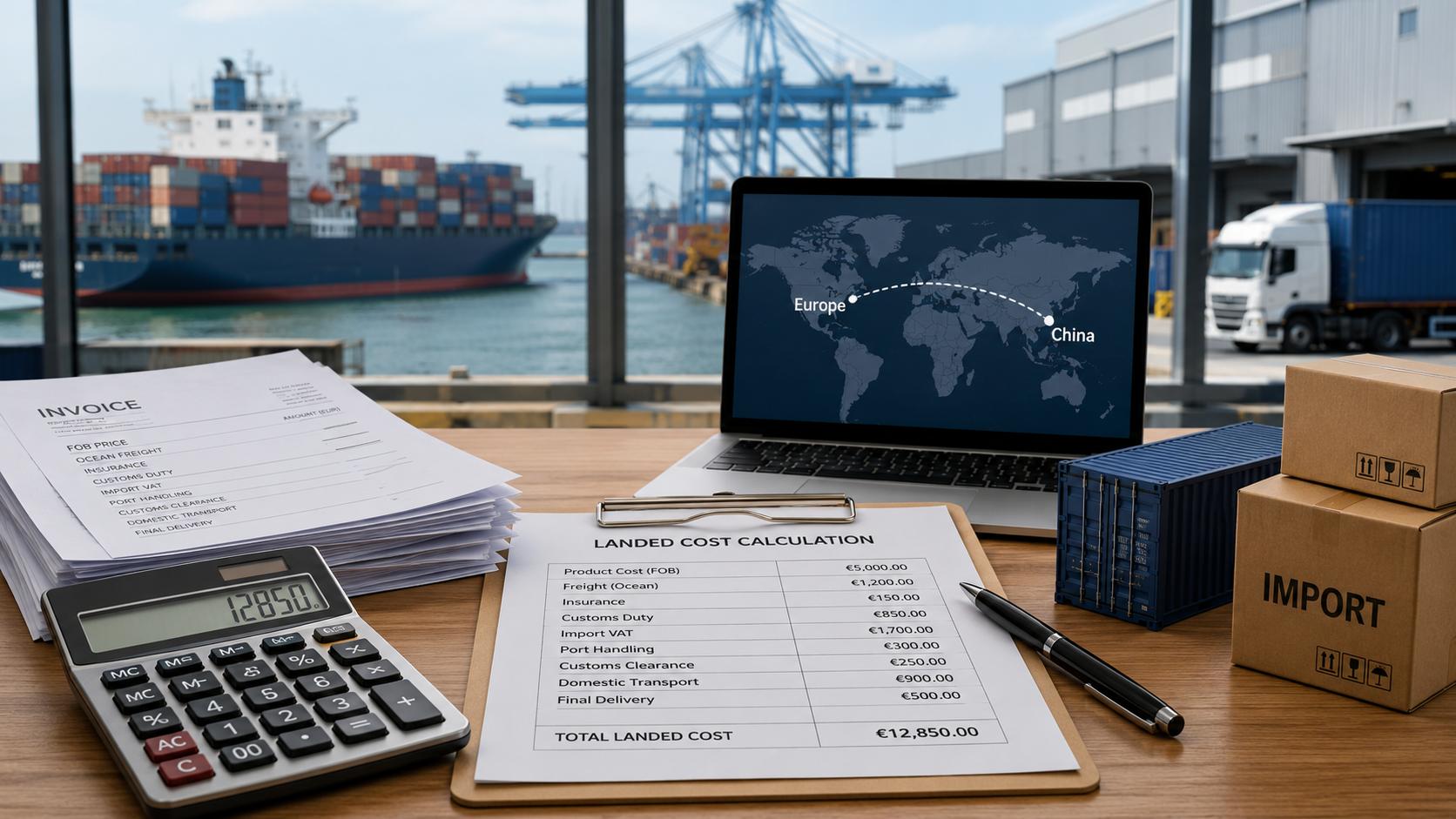
The basic landed cost formula is:
Landed Cost = Product Cost + China Local Charges + International Freight + Insurance + Customs Duty + Import VAT + Destination Charges + Final Delivery
For a more accurate China to Europe import cost calculation, you can break it down into four steps:
Calculate the customs value.
Calculate customs duty.
Calculate import VAT.
Add local handling, customs clearance, and final delivery costs.
A simplified formula is:
Total Landed Cost = CIF Value + Customs Duty + Import VAT + Destination Handling + Inland Delivery + Other Import Charges
The CIF value normally includes the product value, freight, and insurance up to the EU entry point. Customs duty calculation depends on the product classification, origin, and customs value. The European Commission states that duty calculation depends on three key factors: tariff classification, origin, and customs value.
Landed cost is the total cost of getting imported goods from your supplier in China to your final destination in Europe. It shows the real cost per shipment and the real cost per unit after all shipping, customs, tax, and delivery expenses are included.
For example, if your supplier price is €10 per unit, your final landed cost may become €13, €15, or even higher after freight, duty, VAT, customs brokerage, port charges, and warehouse delivery are added.
Landed cost is especially important for:
Importers buying from Chinese manufacturers
Amazon FBA sellers shipping from China to Europe
E-commerce sellers using DDP or door-to-door shipping
Wholesalers importing containers from China
Companies comparing EXW, FOB, CIF, and DDP quotes
Businesses calculating retail price and profit margin
Without landed cost calculation, a product that looks profitable at the supplier level may become unprofitable after arrival in Europe.
A complete landed cost calculation shows the true cost of getting goods from the supplier in China to Europe and gives a clear overview of the costs involved, including freight, duties, other charges, and other costs from the supplier’s factory through the supply chain to your final warehouse. Some costs are paid in China, some are paid during international shipping, and others are paid after customs clearance in Europe.
Product cost is the amount paid to your supplier in China. The product price, or base manufacturing price, is usually based on your commercial invoice and is influenced by raw materials, labor, and supplier profit.
It may include:
Unit price
Packaging cost
Product customization fee
Mold fee or setup fee
Labeling and branding cost
Quality inspection cost
For landed cost calculation, the commercial invoice value must be accurate. Under-declared invoice values may cause customs delays, penalties, cargo holds, or reassessment by customs authorities.
China local charges depend on your Incoterms. If you buy under EXW terms, you need to pay for pickup, export handling, export customs clearance, and delivery to the port or airport.
Common China-side costs include:
Factory pickup
Trucking to port, airport, or rail terminal
Export customs declaration
Warehouse handling
Port charges
Documentation fee
Container loading or LCL handling
If you buy under FOB terms, the supplier usually covers the China-side export cost up to the departure port. This is why FOB is easier for many importers to calculate than EXW.
International freight is often one of the largest cost items in China to Europe imports. The cost depends on shipping method, cargo size, route, season, service type, shipping rates, and fuel costs.
Common shipping methods include:
Sea freight full container load (FCL)
Sea freight less than container load (LCL), a type of container load
Truck freight for certain China-Europe routes
Sea freight is usually the most cost-effective option for large shipments, and full container load is often more efficient for higher volumes, while LCL can have higher per-unit destination costs. Air freight is faster but more expensive. Rail freight is often used as a middle option between ocean shipping and air freight.
Cargo insurance protects the shipment against loss or damage during transportation, and the insurance cost should be included in your total. It is a small cost compared with the total value of goods, but it is important for high-value or fragile cargo.
Insurance cost is commonly calculated as a small percentage of the declared value and freight cost. For landed cost calculation, cargo insurance should be included because it forms part of the real import cost.
Customs duties and import duties are import taxes charged based on the product’s HS code, origin, and customs value. In the EU, importers can check rates through TARIC, the integrated tariff database used by the relevant customs authority for EU tariff measures and duties.
The basic customs duty formula is: Customs Duty = Customs Value × Duty Rate
For example: €12,000 customs value × 4% duty rate = €480 customs duty
In practice, the duty rate is often applied to the FOB value used for customs valuation, and EU import duties can range from 0% to over 20% depending on the TARIC code and product category.
Value added tax (VAT), or import VAT, is charged when goods enter the European market. The European Commission states that VAT applies to imported goods as a consumption tax and varies by European Union member state.
The basic import VAT formula is: Import VAT = VAT Base × VAT Rate
The VAT base usually includes:
Customs value
Customs duty
Certain import-related costs
Inland transport to the first destination, depending on local rules
The EU requires each member state to apply a standard VAT rate of at least 15%, but actual rates differ by country and affect overall taxes.
For example, Germany applies a standard VAT rate of 19%, while rates for value added tax across the European Union generally range from 17% to 27%. Always check the destination country before calculating your final landed cost.
After the cargo arrives in Europe, you may still need to pay destination-side costs. These charges are often missed by new importers.
Common destination charges include:
Container demurrage
Customs brokerage fee
Import documentation fee
Delivery order fee
Warehouse unloading
Palletization
Final truck delivery
Amazon FBA appointment and delivery
Residential or liftgate delivery surcharge
These costs can significantly change your landed cost, especially for LCL shipments, inland delivery, and shipments to Amazon warehouses.
A clear step-by-step method provides a clear overview and covers the essential steps needed to calculate total landed cost accurately for your team, supplier, or customer.
Before calculating landed cost, confirm whether your supplier quote is EXW, FOB, CIF, DAP, or DDP. Incoterms affect who pays each part of the shipping cost.
| Incoterm | What It Means for Landed Cost |
|---|---|
| EXW | Buyer pays almost all costs from the factory in China |
| FOB | Supplier covers export cost to the China departure port |
| CIF | Supplier covers freight and insurance to the destination port |
| DAP | Seller covers transport to destination, but buyer pays import duty and VAT |
| DDP | Seller or forwarder covers duty, tax, customs, and final delivery |
For importers who want cost control, FOB plus a trusted freight forwarder is often easier to manage. For buyers who want a simple all-inclusive quote, DDP shipping may be more convenient.
The HS code determines the customs duty rate and import requirements. A wrong HS code can lead to incorrect duty calculation, customs delays, penalties, or unexpected costs.
To calculate import duty from China to Europe, you need to know:
Product name
Material
Function
Usage
Technical specification
Destination country
Correct HS or TARIC code
For EU imports, the TARIC database helps importers check tariff measures and product classification information.
The customs value is usually based on the value of the goods plus freight and insurance up to the EU entry point. In many cases, customs valuation starts from the FOB value and then adds freight and insurance to the EU entry point, where applicable.
A simple customs value formula is: Customs Value = Product Cost + Freight to EU Entry Point + Insurance
For EXW shipments, you may also need to include China local pickup and export-related costs if they are part of getting the goods to the EU border.
Once you know the customs value and duty rate, calculate the customs duty.
Customs Duty = Customs Value × Duty Rate
Example: €14,750 × 4% = €590
This means the customs duty is €590.
Import VAT is usually calculated after customs duty is added.
A simplified VAT base formula is: VAT Base = Customs Value + Customs Duty + Destination-Related Costs
Then calculate VAT: Import VAT = VAT Base × VAT Rate
Example: €16,090 × 19% = €3,057.10
This means the import VAT is €3,057.10.
After customs clearance, add all local costs, shipping fees, and final delivery costs in Europe.
These may include customs broker fees, port handling, delivery order, warehouse unloading, pallet handling, and final truck delivery to your warehouse or Amazon FBA center; unlike the international leg, domestic delivery is usually more predictable.
After calculating the total landed cost, divide it by the number of units.
Unit Landed Cost = Total Landed Cost ÷ Total Quantity
This is the number you should use for pricing, margin analysis, and sales planning.
Here is a simple example of how to calculate total import cost from China to Germany. Assume you are importing electronic accessories from Shenzhen to Germany.
| Cost Item | Amount |
|---|---|
| Product cost from supplier | €12,000 |
| China pickup and export charges | €650 |
| Freight cost and insurance | €2,100 |
| CIF value | €14,750 |
| Customs duty rate | 4% |
| Destination handling and domestic delivery | €750 |
| Germany import VAT rate | 19% |
Customs Value = €12,000 + €650 + €2,100 = €14,750
Customs Duty = €14,750 × 4% = €590
VAT Base = €14,750 + €590 + €750 = €16,090
Import VAT = €16,090 × 19% = €3,057.10
Total Landed Cost = €14,750 + €590 + €3,057.10 + €750 = €19,147.10
If the shipment contains 1,000 units:
Unit Landed Cost = €19,147.10 ÷ 1,000 = €19.15 per unit
This means each product costs €19.15 after product cost, shipping, duty, VAT, handling, and final delivery are included.
Incoterms can change your landed cost calculation significantly. The same product may have different final costs depending on whether you buy EXW, FOB, CIF, DAP, or DDP.
EXW gives the buyer the most responsibility. You need to arrange pickup from the factory, export clearance, China local transport, international freight, customs clearance, and final delivery.
EXW is suitable when:
You have a reliable freight forwarder in China
You want full control of shipping
You are comparing multiple supplier locations
You want transparent cost breakdowns
However, EXW can create hidden costs if China local charges are not estimated correctly.
FOB is one of the most common terms for China exports. The supplier handles the goods until they are loaded at the China departure port. The buyer handles international freight, insurance, import customs, duty, VAT, and delivery in Europe.
FOB is suitable for:
Sea freight shipments
Container shipping from China to Europe
Importers who want better control over freight rates
Buyers comparing different forwarder quotes
FOB usually gives a clearer starting point for landed cost calculation.
Under CIF, the supplier pays for the freight and insurance to the destination port. However, CIF does not mean the goods are fully delivered. The buyer still needs to pay import duty, VAT, customs clearance, port charges, and inland delivery.
CIF can look cheaper at first, but destination charges may be higher if the supplier uses a nominated agent.
DDP means the seller or freight forwarder handles shipping, customs clearance, duty, tax, and delivery to the final address.
DDP is simple for buyers because it usually provides one all-inclusive price with a single payment structure. It is commonly used for e-commerce sellers, Amazon FBA shipments, and small to medium commercial shipments.
However, buyers should confirm:
Whether duty and VAT are truly included and how their payment is handled
Whether the customs declaration is legal and accurate
Who is the importer of record
Whether delivery is to warehouse, business address, or Amazon FBA
Whether there are extra charges for remote areas or oversized cargo
A very low DDP quote may not include proper tax handling or compliant customs clearance.
Reducing landed cost does not always mean choosing the cheapest freight quote. A better approach is to optimize packaging, shipping method, customs planning, and delivery structure.
You can reduce landed cost by:
Choosing FOB instead of unclear CIF quotes
Consolidating small shipments into one larger shipment
Using sea freight for non-urgent cargo
Reducing packaging volume to lower CBM
Avoiding peak season when possible
Checking HS code and duty rate before placing orders
Comparing FCL and LCL for shipments close to container volume
Using rail freight when sea freight is too slow and air freight is too expensive
Preparing accurate invoices, packing lists, and product descriptions
Working with a freight forwarder that understands China-Europe customs clearance
For importers shipping regularly, even a small reduction in unit landed cost can improve annual profit significantly.
Accurate documents are essential for customs clearance and landed cost calculation.
Common import documents include:
Bill of lading or air waybill
HS code
Certificate of origin, when required
Import license, when required
CE certificate or test report, when required
Insurance certificate
EORI number for EU importers
Customs declaration documents
The commercial invoice and packing list should match the actual goods, quantity, value, weight, and packaging. Any inconsistency may cause delays or customs checks.
The basic landed cost formula is:
Total Landed Cost = Product Cost + Freight Cost + Insurance Cost + Customs Duties + Import VAT + Local Charges + Final Delivery
This formula helps importers calculate the true cost of imported goods before setting the selling price.
To calculate landed cost, add the product price, international shipping, insurance, customs duties, import VAT, customs clearance fees, handling fees, and domestic delivery. The final result shows the total cost from the supplier in China to the buyer’s door in Europe.
Total landed cost usually includes product cost, freight, insurance, import duties, VAT, customs broker fees, destination handling, local charges, bank charges, exchange rates, and other costs. These expenses should be checked before shipment to avoid hidden costs.
Customs duties are calculated based on the CIF value, HS code, duty rate, and destination country.
Customs Duties = CIF Value × Duty Rate
The CIF value usually includes the declared value of the goods, freight cost, and insurance cost.
The supplier price only covers the product cost. Landed cost is higher because it also includes freight cost, insurance, customs clearance, import duties, value added tax, handling fees, domestic delivery, and unexpected costs after arrival.
Useful freight, customs and importing resources related to this shipping guide.
Customs Clearance in Europe for Imports from China Verified & Reviewed · Last updated July 2026 Customs clearance in Europe for imports from Chin...
Read guide →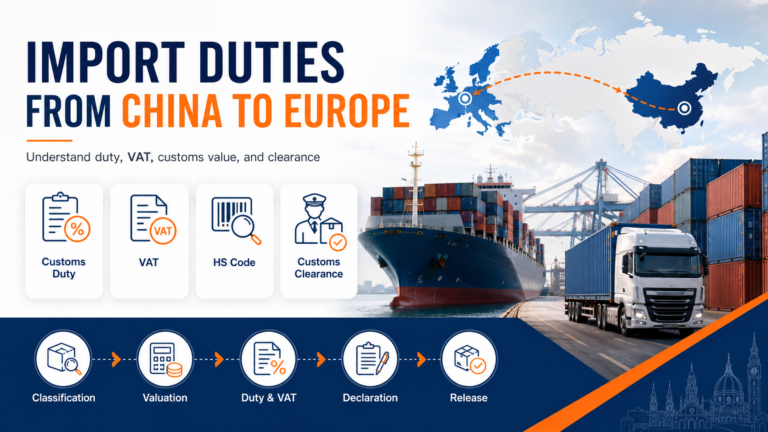
Import Duties from China to Europe Verified & Reviewed · Last updated July 2026 Import duties from China to Europe depend on the HS code, customs...
Read guide →
EORI Number Explained: Do You Need It to Import from China? Verified & Reviewed · Last updated July 2026 An EORI number is usually required when...
Read guide →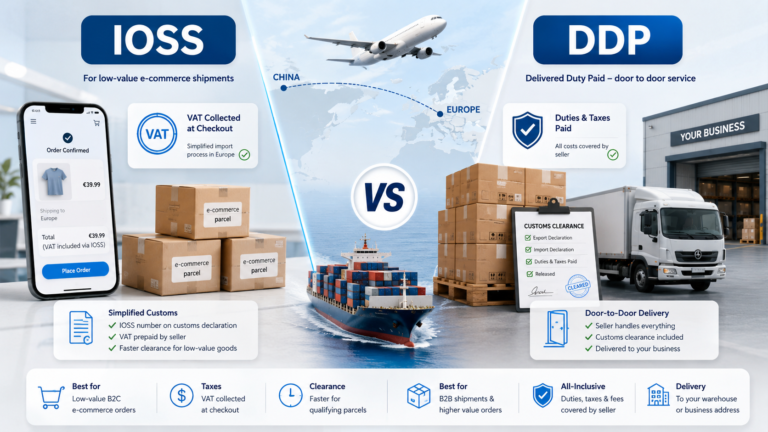
Compare IOSS and DDP for China to Europe shipping. Learn how tax, duties, customs, UK rules, and door-to-door delivery work for ecommerce sellers...
Read guide →DDP Shipping from China to Europe Verified & Reviewed · Last updated June 2026 DDP shipping from China to Europe helps importers move cargo door...
Learn more → Useful Resource What is HS Code? 2025 GuideIf you’re involved in international shipping, you’ve probably encountered the term HS Code on shipping documents, customs forms, or commercial in...
Learn more →WhatsApp us