Related Guide
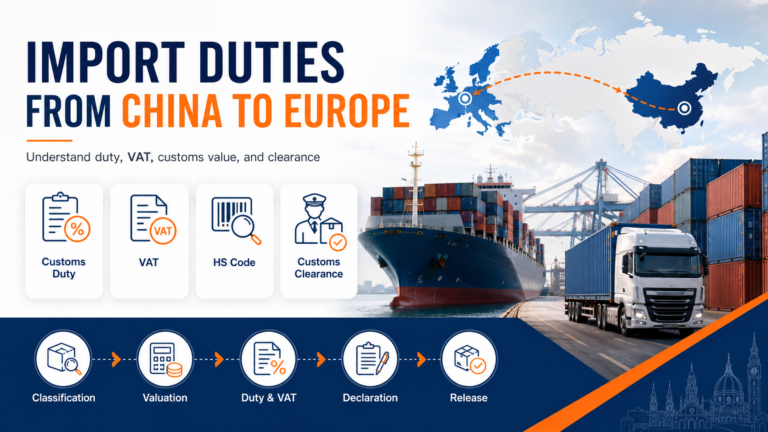
Import Duties from China to Europe
Import Duties from China to Europe Verified & Reviewed · Last updated July 2026 Import duties from China to Europe depend on the HS code, customs...
Read guide →

Customs clearance in Europe for imports from China involves declaring goods, verifying their customs value, and paying applicable customs duties and import VAT.
This guide explains EU customs clearance procedures, required documents, HS codes, EORI registration, product compliance, and how to avoid delays when importing from China.
EU Customs Clearance
Customs Duties & Import VAT
Import Documents
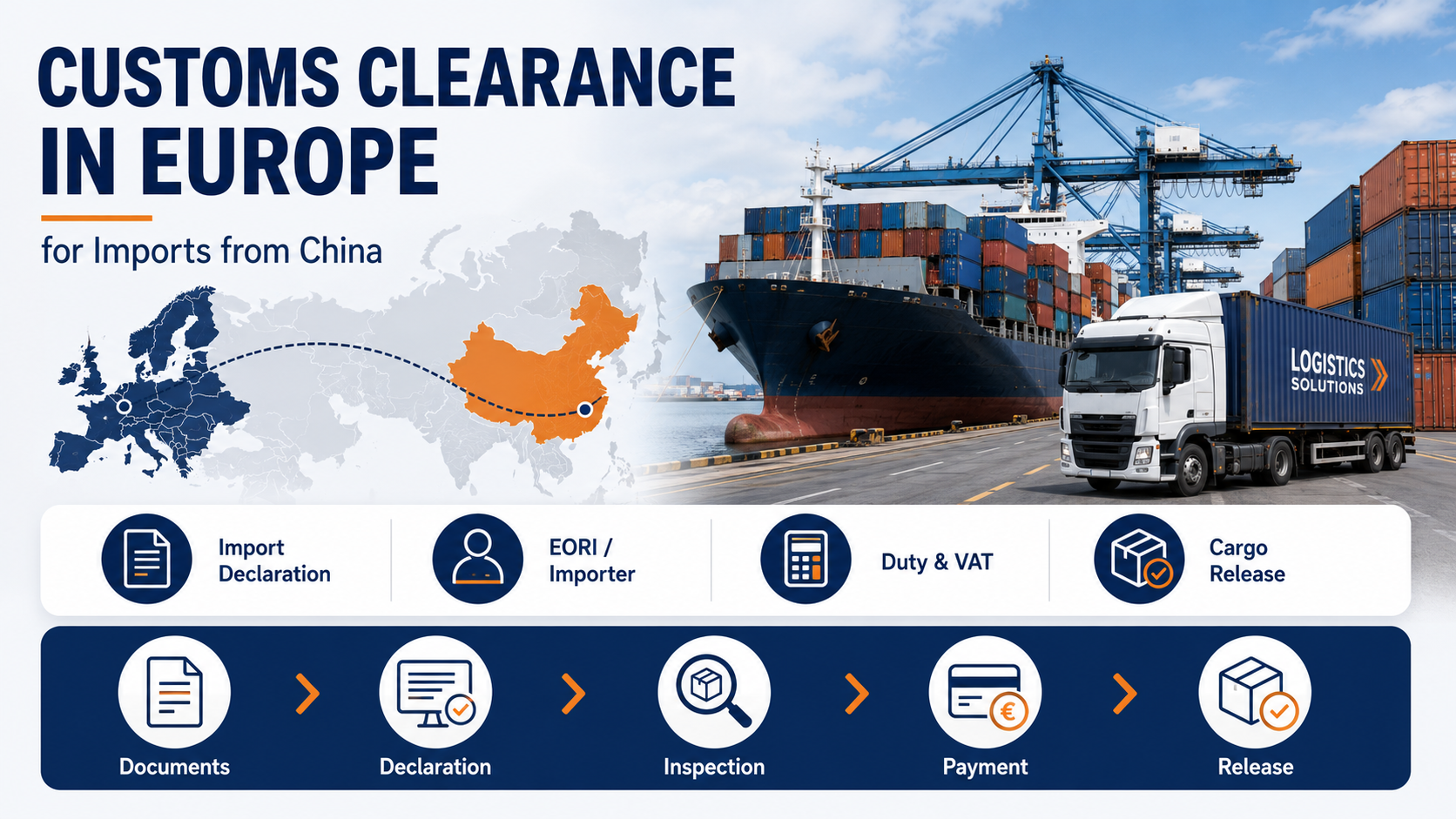
The European Union operates as a single customs territory. Goods entering through an EU member state are subject to the EU customs framework and the Common Customs Tariff.
For example, a sea freight shipment may enter Europe through Rotterdam but have Germany as its final destination. The importer can either complete customs clearance in the Netherlands or place the cargo under an external transit procedure and clear it with local customs in Germany.
After the goods arrive, the customs authorities review the declaration and supporting documents. They may release the shipment immediately, request additional documents, conduct a document check, or arrange a physical inspection.
Once all applicable duties and import VAT have been paid or accounted for, and the goods satisfy the relevant import requirements, customs releases them for free circulation within the European Union.
Customs clearance normally involves four main checks:
Correct identification and classification of the goods
Verification of customs value and country of origin
Assessment of customs duties, import VAT, and other charges
Confirmation that the products meet EU regulations
Customs release only confirms that the customs procedures have been completed. It does not automatically prove that a product is legally marketable in every EU country.
When importing goods from China into Europe, the responsibility for customs clearance is not only about who physically submits the documents, but also about who is legally accountable for the accuracy of the declaration and compliance with EU customs rules.
In most cases, the importer of record is ultimately responsible for customs clearance. This means the importer must ensure that all information provided to EU customs authorities is correct, complete, and compliant with applicable regulations.
Even if a customs broker or freight forwarder handles the paperwork and submits the customs declaration on behalf of the importer, the legal responsibility for the goods still remains with the importer.
Importer of Record: Legally responsible for ensuring goods are correctly declared, properly valued, and compliant with EU customs requirements.
Customs Broker: Acts as an intermediary who submits declarations, calculates duties and import VAT, and communicates with customs authorities.
Freight Forwarder: Manages transportation and may coordinate customs clearance services, but is not always the legal declarant unless specifically appointed.
In the European Union, responsibility can also depend on the type of representation used. Under direct representation, the broker acts in the name of the importer, while under indirect representation, the broker may share liability for customs debt.
Ultimately, even when outsourcing the process, the importer must ensure that the HS code, customs value, product description, and compliance documents are correct before shipment.
Customs clearance in Europe for imports from China requires several key documents. These documents allow EU customs authorities to identify the goods, calculate duties and import VAT, and check compliance with EU regulations.
Commercial Invoice: This is the main document used for customs valuation. It must clearly show the product description, quantity, value, currency, and trade terms.
Packing List: This document describes how the shipment is packed, including carton count, weight, and dimensions, so customs can verify the physical cargo.
Transport Document (Bill of Lading / Air Waybill / Rail Waybill): This confirms the shipment details and proves that the goods have been transported from China to the EU.
Customs Declaration: This is the official filing submitted to EU customs. It includes HS code, customs value, importer details, and shipment information.
Certificate of Origin: This confirms where the goods were manufactured and may be used for tariff checks or origin verification.
Product Compliance Documents: Some goods require documents proving compliance with EU safety and regulatory standards.
Additional Certificates (if required): Certain products such as food, chemicals, electronics, or medical goods may need extra import licences or certificates.
EU customs clearance for imports from China follows a structured process designed to ensure goods comply with customs regulations, duty requirements, and import controls before being released into free circulation within the European Union.
Before shipping, importers must verify whether the goods are subject to specific EU regulations such as CE marking, RoHS, REACH, sanitary rules, or other product compliance requirements.
The process begins with determining the correct HS code for the product. This classification defines the applicable customs duties, import VAT treatment, and any restrictions or additional requirements under EU customs rules.
The supplier and importer must prepare consistent shipping documents, including the commercial invoice, packing list, and transport document, ensuring that product descriptions, quantities, and values match across all paperwork.
For most shipments, an Entry Summary Declaration may be required before arrival at the first EU port or airport. This provides advance security information to EU customs authorities.
Once the goods arrive in the European Union, they are presented to customs at the port, airport, or inland terminal and remain under customs supervision until clearance is completed.
The importer or customs broker submits the official customs declaration electronically. This includes HS code, customs value, origin, importer details, and transport information.
EU customs authorities review the declaration and may perform document checks, value verification, HS code review, or physical inspection depending on risk analysis.
Customs duties and import VAT are calculated based on the customs value and applicable tariff rates. Payment or deferment must be completed before goods can be released.
After all requirements are met, customs releases the goods for free circulation within the European Union, allowing them to move to the final destination or be sold in the market.
Customs duties and import VAT are the two main taxes applied to goods imported from China into the European Union. Both are calculated based on the customs value, but they serve different purposes and follow different calculation rules.
Customs duties are applied when goods enter the EU customs territory and are calculated based on the HS code classification and the customs value of the goods.
Customs Duty = Customs Value × Duty Rate
The duty rate depends on:
HS code of the product
Country of origin
EU tariff measures or trade policies
Product category and material
Different products have different tariff levels. Industrial goods often have lower rates, while textiles, footwear, ceramics, and certain consumer goods may face higher duties or additional trade measures such as anti-dumping duties.
Import VAT is a consumption tax applied when goods enter the EU market. It is calculated on a broader base than customs duties.
Import VAT = VAT Rate × (Customs Value + Customs Duty + Certain Import Costs)
Import VAT rates vary by EU member state and are generally applied when goods are released from customs. Depending on the country, VAT may be:
Paid at the time of customs clearance
Deferred through VAT accounts
Recovered later by VAT-registered importers
Although both are import taxes, they are applied differently:
Customs duty is a tariff based on product classification and origin
Import VAT is a consumption tax applied to the total value of imported goods
Customs duty is usually a smaller percentage, while VAT often represents a larger portion of the total import cost.
In addition to customs duties and import VAT, some imports may be subject to additional charges depending on the product type and EU regulations.
These may include:
Anti-dumping duties
Excise duties (for specific goods such as alcohol or tobacco)
Environmental or regulatory charges under EU trade measures
These additional costs vary by product category and must be checked before shipment.
Product compliance is a key part of customs clearance in Europe for imports from China. Even if goods successfully pass customs procedures, they must still comply with EU product regulations before they can be legally sold in the European market.
Certain product categories must carry CE marking to demonstrate compliance with EU safety standards. These include products such as electrical equipment, machinery, toys, and medical devices.
CE marking confirms that the product meets applicable EU directives, but it must be supported by technical documentation and a declaration of conformity.
For electrical and electronic products, RoHS compliance is required to restrict the use of hazardous substances.
For chemical-related products, REACH regulation applies to ensure that substances used in manufacturing meet EU safety and environmental standards.
These regulations are essential for ensuring that imported goods are safe for use within the European Union.
Imported products must also meet EU product safety and labelling requirements. This may include:
Clear product identification
Manufacturer and importer details
Safety warnings and instructions
Language requirements for the destination country
Proper labelling is required before goods can be placed on the EU market.
Some product categories require additional approvals or certificates before importation, especially for:
Food and agricultural products
Medical devices
Chemicals and hazardous goods
Electronics with wireless functions
These may include sanitary certificates, phytosanitary certificates, safety testing reports, or import licences depending on the product type.

Customs clearance procedures in Europe vary depending on the transportation method. While the core customs rules remain the same, the timing, documentation flow, and inspection risk can differ between sea freight, air freight, rail freight, and express courier shipments.
Sea freight is the most commonly used method for large-volume shipments from China to Europe. It is usually chosen for FCL and LCL cargo due to its cost efficiency, although customs processing is slower compared to air freight.
Customs clearance normally begins before the vessel arrives, and documents must be submitted early to avoid port storage charges.
Key points include:
Typical clearance time: around 2–5 working days
Higher inspection rate due to cargo volume and mixed shipments
ENS filing required before vessel arrival in the EU
D/O release and port handling required after arrival
Storage fees may apply if clearance is delayed (THC, demurrage, detention)
Sea freight is most suitable for bulky, heavy, or non-urgent goods such as machinery, furniture, and general commercial cargo.
Air freight is widely used for high-value, urgent, or time-sensitive shipments. Customs clearance is much faster compared to sea freight, often completed within hours after arrival.
However, preparation time is shorter, so documentation must be accurate before departure.
Key points include:
Typical clearance time: 12–24 hours
Lower inspection rate but stricter checks for batteries, electronics, and sensitive goods
AWB data is transmitted electronically before arrival
Goods must be cleared quickly due to limited airport free storage (usually 24–48 hours)
Storage charges apply if documents are incomplete
Air freight is ideal for electronics, samples, and urgent commercial shipments.
Rail freight between China and Europe is a balanced option between sea and air transport. It passes through multiple countries before entering the EU, which makes customs coordination more complex.
Depending on the route, clearance may happen at the EU entry point or final destination.
Key points include:
Typical clearance time: 2–3 working days
Medium inspection risk depending on entry border
Transit procedures (T1 documents) may be required
Common entry points include Poland and Germany borders
Requires accurate rail waybill and transit documentation
Rail freight is commonly used for industrial goods, machinery parts, and medium-urgency shipments.
Express courier is the fastest customs clearance method, widely used for samples, small parcels, and e-commerce shipments.
Customs clearance is usually handled directly by the courier company using simplified procedures.
Key points include:
Clearance time: a few hours to same day
Very low inspection rate for low-value goods
Customs handled by courier as default importer representative
VAT and duties may be prepaid or collected on delivery
Low-value shipments may qualify for simplified clearance systems (e.g. IOSS)
This method is suitable for samples, spare parts, and B2C e-commerce shipments.
A reliable clearance process starts before the goods are shipped. Importers should not wait for customs authorities to identify problems after arrival.
First, confirm the HS code, customs tariff, import licences, and product-specific regulations. The supplier should then prepare a detailed commercial invoice and packing list using the same product information provided to the freight forwarder.
Before departure, the importer should also confirm:
The EORI number is active
The importer of record is clearly identified
The customs broker has authorization
Freight and insurance costs are available
Product certificates match the actual goods
Labels and packaging meet the destination-country rules
Anti-dumping measures have been checked
The customs value can be supported by payment records
The final destination and clearance country are confirmed
For repeat shipments, businesses can create a product database containing approved descriptions, HS codes, origin information, unit values, certificates, and supplier details. This improves consistency and reduces errors across the supply chain.
Yes. Goods imported from China into the European Union may be subject to customs duties, import VAT, and other import taxes depending on the product type and HS code classification.
The final amount of customs duties depends on customs value, duty rate, origin, and EU customs regulations, which are assessed by EU customs authorities during clearance.
Yes. An EORI number (Economic Operator Registration and Identification) is generally required for businesses involved in importing from China into EU countries and submitting a customs declaration.
The key documents for EU customs clearance procedures include:
Commercial invoice
Packing list
Transport documents (bill of lading / air waybill / rail waybill)
Customs declaration
EORI details
Product compliance or required certificates
These documents are reviewed by local customs and EU customs authorities to assess imported goods before release.
Customs duties are calculated based on the customs value and HS code of the goods.
The general formula is:
Customs Duty = Customs Value × Duty Rate
The customs value usually includes the transaction value, freight costs, and insurance costs. EU customs authorities use this to determine applicable duties under EU tariff rules.
Import VAT is calculated on:
Customs value
Plus customs duties
Plus certain import-related costs
Import VAT rates vary across EU member states, typically ranging from 17% to 27%, and are paid when goods arrive at the EU border during customs clearance.
Not automatically. A certificate of origin only confirms where goods are manufactured.
It may support preferential tariff treatment only if the goods meet specific EU customs regulations or trade agreement rules.
Useful freight, customs and importing resources related to this shipping guide.
Import Duties from China to Europe Verified & Reviewed · Last updated July 2026 Import duties from China to Europe depend on the HS code, customs...
Read guide →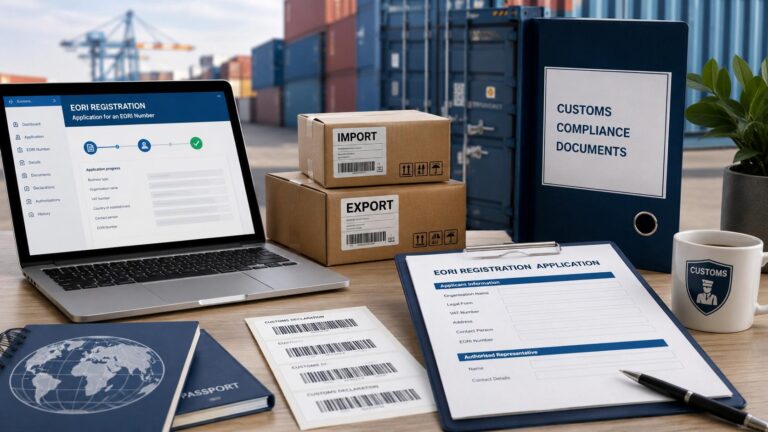
EORI Number Explained: Do You Need It to Import from China? Verified & Reviewed · Last updated July 2026 An EORI number is usually required when...
Read guide →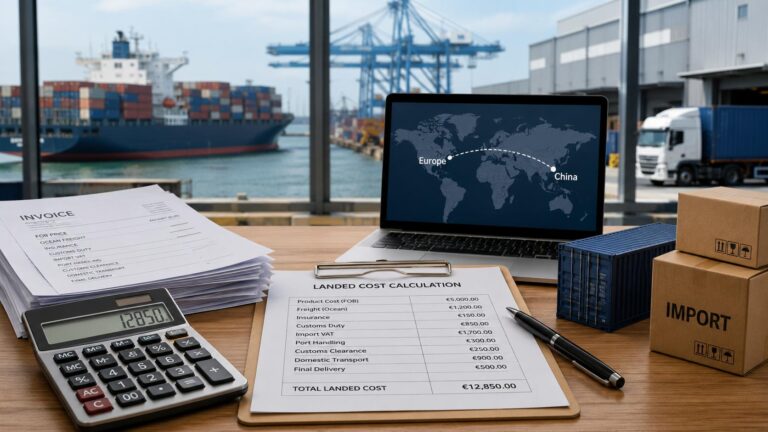
How to Calculate Landed Cost When Importing from China to Europe Verified & Reviewed · Last updated June 2026 Landed cost from China to Europe in...
Read guide →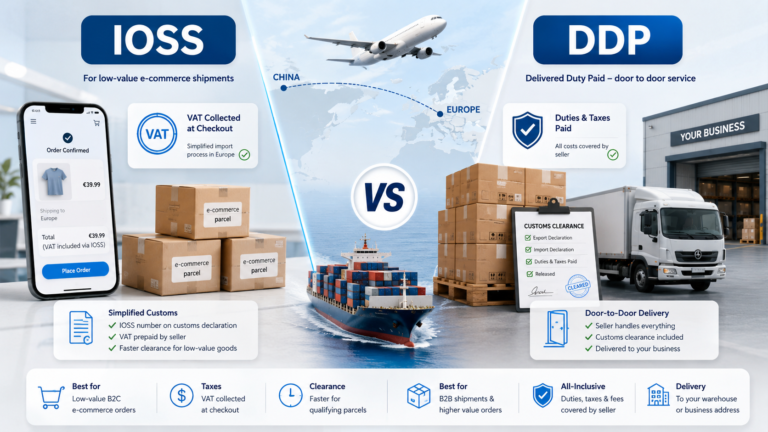
Compare IOSS and DDP for China to Europe shipping. Learn how tax, duties, customs, UK rules, and door-to-door delivery work for ecommerce sellers...
Read guide →DDP Shipping from China to Europe Verified & Reviewed · Last updated June 2026 DDP shipping from China to Europe helps importers move cargo door...
Learn more → Useful Resource Shipping from China to Europe (2025 Guide)International shipping from China to Europe remains one of the most vital trade routes in global logistics. With Europe being a massive consumer...
Learn more →WhatsApp us