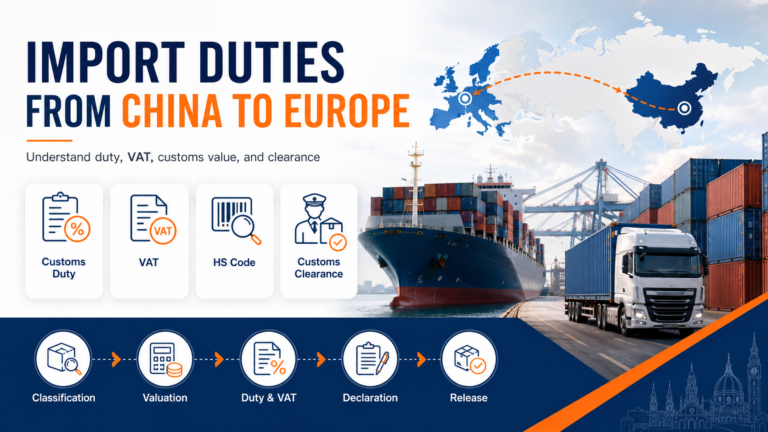
Related Guide
Import Duties from China to Europe
Import Duties from China to Europe Verified & Reviewed · Last updated July 2026 Import duties from China to Europe depend on the HS code, customs...
Read guide →

Import duties from China to Europe depend on the HS code, customs value, product category, and destination country within the EU.
This guide explains how customs duties and import VAT are calculated, including customs value, duty rates, VAT rates, import declaration, customs clearance, and total landed cost for goods imported from China to Europe.
Customs Duties
Import VAT
Landed Cost Calculation
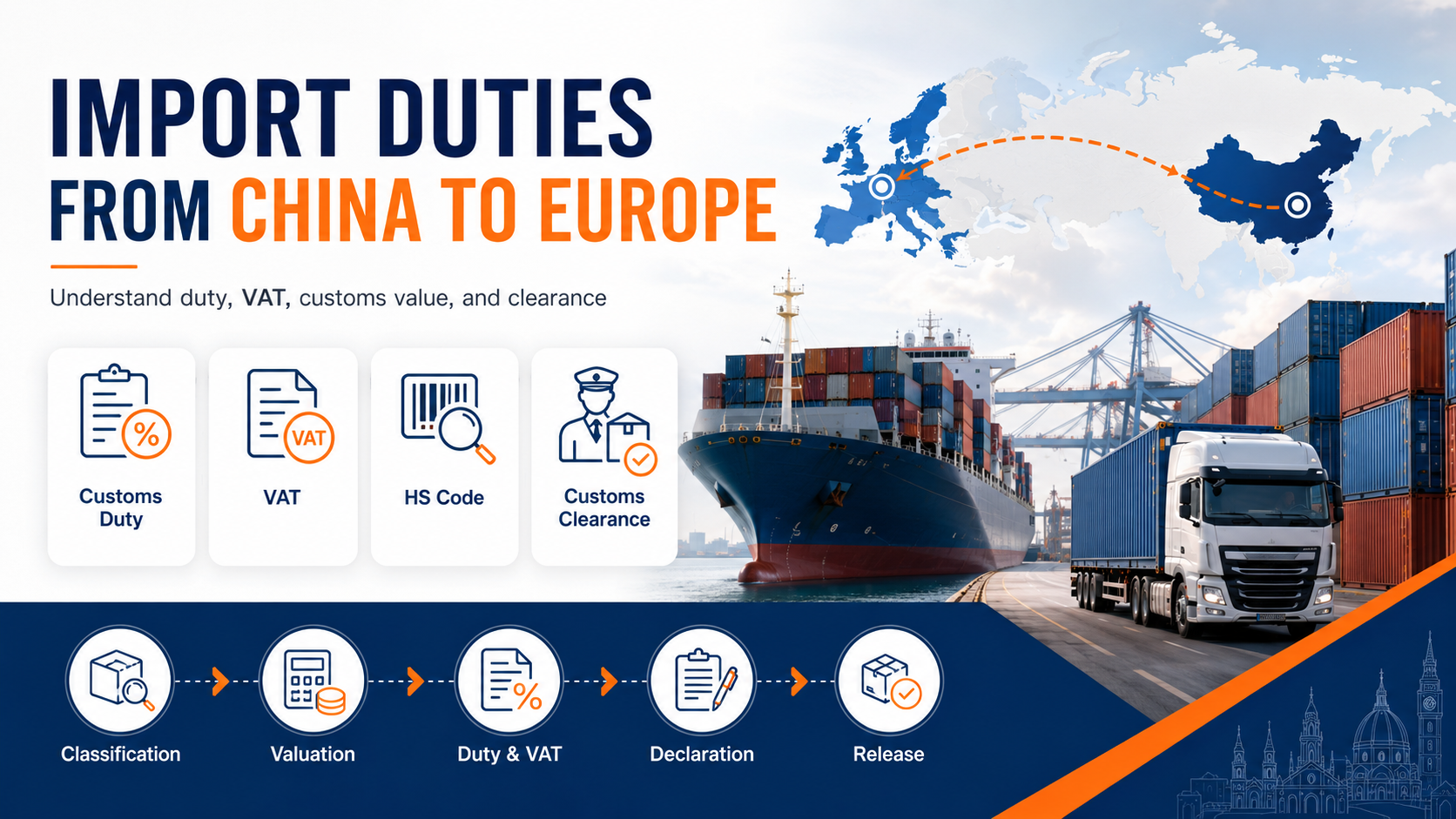
Customs duties are taxes levied on goods imported from outside the EU. When goods are exported from China and imported into an EU member state, customs authorities review the import declaration and calculate duties based on the product classification and customs value.
Import VAT is different from customs duty. Customs duty is linked mainly to the HS code and product type, while import VAT is based on the customs value plus customs duties. In many European countries, VAT has a bigger impact on the final import cost than the duty itself.
A typical import payment may include:
Customs duty paid to customs authorities
Import VAT paid or reported according to local tax rules
Customs broker or declaration service fees
Inspection, storage, or handling fees when applicable
Duties and taxes usually need to be cleared before goods are released into the domestic market. For VAT-registered companies, import VAT may be recoverable depending on local tax rules, but it still affects cash flow and accounting.
When importing goods from China into Europe, the total import cost is mainly made up of two parts: customs duty and import VAT. Both are calculated based on the customs value of the shipment, which follows EU customs rules.
To estimate the total cost accurately, importers usually follow three basic steps.
EU customs treats imports differently depending on value:
Under €150 (small parcels / e-commerce shipments)
Usually no customs duty
Import VAT still applies
Often handled by courier or platform (e.g. IOSS system)
Over €150 (commercial shipments)
Full customs declaration required
Customs duty + import VAT apply
Based on HS code and customs value
This threshold is important because it directly affects whether duty is charged or not.
The customs value is the base used by EU customs to calculate both duty and VAT. It is usually based on the CIF value, which includes:
Product cost (goods value)
International shipping cost (China to EU)
Insurance cost (if applicable)
In simple terms: Customs Value = Goods Value + Freight + Insurance
This means import tax is not only based on the supplier’s invoice, but also includes transport-related costs.
Once the customs value is confirmed, import duty is calculated based on the HS code and the corresponding EU tariff rate.
Import Duty = Customs Value × HS Code Duty Rate
The duty rate depends on product classification under the EU TARIC system. Different products such as electronics, clothing, machinery, or furniture can have very different duty percentages.
After customs duty is applied, import VAT is calculated based on the total of customs value plus duty.
Import VAT = (Customs Value + Import Duty) × VAT Rate
VAT rates vary by EU member states and destination country, and import VAT in the EU can be 6%, 12%, or 25% depending on the product treatment.
This means VAT is charged not only on the goods themselves, but also on shipping cost and customs duty combined.
There is no single fixed customs duty rate for all goods imported from China to Europe. Duty rates are determined by the EU TARIC system and depend on product classification, material, function, and HS code.
In general, EU customs duties range from 0% to around 17%, but most commercial products fall into specific category-based ranges. Some goods are duty-free, while others may face higher tariffs or additional trade measures, and the EU may have imposed anti-dumping duties on certain Chinese goods to protect domestic industries.
For importers, these rates are only used for initial landed cost estimation. The final duty must always be confirmed using the exact HS code.
Electronic products are generally classified as low-duty or duty-free goods in EU customs, especially when they are components rather than finished retail products.
Typical duty levels:
Smartphones, laptops, semiconductor components: 0%
LED lighting products: 3% – 4.7%
Optical devices (binoculars, lenses): around 4%
These products usually require precise HS classification, especially for mixed-use or industrial-grade components.
Textile and garment products are among the most frequently imported categories from China, and they typically carry higher customs duties compared to industrial goods.
Typical duty levels:
T-shirts, jackets, outerwear: around 12%
Undergarments: around 12%
Fabric accessories (scarves, textiles): around 8%
Duty rates depend heavily on fabric composition, garment structure, and production category under HS classification.
Footwear is one of the most sensitive product categories in EU tariff classification. Duty rates vary significantly based on material type and construction.
Typical ranges:
Synthetic sports shoes (rubber/plastic): up to 17%
Textile upper shoes (mesh/canvas): up to 16.9%
Leather shoes and sneakers: 5% – 8%
Even small differences in materials can lead to different HS codes and different duty outcomes.
Many general household goods and low-risk consumer items have relatively low or zero duty rates when imported into the EU.
Typical duty levels:
Children’s toys: 0%
Home furniture: 0%
Bags, backpacks, suitcases: around 3%
Vacuum flasks and insulated drinkware: around 6% – 7%
However, packaging, material composition, and product function can affect classification in customs systems.
Industrial and energy-related products often require additional customs attention due to trade policy measures and technical regulations.
Typical treatment:
Solar panels and solar glass: base duty + possible anti-dumping duties
Steel products: subject to trade defense measures
Electric bikes and EV-related goods: varies depending on specification
These categories often require technical documentation and may be subject to additional customs checks or regulatory approval.
Import VAT is usually one of the largest costs when importing goods from China to Europe. Even if a product has a low customs duty rate, VAT may still apply when goods enter the EU.
VAT is normally calculated on the customs value plus customs duty. This means the VAT amount may increase when the freight cost or customs duty is higher.
Common standard VAT rates include:
| Country | Country Code | Standard Import VAT Rate |
|---|---|---|
| Germany | DE | 19% |
| France | FR | 20% |
| Netherlands | NL | 21% |
| Italy | IT | 22% |
| Spain | ES | 21% |
| Belgium | BE | 21% |
| Poland | PL | 23% |
| United Kingdom | GB | 20% |
Import VAT rates vary by EU member state and may change over time. Some countries also apply reduced VAT rates for specific goods, but most commercial imports are charged at the standard rate.

To better understand import costs from China to Europe, let’s take a practical example of a commercial shipment entering Germany.
Product: Apparel (woven outerwear)
Customs value (CIF): €10,000
HS code duty rate: 12%
Destination country: Germany
VAT rate: 19%
Customs value includes goods cost plus shipping and insurance.
Customs Value = €10,000
Duty is applied based on HS code classification.
Import Duty = €10,000 × 12% = €1,200
VAT is calculated on customs value + import duty.
VAT Base = €10,000 + €1,200 = €11,200
Import VAT = €11,200 × 19% = €2,128
Total Import Taxes = Duty + VAT = €1,200 + €2,128 = €3,328
Total Landed Cost = €10,000 + €3,328 = €13,328
For goods shipped from China to Europe, customs clearance is required before the cargo can be released for delivery. This process ensures that all imported goods meet EU regulations and that any applicable taxes are correctly assessed. For excise goods, excise duty must be paid before the goods are consumed.
During clearance, customs authorities review the shipment details provided in the import declaration, including product information, value, origin, and transport documents. Based on this information, they determine whether duties or import VAT apply and whether further inspection is needed.
If the information is incomplete or inconsistent, customs may request additional documents or hold the shipment for review. Importers should also follow the correct customs procedures to ensure compliance when special product restrictions or licenses apply. This can result in delays or extra handling costs.
A standard import declaration is based on the following information:
Importer details (including EORI number)
Buyer and seller information
Product description
Quantity and weight
Declared customs value
Transport and insurance details
To support the declaration, importers usually need documents such as the commercial invoice, packing list, and transport document (bill of lading or air waybill). Depending on the product, additional forms like certificates of origin, compliance reports, or import licenses may also be required.
An EORI number is required for businesses importing into the EU. It allows customs authorities to identify the importer and process shipments more efficiently. For first-time importers, it is recommended to complete registration before the goods leave China to avoid delays upon arrival.
Incoterms define the responsibilities of the seller and buyer, but they do not remove customs duties or VAT. The chosen term affects who must manage import customs clearance, pay duties and taxes, and arrange distribution after arrival.
For imports from China to Europe, common trade terms include EXW, FOB, CIF, DAP, and DDP. Because importation involves buying goods abroad and bringing them into the local market, the agreed Incoterm can strongly affect both cost control and post-arrival handling.
| Incoterm | Who Usually Handles Import Duties and VAT |
|---|---|
| EXW | Buyer |
| FOB | Buyer |
| CIF | Buyer |
| DAP | Buyer pays on arrival |
| DDP | Seller or freight forwarder |
Under EXW, the buyer manages almost the entire logistics process from the supplier’s location, which is why business buyers often carry these import responsibilities in practice. Under FOB, the seller delivers goods to the China export port, while the buyer handles international freight, customs clearance, duties, VAT, and delivery. Under DDP, the seller or freight forwarder usually manages customs duties, VAT, and final delivery.
Importers should confirm whether duties, VAT, customs clearance fees, local delivery, and other charges are included in the quote before booking.
Yes. Goods imported from China to the EU may be subject to customs duties, import VAT, and other charges such as customs clearance fees. The exact amount depends on the HS code, customs value, product category, and destination country within the EU. There is no single tariff for all goods imported from China into Europe, as rates vary by product type and value.
There is no single fixed rate. Some products may have 0% customs duty, while clothing, footwear, bags, textiles, and certain regulated goods may have higher rates. The exact duty rate should be checked according to the HS code.
First, calculate the customs value by adding product price, shipping cost, and insurance. Then multiply the customs value by the customs duty rate. After that, calculate import VAT based on the customs value plus customs duty.
Yes. Businesses importing goods into the EU usually need an EORI number. Without it, the import declaration and customs clearance process may be delayed.
A proper DDP shipping service usually includes customs clearance, import duties, VAT, and final delivery. However, importers should always confirm details in advance, as some low-cost quotes may exclude VAT, remote area fees, or inspection-related charges.
Useful freight, customs and importing resources related to this shipping guide.
Import Duties from China to Europe Verified & Reviewed · Last updated July 2026 Import duties from China to Europe depend on the HS code, customs...
Read guide →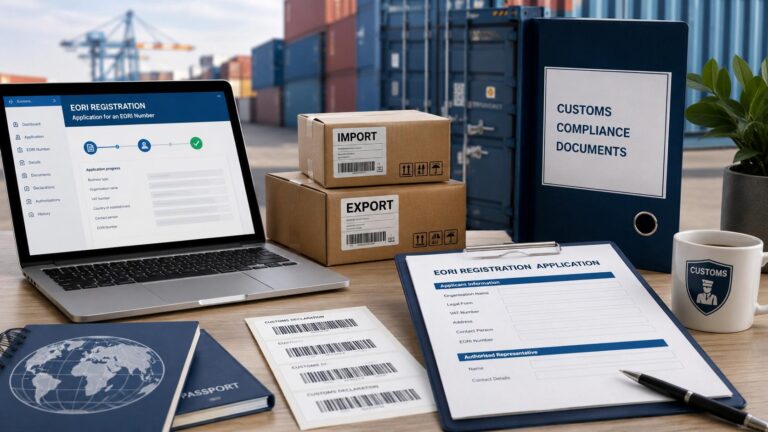
EORI Number Explained: Do You Need It to Import from China? Verified & Reviewed · Last updated July 2026 An EORI number is usually required when...
Read guide →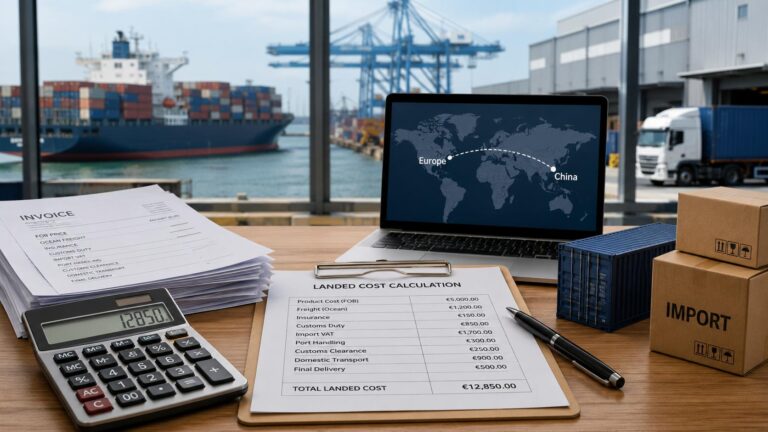
How to Calculate Landed Cost When Importing from China to Europe Verified & Reviewed · Last updated June 2026 Landed cost from China to Europe in...
Read guide →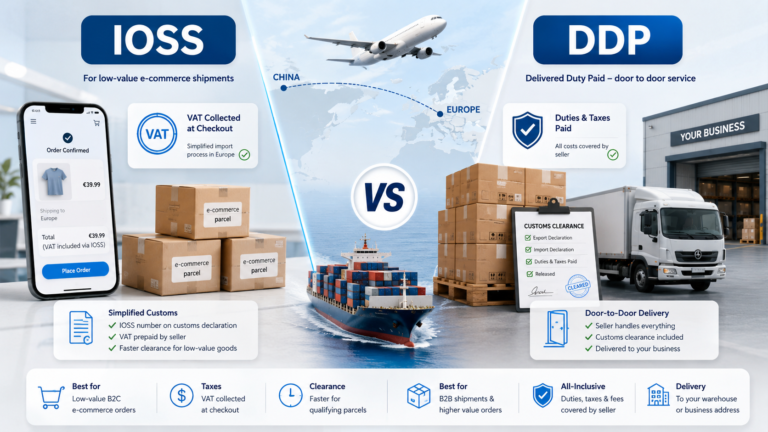
Compare IOSS and DDP for China to Europe shipping. Learn how tax, duties, customs, UK rules, and door-to-door delivery work for ecommerce sellers...
Read guide →DDP Shipping from China to Europe Verified & Reviewed · Last updated June 2026 DDP shipping from China to Europe helps importers move cargo door...
Learn more → Useful Resource Shipping from China to Europe (2025 Guide)International shipping from China to Europe remains one of the most vital trade routes in global logistics. With Europe being a massive consumer...
Learn more →WhatsApp us