

What Does CNF Mean? Differences from FOB and CIF
- Verified & Reviewed · Last updated July 2026
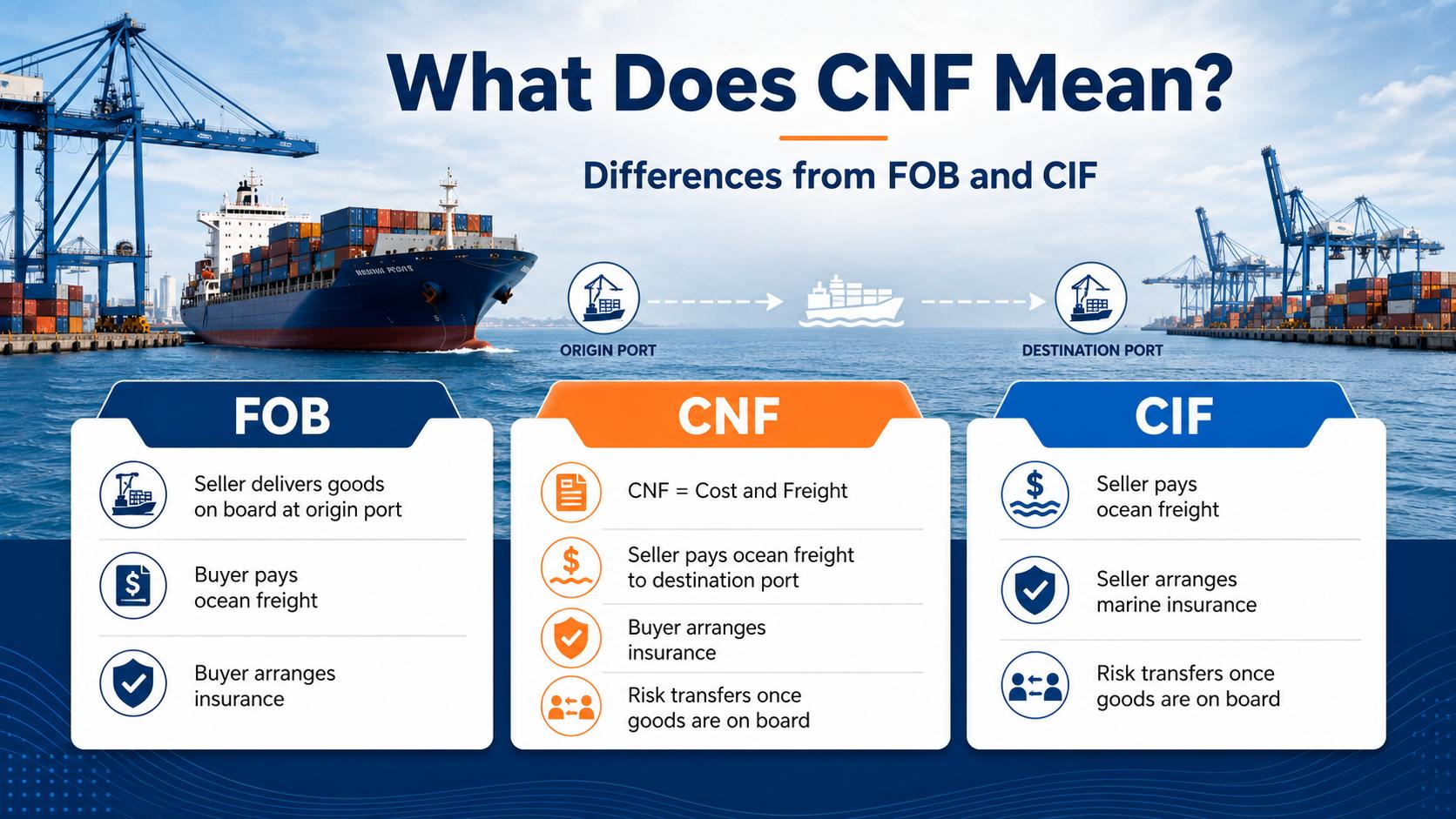
CNF, FOB, and CIF are common shipping terms used in international trade to define who pays freight charges, who arranges shipping, who covers insurance, and when risk transfers from seller to buyer.
This updated guide explains what CNF means in shipping, how CNF Cost and Freight works, and the key differences between CNF, FOB Free On Board, and CIF Cost, Insurance and Freight. It also covers CNF price, CNF value, customs clearance, import duties, marine cargo insurance, and when buyers may prefer CNF, CIF, or FOB.
CNF meaning
CNF vs CIF
CNF vs FOB
- Experienced China-based logistics specialists
Table of Contents
CNF Meaning & Full Form
CNF means Cost and Freight. Under CNF shipping terms, the seller is responsible for arranging and paying the ocean freight to the named destination port. The buyer takes responsibility for import clearance, taxes, insurance, and inland delivery after the cargo reaches the destination country.
For example, if your supplier quotes CNF Los Angeles, it usually means:
The seller exports the goods from China
The seller pays sea freight to Los Angeles port
The buyer pays U.S. customs clearance, import duty, port charges, and truck delivery
CNF is commonly used in sea freight shipments, especially for bulk cargo, machinery, furniture, building materials, textiles, and general commercial goods.
| Responsibility | Seller | Buyer |
|---|---|---|
| Product cost | Yes | No |
| Export customs clearance | Yes | No |
| Origin port handling | Usually yes | No |
| International sea freight | Yes | No |
| Marine insurance | No | Yes |
| Destination port charges | No | Yes |
| Import customs clearance | No | Yes |
| Import duties and taxes | No | Yes |
| Delivery to warehouse | No | Yes |
So, the simple CNF meaning is: the seller pays freight to the port, but the buyer handles everything after arrival.
CNF in Incoterms
In current Incoterms rules, the official term is CFR, not CNF. CFR stands for Cost and Freight and is officially recognized by the International Chamber of Commerce.
However, in real-world shipping, many companies still use the older or informal terms CNF, C&F, or C and F. In most quotations, these terms are used to describe the same basic arrangement as CFR.
You may see these search terms or quotation formats:
CNF incoterm
CNF Incoterms
Incoterm CNF
CNF inco
C&F meaning
CNF value
CFR shipping term
CNF is commonly used in sea freight shipments and is especially suitable for bulk shipments like machinery and textiles. In the same 2020 Incoterms framework, you may also come across free carrier (FCA), free alongside ship (FAS), or delivered duty paid (DDP) when comparing how costs, risk, customs, and delivery obligations are split.
For practical shipping purposes, CNF and CFR are usually treated as the same cost arrangement, but it is always better to confirm the exact responsibilities with your supplier or freight forwarder before payment.
How CNF Shipping Works
CNF shipping is usually simple at the beginning because the seller arranges the international freight. The buyer does not need to book the vessel or coordinate with the carrier at origin.
A typical CNF shipment works like this:
The buyer places an order with the supplier.
The supplier prepares the goods and export documents.
The seller books sea freight to the agreed destination port.
The goods are loaded onto the vessel at the origin port.
The seller provides shipping documents such as commercial invoice, packing list, and bill of lading.
The buyer arranges import customs clearance after the cargo arrives.
The buyer pays duties, taxes, destination charges, and local delivery.
This is why CNF is often attractive for new importers. The seller handles the ocean freight, but the buyer still keeps control of destination customs and local delivery.
CNF vs CIF: What’s the Difference?
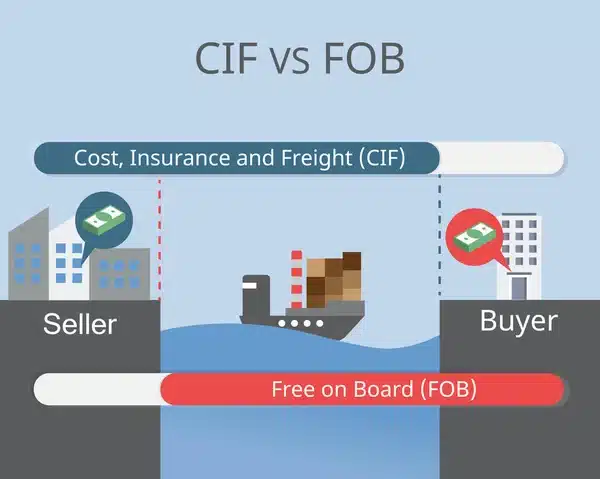
The main difference between CNF and CIF is insurance coverage. Both terms are used for sea freight, and under both terms the seller pays ocean freight to the named destination port. However, CNF does not include marine insurance, while CIF includes basic marine insurance arranged by the seller.
| Term | Seller Pays | Buyer Pays | Insurance Included? |
|---|---|---|---|
| CNF / CFR | Goods + ocean freight | Insurance, import clearance, tax, delivery | No |
| CIF | Goods + ocean freight + insurance | Import clearance, tax, delivery | Yes |
CIF may look safer because insurance is included, but buyers should still check the insurance coverage carefully. Some supplier-arranged insurance only provides minimum coverage and may not fully protect high-value or fragile cargo.
CNF vs FOB: Who Has More Control?
Under FOB, the seller delivers the goods to the origin port and loads them onto the vessel. After that, the buyer arranges and pays for the international freight, insurance, destination clearance, and delivery.
Under CNF, the seller arranges and pays for the international freight to the buyer’s destination port.
| Comparison Point | CNF / CFR | FOB |
|---|---|---|
| Who books ocean freight? | Seller | Buyer |
| Who pays ocean freight? | Seller | Buyer |
| Who controls the carrier and routing? | Seller | Buyer |
| Insurance | Buyer | Buyer |
| Import clearance | Buyer | Buyer |
| Best for | Simpler buying process | Better freight control |
FOB usually gives the buyer more control over shipping cost, vessel schedule, freight forwarder selection, and destination coordination. This is why experienced importers often prefer FOB when shipping from China.
CNF is easier when the buyer does not want to manage freight booking or when the supplier can provide a competitive shipping rate.
CNF vs FOB vs CIF: Key Differences at a Glance
The biggest difference between CNF, FOB, and CIF is who arranges freight and who pays for insurance.
| Shipping Term | Freight Paid By | Insurance Paid By | Risk Transfers At | Final Price Usually Includes |
|---|---|---|---|---|
| CNF / CFR | Seller | Buyer | Origin port after loading | Goods + freight to destination port |
| CIF | Seller | Seller | Origin port after loading | Goods + freight + basic insurance |
| FOB | Buyer | Buyer | Origin port after loading | Goods delivered onto vessel |
That is why cargo insurance is important, especially for high-value, fragile, customized, or time-sensitive shipments.
What Does CNF Price Include?
A CNF price usually includes the cost of the goods and the freight-related costs required to move the cargo from the seller’s side to the named destination port. For example, CNF Los Angeles, CNF Jebel Ali, or CNF Hamburg means the seller pays to ship the goods to that destination port.
However, CNF is not a door-to-door price. It does not include insurance, import customs clearance, import duties, destination port charges, or final delivery to your warehouse.
What Is Included in a CNF Price?
The seller normally covers the main origin-side and international shipping costs before the cargo arrives at the destination port.
A CNF price may include:
Cost of goods: The factory price or product value agreed with the supplier.
Export documentation: Documents needed for export, such as the commercial invoice and packing list.
Export customs clearance: Customs declaration and export procedures in the origin country.
Origin inland freight: Trucking from the supplier’s factory to the departure port, if included in the quotation.
Origin port handling fees: Charges for handling and loading the cargo at the origin port.
Ocean freight: Sea freight from the origin port to the named destination port.
What Is Excluded from a CNF Price?
As the buyer, you are responsible for the destination-side costs after the goods arrive. These costs should be calculated before confirming the order, otherwise the CNF price may look cheaper than the real total landed cost.
A CNF price usually does not include:
Marine cargo insurance: CNF does not include insurance coverage during ocean transit.
Destination port fees: Terminal handling charges, unloading fees, port storage, and local handling charges.
Import customs clearance: Customs broker fees and import declaration in the destination country.
Import duties and taxes: Tariffs, VAT, GST, or other import taxes charged by customs.
Inland transport: Trucking from the destination port to your warehouse, store, or Amazon FBA center.
Final delivery: Last-mile delivery, appointment delivery, or special handling after customs release.
Extra costs: Demurrage, detention, storage, inspection fees, or delays caused by incomplete documents.
Before accepting a CNF quote, always ask your supplier or freight forwarder to confirm exactly what is included. A low CNF price may still lead to high destination charges if customs clearance, terminal handling charges, and inland delivery are not planned in advance.
What Is CNF Value?
CNF value refers to the total value of the goods plus the ocean freight to the named destination port. It is commonly used in international trade when preparing quotations, commercial invoices, shipping documents, and estimating import costs.
A simple calculation is: CNF Value = Product Value + Ocean Freight
For example:
| Item | Amount |
|---|---|
| Product value | USD 8,000 |
| Ocean freight | USD 1,200 |
| CNF value | USD 9,200 |
Although the seller pays the ocean freight under CNF, the buyer is still responsible for marine insurance, import customs clearance, import duties, destination port charges, and inland delivery. These costs are not included in the CNF value.
It’s also important to note that customs authorities in many countries calculate import duties and taxes based on CIF value, not CNF value. When a shipment is sold under CNF terms, customs may add an estimated insurance amount to determine the customs value for duty and tax calculations.
Before placing an order, compare the CNF value with your expected destination charges to estimate the total landed cost of importing the goods.
When Should You Use CNF?
CNF shipping can be a good option when you want the seller to handle the international freight but you are comfortable managing import clearance and local delivery.
CNF is suitable if:
You are importing by sea freight
Your supplier has reliable freight rates
You have your own customs broker at destination
You understand local port charges and tax rules
You want a simple port-to-port shipping arrangement
CNF works best when both buyer and seller clearly understand their responsibilities.
Real-World Scenarios: CNF Shipping from China to the USA, Russia, and UAE
CNF Shipping from China to the USA
Example:
Product: Home appliances
Shipping term: CNF Los Angeles
Origin: Shenzhen
Destination port: Los Angeles
In this case, the Chinese supplier arranges export customs clearance and sea freight from Shenzhen to Los Angeles. After the cargo arrives, the U.S. buyer handles customs clearance, import duty, port charges, and truck delivery to the warehouse or Amazon FBA center.
CNF works well here if the buyer already has a customs broker and local delivery provider in the United States.
Learn more: Shipping from China to the USA
CNF Shipping from China to Russia
Example:
Product: Construction tools
Shipping term: CNF Vladivostok
Origin: China
Destination: Vladivostok
The supplier arranges freight to Vladivostok. The Russian buyer then manages import customs clearance, VAT, and inland transportation to cities such as Moscow, Saint Petersburg, or other regions.
CNF is often used because many Russian buyers have their own customs agents and inland logistics teams.
Learn more: Shipping from China to Russia
CNF Shipping from China to the UAE
Example:
Product: Furniture and home décor
Shipping term: CNF Jebel Ali
Origin: Guangzhou or Foshan
Destination port: Jebel Ali, Dubai
The Chinese supplier books sea freight to Jebel Ali Port. The UAE buyer handles import VAT, customs clearance, local port charges, and delivery to Dubai, Abu Dhabi, Sharjah, or other emirates.
CNF is practical for UAE importers who already have local clearing agents and want flexibility after the cargo arrives.
Learn more: Shipping from China to the UAE
Frequently Asked Questions
CNF stands for Cost and Freight. It means the seller pays the cost of goods and ocean freight to the buyer’s destination port.
CNF shipping means the seller arranges and pays for sea freight to the named destination port. The buyer handles insurance, import customs clearance, import duties, taxes, destination port charges, and final delivery.
The official Incoterms term is CFR, which stands for Cost and Freight. CNF, C&F, and CFR are often used in the shipping industry to describe the same basic arrangement.
C&F means Cost and Freight. It is another way to write CNF or CFR. It means the seller pays for freight to the destination port, but insurance and import costs are handled by the buyer.
The difference is insurance. CNF does not include insurance. CIF includes sea freight and basic marine insurance arranged by the seller.
Related CNF, FOB & CIF Shipping Guides
Get a Clear CNF Shipping Quote from China
- Compare CNF, FOB, and CIF options
- Understand freight, insurance, and import costs
- Avoid hidden destination charges
Get expert help with CNF shipping, customs clearance, freight costs, and door-to-door delivery options from China.