

FCA Incoterms Explained: Free Carrier Meaning, Costs and Responsibilities
- Verified & Reviewed · Last updated July 2026
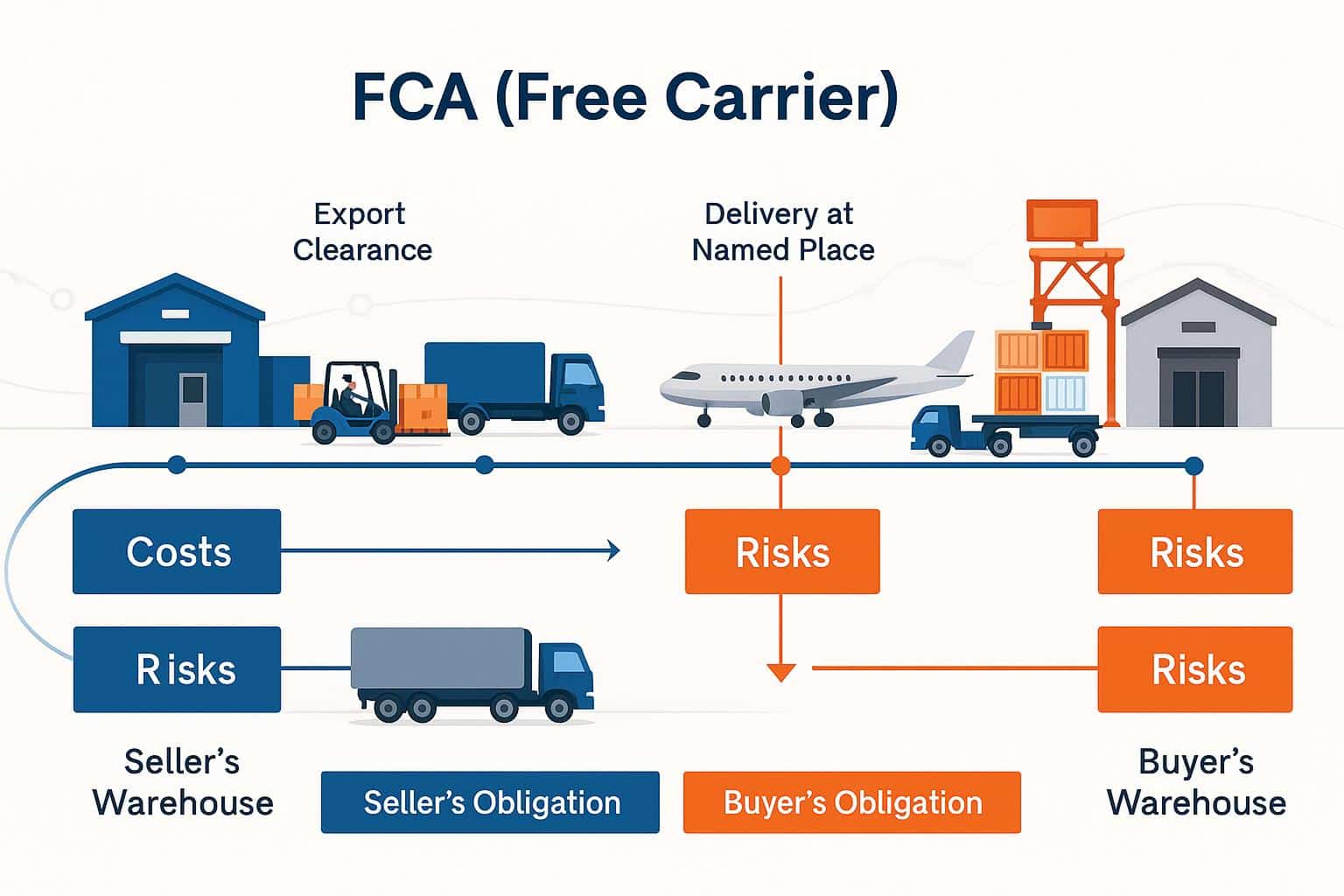
FCA Incoterms, also known as Free Carrier, is a practical trade term used in international shipping. Under FCA terms, the seller delivers the goods to the buyer’s nominated carrier at a named place of delivery, and risk transfers once delivery is completed.
Used under Incoterms® 2020 rules, FCA works for sea freight, air freight, rail, road, and multimodal shipments. It is often more practical than EXW because the seller handles export clearance and delivery to the agreed place, while the buyer controls the main carriage, import clearance, cargo insurance, and final delivery.
Seller responsibilities
Risk transfer point
FCA vs EXW / FOB
- Experienced China-based logistics specialists
Table of Contents
What Does FCA Mean in Shipping?
FCA stands for Free Carrier. In simple terms, the seller delivers the goods to a carrier chosen by the buyer at an agreed place. This place may be the seller’s warehouse, a freight forwarder’s facility, an airport terminal, a container yard, or another location clearly written in the sales contract.
The key point is that FCA does not mean the seller delivers the cargo to the final destination. The seller’s responsibility ends once the goods are handed over at the agreed place. After that, the buyer takes over the main shipping process.
For example, FCA can be written as:
- FCA Seller’s Factory, Shenzhen, China
- FCA Freight Forwarder Warehouse, Guangzhou, China
- FCA Shanghai Airport Cargo Terminal, China
- FCA Ningbo Container Yard, China
- FCA Qingdao Port Terminal, China
The delivery location should be specific. Writing only FCA China or FCA Shenzhen is too vague because it does not show exactly where the handover takes place. A clear FCA location helps both sides understand who pays local charges, when responsibility changes, and where the buyer’s freight forwarder takes over.
Seller Responsibilities Under FCA Incoterms
Under FCA Incoterms, the seller responsibilities mainly cover the export side of the transaction. The seller must prepare the goods, handle export clearance, and deliver the cargo to the named place of delivery agreed in the sales contract.
The seller is usually responsible for:
Preparing the goods according to the sales contract
Providing the commercial invoice and packing list
Arranging export packing and cargo marking
Handling export customs clearance
Completing customs formalities in the export country
Providing an export license or certificate if required
Delivering the goods to the agreed FCA location
Loading the goods if delivery takes place at the seller’s premises
Giving proof that the goods have been delivered to the nominated carrier
If the FCA place is the seller’s factory or warehouse, the seller loads the goods onto the buyer’s collecting vehicle. This is an important difference from EXW, where loading is usually not the seller’s obligation unless both parties agree otherwise.
The seller does not normally pay for the main carriage, international freight, cargo insurance, import clearance, import duties, destination terminal charges, or delivery to the final destination.
Buyer Responsibilities Under FCA Incoterms
Under FCA terms, the buyer responsibilities begin after the goods have been delivered at the agreed FCA location. From that point, the buyer assumes responsibility for the main transport, import process, and destination-side costs.
The buyer usually needs to arrange:
A freight forwarder or carrier
Pickup coordination after FCA delivery
Main carriage by sea freight, air freight, rail, road, or multimodal transport
Cargo insurance, if needed
Destination port, airport, or terminal charges
Import customs clearance
Import duties, VAT, GST, or other taxes
Delivery from the destination facility to the final destination
Any pre shipment inspection required by the buyer or destination country
FCA gives the buyer strong control over the logistics process. This is useful when the buyer already has a trusted freight forwarder and wants to compare shipping rates, choose the shipping line, manage transit time, and control destination customs clearance.
However, FCA also means the buyer must understand the transportation costs after handover. If the buyer has no experience with customs clearance, import duties, or destination delivery, DAP or DDP may be easier.
Who Pays for What Under FCA Terms?
The basic cost rule under FCA is simple: the seller pays for costs before delivery at the named place, and the buyer pays for costs after delivery at that place.
However, the exact cost split depends on where the FCA delivery point is located. If the named place is the seller’s premises, the seller loads the cargo onto the buyer’s vehicle. If the named place is an airport, port terminal, railway station, or freight forwarder warehouse, the seller transports the goods there.
| Cost or Responsibility | Seller Pays / Handles | Buyer Pays / Handles |
|---|---|---|
| Product preparation | Yes | No |
| Export packing | Yes | No |
| Commercial invoice | Yes | No |
| Packing list | Yes | No |
| Export license, if required | Yes | No |
| Export customs clearance | Yes | No |
| Customs formalities in export country | Yes | No |
| Loading at seller’s premises | Yes | No |
| Delivery to another named FCA place | Yes, if agreed | No |
| Main carriage | No | Yes |
| Freight forwarder after FCA delivery | No | Yes |
| Cargo insurance | No obligation | Usually buyer |
| Import clearance | No | Yes |
| Import duties and taxes | No | Yes |
| Destination terminal charges | No | Yes |
| Final destination delivery | No | Yes |
FCA does not mean “freight prepaid” or “door-to-door delivery.” If the buyer wants the seller to pay for international freight, terms such as CPT or carriage paid terms may be more relevant. If the buyer wants the seller to handle import clearance and duties, Delivered Duty Paid is closer to that requirement.
When Does Risk Transfer Under FCA?
Risk transfers under FCA when the goods are delivered to the carrier or made available at the named place of delivery. This point must be clearly written in the sales contract because it decides when the buyer assumes responsibility for loss, damage, delay, or additional transportation costs.
The risk transfer point changes depending on the FCA location:
FCA seller’s premises: risk transfers after the seller loads the goods onto the buyer’s collecting vehicle.
FCA freight forwarder warehouse: risk transfers when the goods are delivered to the nominated warehouse.
FCA airport terminal: risk transfers when the cargo is handed over to the carrier or terminal operator.
FCA container yard: risk transfers when the containerized shipment is delivered to the agreed yard or carrier facility.
FCA railway station: risk transfers when the cargo is delivered to the first carrier at the named rail location.
This is why FCA must not be written vaguely. “FCA Guangzhou” can create disputes because Guangzhou may refer to a factory, warehouse, airport, port, railway station, or logistics park. A precise named place of delivery avoids confusion over loading, unloading, terminal charges, and risk transfer.
FCA Shipping Process Step by Step
The FCA shipping process is straightforward when the handover point is clear. The seller handles the export side, and the buyer controls the main international transport after the cargo is delivered to the nominated carrier.
A typical FCA shipment from China works like this:
Buyer and seller agree on FCA terms
The sales contract should show the exact FCA place, cargo details, Incoterms version, payment terms, and required documents.Seller prepares the goods
The exporter arranges production, export packing, labels, commercial invoice, packing list, and any required export license.Buyer appoints a freight forwarder
The importer chooses the carrier, shipping line, airline, rail operator, or multimodal logistics provider.Seller completes export clearance
The seller handles export customs clearance and export formalities in the origin country.Seller delivers the goods to the FCA place
This may be the seller’s place, a freight forwarder warehouse, an airport terminal, a railway station, or a container yard.Risk transfers to the buyer
Once FCA delivery is completed, the buyer assumes responsibility for the cargo.Buyer’s forwarder arranges main carriage
The freight forwarder manages sea freight, air freight, rail freight, road transport, or multimodal shipments.Buyer handles import clearance and final delivery
The buyer pays import duties, taxes, destination charges, and delivery to the final destination.
This structure makes FCA useful for international trade because each side has a clear role. The supplier manages export-side obligations, while the importer controls the main logistics process and destination country requirements.

FCA vs EXW: Which Is Better?
FCA and EXW both give the buyer control over the shipping process, but they are not the same. Under EXW, the seller only makes the goods available at the seller’s premises. The buyer may need to arrange pickup, loading, export clearance, and international transport.
Under FCA terms, the seller handles export clearance and delivers the goods to the named place of delivery. If delivery happens at the seller’s premises, the seller loads the goods onto the buyer’s collecting vehicle.
| Item | FCA | EXW |
|---|---|---|
| Export clearance | Seller handles export clearance | Usually buyer |
| Loading at seller’s premises | Seller loads | Usually buyer |
| Freight forwarder | Buyer chooses | Buyer chooses |
| Risk transfer | At named FCA place | At seller’s place |
| Best for China exports | More practical | Often difficult |
For most international transactions from China, FCA is usually safer than EXW because the seller is responsible for export customs clearance and export formalities in the origin country.
FCA vs FOB: Main Differences
FCA and FOB are often confused because the buyer pays for the main carriage under both terms. The key difference is the delivery point and the transport mode.
FOB is mainly used for sea freight and inland waterway transport. Under FOB, risk transfers when the goods are loaded on board the vessel. FCA can be used for sea freight, air freight, rail freight, road transport, courier shipments, and multimodal shipments.
| Item | FCA | FOB |
|---|---|---|
| Full name | Free Carrier | Free On Board |
| Transport mode | Any mode | Sea and inland waterway transport |
| Delivery point | Named place or carrier handover point | On board the vessel |
| Containerized shipments | More suitable | Sometimes less accurate |
| Export clearance | Seller | Seller |
| Main carriage | Buyer | Buyer |
For containerized shipments, FCA is often more accurate than FOB because containers are usually handed over to the carrier at a terminal before they are loaded onto the vessel. If the goods are delivered to a freight forwarder warehouse, container yard, airport, or rail terminal, FCA is usually the better term.
FCA is also different from FAS, or Free Alongside Ship. Free Alongside Ship is used when goods are delivered alongside the vessel, while FCA is based on delivery to the carrier or nominated party at the named place.
FCA vs DDP: Buyer Control or Door-to-Door Service?
FCA and DDP are very different. Under FCA Incoterms, the buyer controls the freight forwarder, main carriage, import clearance, customs clearance in the destination country, and final destination delivery. Under Delivered Duty Paid, the seller pays and handles almost the full logistics process.
| Item | FCA | DDP |
|---|---|---|
| Main carriage | Buyer pays | Seller pays |
| Import clearance | Buyer handles | Seller handles |
| Import duties and taxes | Buyer pays | Seller pays |
| Final destination delivery | Buyer arranges | Seller arranges |
| Buyer workload | Higher | Lower |
| Seller obligations | Lower | Higher |
FCA is better when the buyer wants control over shipping costs, shipping line selection, cargo insurance, customs clearance, and delivery arrangements. DDP is better when the buyer wants a simpler door-to-door solution and does not want to manage import procedures.
FCA and Bill of Lading Under Incoterms 2020
One important point under FCA Incoterms is the bill of lading. In some international trade transactions, especially when payment is made by Letter of Credit, the seller may need an on-board bill of lading to submit to the bank.
However, under FCA Free Carrier terms, the seller usually completes delivery before the goods are loaded onto the vessel. This can create a document problem for sea freight shipments.
Incoterms 2020 allows the buyer and seller to agree that the buyer will instruct the carrier to issue an on-board bill of lading to the seller after the goods are loaded on board. This helps the seller complete banking documents, but it does not change the risk transfer point under FCA.
Risk still transfers when the goods are delivered to the carrier or made available at the named place of delivery.
Common Mistakes When Using FCA Terms
The most common mistake is using an unclear delivery place. Writing only “FCA China” or “FCA Shenzhen” can cause disputes because it does not show the exact place of delivery.
A clear FCA clause should include the facility name, address, city, country, and Incoterms version.
Good example: FCA ABC Supplier Warehouse, Shenzhen, China, Incoterms® 2020
Poor example: FCA Shenzhen
Another mistake is assuming FCA includes international freight. Under FCA, the seller pays costs before delivery to the named place, but the buyer pays for the main carriage after handover.
Importers should also avoid treating FCA as the same as FOB. FOB is linked to loading goods on board a vessel, while FCA focuses on delivery to the carrier at the agreed location. For containerized cargo, this difference matters.
Before using FCA, confirm:
Exact named place of delivery
Who books the freight forwarder
Who pays pickup and terminal charges
Whether export clearance is included
When risk transfers
Whether cargo insurance is needed
Which transport document is required
Frequently Asked Questions
FCA Incoterms means Free Carrier. The seller delivers the goods to the buyer’s nominated carrier at a named place. After delivery, the buyer takes responsibility for the main carriage, import clearance, duties, taxes, and final delivery.
Under FCA shipping terms, the seller pays costs before delivery to the named FCA place. The buyer pays for the main international freight, destination charges, import customs clearance, import duties, taxes, and final destination delivery.
Yes, if the named place is the seller’s premises. In that case, the seller loads the goods onto the buyer’s collecting vehicle. If the named place is another location, the seller transports the goods there, but unloading is usually not the seller’s responsibility unless agreed.
No. FCA can be used for any transport mode, while FOB is mainly used for sea freight and inland waterway transport. FCA risk transfers at the named carrier handover point. FOB risk transfers when the goods are loaded on board the vessel.
FCA includes export customs clearance by the seller. It does not include import clearance in the destination country. The buyer usually handles import customs clearance, import duties, VAT, GST, and destination delivery.
No. FCA does not require the seller to provide cargo insurance. The buyer should arrange insurance paid by itself or through its freight forwarder if protection is needed during the main carriage.
Related Incoterms & Shipping Guides
Get an FCA Shipping Quote from China
- Clear FCA pickup and export clearance guidance
- Freight forwarder coordination from China
- Compare FCA, EXW, FOB, and DDP options
Get tailored FCA shipping options, transparent costs, and expert support for your shipment from China.