

How to Import from China to Germany
- Verified & Reviewed · Last updated June 2026
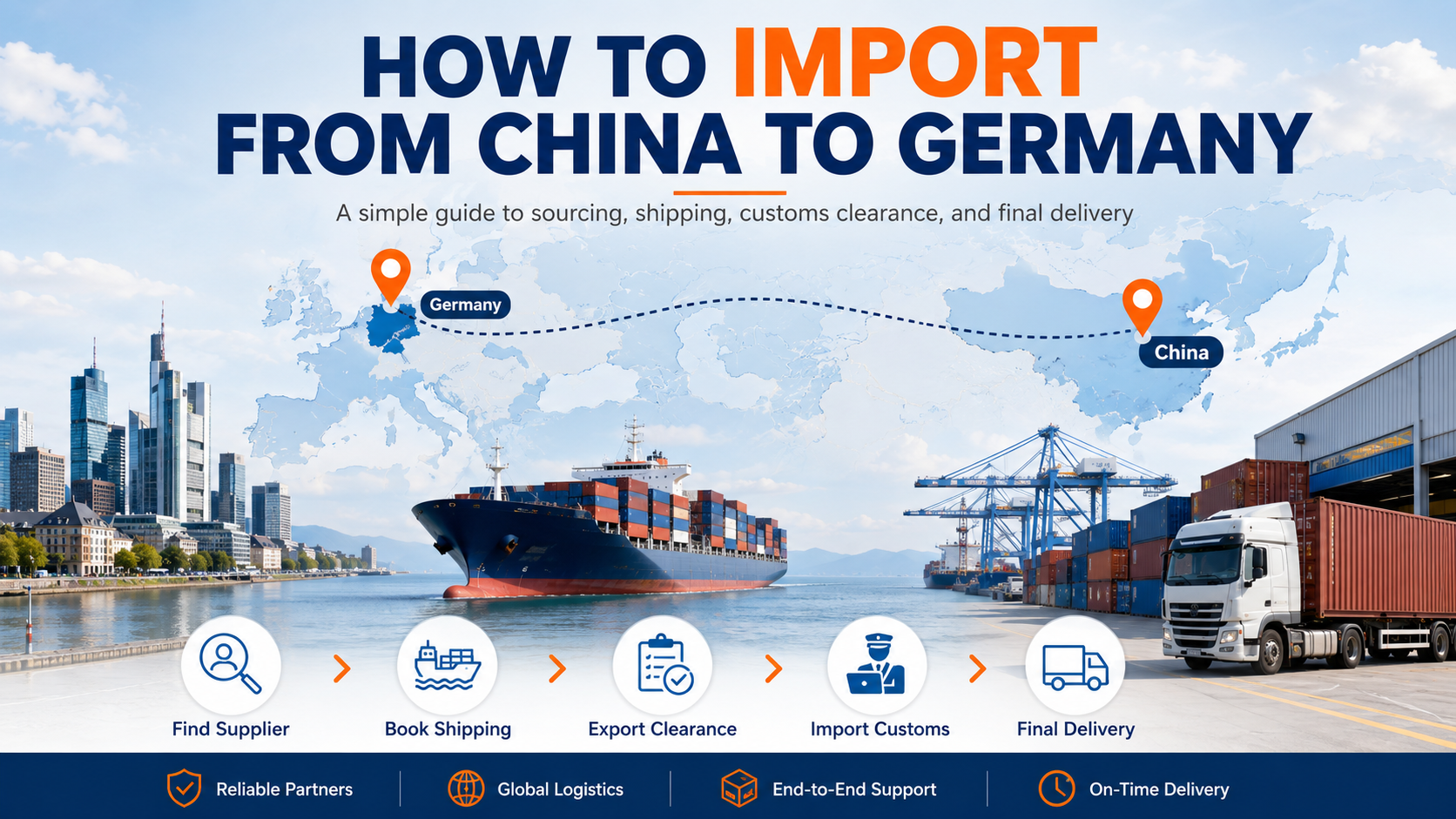
Importing from China to Germany involves more than choosing a supplier and booking freight. Importers need to understand product compliance, Incoterms, shipping methods, customs documents, import duties, VAT, and final delivery requirements.
This guide explains how to import from China to Germany step by step, covering supplier checks, sea freight, rail freight, air freight, German customs clearance, required documents, import taxes, and common mistakes to avoid.
Import Process
Transit time range
Customs & VAT
- Experienced China-based logistics specialists
Table of Contents
Establishing Regulatory Groundwork: EORI and Corporate Readiness
Before entering commercial agreements with an overseas supplier, your business entity must be recognized by customs authorities. Attempting to clear a shipment without the proper registration will lead to immediate port delays and steep storage fees.
Securing an EORI Number
Every commercial entity importing goods into germany must register for an economic operators registration and identification number. This unique identification number is mandatory for all customs clearance processes lodged within Europe. Importers can apply for this registration free of charge via the official german customs portal. This identifier acts as the foundational baseline for all future import declaration filings, tax compliance, and duty processing.
Determining Import Tax Responsibilities
Importers must manage their china trade profiles with extreme diligence. Commercial operations require structured accounting setups to properly handle the statutory import taxes and custom tariffs. Ensuring that your corporate tax registration is active and authorized for cross-border trade transactions prevents immediate seizure of your cargo at the border.
Product Compliance, European Standards, and Certifications
Germany enforces rigorous safety, health, and environmental protections. Non-compliant imports face border rejections, mandatory destruction at the port of entry, or severe corporate penalties. Your supplier must provide verifiable compliance documentation prior to mass production.
CE Marking: This marking demonstrates administrative compliance with European safety, health, and environmental requirements. It requires full technical files and declarations of conformity before the goods hit shelves, specifically for electronics, medical devices, toys, and machinery.
RoHS / WEEE Directives: These directives restrict the deployment of specific hazardous substances in electrical manufacturing, limiting heavy metals and managing electronic waste for consumer devices.
LUCID Register: Under the German Packaging Act, businesses must register commercial packaging in the Central Packaging Registry database to fund recycling, a rule applying to all products utilizing consumer or transport packaging.
Quality Assurance Step: Ordering and testing product samples before signing major contracts is highly recommended. This process allows your team to verify consistency, durability, and complete regulatory compliance before initiating bulk production.
Choose the Best Shipping Method from China to Germany
Choosing the best shipping method from China to Germany requires balancing your budget, cargo volume, and time constraints. The primary transportation modes break down into four distinct categories, allowing supply chain managers to match freight requirements with the correct transport lane.
Express Courier Shipping
Air freight is the fastest shipping method from China to Germany, and express shipping via international couriers like DHL, UPS, or FedEx is the fastest and most seamless transportation method available for small consignments.
Average Transit Time: 1–5 Days.
Best Used For: Small parcels, high-value electronics, prototypes, valuable items, and urgent initial product samples.
Key Advantage: This method operates on a highly integrated, door-to-door delivery framework. The courier handles all administrative customs clearance services directly, significantly reducing the risk of border delays.
Financial Trade-off: It is the most expensive option per kilogram, making it highly uneconomical for bulk stock or large volumes of commercial goods.
Standard Air Freight
Air freight forwarding offers a highly secure, premium middle ground for businesses moving substantial cargo that cannot wait for surface transit options, and for some large or urgent shipments it may be the only option.
Average Transit Time: 4–11 Days.
Best Used For: Time-sensitive, urgent goods or high-turnover cargo weighing over 100 kilograms.
Key Advantage: Air freight completely bypasses maritime port congestion and ensures a swift, reliable delivery window into major German airport hubs like Frankfurt.
Financial Trade-off: While less expensive than express couriers for heavier shipments, air freight rates remain significantly higher than sea or rail alternatives.
Rail Freight via the New Silk Road
The China-Europe Railway Express has emerged as an exceptionally popular and cost-effective alternative for European companies looking to optimize their supply chain velocity.
Average Transit Time: 13–20 Days.
Best Used For: Medium-to-heavy industrial commodities, steady inventory replenishment cycles, and seasonal retail goods.
Key Advantage: Rail shipping serves as a great alternative that balances speed and cost perfectly. Cargo arriving at terminals like Duisburg provides a balanced cost-to-speed ratio, bypassing unpredictable maritime disruptions.
Financial Trade-off: It is slower than air transport and can experience localized border delays during periods of high regional trade volume.
Ocean Freight Shipping
Sea freight is the historic backbone of international trade, accounting for approximately 90% of total China-Germany trade volume. It is split into two primary container load profiles, with the standard equipment being the shipping container:
Less than Container Load (LCL): Ideal for shipments between 1 and 15 cubic meters, where your cargo shares a container with other importers and pricing is often calculated by cubic meter.
Full Container Load (FCL): Optimized for cargo exceeding 15 cubic meters, and FCL shipments let you secure an entire container exclusively for your products to achieve lower per-unit freight costs.
Average Transit Time: 25–55 Days.
Best Used For: Large volumes, bulk raw materials, heavy machinery, and non-urgent consumer stock.
Key Advantage: Sea freight is the most economical shipping method from China to Germany, offering unmatched cost efficiency for massive product volumes moving through maritime gateways like the Port of Hamburg or Bremerhaven port.
Financial Trade-off: It requires extensive advance lead-time planning and exposes your inventory to prolonged transit times and volatile peak-season surcharges.
Efficiently navigating the trade corridor between China and Germany requires a strategic understanding of the major logistics hubs and the geographical routes connecting them. Depending on whether you use maritime lanes, the Eurasian railway network, or international flight paths, your choice of ports and routes directly dictates your transit times and overall supply chain velocity.
Main Ports from China to Germany
Ocean freight handles the highest volume of commercial cargo between the two nations. Shipments travel from China’s coastal manufacturing powerhouses to Germany’s highly integrated northern gateways.
Key Chinese Departure Ports
Shanghai Port (CNSHA): The world’s largest container port. Located at the mouth of the Yangtze River, it acts as the primary hub for goods coming out of Central China, boasting dense direct-sailing schedules to Europe.
Ningbo-Zhoushan Port (CNNGB): Renowned for its exceptional loading efficiency and lower operational costs, this port anchors the East China Sea trade lanes.
Shenzhen Port / Yantian (CNYTN): Anchoring the Pearl River Delta, this modern gateway serves as the primary outlet for South China’s massive electronics, toy, and consumer goods manufacturing clusters.
Key German Destination Ports
Port of Hamburg (DEHAM): Germany’s largest seaport (and Europe’s third-busiest). Known as the “Gateway to the World,” China is its top trading partner. It features massive, highly automated rail infrastructure linking the docks directly to inland Europe.
Port of Bremerhaven (DEBRV): The second-largest German port, heavily specialized in automotive logistics, roll-on/roll-off (Ro-Ro) cargo, and high-volume container processing.
Port of Wilhelmshaven (DEWVN): Germany’s only deep-water container port. It has expanded significantly as a highly efficient distribution alternative for North-West and Central European markets.
Shipping Routes from China to Germany
Logistics managers choose between three primary physical lanes depending on cost, time constraints, and geopolitical stability.
The Maritime Route (Ocean Freight)
Traditional Path: China Port → Malacca Strait → Indian Ocean → Suez Canal → Mediterranean Sea → North Sea → Hamburg or Bremerhaven
The Cape Rerouting: Due to ongoing maritime security disruptions in the Red Sea and Gulf of Aden, many container vessels are rerouted around Africa via the Cape of Good Hope. This alternative safety path bypasses the Suez Canal entirely but adds roughly 10 to 15 days to the journey, stretching typical ocean transit times to 30–55 days.
Sea freight shipments can vary in duration depending on the shipping route, weather, port congestion, and transshipment delays.
The Overland Rail Route (New Silk Road)
The China-Europe Railway Express bypasses maritime chokepoints entirely, moving containers across the Eurasian continent in a highly predictable 12 to 20 days.
Northern Corridor (Main Route): Xi’an / Chongqing / Chengdu → Kazakhstan → Poland → Germany
Middle Corridor (Alternative): Crosses Kazakhstan, the Caspian Sea, the Caucasus, and Turkey into Europe to completely avoid northern regional territories.
Primary German Rail Terminals: Duisburg (the largest inland port in Europe, handling a massive share of trans-Eurasian rail trade) and the Hamburg Port Railway terminal.
Air Freight Routes
For high-value, time-critical items (such as medical tech, automotive parts, and microelectronics), cargo planes fly direct corridors connecting major economic hubs.
Primary China Hubs: Shanghai Pudong (PVG), Hong Kong International (HKG), Guangzhou Baiyun (CAN), Shenzhen Bao’an (SZX), and Beijing Capital/Daxing (PEK/PKX).
Primary German Hubs: Frankfurt Airport (FRA)—the absolute heart of European air cargo—and Munich Airport (MUC). Transit times range from 1 to 3 days for express courier and 5 to 8 days for standard commercial air freight.

Understanding Incoterms for Imports from China to Germany
International Commercial Terms define the exact point where financial risk, logistical responsibility, and customs obligations transfer from the Chinese exporter to the German importer. Selecting the wrong term can expose your business to severe additional costs.
FOB (Free on Board): The Chinese exporter handles domestic transport, export clearances, and loading onto the vessel at the designated origin port like the cnsha port or cnngb port. The German buyer assumes full control, cost, and transit risk once the cargo is loaded.
DAP (Delivered at Place): The supplier arranges comprehensive international transport directly to your designated German facility. However, the buyer remains responsible for managing customs clearance, paying import tariffs, understanding the applicable tariffs before arrival, and settling local taxes.
DDP (Delivered Duty Paid): The supplier manages the complete end-to-end logistics chain, including origin handling, international freight, German customs clearance services, and import tax settlement, making it a door shipping service. While highly convenient, it limits the importer’s control over customs valuations and data accuracy.
Customs Clearance in Germany
All commercial shipments from China must complete German customs clearance before they can be released for delivery. German Customs reviews the shipment documents, verifies the HS code and customs value, and determines whether import duties, VAT, or additional inspections apply. Engaging a customs broker can help you navigate customs processes and reduce the risk of delays. Accurate documentation is essential to avoid customs delays or rejection.
Documents Required for German Customs Clearance
To complete customs clearance smoothly, importers should prepare the following documents:
Commercial Invoice: An official document outlining the total transaction value, detailed currency breakdowns, buyer and seller identifiers, and precise descriptions of the goods. This serves as the primary basis for duty calculations.
Packing List: A comprehensive manifest detailing total shipment weight, net weight, precise exterior dimensions, packaging types, and unit quantities per box.
Bill of Lading or Air Waybill: The legally binding contract of carriage issued by the shipping line or airline, serving as an official receipt of cargo.
HS Code Classification: Every item must be categorized using its specific hs code to query the integrated tariff systems and the European TARIC Database. This code determines the exact customs duties rate, preventing legal compliance risks.
Providing complete and accurate documentation helps avoid customs inspections, storage charges, and unnecessary clearance delays.
Customs Duties and Import VAT
Customs duties are based on the product’s HS code and customs value. Many manufactured goods have low or zero duty rates, while some products may face higher tariffs, anti-dumping duties, or additional EU trade measures.
Customs value usually starts with the item’s purchase price, then includes international freight, insurance, and other eligible cost elements up to the EU border.
Import VAT in Germany is usually 19% for most products. A reduced 7% rate may apply to selected goods such as certain books and food products.
Frequently Asked Questions
To import goods from China to Germany, you need to find a supplier, confirm product compliance, choose Incoterms, arrange shipping, prepare import documents, declare the goods to German customs, pay import duty and VAT, and arrange final delivery. A freight forwarder can help manage the full process. Support from an experienced freight forwarder can simplify shipping goods, documentation, and final delivery coordination.
Yes, commercial importers usually need an EORI number for customs declarations in Germany and the EU. Without it, customs clearance may be delayed.
Sea freight is usually the cheapest option for large shipments. LCL is suitable for smaller cargo, while FCL is more cost-effective for larger volumes. Rail freight is faster than sea freight but usually costs more. Air freight and express are faster but more expensive.
Germany usually applies 19% import VAT to most goods. Some products may qualify for a reduced 7% rate. Import VAT is normally calculated based on the customs value plus duty and certain import-related costs.
Yes, DDP shipping is available from China to Germany and is popular with small importers, Amazon sellers, and e-commerce businesses. It can include pickup, freight, customs clearance, duties, VAT, and final delivery. Always confirm what is included in the DDP quote.
Related China to Germany Import Guides
Import from China to Germany with Confidence
- Supplier pickup, freight, and customs support
- Sea, rail, air, express, and DDP options
- Clear guidance on documents, duties, and VAT
Get a tailored China to Germany logistics solution with transparent pricing, customs support, and reliable final delivery.