

Packing List Template for International Shipping from China
- Verified & Reviewed · Last updated May 2026
A packing list template for international shipping from China helps importers, exporters, freight forwarders, and customs authorities clearly check how a shipment is packed.
This guide explains what a packing list includes, how it works with the commercial invoice and other shipping documents, and how to avoid customs delays caused by missing or inaccurate shipment details.
Packing List Template
Customs Clearance
Shipping Documents

- Experienced China-based logistics specialists
Table of Contents
What Is a Packing List in International Shipping?
A packing list is a shipping document that gives a detailed breakdown of how goods are packed for international shipping. Unlike the commercial invoice, which focuses on product value and transaction details, the packing list focuses on the physical shipment.
It tells all parties involved what is inside the shipment, how many packages are included, how much the cargo weighs, and how much space it takes.
A standard shipping packing list typically includes:
Shipper and consignee information
Commercial invoice number
Purchase order number
Product description
HS code
Quantity
Total cartons or packages
Package type
Net weight and gross weight
Carton dimensions
Total volume
Shipping marks
For international shipments from China, freight forwarders use the packing list to arrange pickup, warehouse receiving, loading, air freight, sea freight, and final delivery. Customs authorities use it to cross check the cargo against the commercial invoice and other shipping documentation.
Why Is a Packing List Important When Shipping from China?
A packing list is important because it connects the supplier’s warehouse, freight forwarder, carrier, customs broker, and final customer. Without this document, it is difficult to confirm whether the shipment matches the declared goods.
For customs clearance, the packing list helps customs officers verify product quantity, total weight, HS code, carton count, and packaging details. If the information is missing or inconsistent, customs may request corrections, inspect the cargo, or delay release.
A complete packing list can help importers:
Avoid delays at customs
Reduce document errors
Confirm the correct number of cartons
Calculate duties more accurately
Check package dimensions and weight
Improve warehouse receiving accuracy
Avoid penalties caused by incorrect documents
For example, if the invoice shows 1,000 units but the packing list shows 950 units, customs authorities may ask for an explanation. If the gross weight or dimensions are inaccurate, carriers may remeasure the cargo and adjust the final shipping costs.
That is why an accurate packing list is not just a formality. It directly affects customs clearance, shipping costs, delivery speed, and customer experience.
Packing List vs Commercial Invoice
The packing list and commercial invoice are both essential shipping documents used in international trade, but they serve different purposes during the shipping process.
A commercial invoice focuses on the transaction value of the goods. It includes the buyer, seller, product price, payment terms, HS code, and total invoice amount used for customs clearance and duty calculation.
A packing list focuses on the physical shipment details. It shows how the cargo is packed, including cartons, pallets, quantity, net weight, gross weight, carton dimensions, total volume, and shipping marks.
| Document | Main Purpose | Typically Includes |
|---|---|---|
| Commercial Invoice | Shows cargo value and trade details | Buyer, seller, product value, currency, HS code, payment terms |
| Packing List | Shows packaging and shipment details | Cartons, packages, quantity, weight, dimensions, CBM |
| Bill of Lading / Air Waybill | Shows transport information | Carrier, route, shipment reference, consignee |
The information across these shipping documents should match. Product description, quantity, HS code, and consignee details must remain consistent to avoid customs issues or shipment delays.
Essential Fields in a Packing List Template
A professional packing list template should include clear shipment details, packaging information, weight, dimensions, and cargo references used for international shipping and customs clearance.
Header & Contact Information
This section identifies the parties involved in the shipment and includes the basic contact details required for shipping documentation and delivery.
It typically includes:
- Shipper / Exporter
- Consignee / Importer
- Notify Party
- Contact info and delivery address
Shipping References
Shipping references help freight forwarders, carriers, and customs authorities identify the shipment and match it with other shipping documents.
Common references include:
Packing list number and date
Commercial invoice number
Purchase order number
Vessel or flight number
Port of loading and destination port
Cargo & Packaging Details
This section provides a detailed breakdown of the products and packaging details inside the shipment.
It commonly includes:
Product description
Product quantity
Package type
Shipping marks and carton numbers
Total cartons or pallets
Weight & Dimensions
Weight and dimension details are important for shipping costs, customs clearance, warehouse handling, and chargeable weight calculations.
This section usually includes:
Gross weight
Carton dimensions
Total volume or CBM
Declaration & Signature
The final section confirms that the shipping information is accurate and officially approved by the exporter or supplier.
It may include:
Declaration statement
Authorized signature
Company stamp or seal
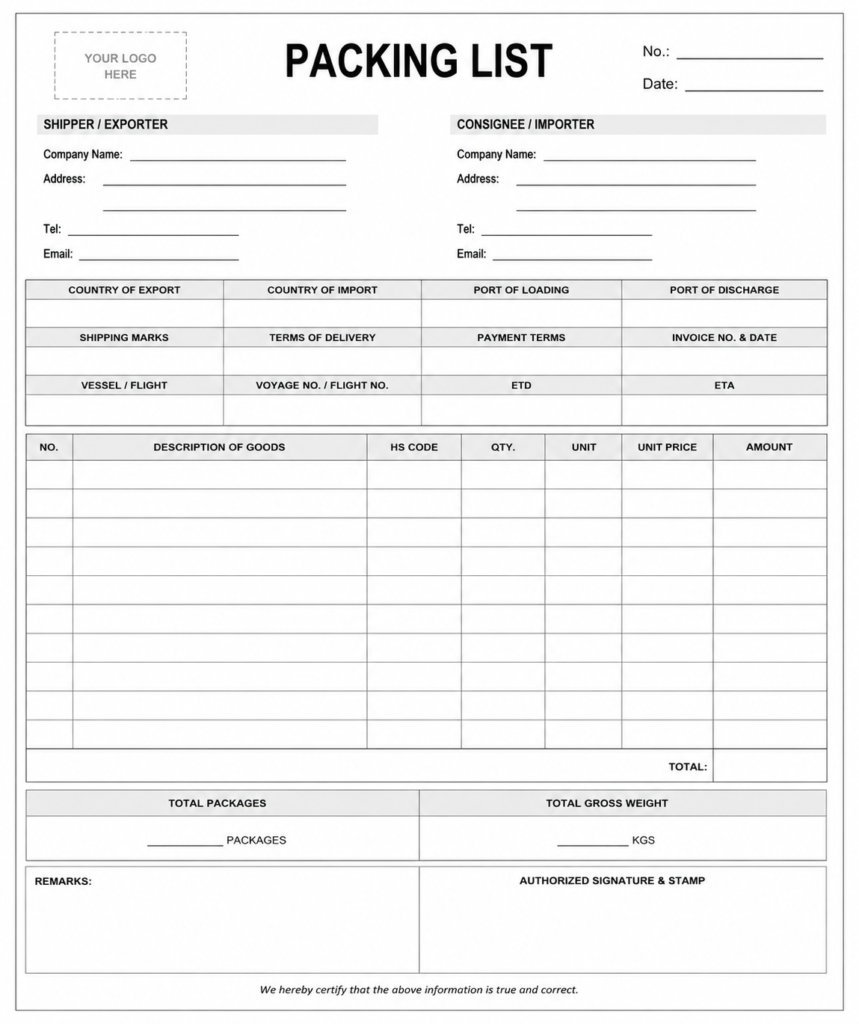
Packing List Template for International Shipping from China
A professional shipping packing list template should make the shipment easy to check at every stage of the shipping process. It should show all essential documents references and cargo details in a clean format.
You can use the template below as a reference when preparing international shipments from China. Before sending it to your freight forwarder or customs broker, make sure the product quantity, packages, weight, dimensions, HS code, and commercial invoice details are correct.
Packing List Example for Shipping from China
Below is a simple packing list example for a sea freight shipment from China. It shows how product details, carton quantity, weight, dimensions, and total volume can be organized in a clear way.
Shipment Information
Shipper: Shenzhen ABC Trading Co., Ltd.
Consignee: USA Import Company LLC
Packing List No.: PL20260501
Commercial Invoice No.: INV20260501
Shipping Method: Sea Freight LCL
Port of Loading: Shenzhen, China
Destination: Los Angeles, USA
Cargo Details
| Item | Description of Goods | HS Code | Quantity | Cartons | Net Weight | Gross Weight | Dimensions | CBM |
|---|---|---|---|---|---|---|---|---|
| 1 | LED Desk Lamp | 9405.20 | 500 pcs | 50 CTNS | 400 kg | 460 kg | 60 × 45 × 40 cm | 5.40 |
| 2 | USB Charging Cable | 8544.42 | 1,000 pcs | 20 CTNS | 120 kg | 145 kg | 50 × 40 × 35 cm | 1.40 |
Shipment Total
Total Cartons: 70 CTNS
Total Net Weight: 520 kg
Total Gross Weight: 605 kg
Total Volume: 6.80 CBM
This format gives freight forwarders and customs brokers the necessary information to check the shipment, estimate shipping costs, arrange warehouse handling, and prepare customs clearance documents.
Common Packing List Mistakes to Avoid
Even small mistakes on a packing list can cause customs delays, shipment problems, or extra shipping costs. Before the cargo leaves China, importers and freight forwarders should carefully cross check all shipping documents.
Some of the most common mistakes include:
Incorrect product description
Missing or wrong HS code
Quantity does not match the commercial invoice
Incorrect net weight or gross weight
Missing carton dimensions or total CBM
Wrong package count or total cartons
Shipping marks do not match the cartons
Incomplete consignee or delivery information
Multiple products combined into one unclear line
Packing list not signed or stamped
For international shipments, inaccurate packaging details or shipment information may lead to customs issues, cargo inspection, delivery delays, or additional warehouse handling costs. An accurate packing list helps avoid delays and keeps the shipping process smoother.
How Freight Forwarders Use a Packing List
Freight forwarders use the packing list throughout the entire shipping process, from cargo pickup in China to customs clearance and final delivery.
Before shipment, the packing list helps confirm the number of packages, carton dimensions, total weight, pallets, and packaging details. This information is important for booking sea freight, air freight, warehouse space, and container loading.
For sea freight shipments, freight forwarders use the total CBM, cartons, and pallets to determine whether the cargo should move by LCL or FCL shipping. For air freight, the dimensions and gross weight are used to calculate chargeable weight and shipping costs.
During customs clearance, the packing list is reviewed together with the commercial invoice, bill of lading, air waybill, and other shipping documents. Customs authorities may use it to cross check the shipment details and verify the cargo.
A clear and accurate packing list helps freight forwarders reduce errors, avoid delays, improve warehouse handling, and keep international shipments moving smoothly.
Need Help Preparing Shipping Documents from China?
Preparing a packing list, commercial invoice, HS code details, and customs clearance documents can be confusing, especially when your shipment includes multiple suppliers, different products, or door-to-door delivery.
Tonlexing helps importers arrange international shipping from China by sea freight, air freight, express, rail freight, and DDP door-to-door service. Our team can review your cargo details, check your packing list, coordinate with suppliers, and help reduce document mistakes before shipment.
To get a shipping quote, please provide the product name, pickup city in China, destination address, number of cartons or pallets, total weight, total volume, cargo value, and preferred shipping method.
Frequently Asked Questions
Yes. A packing list is commonly required for international shipping from China because it shows cargo quantity, packages, weight, dimensions, and packing details. It is used by freight forwarders, customs brokers, warehouses, and customs authorities.
The supplier, exporter, or factory usually prepares the packing list. The importer and freight forwarder should review it before shipment to make sure the information is accurate.
The commercial invoice shows product value and trade details. The packing list shows how the goods are packed, including cartons, pallets, weight, dimensions, volume, and shipping marks.
No. A packing slip is usually used for order checking or domestic delivery. A packing list for international shipping is more detailed and is used for customs clearance, freight forwarding, and cargo handling.
A packing list typically includes shipper and consignee information, item description, HS code, product quantity, package type, total cartons, net weight, gross weight, carton dimensions, total volume, shipping marks, and declaration details. The required information may vary depending on the shipping method, destination country, and product type.
Related Shipping Document Guides
Get Help Preparing Shipping Documents from China
- Packing list and commercial invoice review
- HS code, weight, dimensions, and CBM checking
- Sea freight, air freight, and door-to-door shipping support
Send us your cargo details and we’ll help check your packing list, shipping documents, and freight options before shipment.