Related Guide
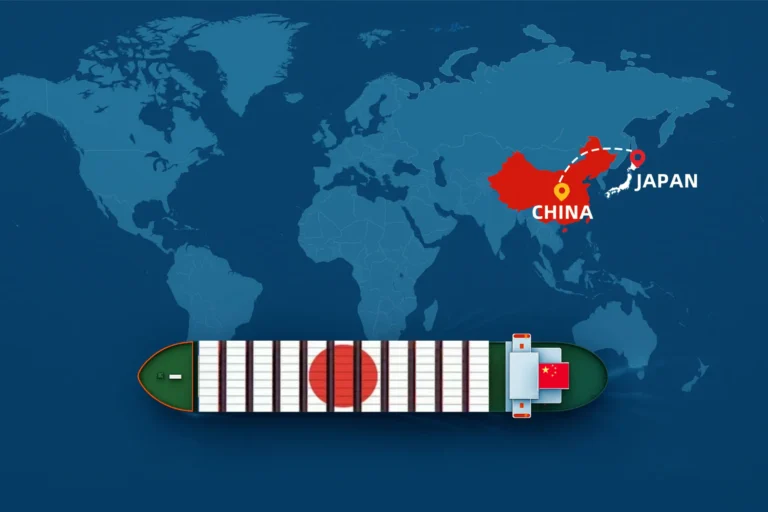
Shipping from China to Japan
Shipping from China to Japan – Sea, Air & DDP in 2026 Fast, reliable shipping from China to Japan for B2B importers,eCommerce sellers, and projec...
Read guide →

Shipping cost from China to Japan in 2026 typically ranges from $1.5–$8 per kg for air freight, $5–$12 per kg for express shipping, $10–$100 per CBM for LCL sea freight, and $800–$2,000 per FCL container, depending on cargo size, shipping method, route, customs requirements, and destination address.
For large or non-urgent shipments, sea freight is usually the most cost-effective option, while air freight and express shipping are better suited for urgent cargo, samples, documents, and small parcels that need faster transit times.
Choosing the right shipping method is essential for balancing freight cost, delivery speed, customs clearance, and overall logistics efficiency when importing goods from China to Japan.
Understanding key factors such as cargo weight, package dimensions, CBM, shipping rates, import duties, consumption tax, and customs clearance in Japan can help importers avoid delays and reduce total landed cost.
Shipping method / Mode
Transit time range
DDP / Door to Door
The table below gives a general reference for shipping prices from China to Japan. Actual rates may change depending on cargo type, shipment size, carrier space, fuel surcharge, customs requirements, and destination service.
| Shipping Method | Estimated Price | Estimated Transit Time | Best For |
|---|---|---|---|
| Sea Freight FCL 20ft | USD 800–1,500 / container | 10–20 days | Medium-volume cargo |
| Sea Freight FCL 40ft | USD 1,200–2,000 / container | 10–20 days | Large shipments and wholesale cargo |
| Sea Freight LCL | USD 10–100 / CBM | 10–20 days | Small and medium shipments |
| Standard Air Freight | USD 1.5–8 / kg | 1–3 days | Urgent commercial cargo |
| Express Shipping | USD 5–12 / kg | 1–5 days | Samples, documents, small parcels |
| Small Parcel Shipping | Around USD 3.7–65+ / parcel | Depends on channel | 1kg parcels and light packages |
These prices are only for reference. A real shipping quote depends on product name, HS code, cargo value, actual weight, package dimensions, total CBM, pickup address in China, and delivery address in Japan.
The total cost should include freight, customs duties, tax, handling fees, and delivery charges when applicable. A low base rate may not include pickup, customs clearance, import duties, consumption tax, warehouse handling, destination charges, or local delivery.
Sea freight is the most popular and cost-efficient method for shipping goods internationally from China to Japan, especially for larger shipments or heavy cargo. Thanks to the short sailing distance and well-developed port infrastructure in both countries, businesses can benefit from reliable service, flexible container load options, and affordable transport prices.
Sea freight is suitable for large shipments, wholesale goods, machinery, furniture, auto parts, building materials, electronics, textiles, and general commercial cargo.
Common shipping routes include:
Major Japanese ports such as Tokyo, Yokohama, Osaka, Kobe, and Nagoya provide strong coverage for the Japanese market, including eastern and western Japan.
Choosing between FCL and LCL mainly depends on cargo volume, budget, urgency, and how much control you need during shipping.
FCL is usually better when your shipment is larger, especially when the total volume is over 13–15 CBM. Since the container is used only for your goods, it offers better cargo control and fewer handling steps. It is also a good choice for fragile goods, precision equipment, high-value cargo, or shipments that need faster loading and delivery arrangements.
LCL is more suitable for smaller shipments, especially when the cargo volume is below 13 CBM. Your goods share container space with other shipments, so the price is usually lower for small batches. It is a practical option for cartons, pallets, sample orders, mixed supplier cargo, and shipments that are not extremely urgent.
If your goods are not enough for one container, LCL is usually more practical than booking a full container.
In simple terms, choose FCL when you have enough volume, need better control, or want a more predictable container solution. Choose LCL when your cargo is small and you want to reduce shipping costs without booking a full container.
Sea freight from China to Japan usually takes around 10–20 days when the full logistics process is included.
Port-to-port transit time can be shorter. For example, Shanghai to Tokyo may take around 3–5 days, while Shenzhen to Osaka may take around 5–7 days. However, the complete process often requires more time because pickup, warehouse handling, customs procedures, and local arrangements are also included.
Transit time may also be affected by weather conditions, port congestion, customs inspection, carrier schedules, and peak seasons. Bad weather conditions may extend vessel schedules and increase the total shipping time.
Air freight from China to Japan is suitable for urgent shipments, high value goods, electronics, auto parts, fashion products, medical supplies, replacement parts, samples, and time-sensitive cargo.
Air freight is faster than ocean transportation, but the price is higher. Standard air freight usually costs around USD 1.5–8/kg, depending on cargo weight, cargo type, airline space, route, fuel surcharge, and market demand.
Common air freight routes include:
Shanghai Pudong to Tokyo Narita
Guangzhou Baiyun to Osaka Kansai
Beijing Capital to Nagoya Chubu
Shenzhen Bao’an to Tokyo Narita
Hong Kong to Tokyo or Osaka
These routes are supported by cargo airlines and commercial flights, giving importers flexible choices for urgent shipments.
Air freight rates are usually based on chargeable weight. The carrier compares actual weight and volumetric weight, then charges based on the higher number.
The common formula is:
Length × Width × Height in cm ÷ 6000 = Volumetric Weight in kg
Some express carriers may use 5000 as the divisor instead of 6000. This means bulky but lightweight cargo may be priced by package size instead of physical weight. Packaging materials, plastic products, display racks, foam items, and lightweight furniture are common examples.
When comparing air freight rates, importers should check whether the quote includes pickup, export handling, customs documents, fuel surcharge, and destination charges.
Air freight is a good choice when:
the shipment is urgent
the goods are high value
the cargo is time-sensitive
the shipment is too heavy for express but too urgent for ocean freight
you need faster transit time for commercial goods
For heavier commercial cargo, standard air freight may be more cost-effective than express shipping. For very small packages, express air freight or courier service may be easier and faster.
Express shipping is the fastest way to deliver small packages from China to Japan. International courier services such as DHL, FedEx, UPS, SF Express, and EMS offer fast service for smaller shipments, samples, e-commerce parcels, and urgent documents.
Express delivery is ideal for urgent samples, documents, and small parcels that need fast arrival in Japan.
Express shipping from China to Japan usually costs around USD 5–12/kg, with transit time around 1–5 days depending on the courier channel, destination area, customs processing, and service level.
For small parcels around 1kg, some economy channels may start from around USD 3.7 per parcel, while premium express channels can be much higher. The final price depends on parcel weight, dimensions, destination, and speed.
Express shipping is suitable when:
Most express delivery services also include cargo tracking, making them useful for e-commerce parcels and time-sensitive packages.
For heavier shipments, express service may become expensive. In that case, air freight or LCL shipping may offer a better balance between price and transit time.
Door to door shipping from China to Japan means the freight forwarder handles the shipment from the supplier’s address in China to the consignee’s address in Japan. This is useful for importers who do not want to manage several logistics providers separately.
A full-service logistics solution may include:
This service helps importers manage pickup, customs, tax coordination, and delivery through one provider. It is especially helpful for small businesses, Amazon sellers, first-time importers, and buyers who do not have their own local customs broker or receiving partner in Japan.
DDP shipping means the seller or logistics provider helps arrange freight, customs clearance, import duties, tax, and delivery to the agreed address.
DAP means the seller handles transportation to the destination, but the buyer is usually responsible for import duties and taxes.
DDU is an older term still used by some shippers. It is similar to DAP in practice, but responsibilities should be confirmed clearly before shipment.
A duty-paid service is useful when:
For sensitive or regulated products such as batteries, food, cosmetics, liquids, chemicals, electronics, branded goods, or fresh produce, confirm the shipping solution before pickup.
Shipping time from China to Japan depends on the shipping method, route, customs process, carrier schedule, and destination arrangement.
| Shipping Method | Estimated Transit Time | Notes |
|---|---|---|
| Sea Freight | 10–20 days | Best for large or non-urgent cargo |
| Standard Air Freight | 1–3 days | Best for urgent commercial cargo |
| Express Shipping | 1–5 days | Best for samples and parcels |
| Door to Door Service | Depends on service type | Includes pickup, customs, and destination arrangement |
Port-to-port transit time is often shorter than the total shipping time. For example, Shanghai to Tokyo may take around 3–5 days by vessel, while Shenzhen to Osaka may take around 5–7 days.
However, a full-process international shipping solution also includes pickup, warehouse handling, export declaration, import procedures, and local transport in Japan. This is why the estimated transit time for sea freight is usually shown as 10–20 days.
Transit time may vary depending on:
During Chinese New Year, Japan’s Golden Week, or other peak periods, both transit time and transport prices may increase.

Customs clearance is an important part of shipping goods internationally from China to Japan. Japan has clear customs regulations, and incomplete or inaccurate documents may cause delays, inspections, or extra charges.
Common customs documents include:
The information on these import documents should be clear and consistent, including product name, quantity, weight, value, origin, and HS code.
Customs duties in Japan vary by product type and are based on the HS code. Some product categories may have low or zero duty, while others may face higher tariff rates.
Japan also applies a 10% consumption tax on the CIF value of most imported goods. CIF value usually includes the value of goods, insurance, and freight.
In some cases, goods with a total customs value of 10,000 yen or less may qualify for duty and tax exemption, but this depends on product type and import rules. Importers should confirm the actual requirement before shipment.
To ensure smooth customs clearance, importers should prepare accurate documents before shipment and classify goods correctly.
Accurate documents and correct HS codes help avoid delays during customs clearance. A reliable freight forwarder or customs broker can help review the paperwork, HS code, declared value, and product requirements before cargo arrives in Japan.
Whether you ship by sea freight, air freight, express service, or full-service logistics, it is important to understand how prices are calculated. A shipping calculator can give a rough estimate, but the final quote still depends on actual cargo details and service scope.
Freight rates from China to Japan are affected by multiple factors, including:
The best transportation mode depends on cargo size, urgency, budget, and customs requirements.
For LCL shipping, charges are usually calculated based on CBM.
CBM = Length × Width × Height in meters
For air freight and express shipping, the price is calculated based on actual weight or chargeable weight, whichever is higher.
Volumetric Weight = Length × Width × Height in cm ÷ 6000
For some express channels, the divisor may be 5000. This is why package dimensions are important when estimating charges.
The base rate is only one part of the total landed amount. Other charges may include pickup, export declaration, document fees, origin handling, destination charges, customs duties, tax, storage, demurrage fees, and local transport.
Before booking, importers should confirm whether the quote is port-to-port, door-to-port, direct-to-address, or DDP. A complete quote is more useful than a low base rate.
Choosing the right shipping method depends on your cargo size, budget, urgency, and import requirements.
Choose sea freight if:
Sea freight is usually the best choice for wholesale cargo, regular import shipments, furniture, machinery, building materials, and other large commercial goods.
Choose air freight if:
Air freight offers a strong balance between speed and price for medium-sized urgent shipments.
Choose express shipping if:
Express shipping is simple and fast, but it is usually not the best option for heavy or bulky cargo.
Choose DDP or full-service logistics if:
For many small and medium importers, this type of service can save time and reduce communication work.
Even experienced importers may face extra charges if they overlook key details in the shipping process.
Some importers assume customs clearance is automatic. In reality, missing documents, unclear product descriptions, incorrect HS codes, or inconsistent declared values can delay cargo release.
Before shipping, check the import documents, HS code, and product requirements carefully.
Import duties and tax are part of the total landed amount. If you only calculate the base rate and ignore import taxes, the final expense may be higher than expected.
For Japan, import duties depend on product classification, and consumption tax is usually applied to imported goods.
The cheapest method is not always the best choice. For example, using sea freight for urgent goods may cause delays, while using express service for heavy cargo may become too expensive.
The best method should match cargo size, urgency, value, and destination requirements.
Large but lightweight cargo may be charged based on volume instead of physical weight. This is especially important for air freight and express service.
Always confirm package dimensions before booking, especially for bulky goods such as packaging materials, plastic products, display racks, foam items, or lightweight furniture.
Destination charges can affect the final price. These may include port handling, CFS fees, storage, customs processing fees, local transport, and demurrage fees.
Importers should ask for a clear breakdown before confirming the shipment.
To get an accurate shipping quote, prepare complete cargo details before booking.
A freight forwarder usually needs:
With complete cargo information, the right freight forwarder can compare sea freight, air freight, express service, and duty-paid solutions, then recommend the most suitable option based on cargo and budget.
Incomplete information may lead to inaccurate quotes, extra fees, or price changes after the cargo arrives at the warehouse.
Shipping from China to Japan may cost around USD 800–1,500 for a 20ft container, USD 1,200–2,000 for a 40ft container, USD 10–100/CBM by LCL, USD 1.5–8/kg by standard air freight, and USD 5–12/kg by express service. The final cost depends on cargo details, route, and service type.
Sea freight is usually the cheapest way to ship goods from China to Japan, especially for large shipments, heavy cargo, and full container load shipments. For smaller cargo, LCL shipping is often more economical than air freight or express service.
Sea freight from China to Japan usually takes around 10–20 days when the full logistics process is included. Port-to-port sailing time may be shorter, such as 3–5 days from Shanghai to Tokyo or 5–7 days from Shenzhen to Osaka.
Air freight from China to Japan usually takes around 1–3 days, depending on the route, airline space, customs process, and handling time. Full-service air cargo may take longer because pickup and destination arrangements are included.
Air freight rates are calculated based on chargeable weight. The carrier compares actual weight and volumetric weight, then charges based on the higher number. The common formula is length × width × height in cm ÷ 6000.
Useful freight, customs and importing resources related to this shipping guide.
Shipping from China to Japan – Sea, Air & DDP in 2026 Fast, reliable shipping from China to Japan for B2B importers,eCommerce sellers, and projec...
Read guide →
Sea freight is the most cost effective shipping method for large volumes and container load cargo. It is ideal for businesses looking to reduce s...
Read guide →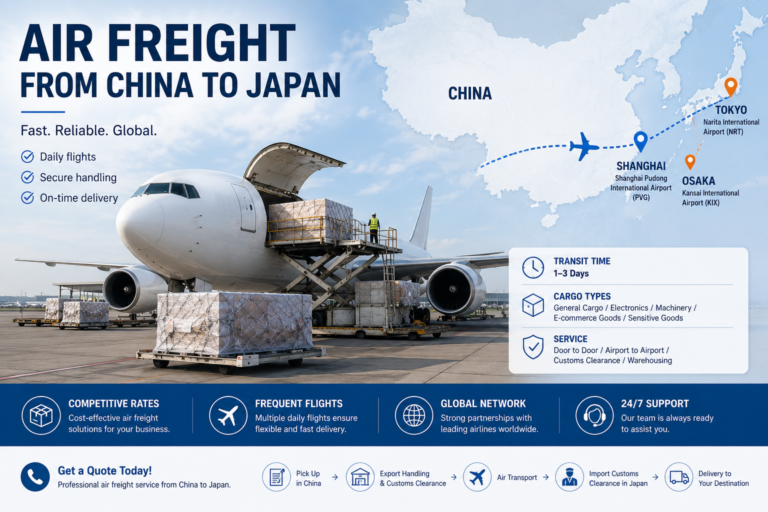
Air Freight from China to Japan Verified & Reviewed · Last updated June 2026 Air freight from China to Japan is one of the fastest ways to ship c...
Read guide →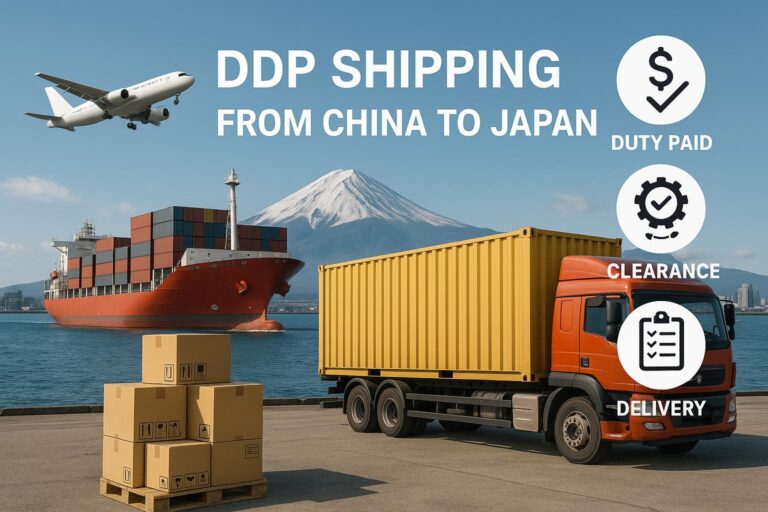
DDP Shipping from China to Japan Guide (2026) Verified & Reviewed · Last updated June 2026 DDP shipping from China to Japan is a convenient door-...
Read guide →China and Japan have one of the most active maritime trade routes in Asia, facilitating high trade volumes for various industries, including elec...
Learn more → Useful Resource Documents Required to Import from China (2025 Guide)Importing goods from China can be highly profitable—but only when you understand the necessary documents and import requirements. Whether you’re...
Learn more →WhatsApp us