Related Guide
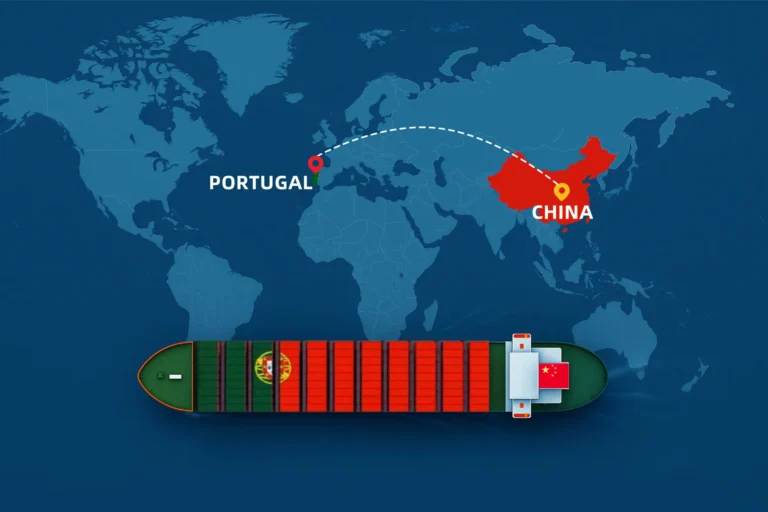
Shipping from China to Portugal
Shipping from China to Portugal – Sea, Air & DDP in 2026 Ship from China to Portugal by sea freight (FCL/LCL), air freight,or DDP door-to-door, w...
Read guide →

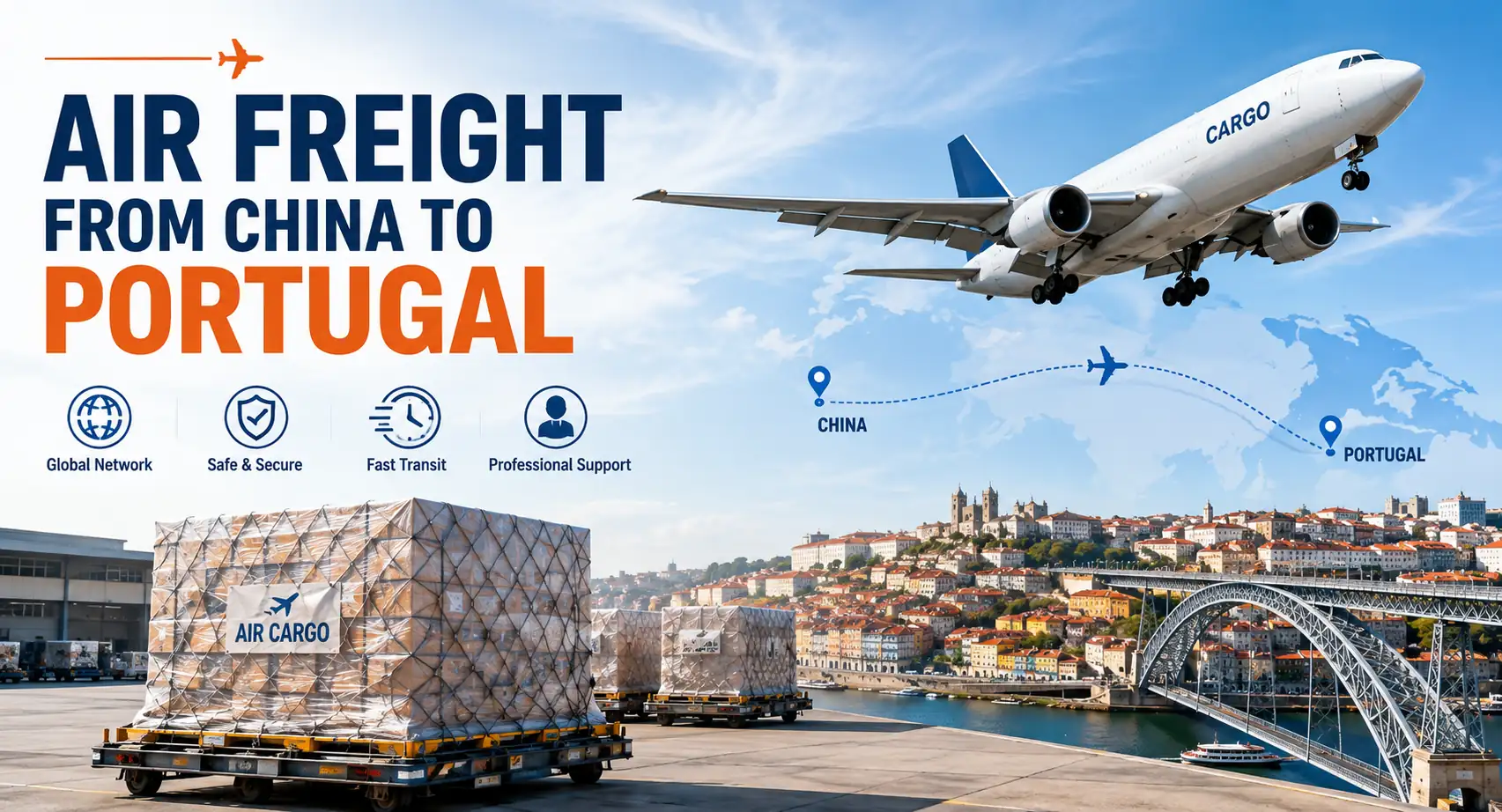
Air freight from China to Portugal typically takes around 5–8 days, with shipping rates depending on cargo weight, volume, airline capacity, and the selected delivery service.
Learn about air freight costs from China to Portugal, transit times, Lisbon and Porto air cargo routes, chargeable weight, Portuguese customs clearance, and door-to-door delivery options.
Air Freight Cost
Transit Time
Door to Door Shipping
For importers planning air freight from China to Portugal, these key figures provide a quick reference before requesting a shipment-specific quotation.
5–8 days
Standard Air Freight
Typical timing for most commercial air cargo shipments.
Lisbon & Porto
LIS / OPO
The main destination airports for air cargo entering Portugal.
$3.00–6.50/KG
Standard Air Freight
Typical 2026 reference rate for general commercial air cargo from China to Portugal.
Air Freight
Flexible Delivery
Choose airport service or delivery to the consignee in Portugal.
Actual transit times and shipping rates vary according to cargo details, airline capacity, routing, customs clearance, and final destination.
The air freight cost from China to Portugal is usually quoted per kilogram, but the final price depends on more than cargo weight alone. Airlines calculate freight according to the shipment’s chargeable weight, while the departure location, destination, available capacity, cargo type, and required delivery service can also affect the rate.
| Shipment | 2026 Reference Rate | Notes |
|---|---|---|
| Standard Air Freight | USD 3.00–6.50/kg | General commercial cargo |
| 1,000+ kg Air Cargo | Around USD 4.90/kg | Larger shipments may receive lower per-kg rates |
| Express Shipping | USD 8.81–13.00/kg | Small and highly urgent shipments |
These figures are intended for budgeting only. Actual shipping rates can change with airline capacity, peak-season demand, fuel surcharges, routing, and cargo availability at the time of booking.
Airlines determine the chargeable weight by comparing the cargo’s actual weight with its volumetric weight and normally use whichever is higher.
Volumetric Weight = Length × Width × Height in cm ÷ 6,000
For example, a carton measuring 80 × 60 × 50 cm has a volumetric weight of 40 kg.
If the carton weighs only 35 kg, the shipment would normally be billed at 40 kg. If it weighs 50 kg, the shipment would instead be billed at 50 kg.
This is why accurate dimensions are essential when requesting an air freight quote.
Even when two shipments have similar weights, their total shipping costs may differ because of the route, cargo characteristics, and service scope.
The main factors include:
Departure location and airport in China
Destination in Portugal
Cargo dimensions and gross weight
Airline space and scheduled departures
General cargo or special cargo requirements
Seasonal and fuel surcharges
Airport-to-airport or door-to-door service
Customs handling and local delivery requirements
Importers should compare quotations on the same service basis. A lower airport freight rate may not result in a lower total cost if pickup, destination handling, customs support, or delivery in Portugal are charged separately.
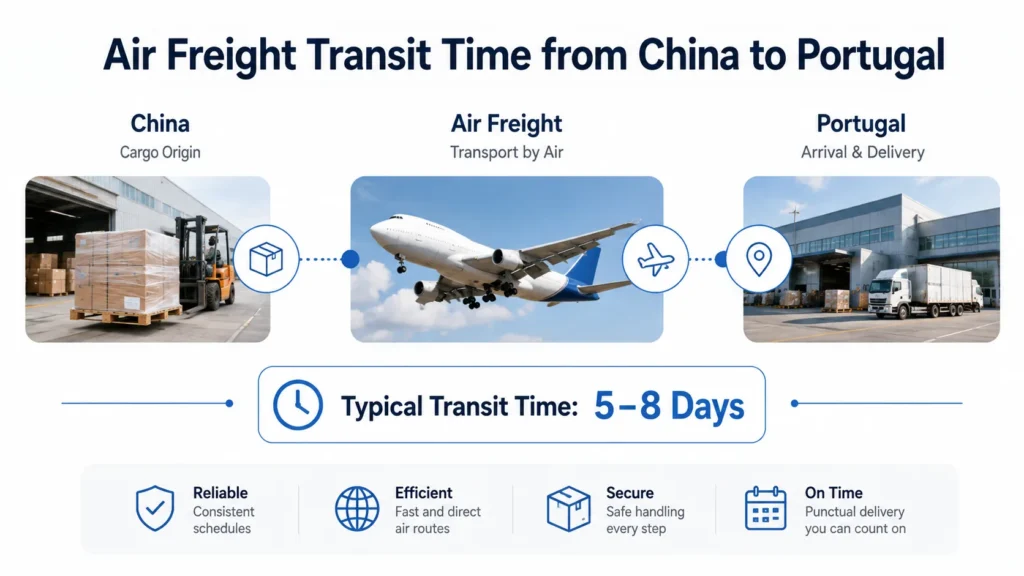
Air freight from China to Portugal typically takes around 5–8 days for standard commercial cargo. For shipments that include additional handling, customs clearance, or delivery arrangements, the overall delivery time can extend to approximately 5–10 days.
The actual transit time varies with the departure location in China, available flights, airline routing, destination in Portugal, and customs processing.
For most importers, 5–8 days is the practical reference range when planning standard air freight from China to Portugal. Express shipping can be faster for small parcels, while larger commercial air cargo usually follows standard airline schedules.
Several factors can extend the shipping time:
Cargo requires a connecting flight
Airline space is limited during peak periods
Special cargo requires additional airline approval
Documents are incomplete before departure
Portuguese customs selects the shipment for inspection
Delivery is required outside the main Lisbon or Porto areas
For time-sensitive shipments, the available flight schedule should be checked when the cargo is ready. A route with stable airline space and fewer connections can often provide a more predictable arrival time than simply selecting the lowest freight rate.
The main air freight shipping routes from China to Portugal connect major Chinese cargo hubs with Lisbon Airport (LIS) and Porto Airport (OPO). The most suitable route depends on the supplier location in China, airline schedule, available cargo space, cargo type, and the final delivery address in Portugal.
Available shipping routes may use direct or connecting airline services depending on current capacity and scheduling. Cargo can also move through another international or European air hub before reaching Portugal.
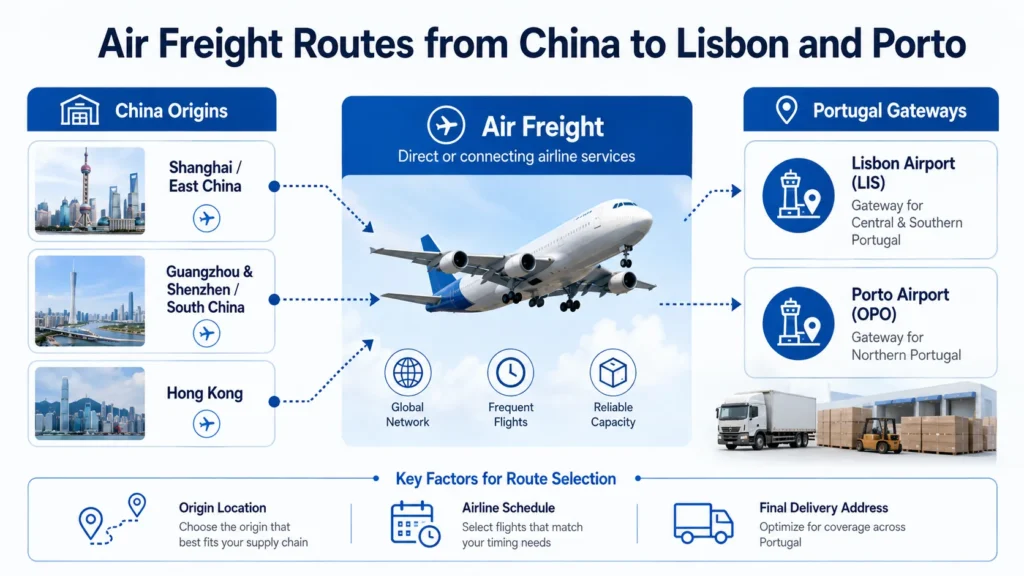
Lisbon is the main gateway to consider for shipments destined for Lisbon, central Portugal, and many southern locations. It can be a practical choice when the consignee or warehouse is located closer to the Lisbon area.
When comparing a Lisbon routing, importers should consider both the international air freight rate and the cost of onward delivery to the final destination.
Porto is particularly relevant for cargo destined for Porto and northern Portugal. For businesses located in the north, using Porto can reduce unnecessary inland transportation after customs clearance.
A lower air freight rate to Lisbon is not always the lowest total logistics cost if the cargo then needs to travel a long distance by road to northern Portugal.
The origin airport is normally selected according to the supplier location and available airline service.
Common departure areas include:
Shanghai for suppliers in East China
Guangzhou and Shenzhen for cargo from South China
Hong Kong where routing, capacity, or cargo requirements make it suitable
Other major Chinese cargo airports depending on shipment location and airline schedules
For this reason, the best China–Portugal air freight route should be selected according to the complete shipment rather than the airport-to-airport rate alone.
When comparing routes, importers should consider the flight schedule, transit time, airline capacity, customs arrangements, and local delivery cost together.
Commercial air cargo entering Portugal must complete customs clearance before the goods can be released for import. Portugal is part of the European Union, so shipments are subject to applicable EU customs rules, tariff classification requirements, import VAT, customs duties, and product-specific import measures.
Smooth Portuguese customs clearance starts before the cargo arrives. The commercial invoice, packing list, air waybill, HS code, declared customs value, and importer details should be prepared accurately and consistently.
The exact requirements depend on the product, but standard air cargo documents usually include:
Commercial Invoice: Seller, buyer, product description, quantity, declared value, currency, and trade terms
Packing List: Number of packages, dimensions, packing details, net weight, and gross weight
Air Waybill: Main transportation information for the air cargo shipment
HS Code: Used by customs authorities to classify the imported goods
EORI Information: Generally required for businesses importing into the European Union
Certificates or Licences: Required where a product is subject to additional regulation
Clear product descriptions are important. Generic or inconsistent descriptions can create questions during customs processing.
Portugal follows the EU customs tariff system. Import duty depends on the product’s HS code, origin, customs value, and applicable EU trade measures. Customs duties therefore vary by product, and certain goods can also be subject to additional measures such as anti-dumping duties.
The standard VAT rate in mainland Portugal is 23%. Import VAT is calculated according to the applicable customs valuation rules and relevant import charges.
Importers calculating the total landed cost should confirm the HS code and tax treatment before shipment rather than estimating duties from the freight rate alone.
Common reasons for customs delays include:
Incorrect or unclear HS classification
Commercial invoice information that does not match the goods
Incorrect customs value
Missing EORI information
Missing certificates or licences
Goods requiring customs inspection or additional review
Where necessary, the freight forwarder or customs broker should receive the documents before arrival so obvious problems can be identified in advance.
Some importers only need airport-to-airport transportation because they already have their own customs broker and local delivery arrangements in Portugal. Others prefer door-to-door air freight from China to Portugal, especially when they want one logistics provider to coordinate the main shipping stages.
Depending on the agreed service, door-to-door shipping can include supplier pickup in China, export handling, international air transportation, Portuguese customs clearance support, and delivery to the consignee.
For destinations outside Lisbon or Porto, the postcode is particularly important because local delivery distance can materially affect total shipping costs.
Airport-to-airport service is generally more suitable when the importer already has:
An established customs broker
Its own destination transport arrangement
Experience handling Portuguese import procedures
Door-to-door service is more convenient when the importer requires pickup in China, customs coordination, and delivery to a warehouse or business address in Portugal.
Delivered Duty Paid (DDP) or DAP arrangements may also be considered depending on the cargo, importer setup, customs requirements, and agreed responsibilities.
The Incoterm and service scope should always be confirmed before booking so both sides understand who is responsible for customs charges, taxes, and destination delivery.
The best shipping method from China to Portugal depends on shipment size, urgency, cargo value, and delivery requirements. Air freight offers a useful balance between speed and capacity, but express, rail, and sea freight may be more suitable in other situations.
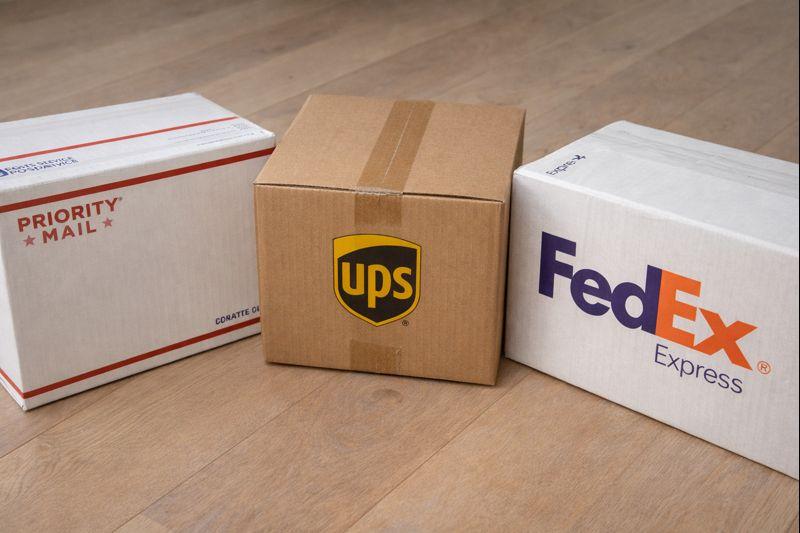
Transit Time: 3–7 Business Days
Small parcels and urgent samples
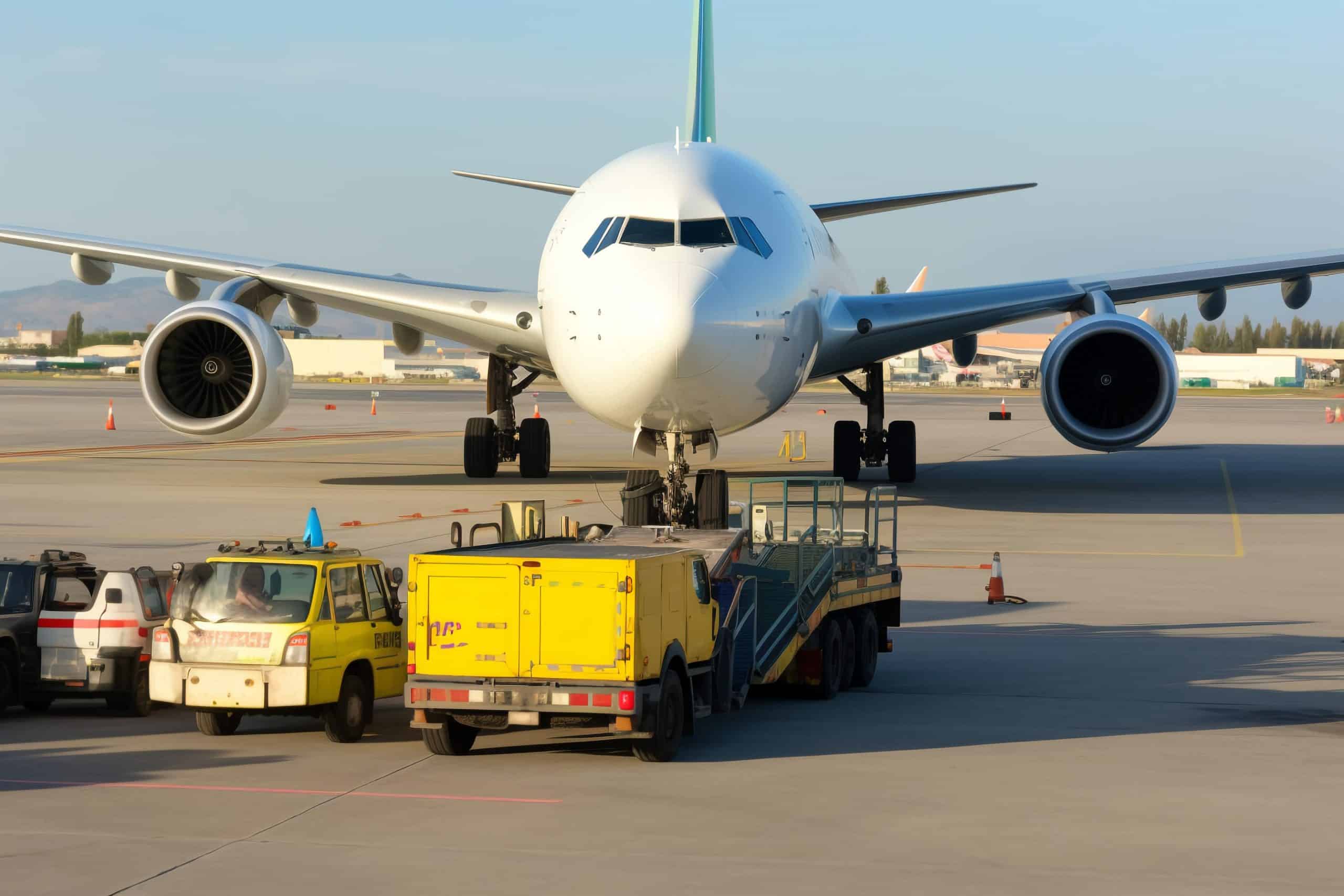
Transit Time: Around 3–7 days
Time-sensitive commercial cargo
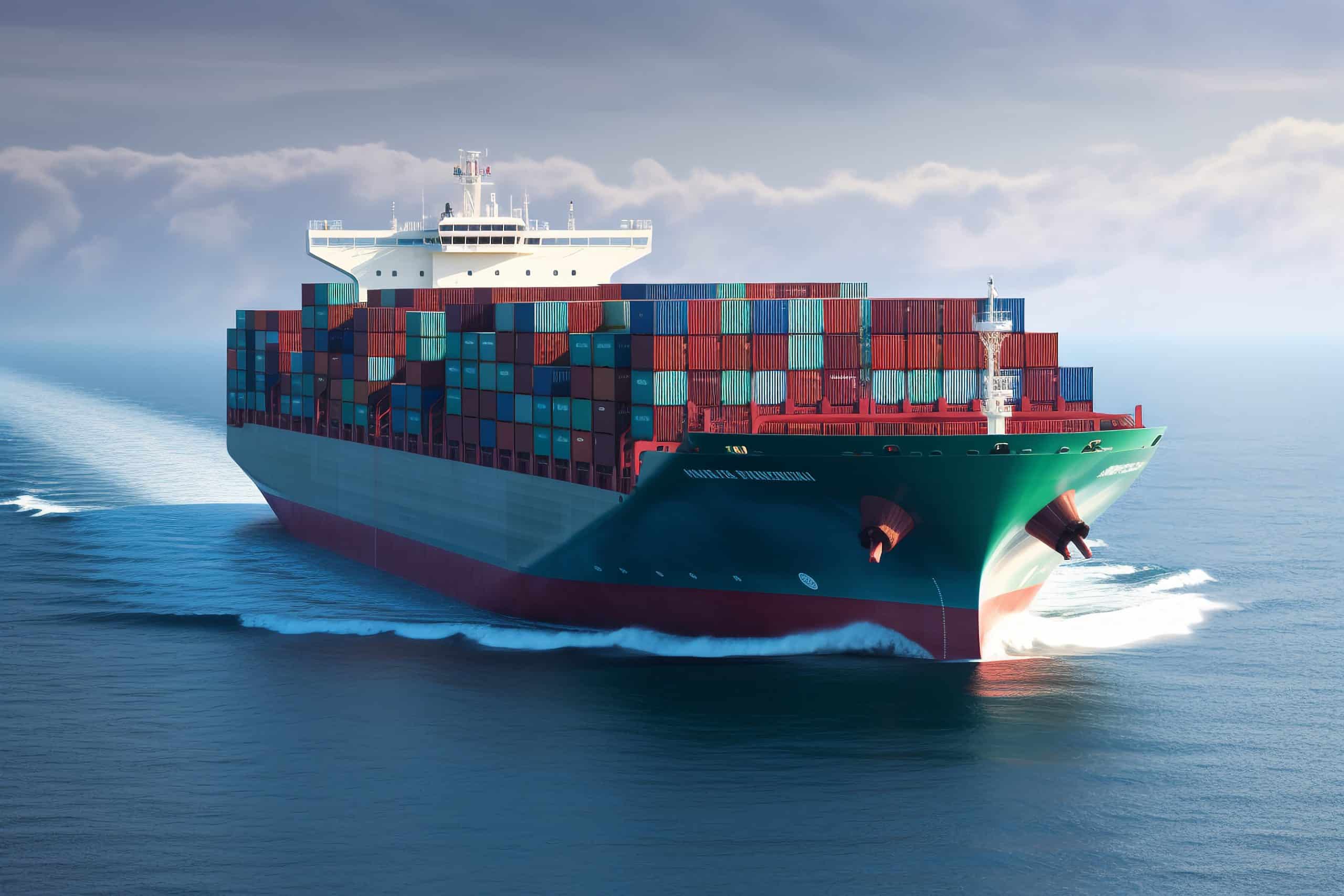
Transit Time: Longer Transit Time
Heavy and high-volume cargo
Air freight is particularly suitable when delivery speed, inventory availability, or cargo value matters more than obtaining the lowest possible freight cost.
It is commonly used when:
Typical air cargo includes electronics, machinery parts, spare parts, fashion products, samples, commercial goods, and other time-sensitive shipments.
For heavy or high-volume cargo with flexible delivery schedules, rail or sea freight may provide better cost efficiency.
An accurate air freight quotation requires more than the shipment’s total weight. A freight forwarder normally needs package dimensions, cargo type, pickup location, destination, and required service level to calculate the correct chargeable weight and total shipping costs.
To receive accurate shipping rates, provide:
Product name
Number of cartons, pallets, or crates
Dimensions of each package
Gross weight
Total cargo volume if available
Supplier or pickup location in China
Destination city and postcode in Portugal
Cargo ready date
Required delivery time
Airport-to-airport or door-to-door shipping preference
Details of batteries, liquids, magnets, chemicals, branded goods, or other special cargo
A freight forwarder can then compare available airline options, transit times, and destination arrangements for the actual shipment.
Tonlexing can arrange air freight from China to Portugal based on cargo size, origin, destination, required delivery time, and customs requirements. Complete shipment information helps the freight forwarder provide a more accurate quotation and reduces the risk of rate changes after the cargo is received and measured.
For door-to-door shipments, the Portuguese delivery postcode should also be provided so local transportation and final delivery costs can be included in the quotation.
Standard air freight may cost around USD 3.00–6.50 per kg as a general market reference. Actual shipping rates depend on shipment weight and dimensions, origin, destination, airline capacity, season, and cargo type.
Typical air freight takes around 5–8 days. The exact transit time depends on airline routing, departure location, cargo handling, customs clearance, and whether airport or door delivery is required.
The better gateway depends mainly on the final destination and available airline routing. Lisbon is generally more practical for central and southern destinations, while Porto can be convenient for northern Portugal. Air freight and local delivery costs should be compared together.
Common documents include a commercial invoice, packing list, air waybill, HS code information, and importer EORI details. Regulated goods may require additional certificates or licences.
Yes. Door-to-door service can combine pickup in China, export handling, international air transportation, Portuguese customs clearance support, and delivery to the consignee.
Useful freight, customs and importing resources related to this shipping guide.
Shipping from China to Portugal – Sea, Air & DDP in 2026 Ship from China to Portugal by sea freight (FCL/LCL), air freight,or DDP door-to-door, w...
Read guide →
Shipping Cost from China to Portugal (2026 Guide) Verified & Reviewed · Last updated June 2026 As of June 2026, LCL sea freight from China to Por...
Read guide →
How long does it take to ship from China to Portugal? This is one of the most common questions asked by importers, eCommerce sellers, and supply...
Read guide →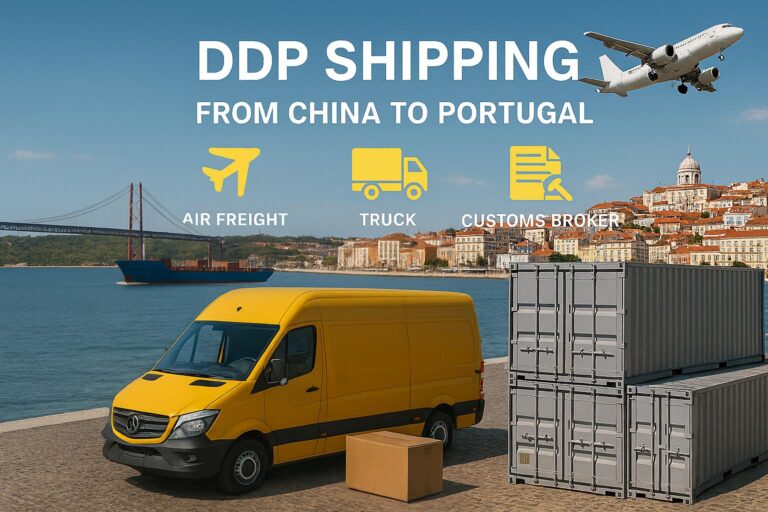
Trade between China and Portugal has expanded rapidly, making logistics a critical part of international business. Importers in Portugal often fa...
Read guide →Shipping containers from China to Portugal is now a core part of many European supply chains. Importers in Lisbon, Porto and other Portuguese cit...
Learn more → Useful Resource Air Freight from ChinaAir freight from China is the best option for time sensitive and high value shipments. It offers fast delivery, reliable transit times, and effic...
Learn more →WhatsApp us