Sea Freight
FCL and shared container shipping to New Zealand by LCL, mainly through Auckland, Tauranga and Lyttelton, for commercial cargo that can allow a longer shipping schedule.
Usually best for From 1 CBM, pallets, machinery and larger orders

China–New Zealand Shipping Guide · Updated August 2026
Compare sea freight, air freight, express and door-to-door shipping from China to New Zealand. Review planning costs, transit times, key routes, New Zealand Customs and MPI biosecurity requirements before booking.
Indicative rates and transit times depend on cargo details, route, service scope and current carrier capacity.
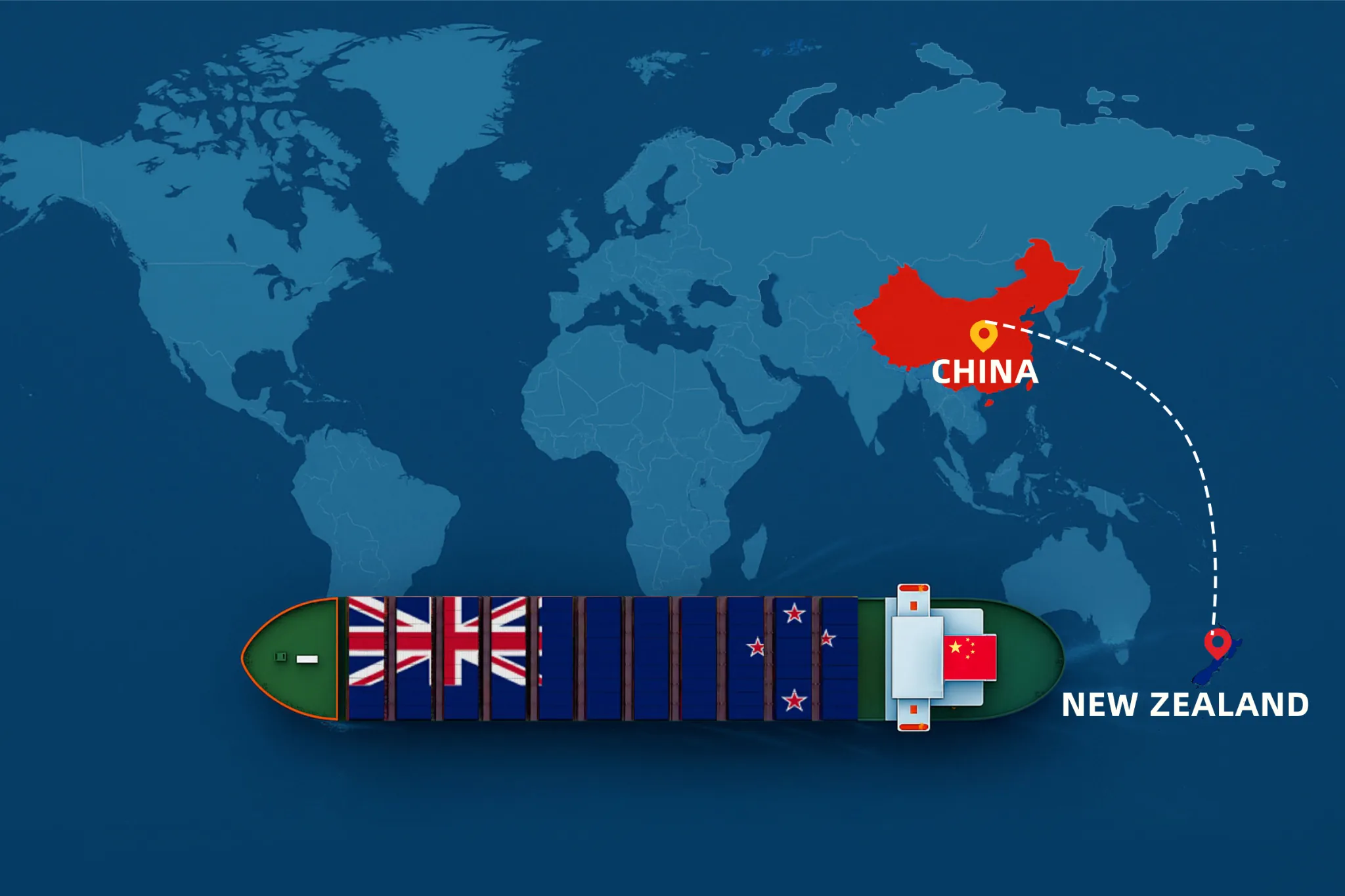
Quick shipping overview
For shipping from China to NZ, choose a method based on cargo volume, urgency, budget, delivery address and New Zealand Customs or MPI requirements. These planning ranges help narrow the options before comparing detailed costs, schedules and routes.
FCL and shared container shipping to New Zealand by LCL, mainly through Auckland, Tauranga and Lyttelton, for commercial cargo that can allow a longer shipping schedule.
Usually best for From 1 CBM, pallets, machinery and larger ordersFaster airport-to-airport transport for urgent, high-value or time-sensitive commercial cargo, mainly through Auckland Airport.
Usually best for From 45 kg, urgent stock and higher-value goodsTracked courier delivery for documents, samples and smaller parcels when fast transit and straightforward handling are the priorities.
Usually best for Small, urgent and easy-to-handle shipmentsCoordinated pickup in China, international freight, New Zealand Customs and MPI support, and final delivery across the North or South Island.
Usually best for Importers wanting one managed shipping arrangementPlanning ranges only. Port-to-port or airport-to-airport transit excludes pickup, consolidation, New Zealand Customs or MPI review, and final delivery. Actual timing depends on cargo, origin, carrier schedule, clearance and destination address.
Cost & Pricing
Freight costs depend on cargo volume, chargeable weight, origin, New Zealand gateway, season and delivery scope. These August 2026 base-freight references help compare methods. See the detailed shipping cost guide from China to New Zealand for additional rate tiers and cost factors. Neither set of figures should be treated as the total landed cost.
August 2026 indicative base-freight comparison
Checked August 2026| Shipping method | Pricing basis | Indicative range | Usually suitable for |
|---|---|---|---|
| Sea LCL | Per CBM or W/M | About US$35/CBM Base freight to Auckland; 1 CBM minimum | Smaller commercial cargo from 1 CBM |
| Sea FCL | Per container | 20GP: US$1,650–1,950 40GP: US$3,500–3,900 to Auckland | Larger or full-container shipments |
| Air Freight | Chargeable weight | From US$4.00/kg 1,000 kg+ general cargo; smaller tiers quoted separately | Urgent commercial cargo from 45 kg |
| Door-to-Door | Shipment-specific | Custom quote Based on pickup, clearance and delivery postcode | Importers needing one managed solution |
These USD planning references do not automatically include all origin and destination charges, such as China pickup, export handling, New Zealand destination handling, customs brokerage, 15% GST, Customs and MPI Goods Levies, import duty, inspection or treatment, storage, demurrage and final delivery. Before booking, compare freight quotes by their inclusions, exclusions, validity, route and chargeable basis—not by the headline freight rate alone.
Transit Time Guide
Sea freight usually takes 18–32 days for the main port-to-port movement, while air freight takes about 3–7 days airport to airport. A complete door-to-door shipment takes longer because pickup, export handling, Customs or MPI review and final delivery must also be included. Review the detailed China-to-New Zealand transit-time guide for additional route timing, planning stages and delay factors.
Typical China-to-New Zealand transit time comparison
Planning ranges| Shipping method | Main transit | Door-to-door planning | Usually suitable for |
|---|---|---|---|
| Sea FCL | 18–28 days Port to port | 25–40 days Normal pickup, clearance and delivery | Full-container and larger-volume cargo |
| Sea LCL | 20–32 days Main LCL movement | 28–45 days Includes consolidation and deconsolidation | Pallets and commercial cargo from 1 CBM |
| Air Freight | 3–7 days Airport to airport | 5–10 days Subject to flight and clearance handling | Urgent commercial cargo from 45 kg |
| Express | Integrated Courier network | 3–6 days Remote areas may take longer | Samples, documents and smaller parcels |
These are indicative planning ranges, not guaranteed delivery times. Customs inspection, MPI biosecurity review, LCL consolidation, port congestion, carrier rollover, unsuitable wood packaging or delivery outside the main New Zealand metropolitan areas can extend the schedule.
Schedule & Routing Direct services and transshipment routes can have different sailing or flight times.
Capacity & Holidays Chinese holidays, peak-season demand and carrier rollovers can delay the planned departure.
Customs & MPI Incorrect documents, biosecurity-risk goods or unsuitable wood packaging can trigger review or treatment.
Final Delivery South Island transfers, rural postcodes, delivery appointments and special equipment may add extra days.
Shipping Methods
The right method depends on cargo volume, urgency, product restrictions, delivery postcode and the required service scope. Compare sea freight, air freight, express courier and managed door-to-door shipping before confirming a route.
Sea freight is usually the most economical option for machinery, furniture, building materials, wholesale orders and other larger commercial shipments to Auckland, Tauranga or Lyttelton.
LCL generally from 1–15 CBM; FCL when cargo volume, handling control or container use justifies 20GP or 40GP.
LCL is charged by CBM or weight/measurement; FCL is quoted by container size, route and current equipment.
Air freight balances speed and shipment control for urgent inventory, electronics, components and higher-value commercial cargo that cannot wait for an ocean sailing.
Commercial shipments generally from 45 kg, including urgent replenishment and time-sensitive goods.
Chargeable weight, aircraft dimensions and acceptance of batteries, liquids, magnetic or other restricted cargo.
Express courier provides integrated pickup, tracking, customs processing and delivery for documents, samples, spare parts and compact parcels moving to New Zealand.
Small urgent shipments that do not justify a separate air-freight booking or cargo-terminal handling.
Dimensional weight, remote-area delivery, oversize fees and courier restrictions for special commodities.
Door-to-door shipping combines sea or air freight with supplier pickup, export handling, New Zealand Customs and MPI coordination, and delivery to the agreed destination address.
Importers wanting one coordinator and a clearly defined service from the Chinese supplier to New Zealand.
DAP or DDP scope, importer and Client Code status, GST, duty, MPI charges and remote-delivery exclusions.
Door-to-door describes the agreed service scope, not a separate international transport mode. DDP availability must be confirmed for the specific cargo and importer arrangement. Solid-wood pallets, crates and dunnage must meet New Zealand MPI and ISPM 15 requirements and remain free of bark, soil and visible pests.
Freight network
Cargo can move from major Chinese ports and airports to New Zealand’s principal gateways, then continue by road, rail or coastal connection. The best route depends on cargo type, supplier location, final delivery address and current carrier schedules.
FCL and LCL services are selected around the Chinese origin, New Zealand delivery region, cargo-ready date and available sailing. Some services operate directly, while others transship through an Asian or regional hub.
Most international air cargo is routed through Auckland, with Christchurch and Wellington used when capacity, handling and final delivery make them practical. Direct and connecting services vary by airline and schedule.
A major import gateway for Auckland and upper North Island deliveries, including containers, vehicles and general cargo.
New Zealand’s largest container gateway, with road and rail links to Auckland, Waikato and the central North Island.
The principal gateway for Christchurch, Canterbury and wider South Island container deliveries.
An alternative regional gateway for Hawke’s Bay and selected lower or eastern North Island cargo.
Port and airport selection is confirmed with the quotation. Direct services are not guaranteed: carrier capacity, cut-off dates, transshipment, equipment and final-delivery requirements can change the routing.
Border compliance
When importing from China to NZ, shipments may be reviewed by the New Zealand Customs Service and the Ministry for Primary Industries. Understanding the customs-clearance process and confirming product eligibility, classification, customs value and supporting documents before departure helps reduce border holds, amendments and avoidable storage costs.
Confirm the product description, HS code, country of origin and whether an MPI import health standard, permit, registration or other approval applies.
The importer or appointed customs broker submits the declaration using consistent shipment, supplier, origin and valuation details. Imports with a customs value over NZ$1,000 generally require a standard import declaration, Client Code and supplier code.
Customs assesses any tariff duty, 15% GST and applicable Customs or MPI goods levies. Duty depends on the HS code, origin and customs value. Qualifying Chinese-origin goods may receive preferential treatment under the New Zealand–China FTA.
Customs and, where applicable, MPI review the shipment. Selected cargo may require inspection, additional evidence, cleaning, treatment or other action before release.
GST is generally 15% and is normally based on the customs value—including the goods, international freight and insurance—plus any applicable duty. Imports with a customs value over NZ$1,000 generally require a standard import declaration, Client Code and supplier code.
From 1 April 2026, per-consignment Customs and MPI goods levies apply to low-value goods of NZ$1,000 or less and high-value goods over NZ$1,000. The applicable levy depends on value, transport mode and declaration type.
MPI may inspect food, plant or animal products, timber, vehicles, machinery, used goods and other biosecurity-risk cargo. Solid wood packaging must meet New Zealand requirements, carry a legible ISPM 15 mark and be clean and free from soil, bark and visible pests.
Food, hazardous substances, chemicals, medicines, batteries, vehicles and other regulated products may need permits, registration or supporting certificates. Food imported for sale also requires a registered food importer. Confirm eligibility before booking; transport arrangements do not replace regulatory approval.
The New Zealand importer remains responsible for product admissibility, accurate declarations, duties, taxes, levies and required approvals. Tonlexing can coordinate transport documents and work with the importer or appointed customs broker.
Review booking requirements →Shipment readiness
Accurate cargo data and a clearly defined delivery scope support route comparison, chargeable-weight calculation and New Zealand Customs or MPI checks before cargo is collected.
Commodity name, intended use, HS code if known, cargo value and whether the goods contain batteries, liquids, magnets, chemicals, untreated wood or other controlled materials.
Provide the package count, gross weight, package dimensions and total CBM. Use the CBM calculator to check shipment volume before requesting a rate. Final charges use verified weight, volume and transport mode.
Chinese supplier pickup address or origin port, complete New Zealand delivery address and postcode, plus whether delivery is commercial, residential, warehouse or port-terminal based.
Confirm the applicable Incoterm, such as EXW, FOB, CIF, DAP or DDP. State who will handle export clearance, import entry, duty, GST, MPI charges and final delivery.
Provide the realistic factory completion date and any required arrival deadline. Space, sailing or flight schedules must be checked again when the cargo is ready.
Confirm the New Zealand importer, Customs Client Code and any MPI permits, treatment records, product certificates or ISPM 15 wood-packaging requirements.
From booking to final delivery
The shipping process from China to New Zealand connects the Chinese supplier, export handling, international transport, New Zealand Customs and MPI clearance, and final delivery while keeping responsibilities clear at every stage.
Provide the China pickup location, New Zealand delivery address and postcode, commodity, package count, dimensions, gross weight, cargo value and cargo-ready date.
Suitable sea, air, express or door-to-door options are compared by route, urgency, chargeable basis and included service scope.
Cargo is collected from the supplier or received at the warehouse for checking, consolidation and export preparation. China export documents and customs procedures are then coordinated.
The shipment departs China by the confirmed vessel, flight or express service. Key movement milestones are monitored while arrival documents are prepared.
The importer or appointed broker submits the import entry. New Zealand Customs and, for biosecurity-risk cargo, MPI review the shipment before the required releases are issued.
After the necessary Customs and MPI releases, cargo is collected from the port, airport or depot and delivered under the confirmed port-to-door, DAP, DDP or other service scope.
Why Tonlexing
One China-based operations team coordinates the shipment plan, supplier pickup, export handling, international freight, transport documents and New Zealand destination handover. Review what to expect when choosing a freight forwarder from China to New Zealand before confirming the service scope.
Company credentials
Established freight-forwarding support with defined service scopes, company payment channels and documented handoffs from China origin through destination delivery.
Routing is matched to cargo size, urgency, delivery location, Incoterm and required Customs or MPI scope instead of placing every shipment into one standard service.
Sea, air, express and door-to-door optionsSupplier contact, pickup, warehouse receipt, cargo details, consolidation and export preparation are coordinated before the shipment leaves China.
Shenzhen, Guangzhou and Ningbo warehouse supportShipment documents are organized for the importer or appointed customs broker, with handoffs coordinated around New Zealand Customs and MPI requirements where applicable.
Import approvals and declarations remain with the importerPickup, departure, arrival, clearance and delivery milestones are followed through the shipment. When conditions change, the team coordinates the available next steps.
Practical communication through shipment completionClear responsibility and quotation scope: the selected route, chargeable basis, included services, exclusions and document responsibilities are confirmed before booking. New Zealand product admissibility, import declarations and regulatory approvals remain the responsibility of the importer and appointed customs broker.
Practical shipping answers
Practical answers about freight methods, shipping costs, transit times, New Zealand Customs and MPI clearance, and final delivery from China.
When shipping goods from China to New Zealand, the best method depends on cargo size, urgency and delivery scope. Sea freight normally suits larger or less urgent shipments, air freight suits time-sensitive commercial cargo, and express shipping suits smaller urgent parcels. Door-to-door delivery can be combined with suitable sea or air services.
Sea freight usually offers the lowest unit cost for larger shipments. LCL allows smaller cargo to share container space, while FCL can become more economical as the volume increases. Compare the total landed transport cost, including pickup, origin charges, ocean freight, destination handling, clearance and delivery—not the ocean rate alone.
Typical planning ranges are 18–28 days port to port for FCL, 20–32 days for the main LCL movement, 3–7 days airport to airport by air freight and 3–6 days door to door by express. Pickup, consolidation, transshipment, Customs or MPI review and final delivery can add time.
August 2026 base-freight references include LCL from about US$35 per CBM to Auckland, US$1,650–1,950 for a 20GP container, US$3,500–3,900 for a 40GP container, and air freight from about US$4.00 per kg for 1,000 kg or more of general cargo. Pickup, origin charges, destination handling, customs brokerage, duty, GST, Customs or MPI levies, inspection and final delivery may be additional.
Tonlexing generally handles commercial air freight from 45 kg and sea LCL from 1 CBM. Smaller shipments may be more suitable for courier or express service. These are Tonlexing service starting points, not New Zealand legal limits, and acceptance still depends on the commodity, dimensions and available route.
Most commercial shipments require a commercial invoice, packing list, bill of lading or air waybill, accurate HS code and New Zealand importer details. Depending on the product, Customs or MPI may also require a Client Code, supplier code, import permit, product declaration, treatment certificate, MSDS, UN38.3 report or other supporting evidence. Importers claiming preferential tariff treatment under the New Zealand–China Free Trade Agreement should also retain sufficient evidence of origin.
GST is generally 15% and Customs normally calculates it using the customs value, including the goods, international freight and insurance, plus any applicable duty. Commercial imports with a customs value over NZ$1,000 generally require a standard import declaration, Client Code and supplier code. Goods that satisfy the New Zealand–China FTA rules of origin may qualify for preferential tariff treatment, but eligibility must be supported and should not be assumed.
From 1 April 2026, Customs and MPI goods levies apply by consignment. Low-value goods are generally those valued at NZ$1,000 or less, while goods valued over NZ$1,000 fall under the high-value goods levy. Exceptions and the applicable amount depend on the shipment and clearance method.
MPI may review food, plant and animal products, timber, vehicles, machinery, used goods and other biosecurity-risk cargo. Solid wood packaging should meet ISPM 15 requirements, carry a legible treatment mark and be clean and free from soil, bark and visible pests. Inspection, cleaning, treatment or other action may be required before release.
Door-to-door delivery can be arranged for suitable shipments and locations. DDP availability depends on the commodity, importer arrangement, duty and GST treatment, Customs or MPI requirements and final delivery address. Import responsibility, excluded charges and whether DAP or DDP applies must be confirmed in the quotation rather than assumed from the term “door to door.”
Provide the cargo description, intended use, HS code if known, package count, packed dimensions, gross weight, total CBM, cargo value, Chinese pickup address, New Zealand delivery postcode, cargo-ready date and preferred service. Disclose batteries, liquids, magnets, chemicals, untreated wood or other special cargo conditions before booking.
Planning note: Rates, schedules and border requirements can change. Confirm the current route, service scope, importer responsibilities, destination charges and Customs or MPI requirements in the final quotation before booking.
Further Reading
Continue with focused resources covering freight-forwarder selection, shipping costs, transit times, air cargo, DDP and container shipping from China to New Zealand.
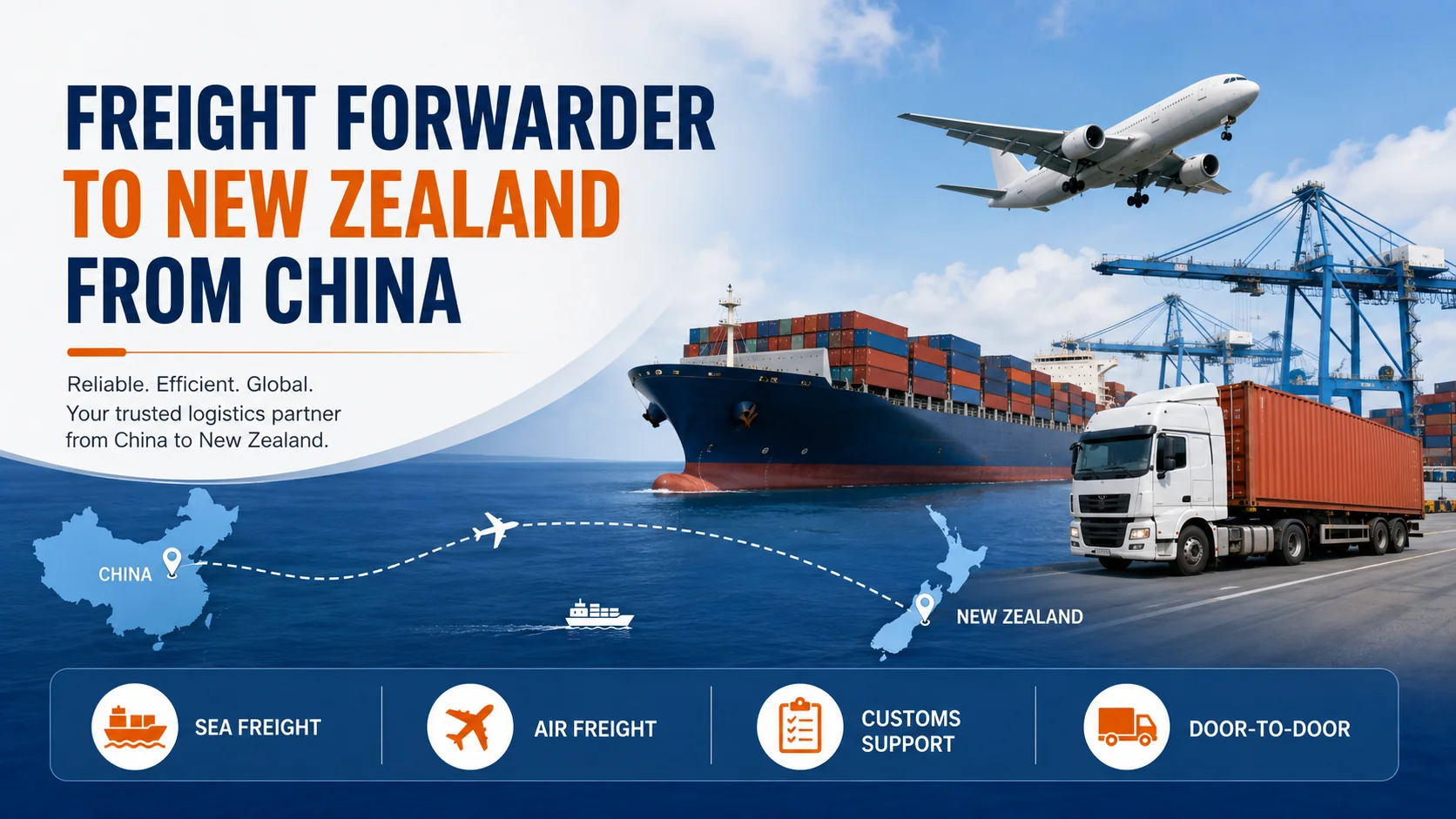
Freight Coordination
Understand supplier pickup, route planning, documentation, Customs and MPI coordination, and final delivery support.
View freight-forwarder guide
Cost & Pricing
Compare FCL, LCL, air freight and courier rate ranges, plus the factors affecting total landed transport cost.
Compare shipping costs
Delivery Planning
Check typical express, air, LCL and FCL timelines and the factors that can extend final delivery.
View transit times
Door to Door
Review DDP service scope, air and sea options, import arrangements, duty, GST and final delivery planning.
Explore DDP shipping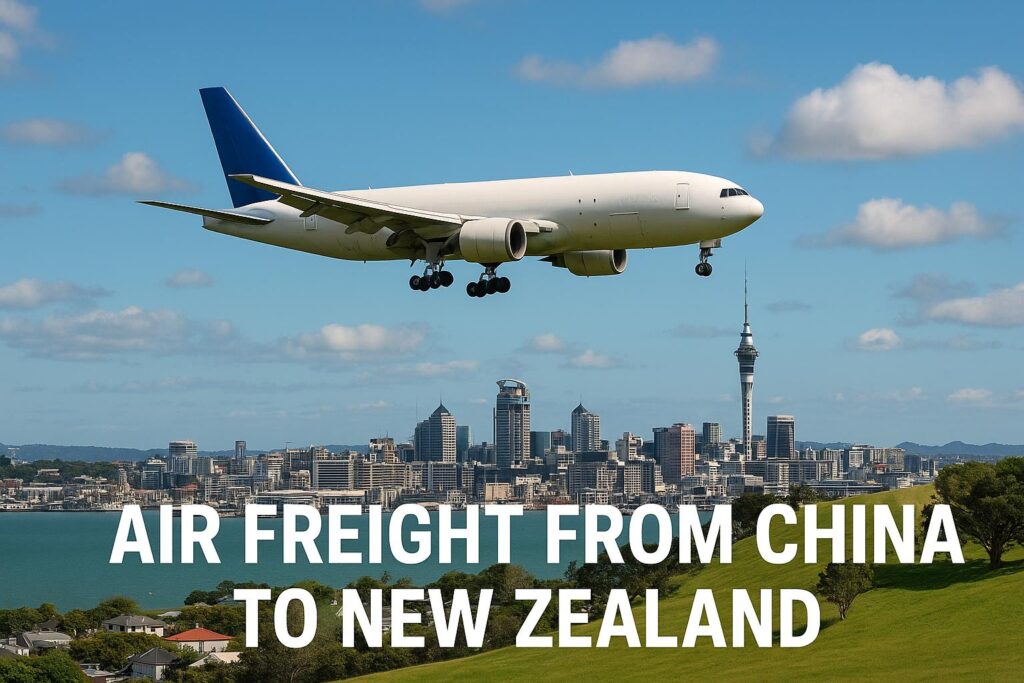
Air Cargo
Compare air-cargo rates, chargeable weight, airport routes and delivery planning for urgent commercial shipments.
View air freight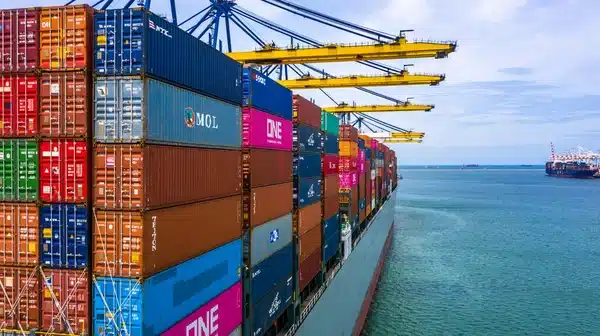
FCL Container Rates
Compare indicative FCL rates, container sizes, port pairs and planning factors for full-container shipments.
Check container costsThis shipment used another destination route, but its LCL consolidation, mixed-product documentation and warehouse handling are also relevant to smaller New Zealand imports.
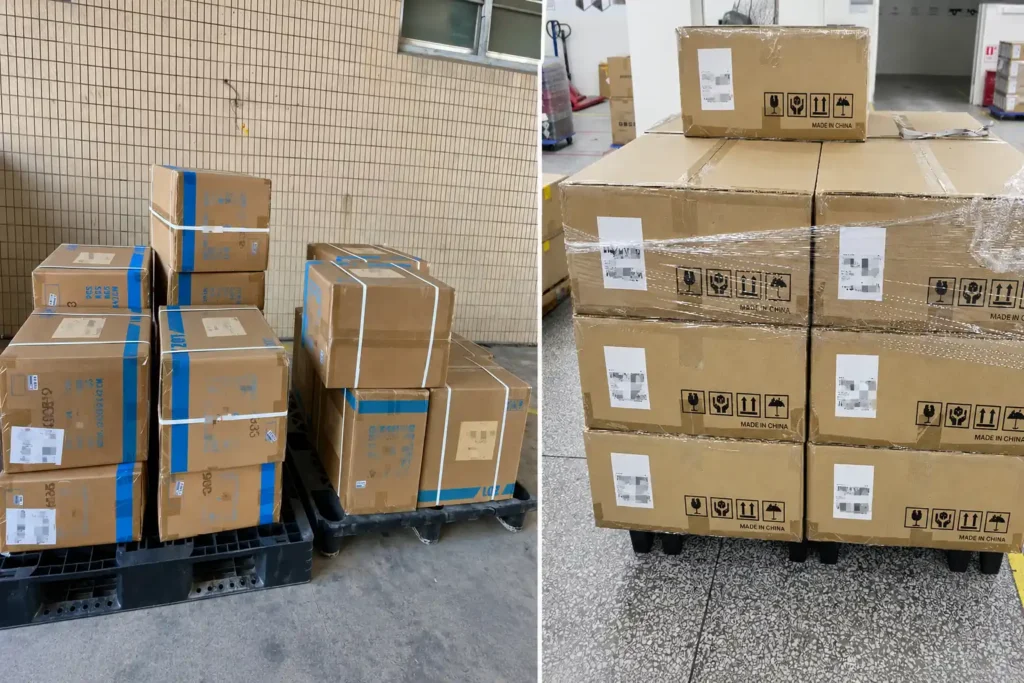
Shenzhen, China → The Netherlands
See how 29 packages of plastic toys and microchip pet feeders—411 kg and 2.46 CBM—were received, checked, documented under separate HS codes and consolidated into one LCL sea-freight shipment.
View case studyWhatsApp us