

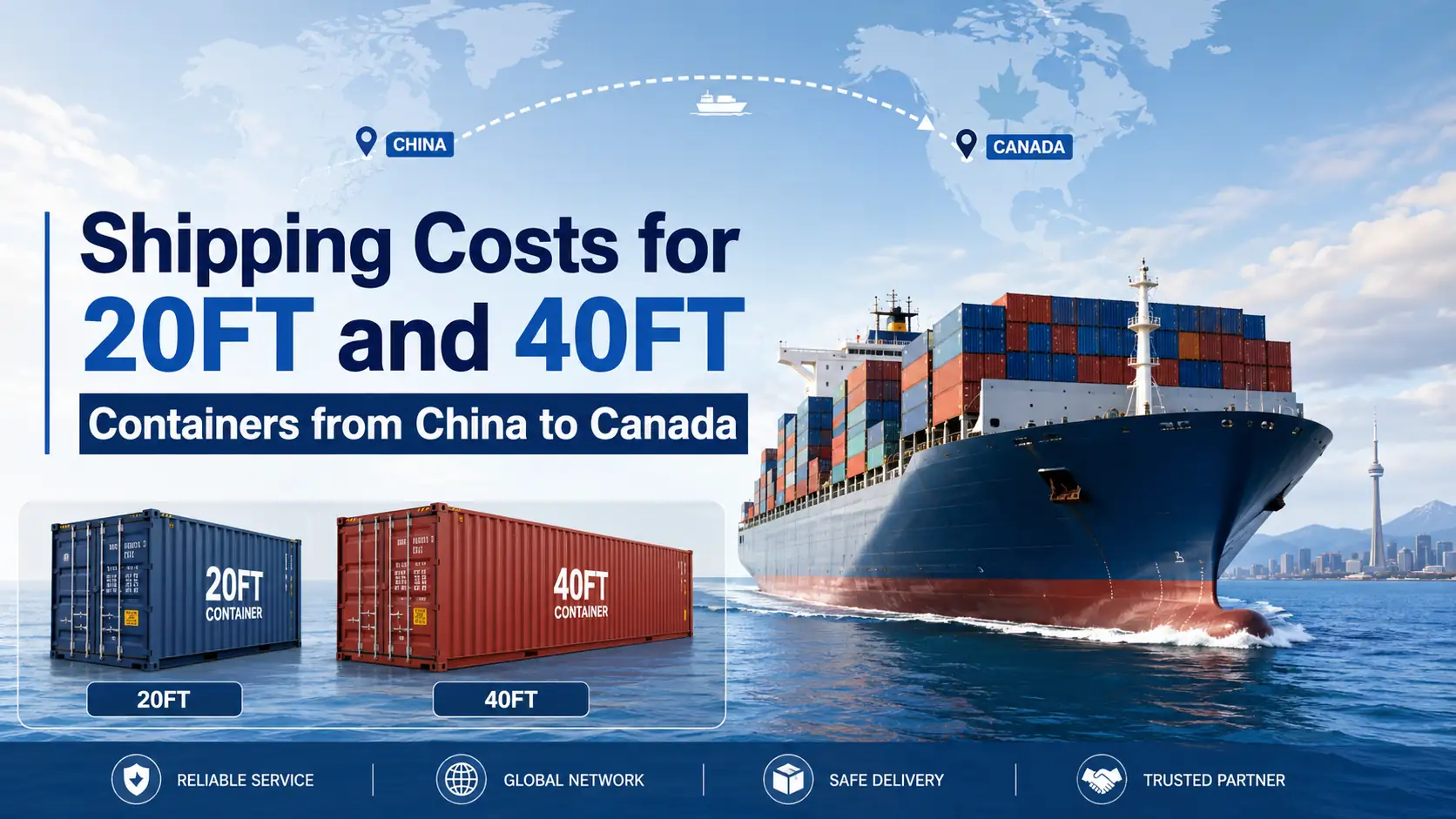
Shipping Costs for 20FT and 40FT Containers from China to Canada
- Verified & Reviewed · Last updated June 2026
Shipping costs for 20FT and 40FT containers from China to Canada depend on container size, ocean freight rates, shipping routes, destination port, seasonal demand, port congestion, and inland delivery requirements.
This guide explains container shipping costs from China to Canada, including 20FT and 40FT container rates, major Chinese ports, Canadian destinations such as Vancouver, Montreal, Toronto, Prince Rupert, and Halifax, transit times, customs clearance, port charges, and door-to-door delivery options.
20FT & 40FT Rates
Transit time range
Customs Clearance
- Experienced China-based logistics specialists
Table of Contents
Overview of 20FT and 40FT Containers
Shipping containers are available in different sizes, but 20ft containers and 40ft containers are the most commonly used options for international freight from China to Canada. Container sizes differ significantly in shipping costs, capacity, loading volume, and suitable cargo types.
A 20ft container generally costs less than a 40ft container, but it offers less internal space. Standard 40ft containers usually provide better value per unit of cargo because they can hold more goods while the total shipping cost is not always double the price of a 20ft container.
Dimensions and Capacities
| Specification | 20FT Container | 40FT Container |
|---|---|---|
| External Length | 6.06 meters / 20 feet | 12.19 meters / 40 feet |
| External Width | 2.44 meters / 8 feet | 2.44 meters / 8 feet |
| External Height | 2.59 meters / 8.5 feet | 2.59 meters / 8.5 feet |
| Internal Length | 5.90 meters | 12.03 meters |
| Internal Width | 2.35 meters | 2.35 meters |
| Internal Height | 2.39 meters | 2.39 meters |
| Volume Capacity | About 33 cubic meters | About 67 cubic meters |
| Payload Capacity | About 28,200 kg | About 28,800 kg |
Actual loading capacity depends on cargo details, packaging, pallet use, cargo weight, cargo volume, and carrier restrictions.
20FT vs 40FT Container: Which One Should You Choose?
Choosing the right container size is important for controlling the total cost of shipping from China to Canada. The best option depends on shipment size, cargo value, product type, loading plan, and delivery time requirements.
When to Use a 20FT Container
A 20ft container is suitable for heavy goods that do not need too much space. It is often used for:
Machinery and equipment
Hardware and tools
Metal products
Tiles and stone
Industrial parts
Dense cargo with high weight but lower volume
For heavy cargo, a 20ft container can be more practical because the shipment may reach the weight limit before filling the entire container.
When to Use a 40FT Container
A 40ft container is better for larger shipments and goods that occupy more space. It is commonly used for:
Textiles and garments
Household goods
E-commerce inventory
Plastic products
Packaging materials
Consumer goods
Light but bulky cargo
Although the 40ft container shipping cost is higher than a 20ft container, it is often more cost efficient when calculated by cubic meter.
Key Ports in China and Canada
The origin port and destination port have a direct impact on container shipping rates, ocean freight rates, shipping times, port fees, and inland transport costs. Choosing the right port pair can help minimize delays and reduce total shipping cost.
Major Chinese Ports
- Shanghai Port: One of the busiest major Chinese ports and a key hub for container shipping from China to Canada, offering frequent sailings and strong carrier availability.
- Shenzhen Port: Widely used for electronics, consumer goods, e-commerce cargo, and high-value products from South China.
- Ningbo-Zhoushan Port: Suitable for machinery, hardware, furniture, auto parts, and general cargo from Zhejiang, Jiangsu, and nearby industrial areas.
- Qingdao Port: A major hub in North China, often used for shipments from Shandong, Hebei, Henan, and surrounding regions.
- Guangzhou / Nansha Port: Convenient for suppliers in the Pearl River Delta and commonly used for mixed cargo, textiles, furniture, and consumer products.
Major Ports in Canada
- Port of Vancouver: Canada’s largest west coast gateway and one of the most important ports for ocean freight from China to Canada. It is suitable for shipments to Vancouver, Calgary, Edmonton, Winnipeg, and other inland destinations.
- Port of Prince Rupert: Another west coast option that may offer shorter routing for some shipments from Asia, depending on carrier schedules and container availability.
- Port of Montreal: A major gateway for Eastern Canada, often used for shipments to Montreal, Ottawa, Toronto, Quebec, and nearby areas.
- Port of Halifax: Useful for cargo moving to Atlantic Canada and selected eastern destinations.
Container Shipping Costs from China to Canada
Container shipping costs from China to Canada vary widely depending on container rates, shipping routes, market conditions, seasonal demand, fuel prices, port congestion, container availability, and inland delivery distance.
The following table shows estimated average price ranges for 20ft and 40ft container shipping from major ports in China to key destinations in Canada.
Origin Port | Destination | 20ft Container Cost | 40ft Container Cost |
Shanghai, China | Vancouver, Canada | $1,800–$2,300 | $3,200–$3,800 |
Ningbo, China | Vancouver, Canada | $1,900–$2,400 | $3,300–$3,900 |
Shenzhen, China | Vancouver, Canada | $1,700–$2,200 | $3,000–$3,600 |
Shanghai, China | Toronto, Canada | $2,500–$3,200 | $4,300–$5,100 |
Ningbo, China | Toronto, Canada | $2,600–$3,300 | $4,400–$5,300 |
Shenzhen, China | Toronto, Canada | $2,400–$3,100 | $4,200–$5,000 |
Shanghai, China | Montreal, Canada | $2,400–$3,000 | $4,200–$4,800 |
Ningbo, China | Montreal, Canada | $2,500–$3,100 | $4,300–$4,900 |
Shenzhen, China | Montreal, Canada | $2,300–$2,900 | $4,000–$4,700 |
These container shipping rates are for reference only. Final shipping rates may change weekly due to supply and demand, fuel surcharges, carrier space, peak seasons, and port conditions.
For an accurate shipping cost, importers should provide the pickup address in China, delivery address in Canada, cargo name, HS code, cargo value, total weight, total volume, container size, and cargo ready date.

Full Container Load and Less Than Container Load Shipping
When shipping from China to Canada, importers usually choose between full container load and less than container load shipping.
Full Container Load Shipping
Full container load, also called FCL shipping, means one shipper uses the entire container. It is suitable for larger shipments, high-volume cargo, or goods that need better control during transport.
FCL shipping is often preferred because it offers:
Better cost control for large cargo
Faster handling than LCL shipping
Lower risk of damage compared with shared containers
More predictable delivery time
Better privacy and security for valuable cargo
A full container load can use a 20ft container, 40ft container, or 40HQ container depending on cargo volume and weight.
Less Than Container Load Shipping
Less than container load, also called LCL shipping, is suitable for smaller shipments that cannot fill an entire container. In LCL shipping, cargo from different importers is consolidated into one container and shipped together.
LCL shipping is usually more cost effective for smaller shipments because importers only pay based on cubic meter or chargeable volume. However, it may take longer due to consolidation, deconsolidation, warehouse handling, and additional documentation.
LCL rates from China to Canada are often quoted by cubic meter, depending on the origin city, destination warehouse, cargo type, and shipping route.
Factors Influencing Shipping Costs
Several factors influence costs when shipping containers from China to Canada. Understanding these key factors can help importers plan better and avoid higher costs.
Container Size
Container size directly affects the total cost. A 20ft container is usually cheaper in total, while a 40ft container often provides lower cost per cubic meter for larger shipments.
Cargo Volume and Cargo Weight
Shipping costs depend on cargo volume, cargo weight, dimensions, and packaging. Heavy cargo may reach payload limits, while bulky cargo may take up container space before reaching the weight limit.
Origin and Destination Port Pair
Direct shipping routes are usually faster, while transshipment routes may take longer. Carrier space, vessel schedule, and container availability can also affect shipping rates.
Shipping Routes and Carrier Space
Different port pairs have different container rates and transit time. Shipping from Shanghai, Ningbo, Shenzhen, Qingdao, or Guangzhou to Vancouver, Montreal, Toronto, Prince Rupert, or Halifax may result in different freight rates.
Seasonal Demand and Peak Seasons
Fuel prices significantly impact ocean freight rates. When fuel costs rise, carriers may add or adjust fuel surcharges, which increases the final shipping cost.
Fuel Prices
Shipping rates can increase during peak seasons, especially before Chinese New Year, back-to-school season, Black Friday, Christmas, and year-end holiday demand.
Port Congestion
Port congestion can increase shipping costs due to delays, storage, demurrage, rail congestion, or additional handling. Congestion at Canadian ports may also affect inland delivery time.
Customs Fees and Destination Charges
Customs fees, terminal handling charges, document fees, inspection fees, and inland transport from Canadian ports can add to the total cost. Importers should check all charges in advance to avoid surprise fees.
Cargo Type and Cargo Value
Hazardous goods, refrigerated cargo, oversized cargo, batteries, fragile goods, or high-value products may require special handling, cargo insurance, certificates, or additional shipping documents.
Transit Times from China to Canada
Transit time from China to Canada depends on the shipping method, shipping routes, carrier schedule, destination port, customs clearance, and inland delivery.
Route | Estimated Sea Freight Transit Time |
Shanghai to Vancouver | 20–25 days |
Shenzhen to Prince Rupert | 18–22 days |
Ningbo-Zhoushan to Montreal | 30–35 days |
Qingdao to Toronto | 32–38 days |
Guangzhou to Halifax | 28–33 days |
Sea freight usually takes longer than air freight, but it offers a lower cost for bulk shipments. Door-to-door delivery may take additional time because it includes pickup, export customs clearance, ocean freight, import customs clearance, port release, inland trucking, and final delivery.
Air Freight and Express Shipping
Air freight from China to Canada is faster but more expensive than ocean freight. It is suitable for urgent cargo, samples, spare parts, high-value goods, and smaller shipments that require fast delivery.
Air freight usually takes about 3 to 10 days, depending on the airport, airline space, customs clearance, and final delivery address.
Express shipping is suitable for small parcels, documents, samples, and urgent e-commerce orders. Express shipping can deliver goods within 2 to 7 days, but air freight costs and express charges are much higher than sea freight for large shipments.
Customs Clearance for Canada
Customs clearance is an important part of the shipping process when importing goods from China to Canada. Accurate shipping documents and correct HS codes help minimize delays and reduce the risk of customs holds.
Required Shipping Documents
Common documents for customs clearance in Canada include:
Bill of Lading
Commercial Invoice
Certificate of Origin, if required
Canada Customs Invoice, if required
HS code
Import permit, if applicable
Product certificates, if required
Duties, Taxes and Customs Fees
Import duties and customs fees depend on the HS code, cargo value, product description, country of origin, and Canadian import regulations. Some goods may also require GST, inspection fees, or special compliance documents.
Products such as food, cosmetics, chemicals, electronics, batteries, medical items, and regulated consumer goods may need additional documents before customs release.
Customs Broker Support
A customs broker can help importers prepare documents, confirm HS codes, submit customs entries, calculate duties and taxes, and communicate with customs authorities. Working with an experienced freight forwarder and customs broker can help businesses navigate customs requirements and avoid unnecessary delays.
Why Choose Tonlexing for Shipping from China to Canada
Tonlexing provides reliable and cost effective container shipping from China to Canada, including full container load, less than container load, ocean freight, air freight, customs clearance support, and door-to-door delivery.
We help importers choose the right shipping method based on shipment size, cargo type, budget, transit time, and delivery address. Our team can also support shipping documents, customs clearance, port handling, and inland delivery from major Canadian ports.
Our Services Include
20ft and 40ft container shipping from China to Canada
FCL shipping and LCL shipping
Sea freight from major Chinese ports to Canada
Air freight and express shipping for urgent cargo
Factory pickup and supplier coordination in China
Export customs declaration
Ocean freight to Vancouver, Montreal, Prince Rupert, Halifax, and other major ports
Customs clearance support in Canada
Inland delivery to warehouses, commercial addresses, and Amazon-related destinations
Cargo consolidation from multiple suppliers
Competitive pricing and shipping route planning
Whether you are shipping machinery, furniture, electronics, textiles, building materials, auto parts, or general commercial goods, Tonlexing can provide a customized shipping solution from China to Canada.
Frequently Asked Questions
As of June 2026, a 40ft container from China to Canada usually costs around $2,000 to $4,500 USD under standard market conditions. During peak seasons or volatile periods, the cost may rise to around $6,800–$8,300, depending on carrier space, destination port, fuel surcharges, and inland delivery requirements.
A 20ft container from China to Canada usually costs around $1,300 to $2,800 USD under normal market conditions. The final shipping cost depends on the origin port, destination port, cargo weight, cargo volume, shipping route, seasonal demand, and final delivery city in Canada.
Shipping from China to Canada can be expensive for urgent shipments, remote destinations, or cargo that requires special handling. However, ocean freight is still the most cost effective option for full container load shipments, larger shipments, and bulk cargo. Air freight and express shipping are faster, but they usually cost much more than sea freight.
Sea freight is usually the cheapest shipping method for container shipping from China to Canada. It is slower than air freight and express shipping, but it is much more economical for full container load, less than container load, and bulk shipments.
Container shipping rates can change weekly because of market conditions, fuel prices, carrier space, container availability, seasonal demand, port congestion, and supply chain disruptions. Rates often increase before Chinese New Year, during summer peak season, and before year-end holiday demand.
Related China to Canada Shipping Guides
Get a 20FT or 40FT Container Shipping Quote to Canada
- Updated 20FT & 40FT container rates
- Sea freight from major Chinese ports to Canada
- Port-to-port and door-to-door delivery options
Get tailored container shipping solutions, transparent pricing, and expert support for your shipment from China to Canada.