

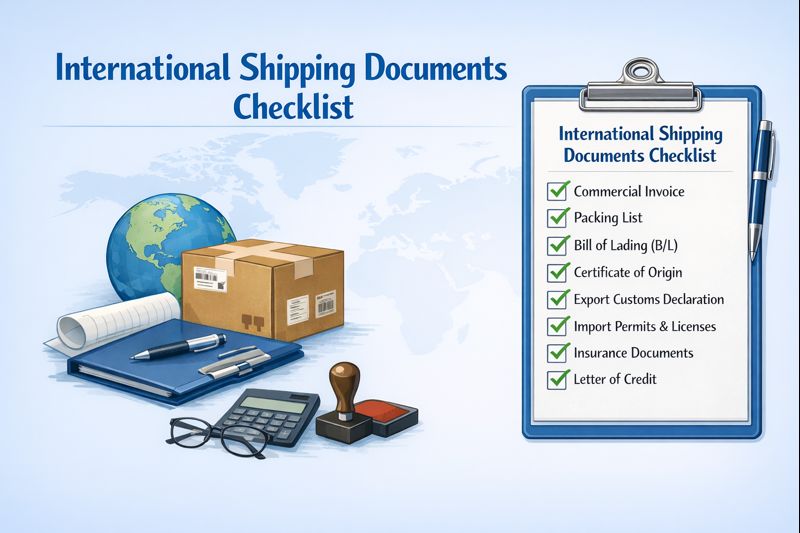
International Shipping Documents Checklist
- Verified & Reviewed · Last updated January 2026
International shipping fails for boring reasons: a shipment is ready, the freight forwarder has space, and customs clearance stalls because document data does not match across the file set, or a destination country requires a form that was never prepared.
This updated 2026 guide explains the key shipping documents most international shipments use and the common add-ons that help prevent customs delays, including the International Air Waybill, Commercial Invoice, Packing List, Certificate of Origin, Pro Forma Invoice, and EEI when required.
Core documents
Required forms
Clearance workflow
- Experienced China-based logistics specialists
Table of Contents
Why proper documentation determines whether you clear customs fast
Customs clearance is a data-matching workflow. Customs authorities and customs officials compare your declared item descriptions, values, origin, and parties involved across documents and electronic filings. When the story matches, you clear customs quickly. When it does not, the shipment is more likely to be questioned, examined, or held.
The biggest performance lever is not “more documents.” It is shipping documentation discipline:
one master dataset for product lines, values, and origin
one final package shared with customs brokers and your freight forwarder
one controlled change rule after cutoff
This is how you ensure smooth customs clearance without constant rework.
The core document set for most international shipments
Most international shipments rely on three key documents:
Commercial invoice
Packing list
air waybill for air shipments, bill of lading for ocean shipments
If you get these three aligned, you remove the largest sources of customs delays. Most issues are not about missing forms; they are about inconsistent data across documents.
To make this repeatable, treat your master dataset as the source of truth for all shipping documentation. Every time you change a quantity, unit value, HS code, or origin line, you must update the dataset first, then regenerate the document set. That is how you avoid version chaos.
Commercial invoice
The commercial invoice is the important document in international shipping because it anchors import control, valuation, and determining customs duties. It is also the document that most customs authorities use to assess duties, taxes, and compliance risk.
Commercial invoice essentials that prevent questions
Include these essential details every time:
Seller and buyer legal names, addresses, and contact details
Importing country consignee details and tax identifiers if applicable
Invoice number and specified date
Accurate content descriptions with material and use
Harmonized system code per line item
Country of origin per line item
Quantity, unit value, total value, currency
Trade term and named place showing responsibility for import duties and whether taxes paid applies
References that connect the file set to your export transaction and internal controls
If any of these fields conflict with the packing list or transport document, expect questions. The goal is not to “sound official.” The goal is to be consistent and verifiable.
Description quality: the simplest way to reduce customs delays
Use a consistent structure: Material + product name + function + end use + model or spec when relevant
Avoid vague descriptions like “parts,” “accessories,” “samples,” or “general goods” without context. When customs officials cannot tell what a product is, they cannot assess duties efficiently, and the shipment becomes a candidate for review.
HS codes and classification discipline
HS codes are essential for the proper classification of goods in shipping documents. Misclassification can trigger duty errors, compliance questions, and clearance slowdowns. Treat HS mapping as a controlled field:
Store one HS code per product line in your dataset
Apply the same HS code across all shipping documents
Only change HS mapping with documentation and internal approval
This is a simple way to ensure compliance under international shipping regulations and reduce duty disputes.
Packing list
A packing list provides a detailed account of the shipment’s contents and how items are packed. It helps your warehouse, carrier handoff, and customs brokers reconcile cargo details quickly. It also supports customs inspections because it shows where items are located within cartons and pallets.
Packing list fields that speed up inspections and release
Include:
Carton and pallet counts
Marks and numbers
Net and gross weight per package
Dimensions and total volume
Item quantities per carton for mixed SKUs
Totals that match the air waybill or bill of lading
A good packing list is not a copy of the commercial invoice. It is a physical map of the cargo. When the packing list totals match the transport document totals, you reduce avoidable customs delays.
Packing slip vs packing list
A packing slip is often used inside cartons for receiving. A packing list is typically part of your shipping documentation package. You can use both, but do not let them conflict. If your buyer relies on a packing slip for receiving, ensure the quantities and item naming remain consistent with the master dataset.
Transport documents
Transport documents connect your paperwork to carrier systems, terminal processes, and release steps. They must match your dataset, and they must stay stable once cutoff passes.
Air waybill for air freight
Air waybill controls:
Shipper and consignee names match the commercial invoice
Piece count and weights match the packing list
Cargo description does not contradict the invoice description
References shared with customs brokers are consistent
Bill of lading for ocean freight
The bill of lading is a core transport document and often treated as a legal document in commercial practice. Small errors can create significant delays at the port.
Bill of lading controls that work:
Lock party names early and keep them consistent
Match package counts and weights to the packing list
Align the cargo description with the commercial invoice wording
Standardize bill of lading bol references across internal systems, forwarder booking, and broker filing notes
If you use multiple bills in a chain, keep a simple register of all bill numbers, which party holds each reference, and which number is used for customs filing. This prevents confusion and accelerates issue resolution.
Straight bill and negotiable document basics
Different bill types behave differently. A straight bill is generally used when delivery is to a named consignee and is not treated as a negotiable document. If ownership transfer or bank control is involved, confirm document requirements early and keep party names exact. This is a common area where small typos create large release delays.
Certificate of origin and trade agreements
A certificate of origin confirms the goods’ origin and is often required to assess preferential tariffs under trade agreements or satisfy destination country import rules.
Origin best practices:
Keep origin consistent across documents and product lines
Align certificate language with the commercial invoice line descriptions
Keep HS mapping consistent where required
Treat origin as a controlled field when a particular country applies strict origin enforcement
Origin mismatch is one of the most frequent reasons a file set gets questioned. If you claim preferential tariffs, your origin proof must match your dataset cleanly.
Customs forms, customs declaration, and determining customs duties
Customs brokers typically transform your document package into customs forms and a customs declaration. Customs authorities use these filings to assess duties, validate classification, and apply country specific regulations.
To reduce filing errors:
Provide one final package, not multiple drafts
Keep product lines stable across the invoice, packing list, and transport record
Keep valuation logic consistent so assessing duties is straightforward
Avoid last-minute edits after cutoff unless you update the entire file set
Inaccurate documentation can result in miscalculations of duties and taxes, leading to financial losses and avoidable disputes. If the declared value changes, the change must flow through every place that value appears.
Export declarations and export compliance controls
Depending on origin country rules, export declarations may be required, and export compliance responsibilities may include reporting, licensing checks, and restricted-party screening. Even when a broker or forwarder files on your behalf, you still need internal controls.
Practical controls for an export shipment:
Decide who files and document responsibility
Store the filing reference with the shipment file
Avoid value changes after filing without a controlled update
Keep party names and addresses consistent across the full dataset
Compliance with export laws is critical in international shipping to avoid penalties, including fines and shipment seizures. The best defense is clean data and stable versions.
Export licenses, import licenses, trade sanctions, and border protection screening
Export licenses may be required based on commodity type, end use, or destination. Import licenses may be required by the importing country to regulate certain goods and protect domestic industry. Trade sanctions increase screening risk and raise the importance of clarity.
Best practice is to build a control pack for controlled items:
Export license proof or determination notes
Technical description and end-use statement
Consistent descriptions and HS logic
Stable parties involved record and addresses
If one party name is abbreviated on one document and spelled out on another, screening systems may flag the shipment. This is why standardization matters.
Hazardous materials, hazardous goods, SDS, and dangerous goods paperwork
Regulated cargo adds documentation requirements and acceptance rules. If shipping hazardous materials, you may need a safety data sheet and other declarations depending on mode and product.
Practical documentation for hazardous goods and dangerous goods:
Safety data sheet
Dangerous goods declaration when required
Labeling and packaging confirmation
Emergency contact information
Do not treat SDS as an afterthought. Incomplete regulated cargo documentation can cause reroutes, additional costs, and significant delays during customs clearance or carrier acceptance.
Trade finance, insurance certificate, SLI, and buyer requirements
Some document requirements come from commercial terms and banking, not just customs regulations.
Insurance certificate
An insurance certificate serves as evidence of cargo insurance coverage. Insurance certificates are often requested when the trade term or buyer contract assigns insurance responsibility to the seller, or when a bank requires proof of coverage.
Operational control:
Keep insured value aligned with declared cargo value
Keep item descriptions aligned with the commercial invoice
Store insurance proof inside the final package
Letters of Credit
Letters of Credit are financial documents to secure payment, often required by banks. LC shipments demand exact document matching. A small mismatch in names, dates, or quantities can delay payment. Treat LC shipments as “zero tolerance” for version drift.
Pro forma invoice
A pro forma invoice is used by the buyer to secure financing or import permits before actual shipment. Treat it as a controlled pre-shipment draft that must evolve into the final dataset. If the pro forma differs materially from the final invoice, expect questions.
Shipper’s Letter of Instruction
Using a Shipper’s Letter of Instruction can help reduce misunderstandings between the exporter and their freight forwarder. It clarifies instructions, filing responsibilities, and expectations. Even when not legally required, it is a powerful communication control that reduces errors.

Two tool modules you can use immediately
These modules are designed to be copied into your SOP so every team runs the same process and you maintain compliance across lanes.
Tool module 1: Pre-shipment document quality audit
Run this before pickup:
Commercial invoice: essential details complete, descriptions clear, HS mapping consistent, values correct
Packing list: carton counts and weights reconcile, shipment’s contents verifiable by carton
Air waybill: pieces and weights match, consignee matches the invoice
Bill of lading: party names locked, package totals match, bill of lading bol references consistent
Certificates: certificate of origin ready when required, pro forma invoice aligned when used
Regulated cargo: safety data sheet attached when hazardous materials apply, DG paperwork ready when required
Tool module 2: Version control and customs hold response playbook
Prevent version chaos:
Create one folder named with a specified date and FINAL
Store only the final invoice, packing list, transport documents, and certificates
Distribute one link to all parties involved, including customs brokers and freight forwarder
When a hold happens:
Respond once with a complete package
Include the invoice, packing list, transport document, certificate of origin when needed, safety data sheet when applicable
Add product specs and photos for identification clarity
This approach reduces repeated questions, supports smooth customs clearance, and minimizes customs delays.
what documents you need and what usually breaks
| Scenario | Core documents | Common add-ons | What usually breaks |
|---|---|---|---|
| Standard goods | commercial invoice, packing list, air waybill or bill of lading | customs declaration support | vague description, totals mismatch |
| Preference claim | core set | certificate of origin, trade agreements proof | origin or HS mismatch |
| Controlled or licensed | core set | export licenses, end-use statement | screening questions, missing support |
| Hazardous or bank-backed | core set | safety data sheet or insurance certificate | acceptance gaps or document mismatch |
Failure to provide the correct shipping documents can lead to avoidable costs. Missing or incorrect documentation can also trigger demurrage charges at the port, turning a simple delay into a larger financial event.
Cost and compliance risks: how documentation mistakes trigger real charges
International shipping paperwork is not only about clearing customs. It controls cost exposure across terminals, carriers, and regulators. When documentation is incomplete, inconsistent, or late, the shipment may be held for additional information. That hold can cascade into storage charges, demurrage, reroutes, and enforcement risk.
Storage fees, demurrage, and schedule disruption
For ocean cargo, port time is money. If the consignee cannot complete clearance or pickup due to document issues, container dwell time increases and fees can start. The simplest prevention is document readiness before arrival and a clean final package.
Duty and tax miscalculations
Inaccurate documentation can result in miscalculations of duties and taxes. These errors often start with small dataset conflicts: inconsistent product descriptions, incorrect HS assignment, or mismatched totals across documents and systems.
To reduce this risk, lock a single master dataset and keep it consistent from booking to clearance. This supports consistent duty assessment and fewer clarifications.
Penalties, seizures, and long-term friction
Compliance risk is not limited to one shipment. Repeated errors can increase inspection frequency over time, creating long-term friction. Build internal controls that prevent “small mistakes” from repeating, especially around valuation, classification, and party details.
Communication controls across all parties involved
Maintaining clear communication among all parties involved in shipping is crucial to avoid errors and keep shipments on schedule. One source of truth, one final package, one controlled update rule. That is how you keep cross border shipments predictable even when rules change.
Frequently Asked Questions
Essential documents usually include a commercial invoice, packing list, and a transport document such as an air waybill or bill of lading. Depending on the destination country and product, you may also need a certificate of origin, customs declaration support, licenses, or a safety data sheet.
The commercial invoice is typically the most important document because it supports valuation, classification, and duty assessment during customs clearance.
You need consistent party details, accurate item descriptions, HS codes, origin, quantities, values, trade terms, and stable references that connect the shipment across systems.
Customs clearance normally requires a complete document package that supports a customs declaration, including item lines, value logic, and origin proof. Additional customs forms may apply based on the importing country.
You often need it when a destination country requires origin proof, or when you claim preferential tariffs under trade agreements.
Prepare a safety data sheet and any required dangerous goods paperwork, and ensure packaging and labeling match the declared classification.
Use one master dataset, keep all shipping documents aligned, control versions with one final package, and respond to requests with a complete bundle plus product specs and photos.
Related Shipping Documentation Guides
Get Your International Shipping Documents Checklist
One FINAL document set, ready to share with your forwarder and broker
HS code, origin, and value consistency checks to prevent holds
Lane-based add-ons for controlled and hazardous shipments
Get tailored shipping options, transparent pricing, and expert support for your shipment.