

ISF Filing 10+2 Explained: Importer Security Filing Guide for Global Shippers
- Verified & Reviewed · Last updated January 2026
ISF filing 10+2 explained is a practical guide for international importers, exporters, and logistics teams shipping U.S.-bound ocean cargo. Importer Security Filing is an advance cargo security requirement that gives U.S. Customs and Border Protection early visibility into shipment parties and key identifiers before a container is loaded overseas.
This guide breaks down what ISF 10+2 requires, who files it, the key data elements you need, and how ISF aligns with the ocean manifest and customs entry process. Use it to build repeatable ISF compliance across suppliers and forwarders, reduce holds and exams, and keep your global supply chain moving smoothly.
ISF 10+2 basics
24-hour rule
Data checklist
- Experienced China-based logistics specialists
Table of Contents
What Importer Security Filing ISF 10+2 Means
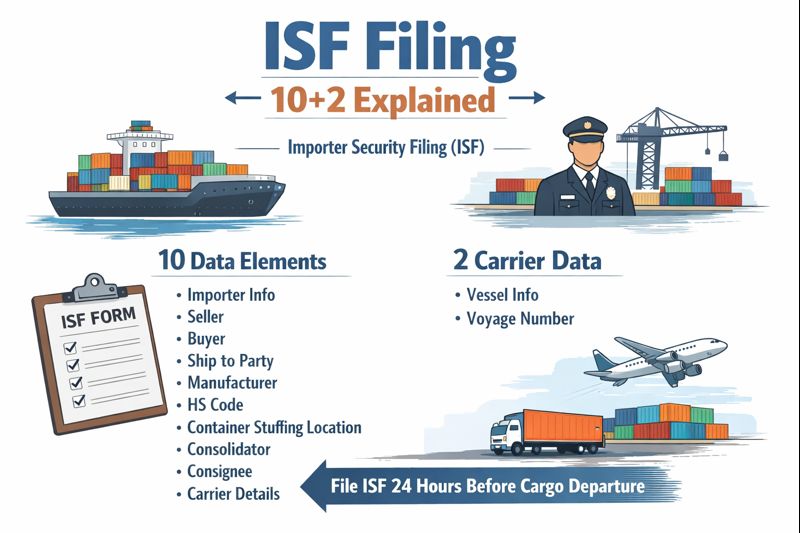
Importer Security Filing is a U.S. pre-loading security filing for U.S.-bound ocean cargo. It is called ISF 10+2 because the submission is made up of two parts.
The “10” importer data elements
The importer provides 10 data elements about the shipment. These identify the key parties and where the cargo comes from and is packed, such as seller, buyer, importer of record, consignee, manufacturer, ship-to party, country of origin, harmonized tariff schedule number, container stuffing location, and consolidator.
The “+2” carrier data elements
The ocean carrier provides 2 additional data elements: the vessel stow plan and container status messages. These help CBP understand how the container is positioned and tracked during the voyage.
Why the 10+2 structure matters
CBP combines the importer’s “10” and the carrier’s “+2” as advance cargo information to assess risk before loading. When your importer-side details are consistent and complete, the filing is easier to repeat, ISF compliance is stronger, and the shipment is less likely to be treated as higher-risk due to unclear or conflicting information.
Why ISF Exists: SAFE Port Act, Final Rule, and Enforcement Purpose
ISF is widely associated with stronger maritime security measures after the SAFE Port Act of 2006, and the ISF final rule and related guidance now form part of broader statutory and regulatory requirements for pre-arrival screening. Under border protection, CBP uses ISF as a risk-management tool by collecting advance cargo information early enough to identify potential issues before loading and before the shipment reaches a U.S. port, supporting cargo security and trade enforcement.
What the SAFE Port Act changed for ocean imports
After the SAFE Port Act, CBP placed more emphasis on upstream visibility and targeting. ISF supports that approach by requiring importers to provide key shipment details early, helping CBP focus resources on higher-risk cargo while allowing compliant shipments to move with fewer disruptions.
What “final rule” and enforcement mean in real operations
The final rule sets the filing expectations, and enforcement is how CBP encourages consistent compliance. In practice, late, missing, or inaccurate filings can trigger extra scrutiny, cargo holds, and financial exposure. The best way to reduce risk is to file early, keep party data consistent, and correct updates quickly when shipment details change.
Scope: ISF Filing Requirements Apply to Ocean Cargo Only
The ISF regulation applies to cargo entering the United States by ocean vessel. It does not apply to air, truck, or rail shipments, so you do not file ISF for air freight, express parcels, or cross-border trucking.
If your goods move by vessel as containerized cargo, assume the isf filing requirements apply unless your licensed customs broker confirms a specific exception for your movement type. This matters even more for consolidations, because the ISF must align with the bill of lading level filed in the Automated Manifest System.
ISF Importer, Authorized Agent, and Liability
The responsible party is the isf importer. The ISF importer is responsible for timely, accurate, and complete submission of the importer-provided data elements, even when a third party transmits the filing.
Many companies appoint a broker or provider as an authorized agent. In daily operations, a licensed customs broker commonly submits electronically. A strong customs broker process reduces errors, but it does not replace importer responsibility. A practical reminder is that only the party acting as the ISF importer remains accountable for the facts.
How to structure responsibility to support ISF compliance
Assign one internal owner to collect supplier facts and one owner to manage broker communication. This prevents missing fields and keeps ISF compliance consistent.
Where freight forwarders fit in the ISF workflow
A freight forwarder helps coordinate upstream details such as booking updates, document cutoffs, and stuffing-site confirmation, especially for consolidations or multi-supplier shipments. The ISF Importer still owns accuracy and timing, while the forwarder supports coordination with the customs broker. For example, Tonlexing can help keep these details aligned so your ISF submission stays consistent.
Timing Rules: Foreign Port Deadline and Booking Coordination
Core timing rule at the foreign port
The ISF filing must be submitted at least 24 hours before cargo is loaded onto the vessel at the foreign port. This clock is based on loading time, not sailing time and not arrival time.
Document cutoff is your real internal deadline
Confirm cutoffs with the booking owner, often tracked as the booking party foreign port or a party foreign port contact. In practice, document cutoffs usually come earlier than the loading window, so treat the document cutoff as your internal target.
What to do when schedules shift
If the loading window moves forward, check immediately whether your customs broker needs an update. Timing shifts are most risky when your filing still depends on incomplete supplier details.
ISF Data Elements: What Importers Must Collect
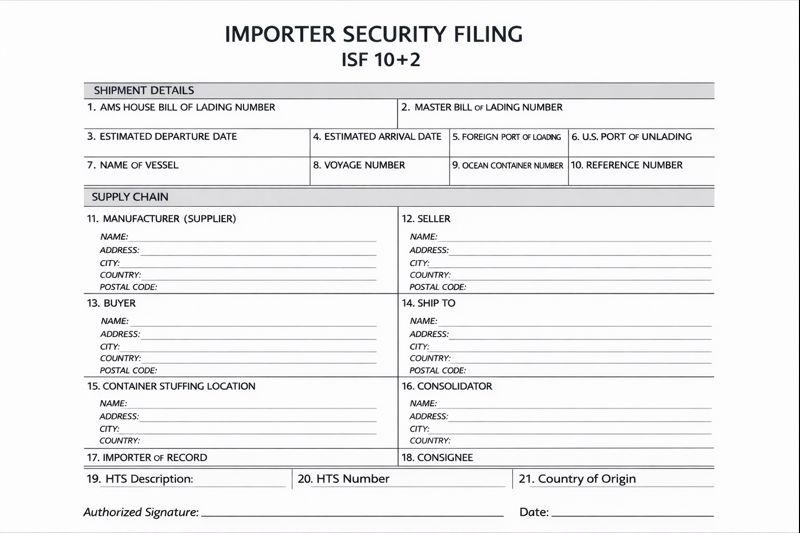
The importer must provide a defined set of shipment data elements electronically. These data elements should match bill of lading instructions and align with later clearance work. Most problems come from mismatched identities, guessed stuffing details, or classification changes made too late.
| ISF data elements group | What to confirm |
|---|---|
| Seller, Buyer | Correct name and address |
| IOR, Consignee | importer of record number, consignee number |
| Manufacturer | name and address of the actual manufacturer |
| Ship-to | ship to party details and ship to party country when used internally |
| Classification | harmonized tariff schedule number under the harmonized tariff schedule |
| Stuffing + Consolidator | container stuffing location and consolidator name and address |
Many teams remember the core parties with seller buyer importer, then focus verification effort on the operational fields.
Common Error Triggers: Manufacturer, Stuffing Site, and Supporting Proof
Manufacturer accuracy matters. Do not list a trading company when CBP expects the factory. Confirm the actual manufacturer and keep the manufacturer name and address consistent across invoice and broker worksheet.
Container stuffing location must reflect the real stuffing site. It should match the true physical location, not a generic office address. For consolidated cargo, stuffing may occur at a warehouse different from the seller, so confirm the warehouse address early.
A quick habit that improves isf compliance is to request a loading note or stuffing confirmation that supports the stuffing location you submit.
Carrier Side Filing: Two Additional Data Elements and Responsibilities
The carrier portion of 10+2 is submitted by the ocean carrier. The carrier transmits the vessel stow plan and container status messages to complete the screening dataset.
These are commonly described as the two additional data elements on the carrier side. Importers do not submit them, but importer-side accuracy still affects how coherent the combined record appears.
You may also see references to additional data elements in this context. Keep your importer-side data elements clean so the full dataset remains consistent.
Customs Entry Alignment
ISF vs customs entry: different purpose, same facts
ISF supports early screening, while customs entry supports admissibility, duty assessment, and release. Even though they are different filings, the core shipment facts must match.
Most common mismatch areas
Conflicts usually come from party name and address, manufacturer identity, ship-to details, and classification, especially the harmonized tariff schedule number. These mismatches increase the chance of extra questions and rework.
Quick mismatch checklist before discharge
Compare the ISF confirmation against the customs entry draft. Check party name and address, manufacturer, ship-to details, and harmonized tariff schedule number, then fix conflicts before discharge planning, especially for a consumption entry where release timing is more sensitive.
Avoid Inaccurate Filing and Reduce Operational Risk
Avoid inaccurate filing with verified source data
Use one standardized intake sheet and require supplier confirmation for key fields before you submit. Most inaccurate filing comes from copied details, inconsistent name and address, or guessing the stuffing location.
Correct incomplete data as soon as it is confirmed
If you discover incomplete data or a wrong detail after filing, update it immediately once the verified information is available. Early corrections are easier and reduce the chance of delays later.
Reduce operational risk with a simple control loop
After submission, review the ISF confirmation against your invoice and shipment instructions. This quick loop prevents small errors from turning into cargo delays, extra questions, or significant consequences for delivery planning.
Bonds, Penalties, and Special Scenarios
Customs bond for ISF filing requirements
A customs bond is generally required for ISF filing requirements.
Continuous bond: Best for frequent importers. It supports repeat shipments and keeps ISF compliance consistent.
Single-entry bond: Works for occasional imports, but confirm coverage early so your ISF filing is not delayed.
Monetary penalties and liquidated damages exposure
CBP risk usually comes from three issues: late ISF filing, missing ISF filing, or materially inaccurate filing. These can trigger monetary penalties, and CBP may assess liquidated damages depending on bond terms. To avoid costly penalties, submit early with verified party details, keep the harmonized tariff schedule number stable, and update quickly if shipment facts change.
Special scenarios to confirm with a customs broker
Some shipments require extra attention, including ISF-5 movements and non-standard cases flagged by terms like freight remaining or same vessel. Cargo type can also change handling, including bulk cargo, bulk shipments, and break bulk shipments. In these situations, confirm the correct ISF approach with a customs broker before assuming an exemption, so your filing stays compliant and your ocean cargo moves without avoidable holds.
Frequently Asked Questions
It means the importer submits required shipment data elements to U.S. Customs and Border Protection, and the ocean carrier submits carrier-side information used for screening.
The isf filing must be submitted at least 24 hours before cargo is loaded at the foreign port. Submitting earlier gives you time to correct mistakes.
The biggest issues are inconsistent name and address, wrong container stuffing location, unstable classification and harmonized tariff schedule number, and manufacturer identity problems.
A customs bond is generally required, and many importers use a licensed customs broker to transmit the filing. A customs broker reduces execution errors, but the importer remains responsible for correct facts.
Use one standard intake template, verify stuffing facts as the real physical location, lock key data elements early, align the file with customs entry, and correct quickly if facts change. This is the most reliable way to meet isf requirements and reduce risk.
Learn more Guides
Get help with ISF 10+2 filing
ISF 10+2 data checklist review
Meet the 24-hour loading rule
Reduce holds, exams, and penalties
Send your shipment details and B/L info. We’ll confirm what’s needed before loading.