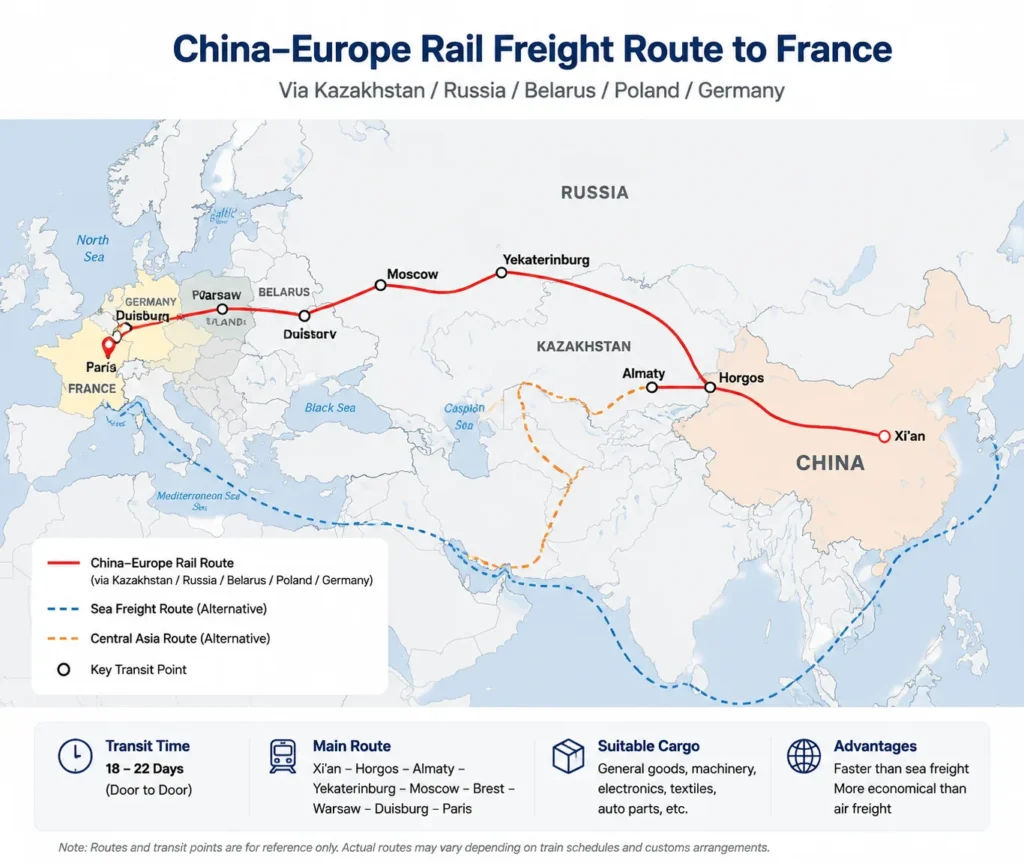
China → Kazakhstan → Russia → Belarus → Poland → Germany → France


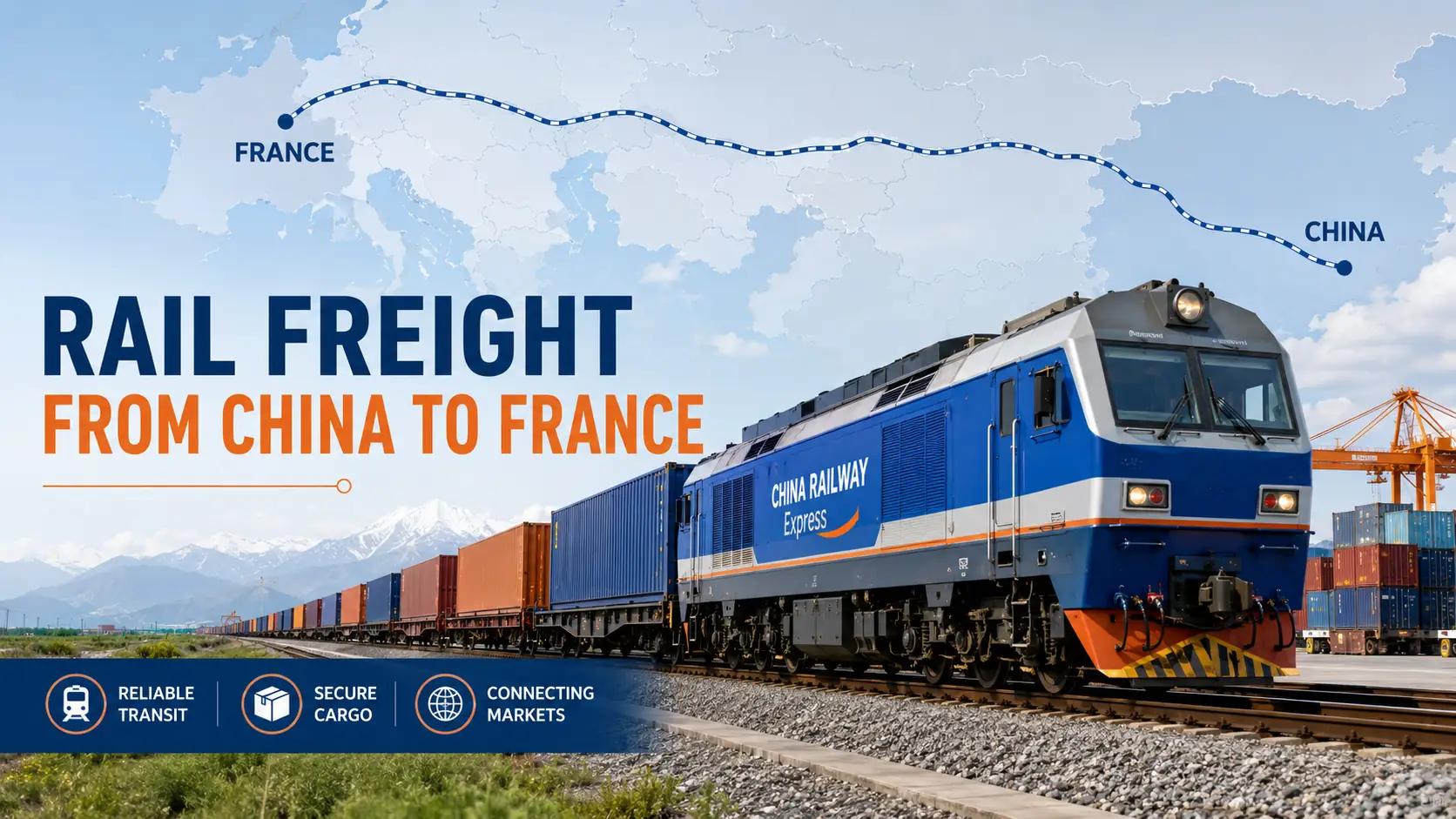
Rail Freight from China to France
- Verified & Reviewed · Last updated August 2026
Rail freight from China to France provides a balanced shipping solution for importers that need faster delivery than sea freight with lower costs than air freight.
Typical rail transit takes around 18–22 days, with FCL, LCL and door-to-door services available for commercial shipments across France.
Rail Shipping Service
Major French Destinations
Door-to-Door Support
- Experienced China-based logistics specialists
10,000+ international shipments handled Global sea, air & DDP shipping solutions 24/7 shipment tracking & customer support
Rail Freight from China to France at a Glance
For importers planning rail freight from China to France, the following figures provide a practical reference before requesting a shipment-specific quotation.
20GP CONTAINER
$4,150–5,100
FCL Rail Freight
Dense cargo & machinery
40GP CONTAINER
$6,000–7,400
FCL Rail Freight
Larger commercial shipments
LCL RAIL FREIGHT
$120–250/CBM
Shared Container Space
Smaller shipments
TYPICAL TRANSIT
18–22 Days
China–France Rail
Route and destination dependent
Actual rail freight costs and transit times vary according to the route, cargo details, season, terminal availability and final delivery requirements.
Table of Contents
Rail Freight Costs from China to France
Rail freight costs from China to France generally sit between air and sea freight. For businesses moving machinery, electronics, automotive parts or regular commercial cargo, rail can provide a useful balance between transit time and transportation cost.
FCL Rail Freight Rates
Full container load rail freight is suitable for larger shipments that can use most or all of a container. Standard 20GP, 40GP and 40HQ equipment is commonly used for China-Europe rail services, although availability should be confirmed before booking.
| Container Type | Estimated Rail Freight Cost | Best For |
|---|---|---|
| 20GP | US$4,150–US$5,100 | Dense cargo, machinery and industrial goods |
| 40GP | US$6,000–US$7,400 | Larger commercial shipments |
| 40HQ | US$6,500–US$8,300 | High-volume and lightweight cargo |
These prices are general market references rather than fixed quotations. Rates can change according to the Chinese departure hub, European arrival terminal, train capacity and final delivery location in France.
LCL Rail Freight Rates
Less than container load rail freight is a practical option when the shipment is not large enough to justify an entire container. Cargo is consolidated with other compatible shipments in China and deconsolidated after arrival in Europe.
As a general reference, LCL rail freight can range from approximately US$120–US$250 per CBM. The actual charge depends on cargo density, consolidation terminal, handling requirements and the final destination.
For heavier or higher-volume LCL shipments, it is worth comparing the LCL quotation with a full container load rate. As shipment volume increases, FCL can sometimes provide better cost efficiency and simpler handling.
What Affects the Final Rail Freight Cost?
The international rail rate is only one part of the total shipping cost. Pickup in China, terminal handling, customs procedures and final road delivery can all affect the final quotation.
The main cost factors include:
Origin pickup: Distance from the supplier to the departure rail terminal
Cargo size and weight: Particularly important for LCL shipments
Container type: 20GP, 40GP and 40HQ have different base rates
Departure terminal: Different Chinese rail hubs may have different schedules and pricing
Rail route: Available capacity and corridor selection can affect the rate
Destination handling: Terminal and customs-related charges in Europe
Final delivery: Trucking from the arrival terminal or European gateway to the consignee in France
For this reason, the cheapest terminal-to-terminal rail rate is not always the cheapest door-to-door option. A lower international rate can be offset by longer domestic trucking in China or higher last-mile delivery costs in France.
Peak Season and Rate Changes
Rail freight rates can rise when capacity becomes tight, particularly before Chinese New Year and during the main autumn shipping season when importers are preparing inventory for year-end demand.
For shipments with a fixed delivery deadline, booking earlier can help secure space and reduce the risk of last-minute rate increases. It is usually better to compare both price and available departure schedules rather than waiting for the lowest possible rate.
For an accurate quotation, provide the product name, number of cartons or pallets, gross weight, dimensions, supplier address and final delivery address in France.
How Long Does Rail Freight from China to France Take?
The main rail transit time from China to France is typically around 18–22 days for many scheduled services. This makes rail considerably faster than conventional sea freight while remaining slower than air freight.
For comparison, air freight generally takes around 5–7 days, while sea freight may take around 25–28 days or longer for the main international journey. Express shipping can be faster still, but it is normally used for small and urgent shipments rather than regular commercial cargo.
Typical Rail Shipping Timeline
| Shipping Stage | Estimated Time |
|---|---|
| Supplier Pickup & Export Preparation | 1–3 days |
| China-Europe Rail Transit | Around 18–22 days |
| Customs Clearance & Terminal Handling | 1–3 days |
| Final Delivery in France | 1–3 days |
Factors Affecting Rail Transit Time
Several factors can influence the final delivery schedule:
Departure city in China: Rail schedules and domestic transportation time vary between different origins, such as Xi’an, Chengdu, Chongqing and other major rail hubs.
Rail route selection: Different China-Europe rail corridors may have different transit times depending on capacity and operating conditions.
Border operations: Containers may require transfer at certain border crossings due to different railway systems, which can affect the schedule during busy periods.
Customs clearance: Complete and accurate shipping documents help avoid unnecessary delays.
Final destination in France: Delivery time after rail arrival depends on the location of the consignee and inland transportation arrangements.
For businesses planning inventory or production schedules, it is recommended to estimate the shipment based on the complete door-to-door transit time rather than only the international rail journey.
Main Rail Routes from China to France
There is no single rail route used for every shipment from China to France. The actual routing depends on the cargo origin, departure schedule, available rail capacity, geopolitical conditions and final destination.
China-Europe rail corridors can cover more than 11,000 km, crossing several countries before cargo reaches Western Europe. Some trains connect with French terminals, while other shipments first arrive at major European logistics hubs before continuing to France by rail or road freight.
For this reason, route planning should consider the complete journey rather than only the international rail section.
01 Northern Corridor
Traditional Eurasian Route
The Northern Corridor is one of the established China-Europe rail routes. Cargo leaves China through western border gateways such as Alashankou or Khorgos, crosses Central Asia and enters Europe through major rail gateways.
Suitable for stable rail services with established connections to Western Europe.
02 Middle Corridor
Trans-Caspian Route
China → Kazakhstan → Caspian Sea → Azerbaijan → Georgia → Europe → France
The Middle Corridor provides an alternative route that avoids the northern path. It combines rail transport and Caspian Sea shipping before continuing toward Europe.
Useful when route availability, capacity or geopolitical conditions require alternatives.
Major Rail Hubs in China
Rail freight from China can depart from several inland logistics centers. Xi’an, Chengdu, Chongqing, Zhengzhou and Wuhan are among the major China-Europe rail hubs, with other terminals available depending on the train schedule and destination.
Factories do not need to be located in the same city as the departure terminal. Cargo from coastal manufacturing regions can be collected and transported inland before joining an international train.
For example:
Cargo from Shenzhen, Guangzhou and Dongguan can be collected across South China.
Shipments from Shanghai, Suzhou, Ningbo and Hangzhou can be transferred from East China.
Suppliers in central and western China may have shorter access to inland rail terminals.
The nearest terminal is not automatically the best option. A slightly longer domestic transfer may provide access to a more frequent train, better capacity or a more efficient connection to France.
Rail Hubs and Final Delivery in France
The first European rail terminal does not always need to be located in France. Depending on the service, cargo may arrive at a French terminal or enter Europe through Germany, Poland, Belgium or another nearby gateway before continuing to France.
The most suitable arrival point depends on the consignee’s final location. Cargo bound for northern France may use a different European connection from shipments going to Paris, Lyon or other regions.
After the rail section is complete, road freight is commonly used for final delivery to:
Warehouses
Factories
Distribution centers
Fulfillment facilities
Commercial addresses
This combination of rail and truck transport makes it possible to serve French destinations that do not have direct access to an international rail terminal.
FCL and LCL Rail Freight from China to France
Rail freight can be booked as either a full container load (FCL) or less than container load (LCL) service. The better option depends mainly on shipment size, cargo characteristics, frequency and overall shipping costs.
FCL is generally more suitable for larger or regular shipments, while LCL allows smaller shipments to use rail transport without paying for an entire container.
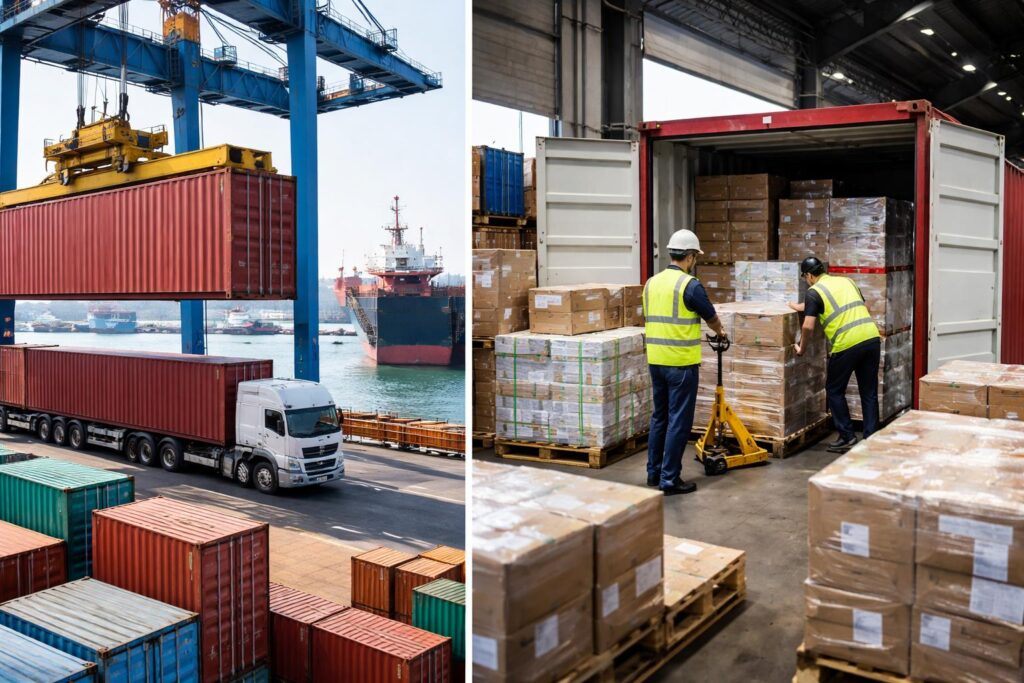
FCL Rail Freight
With FCL shipping, one shipper uses the entire container. This is often the preferred option for larger commercial orders, regular replenishment cargo and goods that benefit from fewer consolidation operations.
Common equipment includes 20GP, 40GP and 40HQ containers, subject to route and equipment availability.
Full container load rail freight is commonly used for:
Machinery and industrial equipment
Automotive components
Mechanical and electrical products
Furniture
Larger quantities of consumer goods
Using an entire container also reduces consolidation handling because the goods do not need to share space with unrelated shipments.
LCL Rail Freight
Less than container load rail freight allows cargo from several customers to share one container. It is often suitable for smaller shipments that are too heavy or bulky for economical air freight but do not require a full container.
Cargo is first delivered to or collected for a consolidation warehouse in China. After compatible shipments are combined, the container travels through the international rail network.
At destination, the container is deconsolidated and each shipment continues through customs clearance and final delivery separately.
How the Rail Shipping Process Works
Shipping goods from China to France by rail involves several coordinated steps, including cargo pickup, export preparation, international rail transport, customs clearance and final delivery.
A reliable freight forwarder helps manage each stage of the shipment, ensuring the cargo moves smoothly from the supplier in China to the final destination in France.
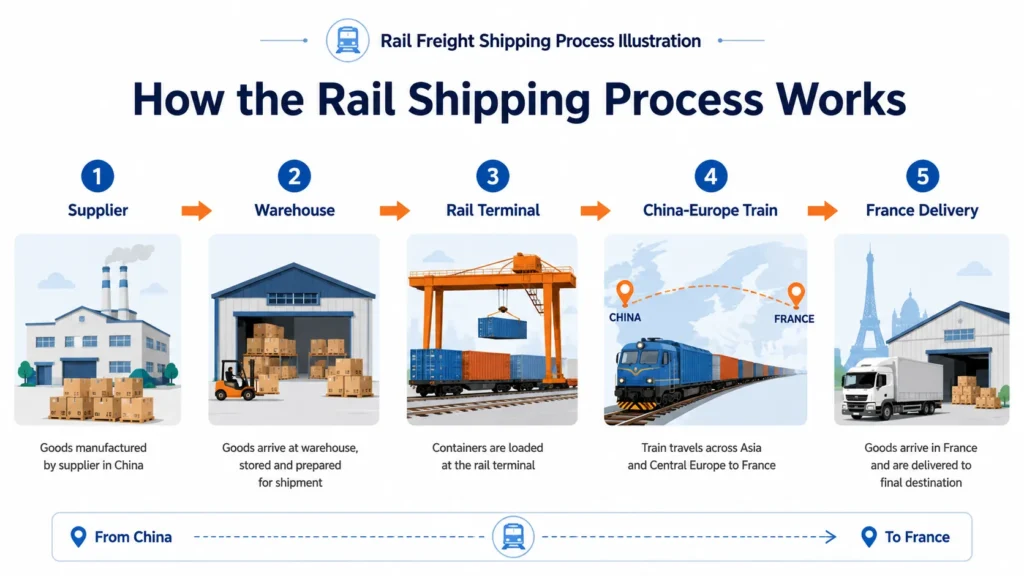
Send Cargo Details
Provide the product name, package details, weight, dimensions, supplier location and final delivery address. This information helps determine the suitable rail route, FCL or LCL option and estimated cost.

STEP 01
Pickup & Export Preparation
Cargo is collected from the supplier and transported to the rail terminal or consolidation warehouse in China. Export documents are prepared and customs procedures are completed before departure.

STEP 02
China-Europe Rail Transit
The shipment travels through the selected rail corridor toward Europe. Depending on the route, containers may pass through border crossings and transfer points before reaching the European gateway.

STEP 03
Import Customs Clearance
After arrival in Europe or France, the shipment completes customs procedures and terminal handling before moving to the final delivery stage.

STEP 04
Final Delivery in France
The cargo is transported by truck from the rail terminal to the customer's warehouse, factory or commercial address, completing the door-to-door shipping process.

STEP 05
Door-to-Door Rail Shipping from China to France
Door-to-door rail shipping from China to France combines cargo pickup, international rail transport, customs coordination and final delivery into one complete logistics solution.
Instead of arranging multiple transportation providers separately, importers can use one service that manages the shipment from the supplier’s location in China to the final warehouse, factory or commercial address in France.
A typical door-to-door rail service includes:
Supplier pickup in China
Export customs clearance
Rail freight to Europe
Import customs coordination
Terminal handling
Final truck delivery in France
This service is especially useful for businesses purchasing from multiple Chinese suppliers or companies that prefer a simpler supply chain management process. Cargo can be collected, consolidated and shipped through the most suitable rail route before being delivered directly to the final destination.
Customs Clearance in France for Rail Freight
Rail freight from China to France still requires proper import customs procedures after the shipment arrives in Europe. Although rail provides a faster alternative to sea freight, customs clearance remains an important step that can affect the final delivery schedule.
A smooth customs process depends on accurate shipment information, correct product classification and complete import documentation. Preparing the required documents before the cargo arrives helps reduce delays and unexpected costs.
Common Documents Required for Customs Clearance
The required documents may vary depending on the cargo type and import requirements, but most shipments include:
Commercial invoice
Packing list
Rail transport document
HS code and product description
Importer information and EORI number
Certificates or compliance documents when required
The commercial invoice should clearly show the seller, buyer, product details, quantity, value, currency and trade terms. The product description and HS code should match the actual cargo to avoid classification issues during customs review.
Customs Considerations for Rail Shipments
Several factors can influence the customs clearance process in France:
Product classification: Different goods may have different import requirements, duties and compliance obligations.
Documentation accuracy: Missing or inconsistent information can delay customs processing.
Cargo type: Electronics, machinery, batteries and regulated products may require additional documents.
Importer responsibility: The importer should understand their obligations regarding duties, VAT and customs declarations.
For shipments entering through other European gateways before delivery to France, customs arrangements may depend on the selected route and transport solution.
Customs Support for China-France Rail Freight
Working with an experienced freight forwarder can simplify the customs process by coordinating documents, shipment information and communication between suppliers, carriers and customs parties.
Tonlexing can assist with customs coordination as part of China-France rail freight solutions, helping importers manage the shipment from origin pickup through final delivery in France.
Rail Freight vs Air Freight vs Sea Freight
Choosing the right shipping method from China to France depends on several factors, including delivery time, cargo volume, budget and the importance of inventory availability.
Rail freight provides a middle solution between air and sea transport. It is faster than ocean freight while offering lower transportation costs than air freight for many commercial shipments.
| Shipping Method | Transit Time | Cost Level | Best For |
|---|---|---|---|
| Air Freight | Around 5–7 days | High | Urgent and high-value cargo |
| Rail Freight | Around 18–22 days | Medium | Time-sensitive commercial shipments |
| Sea Freight | Around 25–40 days | Lower | Large-volume and less urgent cargo |
Rail Freight: Balanced Speed and Cost
Rail freight is suitable for businesses that need faster delivery than sea freight but do not require the speed of air transportation.
It is commonly used for:
Machinery and industrial equipment
Automotive components
Electronics
Regular inventory replenishment
Medium and high-value commercial goods
Rail is especially useful when reducing transit time can improve inventory planning, but air freight costs are too high for the shipment size.
Air Freight: Fastest Option for Urgent Shipments
Air freight is the best choice when delivery speed is the highest priority.
It is commonly selected for:
Urgent spare parts
Samples and prototypes
High-value products
Time-critical shipments
However, air freight costs increase significantly with shipment weight and volume, making it less practical for large commercial cargo.
Sea Freight: Best for Large and Cost-Sensitive Cargo
Sea freight remains the most economical option for large-volume shipments where delivery time is less critical.
It is commonly used for:
Full container shipments
Bulk cargo
Large inventory orders
Non-urgent commercial goods
For businesses that can accept longer transit times, ocean freight often provides the lowest transportation cost per unit.
What Can Delay a Rail Shipment to France?
China-Europe rail freight operates on scheduled services, but the journey still passes through several railway networks, countries and border terminals. Actual transit time can therefore vary between departures.
Congestion at border crossings is one of the more common causes of delay. Containers may need to wait for wagon transfer or terminal capacity before continuing to the next railway network.
Other possible causes include:
Cargo arriving late at the departure terminal
Missing or incorrect export documents
Customs inspection
Limited rail capacity during peak periods
Changes to the planned route
Geopolitical disruption
European terminal congestion
Incomplete consignee information
Delays during final road delivery
Rail freight is generally less exposed to some maritime weather and port disruptions than sea freight, but it has its own operational risks.
Early booking, accurate documentation and realistic transit-time planning can reduce avoidable delays and make the shipment easier to manage.
What Can Delay a Rail Shipment to France?
Choosing a rail freight partner for China-France shipments requires more than arranging train space. Importers need reliable coordination between suppliers, rail operators, customs procedures and final delivery to ensure the shipment moves smoothly from China to France.
Tonlexing provides integrated rail freight solutions for businesses shipping commercial cargo from China to France, including route planning, cargo handling, customs coordination and door-to-door delivery.
China Rail Network Coordination
Tonlexing works with major China-Europe rail departure hubs and helps select suitable transportation solutions based on cargo origin, shipment size and delivery requirements.
Whether cargo comes from South China, East China or inland manufacturing areas, the shipment can be arranged through an appropriate rail connection.
Flexible FCL and LCL Rail Solutions
Different businesses have different shipping requirements. Tonlexing supports both FCL and LCL rail freight options for various cargo volumes.
FCL solutions for larger shipments requiring dedicated container space
LCL solutions for smaller shipments that do not require a full container
End-to-End Shipment Management
Rail freight involves multiple stages, including supplier pickup, export preparation, international transport, customs clearance and final delivery.
Tonlexing helps coordinate these processes through one logistics solution, reducing the complexity of managing multiple service providers.
Customs and Final Delivery Support
From document preparation to customs coordination and inland transportation in France, Tonlexing helps importers manage the shipment beyond the rail journey itself.
This allows businesses to focus on their operations while maintaining better visibility throughout the supply chain.
Frequently Asked Questions
How long does rail freight from China to France take?
The main international rail journey typically takes around 18–22 days for many scheduled services. Total door-to-door transit time is longer because supplier pickup, terminal handling, customs clearance and final delivery also need to be included.
How much does rail freight from China to France cost?
As of August 2026, indicative FCL rail rates are around US$4,150–US$8,300 per container, depending on container size, route and capacity. LCL rail freight can be around US$120–US$250 per CBM. Actual shipping costs depend on the origin, destination and final delivery requirements.
Is there a direct freight train from China to France?
Some China-Europe services connect with French rail terminals, but not every shipment travels from China to France on one direct train. Cargo may first reach another European rail hub before continuing to France by rail or truck.
Is rail freight cheaper than air freight?
Rail freight is generally more cost effective than air freight for larger and heavier commercial shipments. Air remains much faster, so the better option depends on how urgently the cargo is required.
Is rail freight faster than sea freight?
Yes. Rail normally provides a shorter transit time than conventional sea freight between China and France. Sea freight remains more suitable for larger volumes where lower transportation costs are more important than speed.
Can small shipments move by rail?
Yes. LCL rail services allow smaller shipments to share container space with other cargo. This can be a practical alternative to air freight for heavy or bulky goods that do not require a full container.
Related Logistics Guides
Useful freight, customs and importing resources related to this shipping guide.
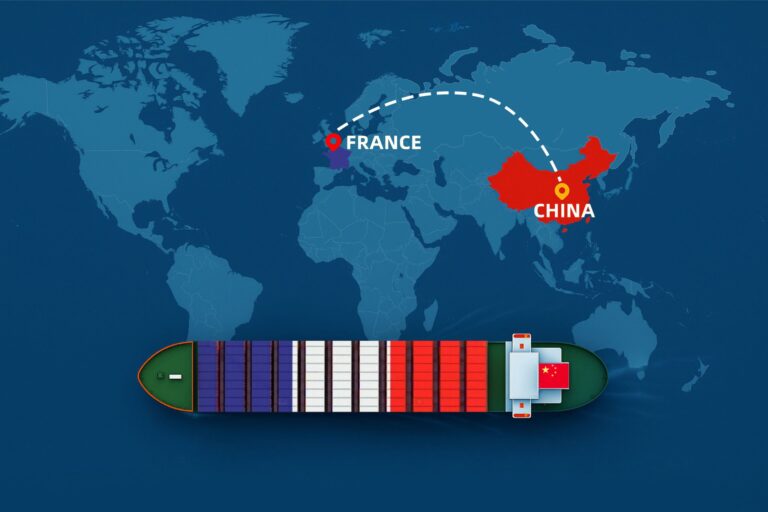
Related Guide
Shipping from China to France
Visual map showing shipping route from China to France with a cargo ship carrying containers in the colors of the French flag.
Read guide →
Related Guide
Shipping Cost from China to France (2026 Guide)
Shipping Cost from China to France (2026 Guide) Verified & Reviewed · Last updated June 2026 Shipping cost from China to France typically starts...
Read guide →
Related Guide
How Long Does It Take to Ship from China to France?
France is one of the largest import markets in Europe, and trade with China has been growing rapidly over the last two decades. Whether you are a...
Read guide →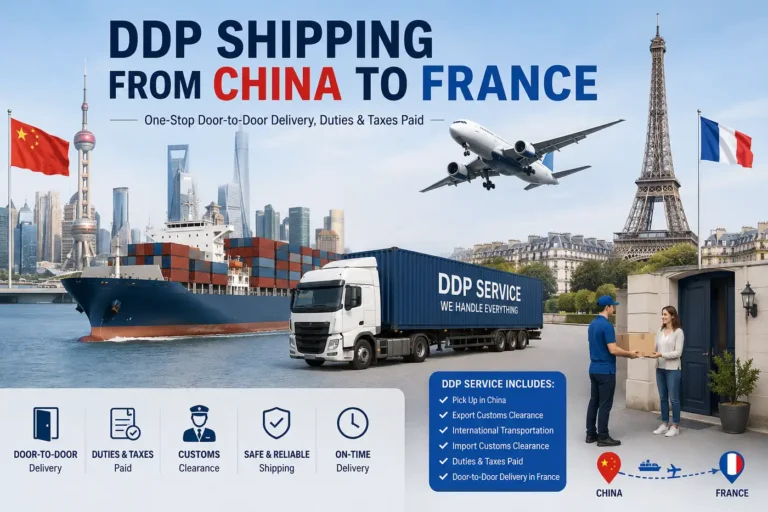
Related Guide
DDP Shipping from China to France
DDP Shipping from China to France Verified & Reviewed · Last updated June 2026 DDP shipping from China to France is an all-inclusive door-to-door...
Read guide →
Useful Resource
Rail Freight from China
Shipping from China / Rail Freight from China International Rail Freight Services · China to Europe & Eurasia Rail Freight from China Move cargo...
Learn more → Useful Resource Railway Freight from China to Europe: A Comprehensive GuideRailway freight has become an increasingly popular shipping solution for businesses looking to transport goods from China to Europe. The rise of...
Learn more →