Related Guide
Shipping Cost from China to Uzbekistan
Introduction: Why Uzbekistan Matters in China’s Cross-Border Trade Shipping cost from China to Uzbekistan is a key consideration for businesses l...
Read guide →

Rail freight from China to Uzbekistan is a practical and cost-effective option for commercial cargo moving across Central Asia. Most established services travel through Kazakhstan to Tashkent and other inland destinations, with both FCL and LCL options available for different shipment sizes.
This guide covers the main China–Uzbekistan rail routes, typical 15–25 day transit times, rail freight costs, container options, customs clearance, and door-to-door delivery. It also explains the key factors that can affect schedules and final shipping costs.
Rail Freight
FCL & LCL
Door-to-Door Delivery
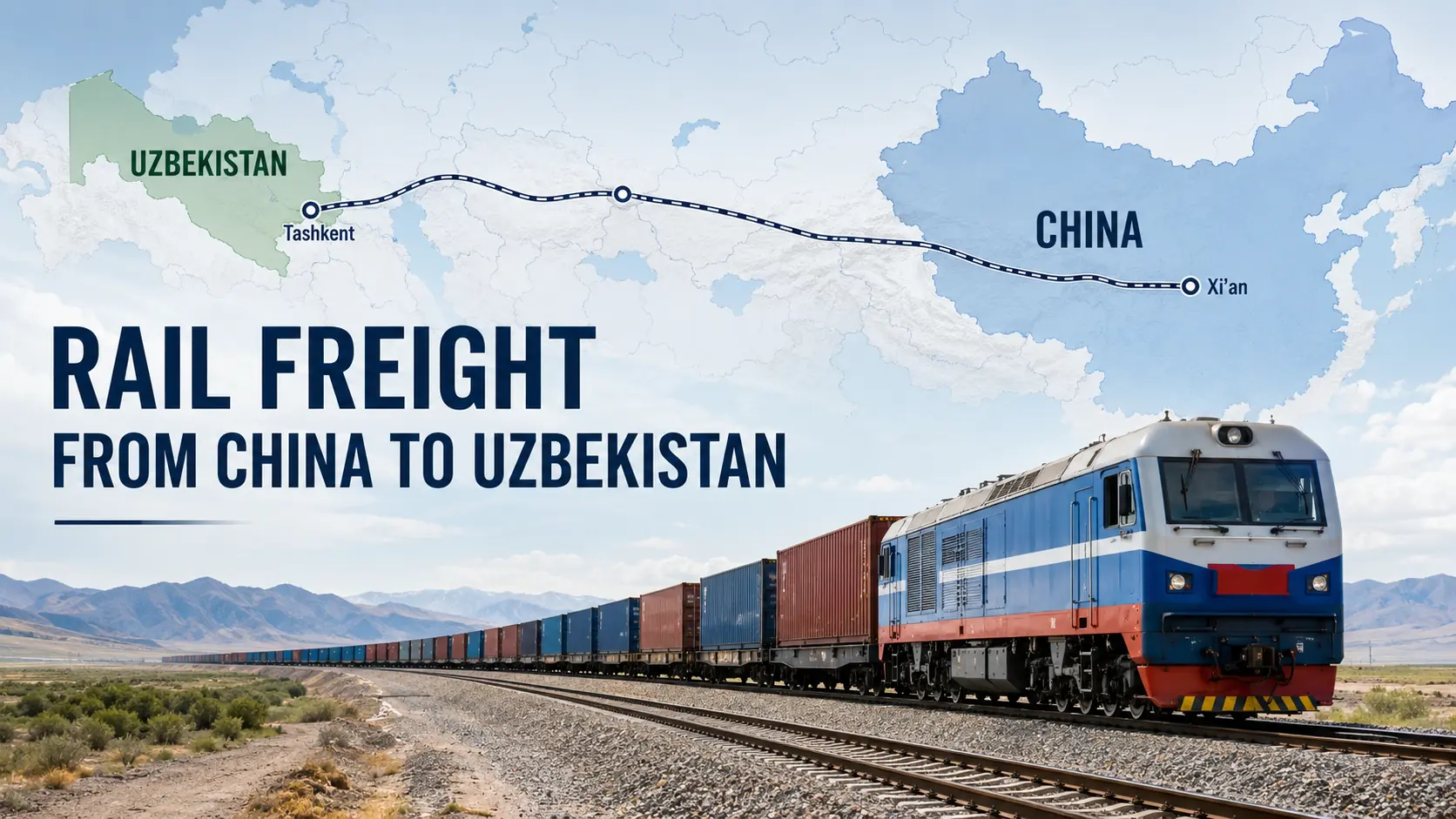
Most shipments begin with factory pickup in China before being transferred to a suitable international rail hub. After crossing the China–Kazakhstan border, the cargo continues through Central Asia and enters Uzbekistan for customs clearance and final delivery.
| Item | Typical Arrangement |
|---|---|
| Main route | China → Kazakhstan → Uzbekistan |
| Main destination | Tashkent |
| Shipping options | FCL and LCL |
| Typical planning time | Around 15–25 days |
| Common containers | 20GP, 40GP and 40HQ |
| Suitable cargo | Commercial and industrial goods |
| Delivery | Rail terminal or door-to-door |
Transit time depends on the origin city, train schedule, border handling, customs clearance and final destination.
Uzbekistan’s inland location makes railway transportation an important part of trade with China. Ocean freight must first arrive at a port in another country before continuing overland, while rail can connect Chinese logistics hubs directly with the Central Asian railway network.
Compared with air freight, rail is usually more economical for heavier and larger shipments. It also offers containerized transportation for businesses importing goods from China on a regular basis.
Rail freight is particularly suitable when:
The shipment is too heavy for economical air freight
Delivery is not urgent enough to justify air shipping
The cargo can move in an FCL or LCL rail service
Regular shipments need a stable Central Asia route
Final delivery is required in Tashkent or another inland city
Road freight may still be more suitable for shipments requiring greater routing flexibility, so the best option should be selected according to cargo size, cost and delivery time.
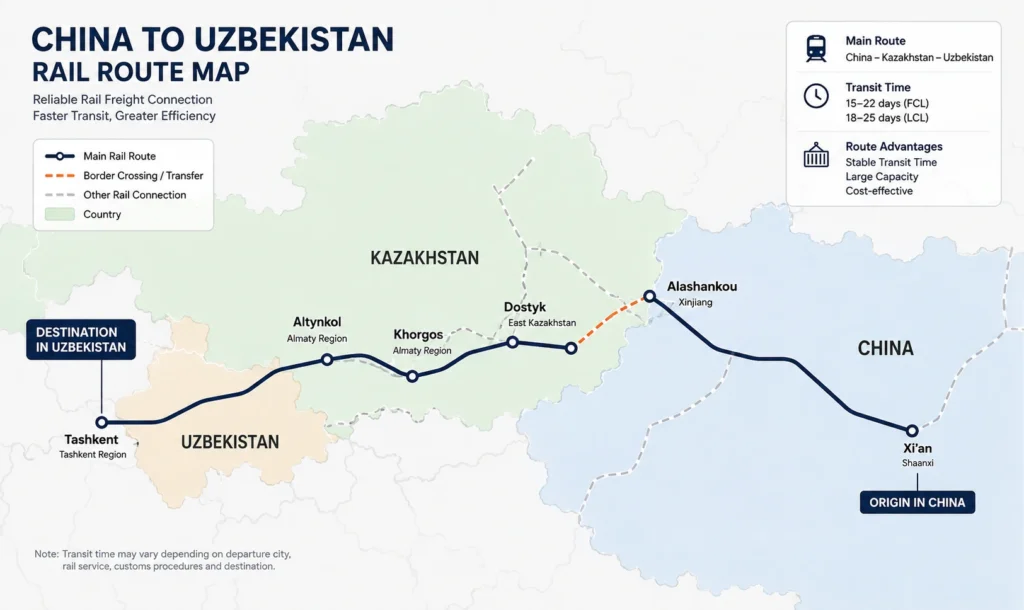
The established rail route from China to Uzbekistan normally passes through Kazakhstan.
A typical movement is:
China rail hub → Alashankou or Khorgos → Kazakhstan → Uzbekistan → Tashkent
Cargo can depart from major Chinese rail hubs such as Xi’an, Chengdu, Chongqing, Zhengzhou and Yiwu. Goods produced in Shanghai, Ningbo, Shenzhen, Guangzhou and other manufacturing areas can first be moved by truck or domestic rail to the selected departure hub.
Two important China–Kazakhstan railway gateways are:
Alashankou → Dostyk
Khorgos → Altynkol
After entering Kazakhstan, the shipment continues through the regional railway network before crossing into Uzbekistan.
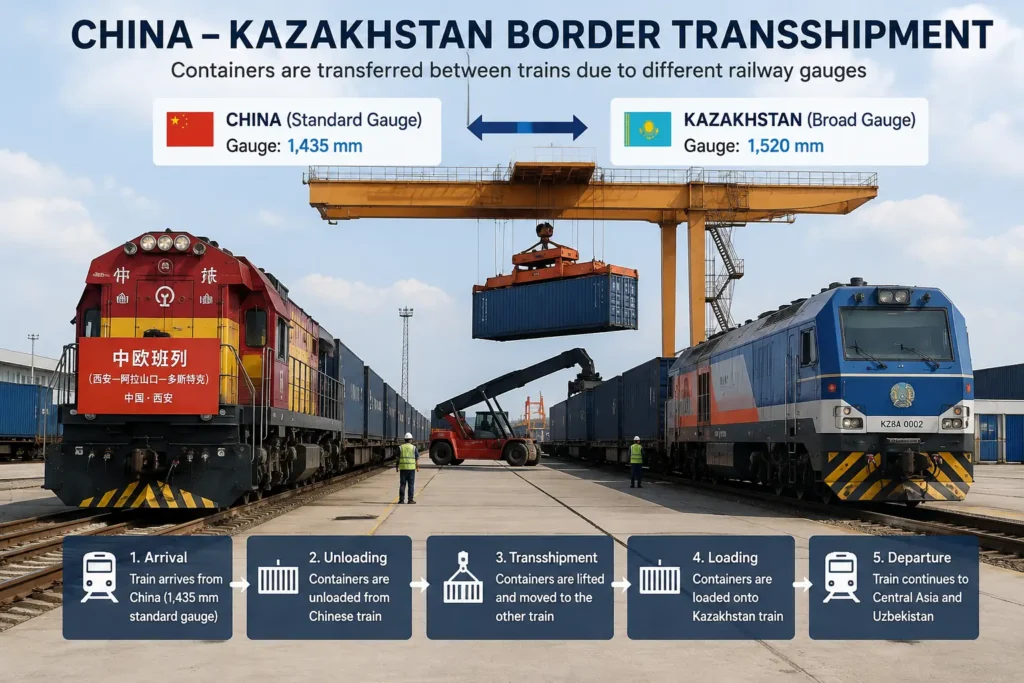
China uses a 1,435 mm railway gauge, while Kazakhstan and Uzbekistan use the wider 1,520 mm gauge.
Because of this difference, containers normally need to be transferred between railway wagons at the China–Kazakhstan border. This is a standard part of the route, but border congestion, terminal capacity and train coordination can affect overall transit time.
The China–Kyrgyzstan–Uzbekistan railway is an important future corridor, but it remains under construction in 2026.
For current commercial shipments, importers should still plan around the established rail services through Kazakhstan rather than assuming the CKU railway is already available for regular freight transportation.
Rail freight to Uzbekistan can depart from several major logistics hubs in China, including Xi’an, Chengdu, Chongqing, Zhengzhou and Yiwu. The most suitable departure point depends on the supplier location, available train schedules and the cost of moving the cargo to the rail terminal. Goods from Shanghai, Ningbo, Guangzhou, Shenzhen and other coastal manufacturing areas are often transferred inland before joining an international rail service.
On the Uzbekistan side, Tashkent is the main destination for many China–Uzbekistan rail shipments, with terminals such as Chukursay and Sergeli handling containerized cargo. Shipments can also continue to other inland locations depending on the consignee’s final address.
Common destinations include:
Tashkent
Andijan
Bukhara
Samarkand
Kokand and the Fergana Valley
The best route should be selected according to the complete journey rather than simply choosing the nearest rail terminal. For cargo delivered outside Tashkent, onward rail or truck transportation may be required to reach the final warehouse or project site.
Rail freight transit time varies according to what is included in the quoted schedule.
Some operators quote only the international train journey, while a freight forwarder may calculate from factory pickup in China through customs clearance and final delivery in Uzbekistan.
| Route | Indicative Planning Time |
|---|---|
| Major China rail hub → Tashkent | Around 15–20 days |
| East China → Tashkent | Around 18–23 days |
| South China → Tashkent | Around 20–25 days |
These figures are planning estimates rather than guaranteed schedules.
Transit time may be affected by supplier pickup, LCL consolidation, train departure frequency, border transshipment, rail congestion, Uzbekistan customs clearance and final truck delivery.
When comparing quotations, confirm whether the stated transit time is terminal-to-terminal or door-to-door.
Rail freight cost depends on the departure city, container type, cargo volume, railway capacity and destination in Uzbekistan.
FCL cargo is generally quoted by container, while LCL shipments are calculated according to volume, weight and consolidation requirements.
| Origin | Destination | 20GP | 40GP / 40HQ |
|---|---|---|---|
| Xi'an | Tashkent | $2,200–$2,500 | $2,800–$3,200 |
| Chengdu / Chongqing | Tashkent | $2,400–$2,700 | $3,100–$3,500 |
| East China | Tashkent | $2,600–$2,900 | $3,400–$3,800 |
| South China | Tashkent | $2,800–$3,200 | $3,800–$4,200 |
For smaller shipments, LCL rail freight allows cargo to share container space with other consignments. Rates can be calculated by volume or weight, depending on the shipment.
| Origin | Rate per CBM | Rate per KG | Estimated Transit Time |
|---|---|---|---|
| Xi'an | $110–$135 | $0.40–$0.55 | 15–18 days |
| Yiwu / Ningbo | $130–$160 | $0.50–$0.65 | 18–22 days |
| Guangzhou / Shenzhen | $145–$180 | $0.55–$0.75 | 20–25 days |
| Urumqi | $90–$115 | $0.35–$0.45 | 10–14 days |
A complete quotation may include factory pickup, domestic transportation to the rail hub, warehouse handling, export customs clearance, international rail freight, destination terminal charges, customs brokerage and final delivery.
Minimum charge: LCL rail freight normally has a minimum chargeable quantity. Based on your current rate sheet, the minimum is generally 1 CBM or 200 KG, even when the actual shipment is smaller.
Rail freight from China to Uzbekistan can be arranged as either FCL or LCL, depending on the shipment size, cargo type and required schedule. FCL is usually more suitable for larger or regular shipments, while LCL gives smaller importers access to rail service without paying for an entire container.
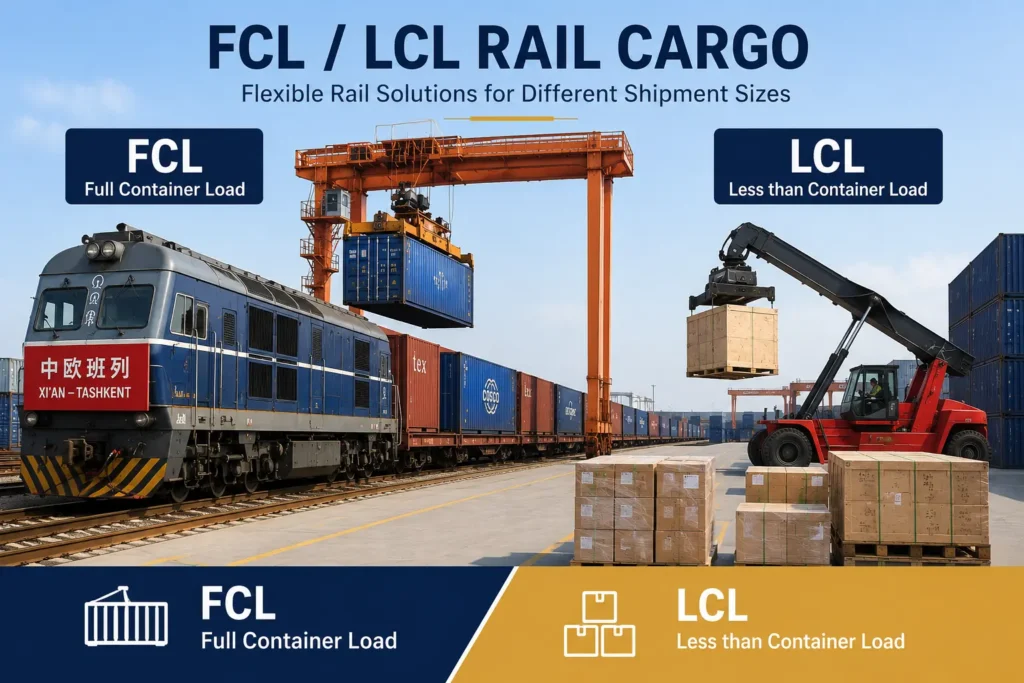
FCL means the shipper uses the full container for one shipment. Common options include 20GP, 40GP and 40HQ, subject to the selected rail service and equipment availability.
It is often the better choice for machinery, auto parts, construction materials, furniture and other higher-volume commercial cargo. Because the goods remain inside the same container during most of the journey, FCL also reduces the amount of cargo handling compared with consolidated freight.
FCL is generally worth considering when:
The shipment occupies a large part of a container
The cargo is heavy or difficult to consolidate
The importer ships regularly from China
Reducing handling between origin and destination is important
LCL allows several shipments to share one container. Cargo is first delivered to a consolidation warehouse in China, where it is checked, measured and loaded together with other consignments before rail departure.
This option works well for smaller shipments that are too large or expensive to send by air but do not require a full container. LCL rates are usually calculated by CBM or chargeable weight, with a minimum charge applied by the consolidator.
Because LCL involves consolidation and deconsolidation, the total transit time can be slightly longer than FCL. Importers should therefore compare both the freight rate and the complete delivery schedule before deciding which option is more suitable.
Commercial cargo arriving in Uzbekistan by rail must complete import customs clearance before it can be released from the terminal. The importer should confirm the HS code, customs value and any product-specific requirements before the shipment leaves China, especially for regulated goods or products that may require certificates or permits.
The exact documents depend on the product and import arrangement, but a typical rail shipment may require:
Commercial invoice
Packing list
Railway waybill
Customs cargo declaration
HS code and detailed product description
Consignee and importer information
Certificate of origin where required
Product certificates or permits where applicable
The invoice, packing list and transport documents should contain consistent information. Differences in product description, quantity, weight or declared value can lead to additional customs checks or delays.
Import duty depends on the HS code and applicable tariff for the goods. Uzbekistan’s standard VAT rate is 12%, and customs processing or brokerage charges may also apply.
Importers should therefore calculate the total landed cost using more than the rail freight rate alone. Depending on the shipment, the final cost may include import duty, VAT, customs clearance, terminal handling and inland delivery.
For products with additional regulatory requirements, the necessary certificates or permits should be confirmed before booking the rail shipment.
Rail transportation can be combined with pickup and final trucking to provide a complete door-to-door service.
A typical shipment may follow:
China factory pickup → consolidation or container loading → export customs → rail transportation → Uzbekistan import clearance → final truck delivery
Delivery can be arranged to Tashkent as well as cities such as Samarkand, Bukhara, Andijan and other inland destinations.
For importers purchasing from several Chinese suppliers, cargo can also be collected and consolidated before rail departure. This can simplify transportation and reduce the need to manage several shipments separately.
| Method | Speed | Cost | Best For |
|---|---|---|---|
| Rail freight | Medium | Medium | Heavy and regular commercial cargo |
| Road freight | Medium to fast | Medium | Flexible door-to-door shipments |
| Air freight | Fastest | Highest | Urgent and high-value goods |
Rail freight is usually the best option when the shipment is relatively heavy, delivery is not extremely urgent and the importer wants a balance between cost and transit time.
Tonlexing provides practical rail freight solutions for commercial cargo moving from China to Uzbekistan. Services can cover supplier pickup, consolidation, rail transportation, customs coordination and final delivery according to the shipment requirements.
Key advantages include:
FCL and LCL options for different shipment sizes
Supplier pickup and consolidation in China for single or multiple factories
Customs and final delivery support to Tashkent and other destinations in Uzbekistan
For an accurate quotation, provide the cargo description, weight, dimensions, supplier location, HS code and final delivery address.
Many shipments require around 15–25 days depending on the origin, train schedule, border handling and final destination.
Most established services currently move through Kazakhstan using gateways such as Alashankou–Dostyk or Khorgos–Altynkol before continuing to Uzbekistan.
Yes. LCL rail freight is available for smaller commercial shipments that do not require a full container.
For heavier and larger shipments, rail freight is generally much more economical than air freight, although air remains faster.
Yes. Rail transportation can be combined with pickup in China, customs coordination and final truck delivery in Uzbekistan.
Useful freight, customs and importing resources related to this shipping guide.
Introduction: Why Uzbekistan Matters in China’s Cross-Border Trade Shipping cost from China to Uzbekistan is a key consideration for businesses l...
Read guide →
Shipping from China / Rail Freight from China International Rail Freight Services · China to Europe & Eurasia Rail Freight from China Move cargo...
Read guide →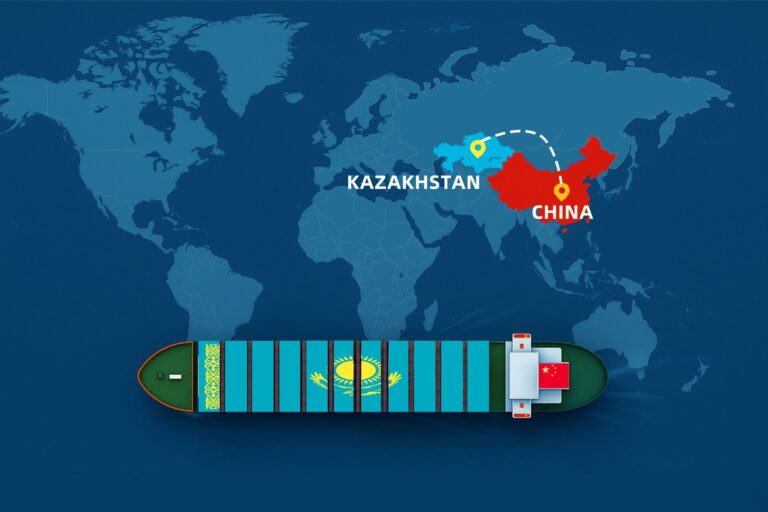
Shipping from China to Kazakhstan (Rail, Road & Air) | 2026 Guide Reliable shipping from China to Kazakhstan for B2B importers,industrial cargo...
Read guide →
As Central Asia rises in strategic importance, road freight from China to Kazakhstan has become one of the most efficient and flexible logistics...
Read guide →Door to door shipping from China by air, sea, rail or express. Compare DDP vs DAP, costs, transit times, customs clearance and final delivery.
Learn more → Useful Resource Customs Clearance Step by StepCustoms Clearance Step by Step: The Complete Process Verified & Reviewed · Last updated February 2026 Customs clearance step by step helps intern...
Learn more →WhatsApp us