

Certificate of Origin (COO) Explained: Customs Use, FTA Savings, and Error-Free Docs
- Verified & Reviewed · Last updated January 2026
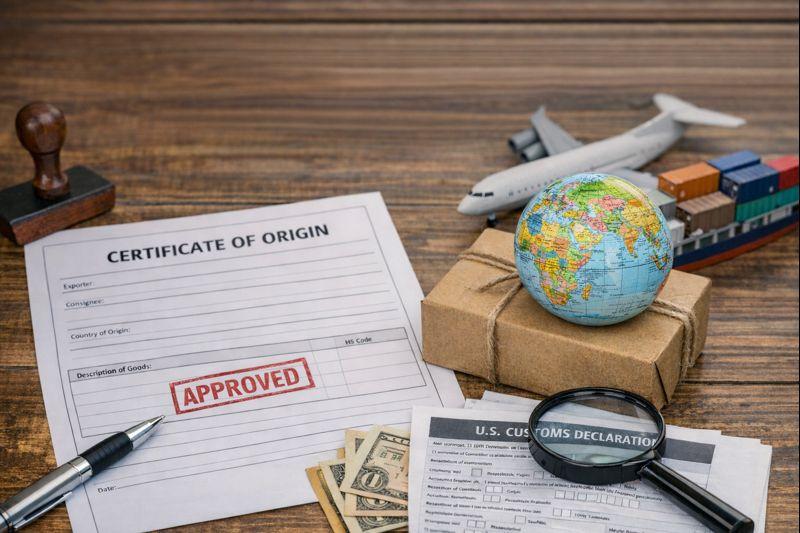
A Certificate of Origin (COO/CO) proves where your goods were made or processed. Customs uses it to confirm origin, apply the correct duty rate, and enforce origin-based controls.
When shipments move under Free Trade Agreements, a correct COO helps determine eligibility for preferential tariffs and can reduce or eliminate duties. If the COO conflicts with the commercial invoice, packing list, or shipping details, customs may hold the shipment, deny preference, or request corrections that add time and extra costs—so consistency and accuracy are essential.
Customs clearance use
FTA duty savings
Avoid COO errors
- Experienced China-based logistics specialists
Table of Contents
What a Certificate of Origin Does for Customs Authorities
A Certificate of Origin serves as proof of origin for customs purposes and supports key decisions that drive clearance outcomes.
Duty and tariff rates
Origin can change tariff rates. Customs uses the COO to determine customs duties and confirm whether the product’s country triggers standard rates, special programs, or origin-based controls. When origin is unclear or inconsistent, customs offices may require additional review, delay release, or request detailed information about production and sourcing.
Preferential tariff treatment under a free trade agreement
Under Free Trade Agreements and other trade agreements, a preferential certificate can unlock trade benefits such as reduced tariffs and, in qualifying cases, tariff-free treatment. Preferential duty rates are not automatic. Customs authorities will only apply them when the origin rule is met, the certificate is valid, and the clearance file is consistent.
Enforcement of restrictions and risk controls
Customs offices use origin certificates to enforce import quotas, trade sanctions, and anti dumping measures. Some imports require origin disclosure for political reasons, trade balances, environmental controls, or safety regulations. For restricted goods, customs may also screen for issues such as endangered species controls.
Letters of Credit and bank document checks
Banks often require a COO to process Letters of Credit for trade transactions. In documentary collections or LC shipments, a mismatch between the COO and commercial invoice can cause payment delays or discrepancies. If you ship under LC terms, treat the COO wording as a financial document standard, not just a customs form.
When a Certificate of Origin Is Required
A Certificate of Origin is often required when the importing country’s regulations demand it or when origin must be disclosed for economic, environmental, or political reasons. It is also commonly required when:
Preferential tariff treatment will be claimed under trade agreements
The destination country applies origin-based controls such as import quotas
Trade sanctions or anti-dumping measures are involved
Banks require a COO for Letters of Credit processing
GSP and other preference programs
Some importers rely on preference programs outside classic FTAs, such as generalized system preferences in certain markets. The documentation approach can differ from an FTA certificate. The key point is the same: customs authorities must be able to verify the product’s origin and the basis of the claim.
Own certificate and self-certification scenarios
Not every lane requires a strict template. In some programs, an exporter can issue an own certificate if it contains the required information and the destination country accepts that approach. When self-certification is allowed, accuracy and recordkeeping become even more important because the exporter’s statements carry the compliance burden.
Types of Certificates of Origin: Non-Preferential vs Preferential
There are two main types of Certificates of Origin used in international shipping.
Non-preferential certificates
Non-preferential certificates confirm the country of origin for customs clearance and compliance, but do not grant reduced tariffs under trade agreements. They are widely used when the importing country requires a standard origin document or when no preferential treatment claim is being made.
Preferential certificates
Preferential certificates are used when exported goods qualify under a free trade agreement for preferential tariff treatment. If imported materials are used, the exporter must show the product’s origin meets the agreement rule, often through substantial transformation or value-based tests.
Preferential treatment can materially change landed cost. Many buyers pursue it because reduced tariffs can reduce duties significantly and, for certain HS codes and lanes, may reach zero when goods qualify. The exact outcome depends on the specific trade agreements involved, the product classification, and the importing country’s regulations.
How FTA Savings Work: The Practical Path to Reduced Tariffs
Preferential tariff treatment can deliver meaningful savings, but it requires a controlled process. A clean workflow usually follows four steps:
Confirm the trade agreement and the importer’s plan to claim preference at entry
Determine eligibility using the agreement’s origin rule
Prepare required documentation that supports the origin claim
Keep the COO aligned with the commercial invoice, packing list, and shipping records
Where FTA claims fail in real life
Most preference denials happen for one of these reasons:
The importer claims preference but the exporter cannot support the origin rule
The certificate type is wrong for the lane or the destination country’s requirements
The product description differs across documents and customs officials treat it as a mismatch
The HS classification logic used for origin rules is inconsistent with the importer’s clearance filing
Supporting evidence exists, but it is not organized as all the relevant information customs expects
If any one step fails, customs authorities may deny preferential duty rates even if the goods were actually eligible.
Origin Rules That Determine Eligibility
Most trade agreements determine eligibility using one or more of these approaches. Because many origin rules are tied to HS classification and product-specific criteria, confirm HS logic first and keep it consistent across documents.
Wholly obtained
Goods are wholly obtained when sourced entirely within the agreement region, common for agricultural products and certain natural resources.
Substantial transformation
Substantial transformation applies when imported goods or imported materials are used. The product must undergo a meaningful manufacturing change defined by the agreement, often linked to tariff classification shifts or specific processing requirements.
Value and content tests
Some agreements require a minimum level of regional value content. In these cases, exporters may need to provide a manufacturing cost statement or supporting calculations for preferential certificates. If your sourcing changes, re-check eligibility because a small cost shift can change the outcome.
Product-specific rules
Certain country lanes and specific trade agreements include product-specific rules, especially for textiles, chemicals, and regulated goods. These rules can be stricter than generic transformation logic and are a common source of compliance mistakes.
Preferential COO Evidence Pack Customs Officials Expect
Customs officials and customs authorities usually focus on whether the origin claim is defensible. A strong evidence pack also helps ensure compliance during audits and post-clearance reviews.
Core shipment documents
Shipping manifest or transport reference
Parties involved, including exporter, producer when relevant, and consignee or importer
Origin proof documents
Bill of materials identifying imported materials and local inputs
Supplier declarations for critical components
Manufacturing process summary showing substantial transformation
Tariff classification rationale for the finished goods
Cost and control records
Manufacturing cost statement when required by the trade agreement
Internal checks used to prevent inconsistencies
Recordkeeping plan to respond to customs procedures and verification requests
A practical tip for audits
If customs authorities request verification, they often want a short story that matches the paper trail: what was imported, what was done, and why the finished product’s origin qualifies. A tidy evidence pack makes it easier for customs offices to determine eligibility without holding the shipment.
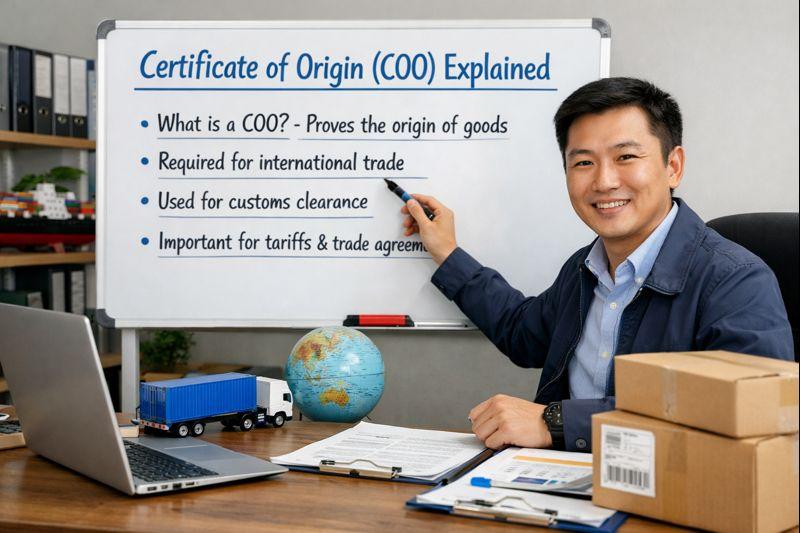
Who Issues a Certificate of Origin
Certificates of Origin can be issued by an issuing authority such as a local chamber of commerce, an accredited trade body, or designated government agencies in the exporting country. In many countries, COOs must be stamped and signed by an authorized entity to be accepted in the destination country.
Some lanes require notarization or additional verification for certain product categories or for shipments into a specific country with stricter customs procedures. When the destination country’s requirements are strict, confirm details before cargo departs to avoid last-minute document chases.
How to Obtain a Certificate of Origin Online
Many exporters can obtain certificates online through chamber portals or authorized systems. Online filing can shorten turnaround and reduce document loss risk, especially when documents are submitted online and validated digitally.
A typical application requires required documentation such as:
Commercial invoice
Packing list
Shipping manifest or draft bill of lading or airway bill details
Origin statement and product description
Supporting evidence for preferential treatment claims
Processing time and what changes it
Processing time varies, but many routine applications are completed in 1–3 business days. Preferential certificates may take longer if the issuing authority requests detailed information or additional proof for imported materials and value tests. Rework also adds time, so the fastest route is accuracy on the first submission.
Electronic Certificate of Origin and 2026 Document Trends
Electronic certificate systems are increasingly used in global trade to support faster processing and reduce the risk of lost originals. Many countries are moving toward electronic certificate workflows, but acceptance still depends on the destination country’s requirements and the way customs offices process documentation.
Even when an electronic certificate is accepted, document quality remains the key factor. An eCOO with inconsistent data can still trigger delays, holds, and additional costs. When you switch to an electronic certificate, make sure the importer’s broker can retrieve and present it smoothly during the customs clearance process.
Common COO Errors That Cause Customs Holds and Additional Costs
These are the most common COO mistakes that trigger customs holds and additional costs. Use this quick table to spot issues before shipping.
| COO mistake that triggers customs holds | Likely result | Quick fix |
|---|---|---|
| Description mismatch between COO, commercial invoice, and packing list | Hold or correction | Use the same wording across all documents |
| Wrong COO type, preferential vs non-preferential | Preference denied | Confirm the correct type before applying |
| Weak origin support when imported materials are used | Proof requested | Prepare a basic origin evidence file |
| Issuer or format not accepted, stamp or signature missing | COO rejected | Check destination requirements before shipping |
| Original COO required but eCOO submitted | Release delayed | Confirm original vs eCOO requirement |
| HS classification logic inconsistent | Preference denied or review | Align HS logic before issuing the COO |
| Shipper or consignee name and address mismatch | Discrepancy, bank or customs hold | Standardize party details across documents |
If your Certificate of Origin, commercial invoice, and packing list do not clearly describe the same shipment, customs is more likely to stop the file for review.
Quick Pre-Submission Checklist for a Clean Customs Clearance Process
Use this checklist to reduce clearance risk across many countries and lanes:
Certificate of origin, commercial invoice, and packing list match line by line
Correct certificate type selected, preferential certificate or non preferential certificates
Origin rule basis documented, wholly obtained or substantial transformation
Issuing authority format meets destination country’s requirements
Preferential treatment claims supported with an evidence pack
Electronic certificate acceptance confirmed where used
Importer instructions aligned with customs clearance procedures
How Tonlexing helps shippers avoid COO delays
Freight forwarders reduce clearance friction by coordinating parties involved and spotting issues before documents reach customs offices. They help confirm destination requirements, check COO format, and flag gaps in supporting documents for preferential tariff treatment.
At Tonlexing, we focus on the checks that prevent most rework:
Verify that product descriptions, quantities, and shipper–consignee details stay consistent across COO, invoice, and packing list
Confirm whether the destination requires an original stamped certificate or accepts an electronic certificate
Help exporters structure a basic origin evidence pack so the origin claim is defensible during verification
Coordinate with import brokers so the preference claim matches the filing logic and documentation set
Frequently Asked Questions
It is an official document that verifies where goods were produced or processed. Customs authorities use it for customs clearance, duty determination, and origin-based controls.
Yes. When the product qualifies under the agreement and a preferential certificate supports the claim, the importer may receive reduced tariffs or tariff-free treatment.
Most applications require a commercial invoice and packing list, plus shipping records such as a shipping manifest. Preferential claims may require more evidence and sometimes a manufacturing cost statement.
Typically a local chamber, relevant chamber, accredited trade body, or designated government agency, depending on the exporting country and destination country requirements.
Customs officials may hold the shipment, deny preferential tariff treatment, impose penalties, or require corrections that delay the shipment and add additional costs.
Related COO & Customs Guides
Get a Certificate of Origin Check
COO vs invoice and packing list consistency check
Preferential vs non-preferential guidance
Fast feedback before you ship
Share your invoice, packing list, and destination—our team will flag risks and fixes.