

How Consolidated Shipping Can Save You Money
- Verified & Reviewed · Last updated January 2026
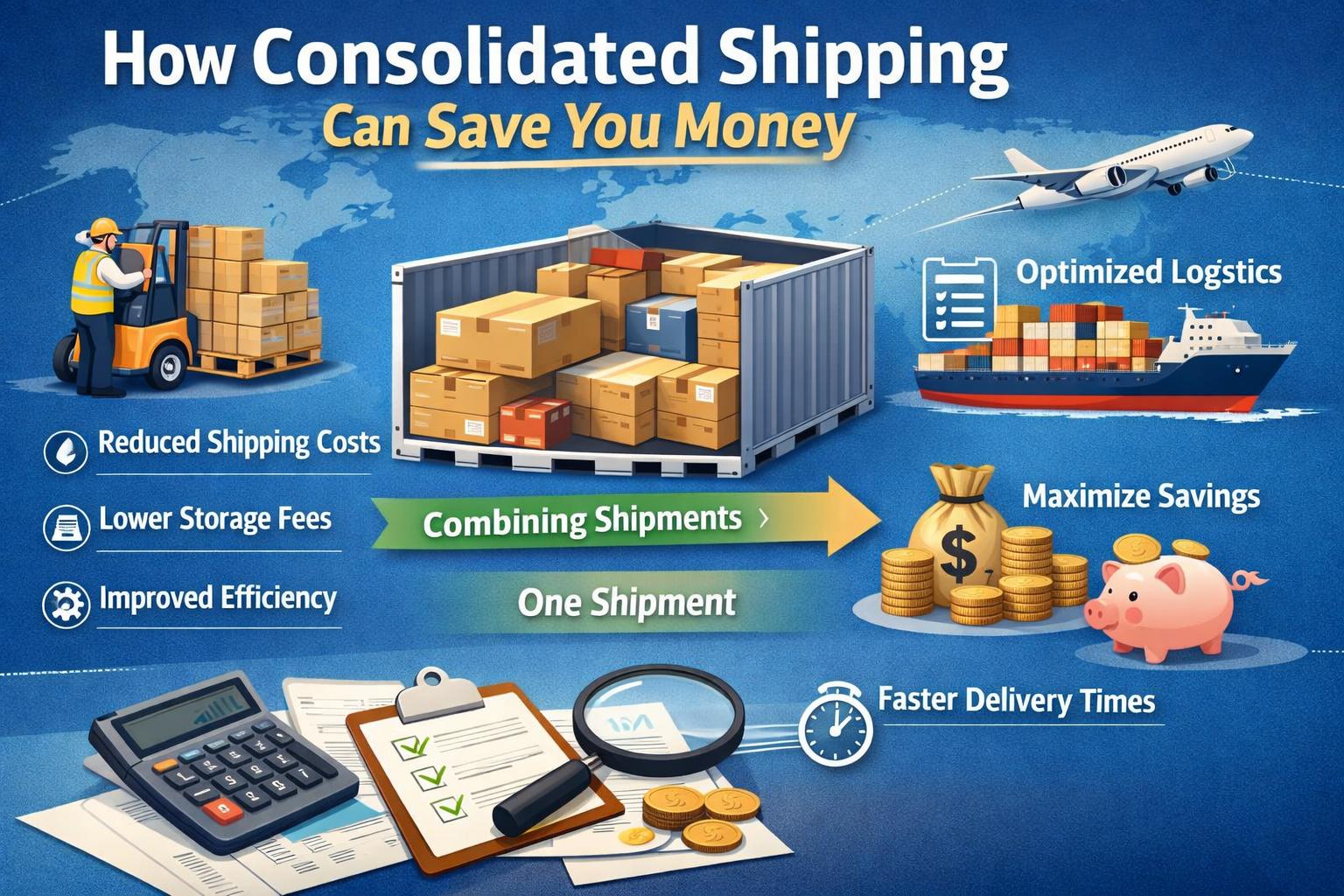
Consolidated shipping is a proven shipping strategy to reduce shipping costs by combining multiple small shipments into fewer consolidated loads. Instead of paying repeated fees on individual shipments, you move a larger shipment, share transportation costs across multiple shippers, and improve truck capacity and space utilization—often lowering transportation costs and handling costs across the supply chain.
This 2026 guide explains how freight consolidation, cargo consolidation, and shipment consolidation work, what cost savings you can realistically expect, and how a logistics provider can set up shipping consolidation that supports reliable delivery schedules, protects delivery deadlines, and improves customer satisfaction.
Consolidation methods / Modes
Cost savings breakdown
Customs & delivery timelines
- Experienced China-based logistics specialists
Table of Contents
What Is Consolidated Shipping?
Consolidated shipping means combining multiple shipments or multiple orders into fewer consolidated loads for part or all of the journey. The goal is simple: move more freight with fewer trips, fewer deliveries, and fewer invoices—while keeping a reliable delivery schedules plan.
You’ll see it applied in different ways:
Freight consolidation for domestic LTL and regional distribution
Cargo consolidation for multi-supplier export and hub moves
Shipment consolidation for ocean LCL, air line-haul, and mixed cartons
Package consolidation for parcel-heavy lanes where repeated base charges add up
A good shipping consolidation plan doesn’t just bundle boxes. It improves the logistics process, aligns documents, and ensures each shipment reaches the final destination on time.
Why Consolidated Shipping Saves Money
Most shipping costs are not purely “per pound” or “per CBM.” You pay a stack of repeated charges every time you move individual shipments. Consolidating multiple shipments reduces those repeats and unlocks better rate tiers.
Share transportation costs instead of paying them repeatedly
When you ship separate cartons or pallets, each move triggers pickup, minimums, and routing charges. With consolidation, you can share transportation costs across multiple shippers, paying only the space you use while improving utilization.
This matters most when you have multiple shipments going to the same region, especially in lanes where carrier minimums are high.
Better pricing tiers for a larger shipment
Carriers price aggressively when volume is predictable. A larger shipment can move you into better brackets and more stable contracts. This is one reason consolidated shipping can deliver repeatable cost savings.
Fewer repeated fees and lower handling costs
Fewer shipments usually means:
fewer pickups
fewer terminal touches
fewer paperwork cycles
fewer billing lines
That directly reduces handling costs and back-office time, which many businesses overlook when comparing quotes.
Less wasted space and better truck capacity
Bad carton sizing and partial pallets waste space and raise effective shipping costs. Consolidation improves truck capacity and reduces air shipping inside cartons, which is common with smaller shipments.
Cleaner customs workflow for international shipping
For international shipping, consolidation can improve the customs clearance process by standardizing commercial invoices, packing lists, and product descriptions. When executed well, it supports streamlined customs clearance and fewer delays.
Consolidated Freight Shipping vs. Standard Shipping
If you’re deciding between frequent small dispatches and consolidation, compare what you actually pay across the full shipping process.
Standard approach: many individual shipments
More base charges
More scheduling events
Higher chance of exception fees
More damaged freight due to more handling points
Consolidation approach: consolidated freight shipping
Fewer shipments and fewer trips
Better rate breaks for consolidated freight
More predictable routing and fewer surprises
Easier compliance control in the logistics process
For many businesses, consolidated freight shipping becomes the default shipping strategy once volume is steady.
A Quick Cost Breakdown: What Consolidation Actually Reduces
When comparing quotes, separate headline rates from the cost drivers that usually inflate total shipping costs.
| Cost driver | Where it shows up | How consolidation reduces it |
|---|---|---|
| Transportation costs | Line-haul, fuel, peak surcharges | Fewer separate moves; better utilization; share transportation costs |
| Handling costs | Terminal touches, cross-dock labor | Fewer handoffs when transfers are minimized |
| Accessorial fees | Appointments, detention, re-delivery | Fewer pickups/deliveries; fewer repeated add-ons |
| Docs & compliance | Invoice/packing list fixes, broker work | Standard templates + streamlined customs clearance |
| Storage & congestion | Port/CFS storage, hub dwell | Fewer arrivals; less dwell time; less temporary storage |
Consolidation Models That Work in Real Operations
LTL freight consolidation for regional delivery
Use this when you ship pallets weekly into the same region. Your logistics provider combines shipments into consolidated freight and arranges distribution near a distribution center to reduce last-mile variability.
LTL to full truckload conversion
When volumes rise, multiple small shipments can be merged into one shipment to approach full truckload rates. Even if you don’t fill an entire truck every time, the pricing often improves when you move as a consolidated load.
Multi-supplier cargo consolidation at origin
If you source from multiple factories, cargo consolidation is a major win. Your logistics provider collects from suppliers, checks labeling and secure packaging, then creates consolidated shipments with one export workflow.
This also improves inventory management because you receive cleaner, planned arrivals rather than scattered cartons.
Air line-haul consolidation for time-sensitive replenishment
For high-value SKUs, consolidation can protect delivery deadlines while lowering the effective cost per kilo. Done correctly, it supports faster delivery while still controlling shipping costs.
Limited package consolidation for small parcel clusters
For certain parcel-heavy lanes, package consolidation can reduce duplicated base charges. Use it selectively, and only when it improves carton efficiency and avoids service delays.
The Operational Benefits That Protect Your Savings
Cost savings disappear if consolidation causes delays, confusion, or damage. A high-performing plan improves operational efficiency, not just rates.
Reliable delivery schedules and steadier arrivals
A well-built consolidation calendar gives you predictable departures and arrivals. This supports reliable delivery schedules, reduces expediting, and prevents last-minute premium charges.
Enhanced security and fewer damage events
Consolidation reduces touchpoints when the lane is designed to minimize transfers. Fewer handoffs means fewer opportunities for loss or damage. Many shippers see enhanced security because consolidated shipments move through fewer facilities and scanning events. Poorly designed networks can add handoffs, which increases risk—so route design, secure packaging, and hub discipline matter.
Improving operational efficiency across the supply chain
Consolidation simplifies the logistics process: fewer bookings, fewer invoices, fewer exceptions. That is improving operational efficiency in a direct, measurable way, especially for teams managing many SKUs and suppliers.
How to Build a Consolidation Plan Step by Step
Step 1: Audit shipping needs
Document weekly shipping needs such as lanes, average carton or pallet counts, lead time tolerance, and service expectations.
Step 2: Identify opportunities for combining shipments
If your team is sending multiple shipments to the same region, this is where consolidating multiple shipments delivers the fastest payback. Look for repeat destinations, clustered suppliers, and multiple orders for the same customer.
Step 3: Choose the right consolidation hub
Common options include an origin warehouse, a forwarder hub near the port or airport, or a regional distribution center near the market. Ask your logistics provider how transportation resources and transportation equipment are assigned.
Step 4: Standardize labels and secure packaging
Secure packaging is non-negotiable when combining multiple items. Label errors are a top reason consolidated shipments become expensive later.
Step 5: Align documents early
For global moves, confirm invoice values, HS code consistency, and packing list accuracy early. This protects the customs clearance process and supports streamlined customs clearance.
Step 6: Measure results and refine
Track cost per unit, damage rate, exception fees, on-time performance, and inventory management stability across the supply chain. Many teams also see less congestion at receiving and more usable warehouse space as arrivals become more predictable.
How to Choose a Logistics Provider for Consolidated Freight Shipping
A consolidation plan is only as strong as the logistics provider running it. Use this checklist to evaluate shipping solutions and avoid “cheap quotes” that create hidden costs.
Provider checklist: questions to ask before you commit
How do you maintain visibility for individual shipments within consolidated freight?
Look for scan points, reference numbers per supplier, and exception rules.How many transfer points will this lane use, and why?
Fewer transfers usually reduce handling costs and damage risk.What are your cutoff times and shipping windows, and how do you enforce them with suppliers?
A clear calendar protects delivery deadlines.What packaging and labeling standards do you require for consolidated loads?
Secure packaging rules prevent rework, claims, and shortages.How do you handle documentation and customs compliance for international shipping?
Ask about template control, pre-checks, and escalation processes.Which accessorials are common on this lane, and how will you minimize them?
A good provider will discuss detention, appointments, re-delivery, and storage risk.What happens when one supplier shipment is late—do you hold the load or release partial?
The answer should align with your shipping strategy and customer commitments.Can you provide performance metrics for on-time delivery, damage rate, and exception frequency?
You want proof of operational efficiency, not promises.

Common Mistakes That Kill Cost Savings
Consolidating incompatible compliance risk into one load
Poor scheduling that misses cutoffs
Weak carton planning that increases damage and rework
Poor visibility for split references within consolidated freight
Ignoring destination fees, especially for international shipping
Choosing shipping solutions that do not match your lane realities
Environmental Benefits That Also Lower Costs
Consolidation often results in fewer trips, which supports reduced fuel consumption and better fuel efficiency. With fewer partial loads, you can reduce carbon emissions and lower overall environmental impact. Over time, that lower environmental impact becomes easier to document for customers and auditors. For many companies, these environmental benefits support sustainable practices reporting and a smaller carbon footprint.
Frequently Asked Questions
For many businesses, yes. Consolidated shipping reduces repeated charges, improves utilization, and can stabilize company shipping costs.
The benefits of consolidated freight include lower cost, fewer shipments, more predictable delivery timelines, enhanced security, simpler admin work, and strong customer satisfaction.
Freight consolidation is common for trucking networks and pallet moves. Cargo consolidation is often used for multi-supplier export workflows. Both are part of shipment consolidation.
It can. With good planning and optimized routing, consolidation reduces exceptions and helps protect promised delivery dates.
Avoid consolidation when your shipping needs are highly urgent, your order profile is extremely inconsistent, or your products require special handling that cannot be standardized across consolidated loads.
Many businesses start with a short shipping window that matches their order cycle, then adjust based on lead time tolerance and service expectations. The right window balances cost savings with delivery deadlines.
Helpful Shipping Guides & Resources
Get a Consolidated Shipping Quote from China
Lower landed cost by combining shipments from multiple suppliers
Fewer destination fees vs. separate LCL shipments
One point of contact for pickup, consolidation, export docs, and delivery options
Get a fast estimate—share origin city, cartons/CBM, cargo details, and destination ZIP/code.