

How Long Does It Take to Ship from China to Thailand is a common question for importers planning international logistics between the two countries. Shipping time is not only about transportation speed, but a complete process that includes export procedures in China, international transit, port handling in Thailand, customs clearance, duty and import tax payment, and final delivery to your destination.
For most shipments, the realistic total shipping time from China to Thailand ranges from 2 to 20 days, depending on the shipping method you choose. Express shipping is the fastest option for small parcels, while air freight is commonly used for urgent commercial cargo. Road freight and rail freight offer a balanced solution for many cross-border routes, and sea freight remains the most cost-effective choice for heavy cargo and full container shipments.
This guide explains shipping time from China to Thailand in detail, breaks down transit time by different shipping methods, highlights where delays usually occur, and helps you plan shipments with fewer risks and surprises.
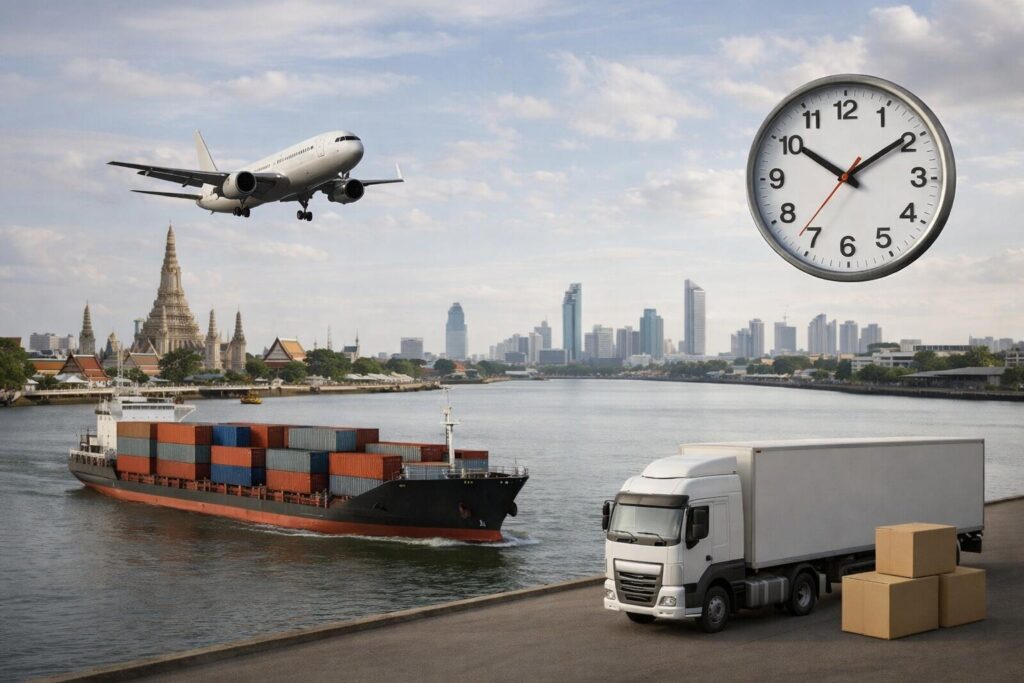
Transit Times by Shipping Method
| Shipping method | Typical transit times | Best for |
|---|---|---|
| Express | 1–3 days | urgent package, samples, lightweight orders |
| Air freight | 2–5 days | time-sensitive cargo with stable scheduling |
| Road freight | 4–8 days | flexible pickup, balanced speed and cost |
| Rail freight | 5–9 days | planned replenishment, efficient lanes |
| Sea freight | 8–14 days | container cargo, bulk trade, cheaper logistics |
These transit times cover the main transport leg. Door delivery adds pickup and final delivery steps, but it can save time by reducing handoffs and document problems.
Sea Freight from China to Thailand
Sea freight is a core shipping option for China and Thailand trade because it scales well for container cargo and helps control cost. Many companies ship consumer goods, machinery, building materials, and mixed cartons by sea because it is cheaper per unit than air.
Typical sea freight transit times
- South China routes: 8 to 12 days
- East China routes: 10 to 14 days
- North China routes: 12 to 20 days
Actual sailing time is only part of the timeline. Sea freight also depends on port cutoffs, vessel schedules, and which Thailand gateway you use.
Bangkok Gateway vs Laem Chabang Gateway
Thailand has two major gateways for many import shipments.
Laem Chabang Port
Laem Chabang Port is Thailand’s primary deep-sea container hub. It is well equipped for large volumes and often supports smoother distribution to industrial zones. For a full container shipment, Laem Chabang is frequently preferred because of high throughput and strong inland trucking connections.
Bangkok Port
Bangkok Port can be convenient for deliveries in Bangkok and nearby areas. However, handling capacity, berth schedules, and operational constraints can influence total transit time. Some shipments move efficiently through the Bangkok gateway when the destination is close and the sailing schedule fits.
Chinese Ports and Departure Scheduling
For sea freight from China to Thailand, the Chinese port you choose can affect how fast your cargo can depart.
Common Chinese ports for Thailand shipments
- South China: Shenzhen, Guangzhou
Often faster to arrange because sailings are frequent. - East China: Shanghai, Ningbo
Stable schedules and strong capacity. - Southeast China: Xiamen
Good option for nearby factories with regular services. - North China: Qingdao, Tianjin
Works well for North China suppliers, but sailings can be less frequent.
Why port choice matters
- Sailing frequency decides how soon you can get a departure.
- Cutoff time matters. If you miss it, you may wait for the next vessel and lose several days.
- Direct vs transshipment routes affect reliability. Direct is usually more predictable.
If you want a steadier timeline, choose a Chinese port with more frequent departures and confirm the cutoff before the cargo is delivered to the port.
FCL vs LCL for Thailand Sea Shipping
Sea freight to Thailand is usually booked as full container load or less than container load.
Full container shipments
A full container is often the best choice when you have enough volume. It improves shipment control, reduces handling points, and may reduce delays. It also supports clearer cost planning because fewer consolidation steps are involved.
LCL consolidated cargo
LCL is useful for smaller cargo volumes, but it can add time because cargo must be consolidated at origin, then deconsolidated after arrival in Thailand. Those extra warehouse and handling steps can extend the process even when vessel transit is normal.
If your goal is faster and more predictable arrival, full container shipping often performs better.
Air Freight from China to Thailand
Air freight is the standard choice when delivery speed matters and cargo value can justify the higher cost. Many customers ship spare parts, electronics, fashion items, and urgent replenishment by air.
Typical air freight timeline
- Export handling in China: 1 to 2 days
- Flight and arrival handling: about 1 day
- Customs processing and release in Thailand: 1 to 3 days
Air freight is usually stable, but clearance issues can still slow delivery. If documents are incomplete or HS code classification is wrong, even an air shipment can lose days.
Common Airports and Air Routes for China to Thailand
Air freight time is affected by two things: which airport the cargo departs from in China, and whether the flight is direct or via a transit hub.
Main departure airports in China
These airports are commonly used for cargo to Thailand because they have frequent flights and mature handling capacity.
- Shanghai Pudong
- Guangzhou Baiyun
- Shenzhen Baoan
- Beijing Capital
In general, South China airports often provide faster departure options for Thailand because flight frequency is high and trucking distance to the airport can be shorter for many factories.
Main arrival airports in Thailand
Most air cargo arrives in Bangkok, then moves to other cities by truck.
- Suvarnabhumi Airport in Bangkok
Main gateway for international air cargo and commercial shipments - Don Mueang Airport in Bangkok
Often used for certain carriers and lighter cargo lanes
If the final destination is outside Bangkok, add one more day for domestic delivery after customs release. Direct flights are usually faster and more predictable. Transit routes via hubs can add time due to connections and re-handling.
Explore more shipping guides:
- Shipping Cost from China to Thailand
- DDP Shipping from China to Thailand
- LCL vs FCL Shipping: What They Mean, Key Differences, and Which One to Choose
- How Long Does It Take to Ship from China to Malaysia?
- How Long Does It Take to Ship from China to Singapore?
- How Long Does It Take to Ship from China to the Philippines?

Road Freight and Rail Freight from China to Thailand
Road freight and rail freight are popular because they combine speed and economy. Many shipments from southern China, including the Pearl River Delta region, can ship efficiently by land routes.
Road freight transit times
Road freight often takes 4 to 8 days. Variations are driven by border processing, route selection, and delivery distance inside Thailand.
Rail freight transit times
Rail freight often takes 5 to 9 days. Rail can be efficient for planned cargo flows and stable trade lanes, especially when schedules align and cargo is suitable for rail handling.
Road freight and rail freight are strong shipping options when you want faster movement than sea and lower logistics costs than air.
Door Delivery from China to Thailand
Door delivery is a practical choice for customers who want one coordinated process from pickup to destination. It also helps with management and control of the full shipment chain.
Door delivery often includes:
- pickup from supplier or warehouse in China
- export documentation and export clearance
- international transport
- customs release in Thailand
- duties and import tax handling
- delivery to the destination address
Typical door delivery timelines
- Air freight door delivery: 5 to 8 days
- Road freight door delivery: 6 to 10 days
- Sea freight door delivery: 12 to 22 days
A managed door delivery plan can reduce delays because fewer parties handle the cargo and documents move in one workflow.
Customs Release in Thailand
Customs is often the biggest variable in shipping time. A ship can arrive at the port on schedule, but cargo cannot move until customs releases it.
Typical customs release time
For many imports into Thailand, customs release takes 3 to 7 days. It can be shorter for routine goods with correct paperwork, and longer if inspections occur.
Common reasons release takes longer:
- incorrect HS code or unclear product name
- mismatch between invoice, packing list, and actual cargo
- missing compliance documents for regulated goods
- value verification or additional checks
To ship smoothly into Thailand, treat customs as part of shipping time, not a separate task.
HS Code and Compliance: Reduce Holds and Rework
HS code accuracy affects duties, tariff rates, compliance checks, and customs decisions. A correct HS code supports a faster import process. A wrong HS code can trigger reclassification, document corrections, extra tax assessment, or inspection.
Compliance checklist:
- confirm HS code before booking transport
- keep product descriptions consistent across documents
- ensure invoice, packing list, and carton data match
- prepare certificates when required
- avoid vague descriptions that slow classification
Compliance is not only about rules. It is also about time.
Import Tax, Duties, and Tariff Timing
Import tax and duties affect delivery because the shipment is not released until payment and checks are completed.
Key points that keep cargo moving:
- estimate duty and tax before arrival
- ensure the importer can pay promptly
- avoid last-minute value changes that cause reassessment
- keep records ready if customs requests verification
Late payment or document corrections can increase storage time and total logistics costs.
Logistics Costs vs Speed: Choosing the Right Shipping Option
Importers want faster delivery and lower cost, but the best shipping option depends on what matters most.
Sea freight is cost effective when
- you ship a full container or heavy cargo
- you can plan inventory with flexible arrival windows
- you want the cheapest per-unit transport for bulk trade
Air freight makes sense when
- cargo is high value
- delays have a real business impact
- speed is more important than lower freight cost
Road or rail is a strong balance when
- you need faster than sea and cheaper than air
- you want stable transit times on China to Thailand lanes
- you need flexible pickup and delivery planning
Remember: total cost is not only freight. Real logistics costs include origin handling, warehouse steps, documentation, port charges, customs, duties, and last-mile delivery.
Common Shipping Delays and How to Prevent Them
Typical delay causes:
- missing documents or inconsistent data
- HS code reclassification
- port congestion during peak seasons
- late duty or import tax payment
- inspection triggered by unclear product descriptions
- missed cutoff and delayed sailing
How to reduce delays:
- prepare documents before cargo reaches the port
- confirm compliance needs early
- book space earlier in peak season
- keep invoice and packing data accurate and consistent
- ship with a freight forwarder familiar with Thailand import procedures
Practical Timeline Examples
Example 1: Sea freight container to Laem Chabang
- supplier delivery and export prep: 1 to 3 days
- port handling and export clearance: 1 to 2 days
- sea transit: 8 to 14 days
- arrival handling and customs release: 3 to 7 days
- delivery to destination: 1 to 3 days
Total delivery can be 15 to 29 days even when the ocean leg is under two weeks.
Example 2: Air freight with delivery in Thailand
- pickup and export handling: 1 to 2 days
- flight and arrival handling: 1 day
- customs processing and tax steps: 1 to 3 days
- delivery to destination: 1 to 2 days
Total delivery often lands around 4 to 8 days depending on release speed.
How to Choose a Freight Forwarder for China to Thailand
A freight forwarder plays a practical role in managing documents, controlling handoffs, and preventing delays. If you ship frequently, the forwarder can also improve efficiency and reduce cost over time.
What to check:
- experience with Thailand import procedures
- ability to offer multiple shipping options
- clear cost breakdown and transparent logistics costs
- support for door delivery if needed
- strong document control and compliance awareness
- fast communication and exception handling
FAQ: Shipping Time from China to Thailand
How long does sea freight take from China to Thailand?
Sea freight usually takes 8 to 14 days, and some routes take 15 to 20 days depending on sailing schedules and port conditions.
How long does customs release take in Thailand?
Customs release commonly takes 3 to 7 days. HS code issues, missing documents, or inspections can extend the timeline.
Is Laem Chabang faster than the Bangkok gateway?
Laem Chabang is a major deep-sea container hub and is well equipped for large volumes, which often supports smooth distribution. The Bangkok gateway can be convenient for Bangkok-area deliveries when schedules and handling align.
What is the fastest way to ship a package to Thailand?
Express delivery is often 1 to 3 days. Air freight is usually 2 to 5 days for transport, plus customs and final delivery time.
Can I ship door delivery from China to Thailand?
Yes. Door delivery is widely used and can reduce delays by combining transport, customs, duties, and delivery into one managed process.