
Related Guide
Customs Clearance in the UK
Customs Clearance in the UK Verified & Reviewed · Last updated February 2026 Customs clearance in the UK is the process of declaring goods to HMR...
Read guide →An added benefit for eligible new customers shipping with Tonlexing.
Check Eligibility & Get a Quote →Subject to cargo eligibility, insurer approval and policy terms.
Coverage and insured value depend on the cargo, route and written insurer confirmation before shipment. Policy exclusions, deductibles and claims terms apply. The US$500,000 figure is a maximum coverage limit, not a guaranteed claim payment. Insurance premiums are not represented as free unless expressly confirmed in your quote.


Importing goods from China to the UK requires accurate customs documents and supporting records for import VAT. Key paperwork includes a commercial invoice, packing list, transport document and CDS import declaration.
The VAT documents depend on your payment method. Businesses using duty deferment need a C79 certificate, while those using Postponed VAT Accounting (PVA) use monthly import VAT statements.
Import Documents
C79 & PVA Statements
VAT Recovery Records
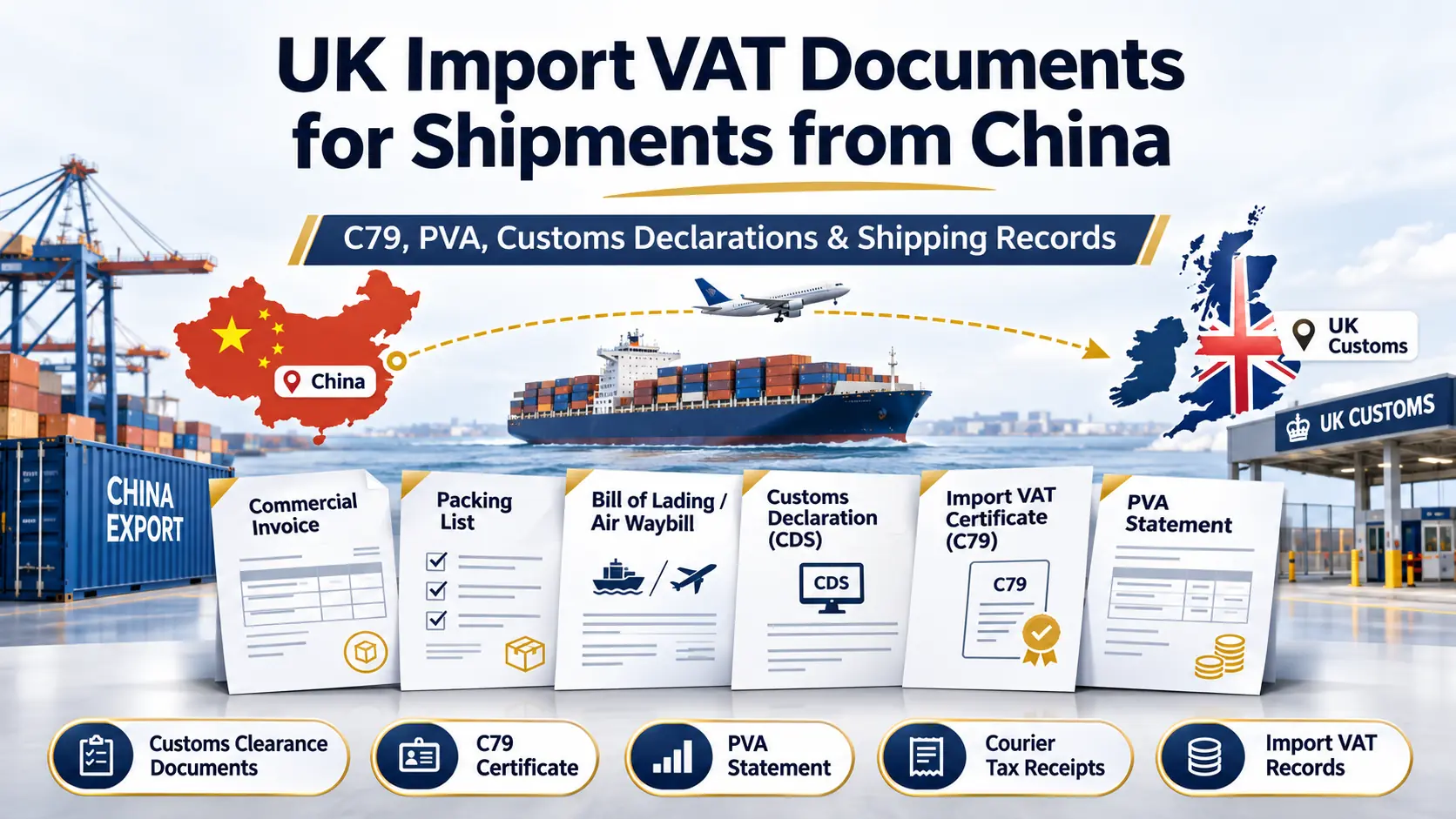
Before goods arrive at a UK port, the importer or appointed customs agent should have the information required to complete the import declaration.
The main supporting documents include:
| Document | Purpose |
|---|---|
| Commercial Invoice | Confirms the buyer, seller, goods description, quantity, declared value and Incoterms |
| Packing List | Shows package quantities, weights and dimensions |
| Bill of Lading / Air Waybill | Provides transportation and shipment details |
| Customs Declaration | Records the import entry submitted through the Customs Declaration Service (CDS) |
| EORI Number | Identifies the importer or relevant customs operator |
| Commodity Code | Determines the applicable import duty rate and product controls |
| Import Licence or Certificate | Supports compliance with requirements for controlled goods |
The information across these documents should be consistent, particularly the goods description, declared value, quantity, country of origin and importer details.
Additional documents may be necessary for regulated products, such as certain food products, chemicals and other controlled goods. Origin evidence may also be required when claiming preferential tariff treatment.
For a complete shipping paperwork checklist, see our guide to shipping documents from China to the UK.

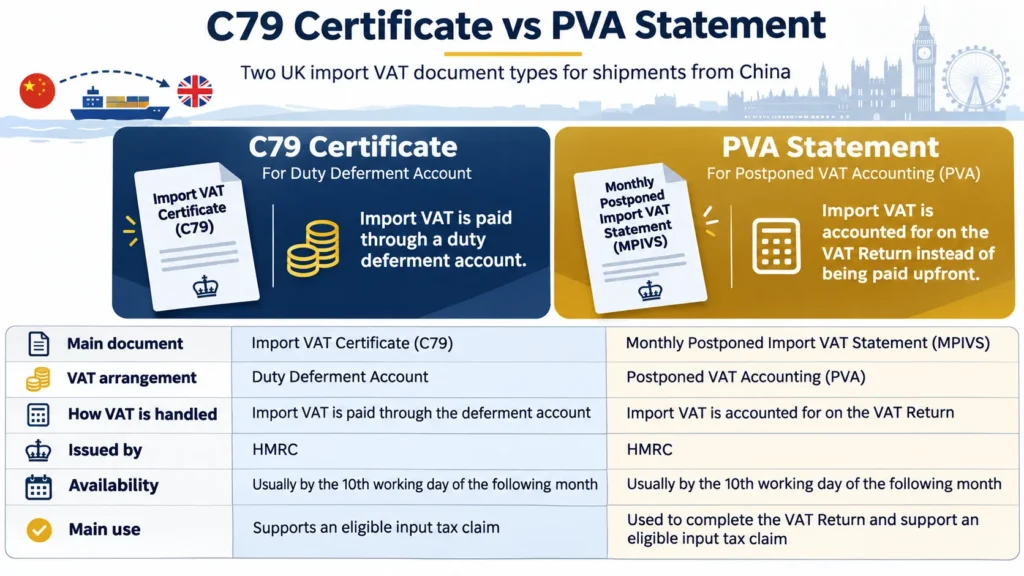
The main evidence depends on whether import VAT is paid through a duty deferment account or accounted for through Postponed VAT Accounting.
A C79 certificate is issued by HMRC when import VAT has been paid through a duty deferment account. It shows the amount of VAT paid on imports during the relevant month.
VAT-registered businesses can use the certificate to support an eligible input tax claim on their VAT Return.
Key points include:
C79 certificates are normally issued monthly.
They are usually available by the 10th working day of the following month.
Each certificate covers import VAT paid during the previous month.
Businesses can access the certificates through HMRC online services.
Online statements are available for six months before being archived.
Importers should download and retain each certificate rather than relying on continued online access.
A C79 certificate is evidence of import VAT paid, but the amount recoverable still depends on the normal VAT input tax rules.
Postponed VAT Accounting allows eligible VAT-registered businesses to account for import VAT through their VAT Return instead of paying it immediately when goods enter the UK.
When PVA is selected on the import declaration, HMRC records the relevant amount against the importer’s EORI number.
The Monthly Postponed Import VAT Statement (MPIVS) provides details such as:
VAT registration number and EORI number.
Import dates and declaration references.
Import VAT amounts for the reporting month.
The UK port of entry, where available.
Individual customs entries associated with the statement.
Businesses use this statement to account for import VAT and support eligible input tax claims.
PVA statements are normally available by the 10th working day of the following month. They can be accessed online for six months before being archived, so businesses should download them regularly.
The customs declaration connects the imported goods with the relevant tax information. It should identify the correct importer and contain consistent details about the goods, customs value and applicable customs procedure codes.
Importers should also retain supporting records, including:
Supplier sales invoices and purchase records.
Transport and insurance invoices.
Customs entry references.
Duty payment records.
Courier company tax invoices, where applicable.
C79 certificates or PVA statements.
A commercial invoice helps establish the transaction value, while freight and insurance records may support the calculation of the import VAT value. However, these documents do not independently prove that import VAT has been paid or accounted for.
For more information about the declaration process, see our guide to UK customs clearance.
UK VAT-registered businesses may recover eligible import VAT as input tax when the imported goods are used for taxable business activities and the normal HMRC conditions are satisfied.
Before making a claim, confirm that:
The business is registered for UK VAT.
The goods are imported for business use.
The business has the right to dispose of the goods, usually as the owner.
The correct VAT registration number and EORI number are used on the import declaration.
Appropriate evidence of the tax paid or accounted for is available.
Appointing a customs agent does not automatically give the agent or another party the right to reclaim the import VAT.
The process depends on the arrangement used for the shipment:
For imports paid through a duty deferment account:
Confirm that import VAT has been paid through the account.
Obtain the relevant monthly C79 certificate.
Check the import entries and VAT amounts.
Use the eligible amount as input tax on the appropriate VAT Return.
For imports using PVA:
Confirm that the business is eligible to use PVA.
Ensure the customs agent selects PVA on the import declaration.
Download the monthly postponed import VAT statement.
Include the import VAT due in Box 1 of the VAT Return.
Claim eligible input tax in Box 4, subject to the normal rules.
Report the value of imported goods, excluding VAT, in Box 7.
The relevant VAT Return must cover the accounting period in which the goods were imported.
Businesses should reconcile their customs entries with the monthly statement to identify missing or duplicated records.
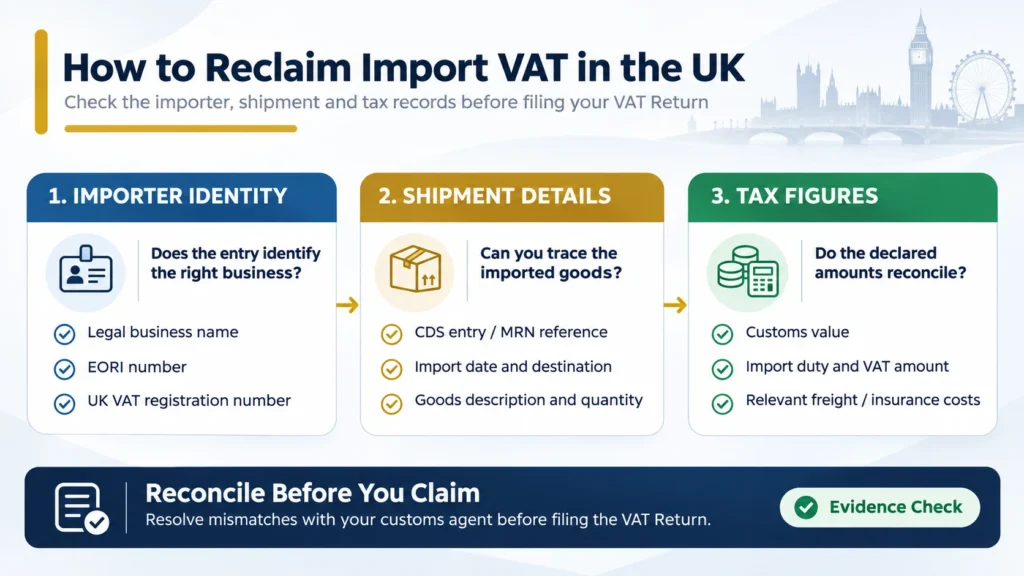
Missing records or inconsistent importer details can create problems when completing VAT Returns or supporting an input tax claim.
If a C79 certificate or PVA statement does not show an expected shipment, check the following:
EORI number: Confirm that the customs declaration used the correct importer EORI.
VAT registration number: Check that the correct VAT registration details were included where required.
Import declaration: Obtain the entry reference and confirm that the declaration was accepted.
Accounting method: Check whether the shipment used a duty deferment account or PVA.
Customs agent: Ask the agent to verify which importer details were submitted and how import VAT was accounted for.
If a statement is still missing, contact HMRC or the customs representative to investigate the entry.
A courier company’s payment receipt alone should not be treated as sufficient proof of an import VAT claim. The importer must establish how the tax was accounted for and obtain the appropriate supporting evidence.
HMRC requires VAT-registered businesses to retain VAT records for at least six years, unless a specific exception or shorter retention arrangement applies.
For shipments from China, businesses should maintain an organised record of:
C79 certificates or PVA statements.
Customs declarations and entry references.
Commercial and purchase invoices.
Transport and insurance costs.
Customs duty and tax payment records.
Correspondence with customs agents and courier companies.
One important distinction is that C79 and PVA statements are only available online for six months before being archived. This is an online access period, not the full record retention period.
Download each monthly statement and store it with the corresponding shipment records. This makes it easier to reconcile import costs, prepare VAT Returns and respond to HMRC enquiries.
Under DDP, the seller agrees to arrange import clearance and pay the relevant import charges under the sales contract. However, this does not automatically mean the UK buyer can reclaim the import VAT.
Before accepting a DDP arrangement for goods from China, confirm:
Who is named as the importer on the customs declaration.
Which EORI number is used.
Who has the right to dispose of the goods at importation.
Whether import VAT is paid through a duty deferment account or accounted for through PVA.
Which party will receive the C79 certificate or PVA statement.
For DAP shipments, the buyer generally handles import clearance and applicable import charges. Under either arrangement, the actual customs declaration and supporting tax records matter more than the Incoterm alone when establishing VAT recovery eligibility.
Businesses should agree on these responsibilities before shipping to avoid missing records and unexpected tax costs.
When shipping commercial goods from China to the UK, a freight forwarder can help coordinate the transport paperwork and customs information needed for import clearance.
Before shipment, the freight forwarder can assist with:
Document checks: Reviewing commercial invoices, packing lists and transport documents to identify missing or inconsistent shipment details.
Importer information: Confirming the EORI number, consignee details and agreed Incoterms before the customs entry is prepared.
Shipping cost records: Coordinating freight and insurance information that may be relevant to customs valuation and import VAT calculations.
Customs coordination: Working with the destination customs agent to arrange the import declaration and clarify who is responsible for import duty and VAT.
Shipment records: Providing relevant transport documents and shipment references to help importers reconcile their customs and accounting records.
For import VAT accounting, businesses should obtain their C79 certificates directly through HMRC or download their PVA statements from the Customs Declaration Service (CDS), depending on the accounting method used.
Tonlexing provides sea freight, air freight and door-to-door shipping services from China to the UK, helping businesses coordinate shipment documents, transportation and destination clearance arrangements.
The main evidence depends on the accounting method. Businesses that pay import VAT through a duty deferment account generally use a C79 certificate. Businesses using PVA should retain their monthly postponed import VAT statements. Customs entry references and supporting purchase and transport records should also be maintained.
Yes, if the business uses Postponed VAT Accounting, it uses the monthly PVA statement rather than a C79 certificate. If import VAT was paid through a duty deferment account, the C79 certificate is the normal evidence for an input tax claim. Missing records should be investigated with HMRC.
A courier company may pay import charges on behalf of the recipient and collect the amount before delivery. However, its receipt or handling invoice is not automatically equivalent to a C79 certificate or PVA statement. Ask for the customs entry details and confirm the importer information.
Not automatically. The business must satisfy the normal VAT recovery conditions, including having the relevant right to dispose of the imported goods and appropriate import evidence. The customs declaration, importer details and VAT accounting arrangements should be checked before agreeing to DDP.
No. Standard UK import declarations are submitted electronically through the Customs Declaration Service. C88 is an older Single Administrative Document format and should not be presented as a separate mandatory paper form for every standard import.
Useful freight, customs and importing resources related to this shipping guide.
Customs Clearance in the UK Verified & Reviewed · Last updated February 2026 Customs clearance in the UK is the process of declaring goods to HMR...
Read guide →
Shipping Documents from China to the UK Verified & Reviewed · Last updated February 2026 Shipping documents from China to the UK are the quickest...
Read guide →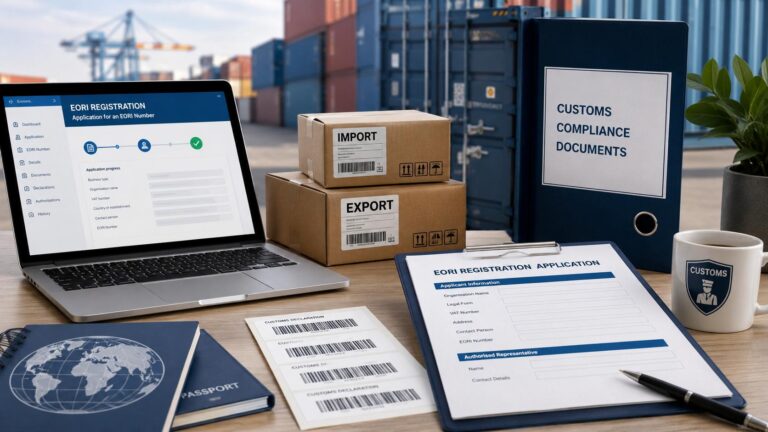
EORI Number Explained: Do You Need It to Import from China? Verified & Reviewed · Last updated July 2026 An EORI number is usually required when...
Read guide →
How to Import from China to the UK: Complete Business Guide Verified & Reviewed · Last updated June 2026 Importing from China to the UK involves...
Read guide →What is a packing list? What is the difference between it and a B/L and CI? In international trade, proper documentation is key to ensuring a smo...
Learn more → Useful Resource DDP Shipping from China to UKShipping from China to the UK has become increasingly efficient and accessible, thanks to international logistics innovations and the rising popu...
Learn more →WhatsApp us