
Amazon FBA Inbound Placement Service & Shipment Splits

Amazon FBA inbound placement affects where your inventory is sent and whether placement fees apply. Sellers may ship to fewer locations for a fee or use shipment splits to distribute inventory across multiple Amazon-assigned destinations.

Learn how Amazon FBA inbound placement service works in 2026, including minimal, partial, and Amazon-optimized shipment splits, placement fees, and how to compare total inbound costs.

Inbound Placement Fees

Shipment Splits

FBA Inbound Costs

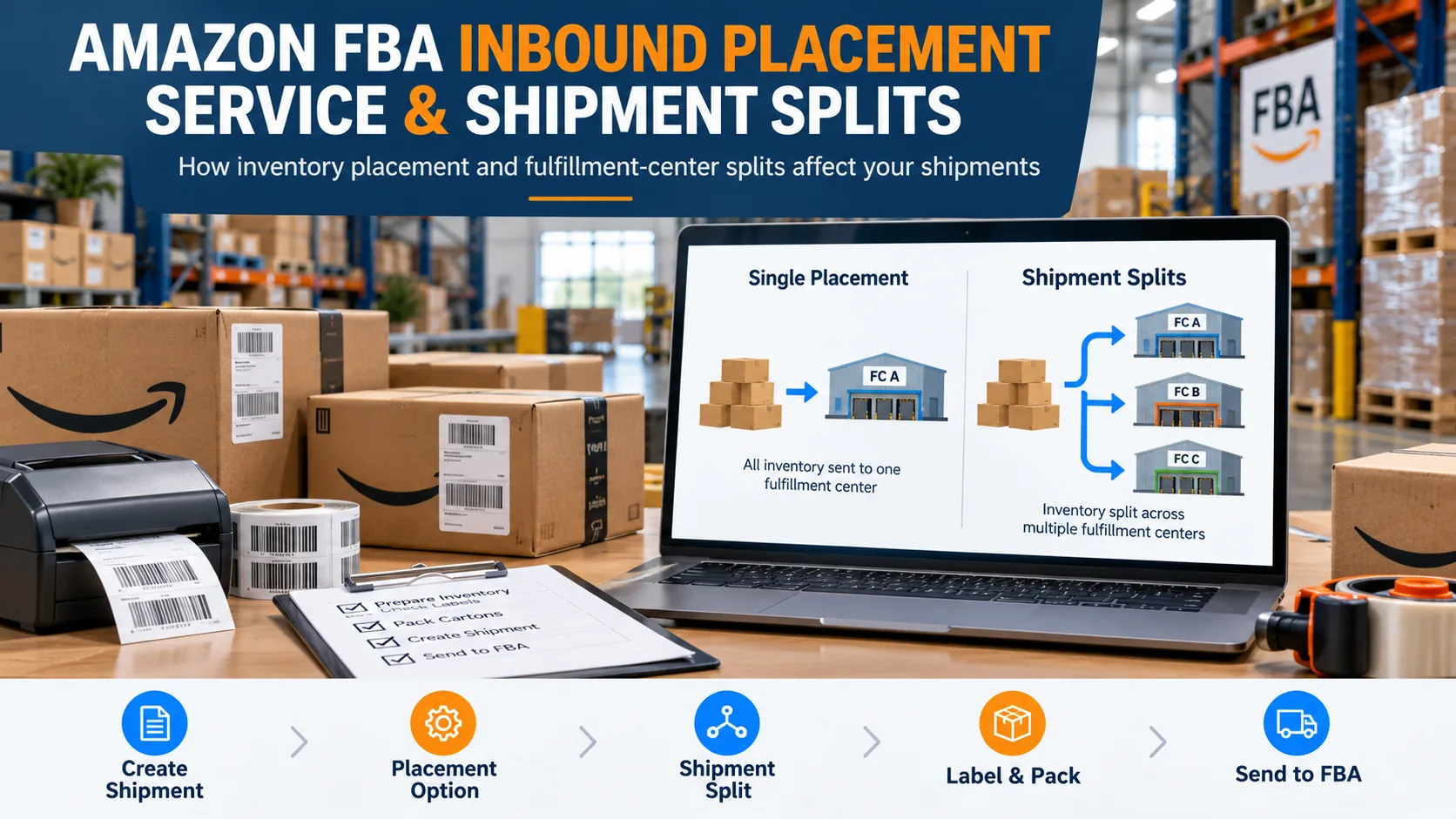
Amazon FBA inbound placement service and shipment splits infographic showing warehouse distribution and inbound options
10,000+ international shipments handled    Global sea, air & DDP shipping solutions    24/7 shipment tracking & customer support

Table of Contents

How Amazon FBA Inbound Placement Works

Amazon operates a distributed fulfillment network. Inventory stored closer to customer demand can generally be delivered faster, so Amazon needs products to be positioned across different fulfillment locations rather than concentrated in one warehouse.

When a seller creates an FBA shipping plan, Amazon evaluates the inventory and presents the placement options available for that particular shipment.

The available options can be affected by factors such as:

  • Product size category

  • Shipping weight

  • Number of units

  • Carton configuration

  • Inbound destination

  • Fulfillment network capacity

  • Product handling category

Sellers may either send goods to fewer receiving locations and let Amazon handle more of the network distribution, or send inventory directly to multiple locations themselves.

Amazon charges an inbound placement service fee when the selected option requires Amazon to perform more of that distribution. The applicable rate depends on the shipment rather than being one fixed fee for every FBA seller.

This is why two sellers shipping similar quantities may see different inbound costs.

A lightweight standard-size product sent to an East Coast location, for example, can have a different rate from a heavier item assigned to another region.

Amazon also notes that some western inbound locations can carry higher placement fees than locations in other parts of the United States.

Minimal, Optimized, and Partial Shipment Splits

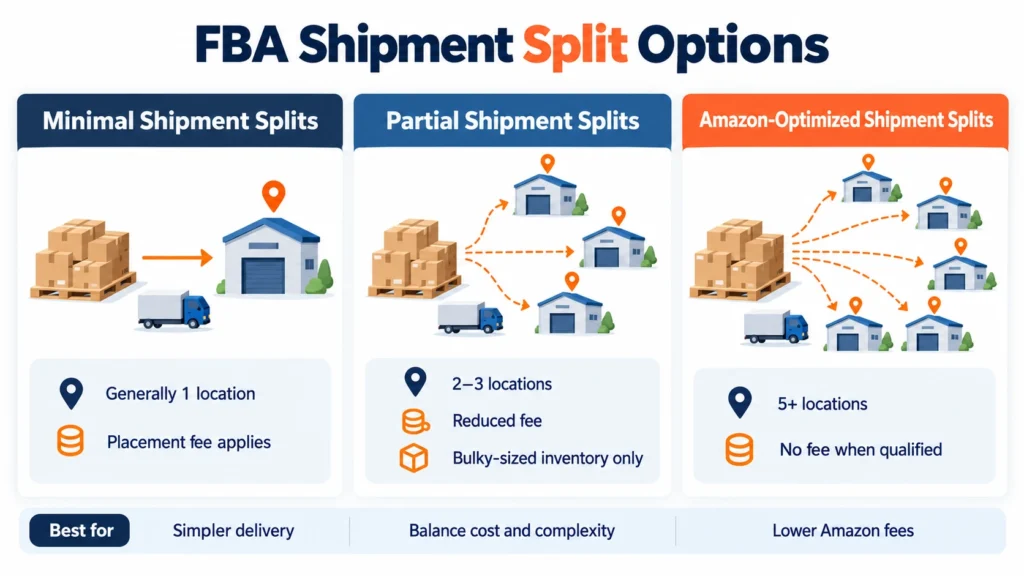
When creating an FBA shipping plan, sellers may be given different inbound placement options depending on the products, quantities, and shipment configuration. The main difference between these options is how many Amazon inbound locations the seller must deliver to and whether a placement fee applies.

For 2026, Amazon uses three main shipment split models: minimal shipment splits, Amazon-optimized shipment splits, and partial shipment splits for eligible Bulky-sized inventory.

Shipment OptionTypical DestinationsPlacement FeeAvailability
Minimal shipment splitsGenerally 1 locationYesStandard-size and Bulky inventory
Amazon-optimized shipment splits5 or more locationsNo fee when qualifiedEligible FBA shipments
Partial shipment splits2 or 3 locationsReduced feeBulky-sized inventory only

Minimal Shipment Splits

Minimal shipment splits allow sellers to send inventory to the minimum number of inbound locations, generally a single location. Amazon then manages the wider distribution of that inventory across its fulfillment network.

This option is usually easier to coordinate because the shipment involves fewer destinations, fewer delivery appointments, and less cargo separation.

The trade-off is that Amazon charges a per-unit placement fee. The actual fee depends on factors such as product size, shipping weight, and the inbound location assigned to the shipment.

Minimal splits can be practical for consolidated, palletized, or heavier shipments where keeping transportation simple may be more valuable than avoiding the placement charge.

Amazon-Optimized Shipment Splits

Amazon-optimized shipment splits require the seller to send inventory directly to multiple inbound locations. When the shipment qualifies, Amazon does not charge an inbound placement service fee.

To qualify, Amazon currently requires at least five identical cartons or pallets per item. Each carton or pallet must contain the same quantity per item and the same item mix.

This option may reduce Amazon fees, but it also requires more shipment coordination because inventory must be divided and delivered to several destinations.

Sellers may need to manage:

  • Separate carton or pallet groups

  • Multiple destination labels

  • Additional delivery arrangements

  • More complex cargo sorting

For this reason, Amazon-optimized splits should be evaluated based on total inbound cost rather than the placement fee alone.

Partial Shipment Splits

Partial shipment splits provide a middle ground between minimal and Amazon-optimized shipment splits.

Under Amazon’s current U.S. FBA rules, this option is available for Bulky-sized inventory only and is not offered for standard-size shipment plans. Inventory is typically sent to two or three inbound locations, and Amazon charges a reduced placement fee compared with minimal shipment splits.

Partial splits can be useful when sending bulky goods to five or more locations would create too much transportation complexity, but the seller still wants to reduce the placement fee associated with sending everything to one location.

Amazon FBA Inbound Placement Fees in 2026

Amazon updated its U.S. FBA inbound placement pricing on January 15, 2026.

For standard-size products, fees increased by an average of $0.05 per unit. Amazon also introduced additional shipping-weight bands.

The former Large Bulky category was divided into Small Bulky and Large Bulky tiers, while minimal split fees for the new Large Bulky tier increased by an average of $0.27 per unit.

Standard-Size Fees

For shipment plans created under the 2026 rate structure:

Product SizeShipping WeightMinimal SplitsAmazon-Optimized
Small Standard8 oz or less$0.14–$0.32/unitNo fee
Small Standard8+ oz to 16 oz$0.16–$0.32/unitNo fee
Large Standard12 oz or less$0.20–$0.40/unitNo fee
Large Standard12+ oz to 1.5 lb$0.24–$0.50/unitNo fee
Large Standard1.5+ lb to 3 lb$0.34–$0.60/unitNo fee
Large Standard3+ lb to 5 lb$0.38–$0.76/unitNo fee
Large Standard5+ lb to 7 lb$0.40–$0.98/unitNo fee
Large Standard7+ lb to 10 lb$0.42–$1.20/unitNo fee
Large Standard10+ lb to 15 lb$0.44–$1.50/unitNo fee
Large Standard15+ lb to 20 lb$0.55–$1.90/unitNo fee

These are Amazon’s published ranges. The exact rate shown when a seller prepares a shipment can depend on the inbound location.

A small difference per unit can become significant at scale.

For example, a $0.40 charge on 100 units is relatively minor. Applied to 10,000 units, the same rate represents $4,000 in additional inbound cost.

That is why placement planning becomes increasingly important as shipment volume grows.

Small Bulky and Large Bulky Fees

Bulky products have substantially higher per-unit rates.

Product SizeShipping WeightMinimal SplitsAmazon-Optimized
Small Standard8 oz or less$0.14–$0.32/unitNo fee
Small Standard8+ oz to 16 oz$0.16–$0.32/unitNo fee
Large Standard12 oz or less$0.20–$0.40/unitNo fee
Large Standard12+ oz to 1.5 lb$0.24–$0.50/unitNo fee
Large Standard1.5+ lb to 3 lb$0.34–$0.60/unitNo fee
Large Standard3+ lb to 5 lb$0.38–$0.76/unitNo fee
Large Standard5+ lb to 7 lb$0.40–$0.98/unitNo fee
Large Standard7+ lb to 10 lb$0.42–$1.20/unitNo fee
Large Standard10+ lb to 15 lb$0.44–$1.50/unitNo fee
Large Standard15+ lb to 20 lb$0.55–$1.90/unitNo fee

Amazon states that the larger of dimensional weight or unit weight is used for Large Standard, Small Bulky, and Large Bulky items when determining the applicable shipping-weight category.

The FBA inbound placement service fee does not currently apply to Extra-Large products.

How the Placement Fee Is Calculated

The basic calculation is straightforward:

Placement Fee = Applicable Per-Unit Rate × Units Received

The challenge is determining which per-unit rate applies.

Amazon considers:

  • Size tier

  • Shipping weight

  • Number of shipment splits

  • Assigned receiving location

For example, Amazon’s 2026 documentation uses a 6 lb Large Standard product sent through a minimal split to an East region inbound location.

For 100 units at $0.42 per unit: 100 × $0.42 = $42

Amazon’s example states that the fee is charged 45 days after initial receipt.

Sellers should therefore use the figures shown in the actual shipping plan rather than estimating costs solely from product weight.

Shipment Splits vs. Total Inbound Cost

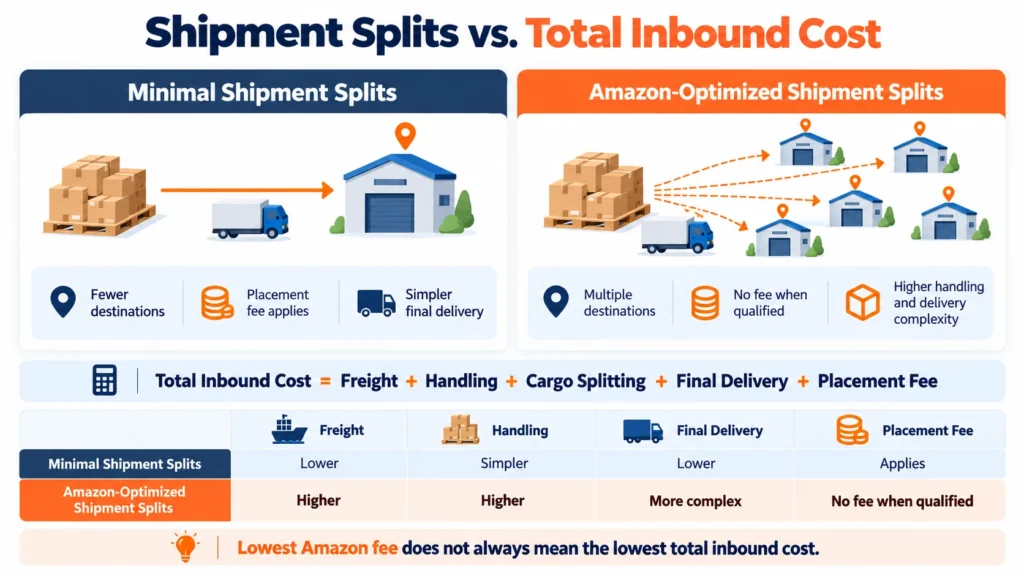
One of the most common mistakes in FBA inbound planning is choosing a shipment option based only on Amazon’s placement fee. A plan showing No fee may appear cheaper, but the seller may still face higher transportation, handling, and multi-destination delivery costs.

A more useful comparison is:

Total Inbound Cost = International Freight + Handling + Cargo Splitting + Final Delivery + Placement Fee

For sellers shipping from China, the difference between these costs can be significant.

Comparison of minimal shipment splits and Amazon-optimized shipment splits against total inbound cost

When Minimal Splits Can Be More Economical

Minimal shipment splits may cost less overall when consolidated delivery provides meaningful freight savings.

For example, palletized or heavy cargo sent to one inbound destination may be easier and cheaper to move than dividing the same shipment among several locations. The seller pays a placement fee but may reduce:

  • Warehouse handling

  • Cargo splitting

  • Domestic trucking

  • Multiple delivery appointments

In these cases, the transportation savings can outweigh the Amazon placement fee.

When Optimized Splits Can Save More

Amazon-optimized shipment splits may be more attractive when inventory is easy to divide and the additional delivery cost is relatively low.

This is often more practical for smaller or lighter shipments that can be distributed efficiently across multiple inbound locations. For high-volume inventory, avoiding a per-unit placement fee can also create meaningful savings.

The best option should therefore be based on the total inbound cost per unit, not simply on whether Amazon shows a placement fee.

Planning FBA Shipment Splits When Shipping From China

When products are manufactured in China, inbound planning should start before the cargo reaches the United States.

Waiting until the goods arrive at a destination warehouse can create unnecessary repacking, labeling, and storage costs.

Prepare the Cartons Before Final Shipping

Before a supplier completes final packing, confirm how the inventory will be prepared for FBA.

Important information includes:

If Amazon-optimized splitting is likely to be used, consistent carton quantities are especially important.

The requirement for identical cartons or pallets should be communicated to the factory or consolidation warehouse before production packing is finalized.

This reduces the risk of paying someone later to reorganize the same inventory.

Split Cargo by Amazon Destination

Once the shipping plan is generated, Amazon provides the receiving destinations for the shipment.

Cargo must then be matched accurately to each destination.

For multi-location shipments, verify:

  • Destination addresses

  • Shipment IDs

  • Box labels

  • Carton quantities

  • Pallet quantities

  • Carrier requirements

  • Delivery appointments when required

This step becomes more important as the number of receiving locations increases.

One incorrect group of cartons can create receiving problems even when the total shipment quantity is correct.

For shipments originating in China, splitting can take place at the origin warehouse or after arrival in the United States.

The better option depends on shipment volume, transportation mode, destination distribution, and how much additional handling each method requires.

Choose the Final Delivery Method Around the Split Plan

The number and location of Amazon destinations can influence the most suitable delivery method.

Small carton shipments may work well with parcel delivery.

Larger palletized shipments may require:

  • LTL

  • FTL

  • Local trucking

  • Warehouse transfer

  • Appointment-based delivery

A shipment that is economical as one truckload can become much more expensive if it is divided among several distant destinations.

Before approving the final plan, compare the cost of each delivery structure rather than assuming that the option with fewer Amazon fees is automatically better.

How to Reduce Amazon FBA Inbound Costs

Reducing Amazon FBA inbound costs requires looking beyond the placement fee alone. The most cost-effective option depends on how inventory is packed, how many destinations Amazon assigns, and how much transportation and handling each shipment plan requires.

Start by comparing the total inbound cost of the placement options available in Seller Central. Minimal shipment splits may involve a placement fee but simplify transportation, while Amazon-optimized splits can remove the fee but require delivery to multiple inbound locations.

For shipments from China, carton preparation should also be planned before export. Consistent carton quantities and SKU configurations make inventory easier to divide if Amazon assigns several destinations and can reduce repacking or relabeling costs later.

Other practical ways to control inbound costs include:

  • Compare placement fees with final delivery costs

  • Keep carton quantities and SKU mixes consistent

  • Avoid unnecessary repacking at destination

  • Choose parcel, LTL, or FTL based on shipment size and destination count

  • Review partial shipment splits for eligible Bulky inventory

The goal is not simply to avoid Amazon’s placement fee. Sellers should choose the shipping plan that provides the lowest total inbound cost per unit after transportation, handling, splitting, and Amazon fees are included.

Frequently Asked Questions