

Customs Clearance in Canada (2026 Guide)
- Verified & Reviewed · Last updated January 2026
Customs clearance in Canada varies by shipment type, but the goal is always the same: make a correct declaration, meet CBSA compliance checks, pay duties and taxes when required, and get cargo released for delivery.
This updated 2026 guide explains the customs clearance process in Canada for travellers, business importers, and courier shipments. It covers CBSA rules, key documents and forms, common delay triggers, and how customs brokers help you clear customs faster.
CBSA process / Mode
Documents & forms
Duties & Taxes / Release
- Experienced China-based logistics specialists
Table of Contents
What is customs clearance in Canada
Customs clearance is the process where CBSA reviews your declaration or import entry, verifies key details such as origin, value, and compliance, assesses duties and taxes when required, and issues a release decision for imported goods.
When CBSA cannot verify a shipment using the information provided, it may request further documentation or select the shipment for inspection. The most reliable way to speed up clearance is to finalize classification, valuation support, and your document set before the cargo arrives.
Who controls customs clearance in Canada
CBSA is the primary authority responsible for customs enforcement at the Canadian border, including airports, land crossings, rail terminals, marine ports, and courier hubs. CBSA also administers import requirements on behalf of other government departments, which is why some products require permits or approvals beyond standard customs paperwork.
CBSA responsibilities
CBSA’s role includes:
reviewing declarations and import entries
verifying origin, value, and compliance
assessing duties and taxes
selecting shipments for inspection
issuing release decisions for goods imported into Canada
Who is responsible in real shipments
Customs outcomes depend on consistent information across the supply chain:
Travellers are responsible for accurate declarations
Importers are responsible for classification, value, origin, and compliance
Customs brokers may act on an importer’s behalf to submit entries and manage documentation
Carriers and couriers transmit shipment and transport data that must match your documents
When any party submits incomplete or inconsistent information, CBSA may delay release until the issue is resolved.
Customs clearance process overview
A clear, repeatable customs process reduces delays and unexpected fees. While the details vary by shipment type, the workflow is consistent for most imports.
The core customs process in Canada
Most shipments follow five steps:
Submit a declaration or entry
CBSA reviews documents and compliance
CBSA assesses duties and taxes
CBSA decides release or inspection
Payment is completed and release is issued
The simplest way to save time is to ensure the invoice, packing list, transport record, and shipment data match before cargo arrives.
Where most delays come from
Most delays have a clear cause. Common triggers include:
generic product descriptions that do not identify composition and use
valuation concerns without transaction support
unclear or inconsistent origin details
missing permits for controlled items
mismatches across invoice, packing list, and transport data
These issues also drive many “further documentation” requests.
Customs clearance for travellers entering Canada
If you are entering Canada, you must declare goods at the border. Goods include purchases, gifts, and items you are carrying for others.
Clearing customs at an international airport
At an international airport, travellers typically complete primary inspection first. If selected, CBSA may refer you to secondary inspection to verify receipts, values, quantities, or restricted items. Being selected for inspection is common and does not automatically indicate wrongdoing.
Advance Declaration in ArriveCAN
Travellers may be able to submit a digital customs declaration using Advance Declaration in ArriveCAN up to 72 hours before arrival for participating airports. If submitted in advance, travellers typically retrieve the confirmed receipt at a kiosk or eGate upon arrival. If not submitted in advance, the declaration can be completed at the airport kiosk or eGate.
Common traveller mistakes that slow clearance
Traveller delays are often caused by missing receipts for high-value items, bringing restricted food or plant products, carrying quantities that appear commercial, or failing to declare reportable currency or monetary instruments.
Customs clearance for commercial goods and business importers
For business imports, customs clearance is document-driven. Most problems occur when importers treat customs as paperwork to fix after shipping instead of a process to complete before arrival.
Business setup: CRA Business Number and CARM Client Portal
Before importing goods commercially into Canada, businesses generally need a Business Number from the Canada Revenue Agency. For 2026 commercial importing, businesses are expected to be registered in the CARM Client Portal to manage duties and tax payment workflows. Incomplete setup can delay clearance even if the shipment is physically ready.
Gather product information before you classify or value
To reduce CBSA questions and prevent rework, gather:
product composition and materials
descriptive literature and specification sheets
intended use and end-user category
model, brand, and technical identifiers when relevant
manufacturing details and country of origin
This information strengthens tariff classification and helps you identify permit requirements early.
Importer SOP: the workflow that prevents delays
A practical importer sequence looks like this:
Confirm admissibility and permits
Assign the 10-digit tariff classification number
Confirm origin and keep proof ready
Set valuation using transaction value
Build and QC the document pack
Submit, pay, and obtain release
Goods must be classified using a 10-digit tariff classification number to determine duty rates. Valuation for most imports is assessed using the transaction value method, typically based on the cost of goods plus shipping and insurance under customs valuation principles.
Documents CBSA expects and what “further documentation” means
Most commercial imports rely on a consistent document set. Accurate documentation ensures the correct duties and taxes are applied and reduces inspection risk.
Core documents for commercial customs clearance
Commercial Invoice
A Commercial Invoice is required for most commercial shipments valued over CAD 2,500. It should include seller and buyer details, ship-to details, a specific product description, unit value, total value, currency, and origin.
Packing List
The packing list should match the invoice in cartons, quantities, and weights.
Transport record
The transport record must align with shipment facts, such as a bill of lading for ocean freight or an air waybill for air shipments.
B3 and customs accounting documents
Commercial clearance often involves structured accounting documentation such as the B3, depending on filing method and broker setup.
What “further documentation” usually indicates
When CBSA requests further documentation, it typically means one of the following:
the product description is not specific enough
the declared value needs transaction support
origin evidence is missing or inconsistent
controlled goods require permits or compliance documents
invoice, packing list, and shipment data do not match
The fastest response is clear evidence that matches the declared shipment facts.
Customs brokers in Canada
Customs brokers are licensed agents who can act on behalf of importers to facilitate customs transactions. They are most valuable when speed and compliance both matter.
What customs brokers do
Brokers typically review documents, prepare declarations and required forms, submit entries electronically, coordinate duties and tax payment workflows, and respond when CBSA requests additional documentation. They can also advise what to submit and who to contact when a shipment is held.
When using a broker is beneficial
A broker is especially useful if you import frequently, ship high-value goods, move time-sensitive cargo by air, or import regulated products where permits and compliance documentation can delay release. Even with a broker, the importer remains responsible for documentation accuracy and payment of duties.
Duties, taxes, fees, and payment
Clearance cost is more than freight. Duties, taxes, and service fees determine true landed cost.
Duties and GST basics
Duties are determined mainly by tariff classification and origin. GST is a federal 5 percent tax that applies to most imported goods. Depending on the province and transaction structure, other tax considerations may apply.
Special measures importers should watch in 2026
Some goods can be subject to surtaxes or special trade measures. As of late December 2025 and into 2026, a 25 percent surtax may apply to certain advanced computing chips and steel derivative goods imported after specific dates. Because trade measures can change, confirm applicability and timing for your product category before shipping.
Why payment timing affects release
Even with correct documents, clearance can slow down when importer account details are incomplete, CARM setup is not ready, or payment instructions are missing. Payment readiness should be treated as a clearance requirement, not an after-arrival task.
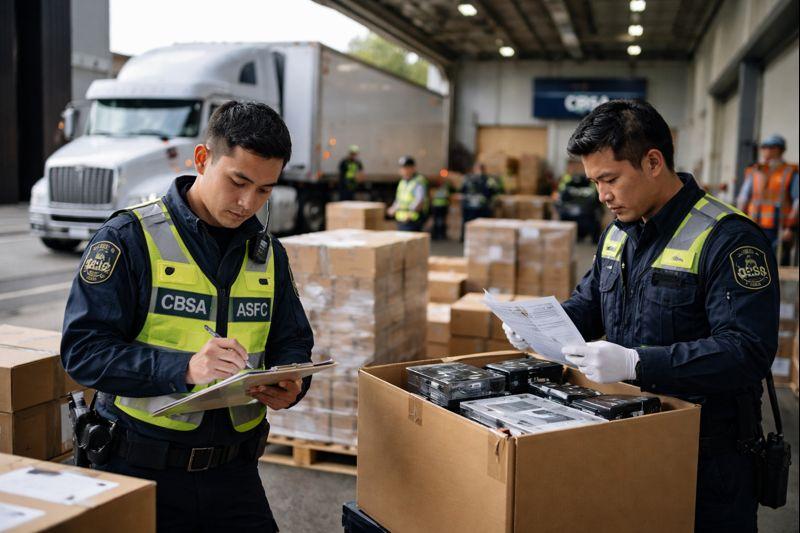
Inspection and delays: why CBSA holds shipments
Inspections may be random or triggered by risk signals. Most holds tie back to the same verification gaps described earlier: unclear descriptions, value and origin questions, missing permits, or document mismatches.
How to respond to CBSA requests
Respond with clean, consistent proof:
updated invoices with clearer descriptions
proof of payment when value is questioned
origin evidence
permits or compliance files for controlled goods
corrected packing lists where needed
Faster response typically improves release speed and reduces storage costs.
Courier and mail shipments: how to clear customs and reduce fees
Courier shipments can clear quickly, but brokerage and disbursement fees can surprise recipients. If the recipient is unprepared, shipments can sit and accumulate service charges.
Self-clearance overview
In many cases, recipients may be able to self-clear depending on courier procedures and local CBSA office practices. The general workflow is to obtain courier paperwork, present it to CBSA for assessment and payment, and return proof of clearance so the courier can deliver.
Common CBSA holds and fast fixes
| Hold reason | What CBSA needs | Fast fix | Prevent |
|---|---|---|---|
| Generic description | Identify goods clearly | Update invoice + spec sheet | Add material + use + model |
| Value questioned | Support transaction value | Proof of payment + PO | Keep value records ready |
| Origin unclear | Proof of origin | Origin statement/certificate | Standardize origin fields |
| Doc mismatch | Consistent qty/weight | Correct packing list | QC invoice = PL = transport |
| Missing permit | Regulatory approval | Permit/compliance file | Check permits before shipping |
| HS code risk | Classification support | Composition + rationale | Maintain SKU tariff file |
Practical checklists
Traveller checklist
Keep receipts accessible, declare purchases clearly, avoid restricted items unless you confirmed rules, and follow kiosk or eGate instructions.
Importer checklist for commercial goods
Confirm BN and CARM readiness, gather product composition and descriptive literature, confirm admissibility and permits, classify using the 10-digit tariff number, support valuation under transaction value, prepare a CAD 2,500+ compliant commercial invoice, ensure documents match, and respond quickly if CBSA requests further documentation.
Frequently Asked Questions
CBSA reviews the declaration and documents, verifies compliance, assesses duties and taxes when required, may select the shipment for inspection, and issues release so goods can move to delivery.
The Canada Border Services Agency is the authority responsible for customs clearance decisions at the Canadian border.
Yes. Travellers clear customs on arrival through primary inspection, with secondary inspection when needed.
Not always, but brokers are beneficial when you import frequently, ship regulated goods, or need fast and accurate submission.
Common reasons include missing documents, unclear product descriptions, origin issues, valuation concerns, permit gaps, and inspection selection.
More Guides for Shipping to Canada
Get Help With Customs Clearance in Canada
Document checklist and pre-review to avoid delays
Duties and taxes estimate based on HS code, value, and origin
Broker support for faster CBSA release
Share your shipment details and we’ll advise the best clearance process and required documents.