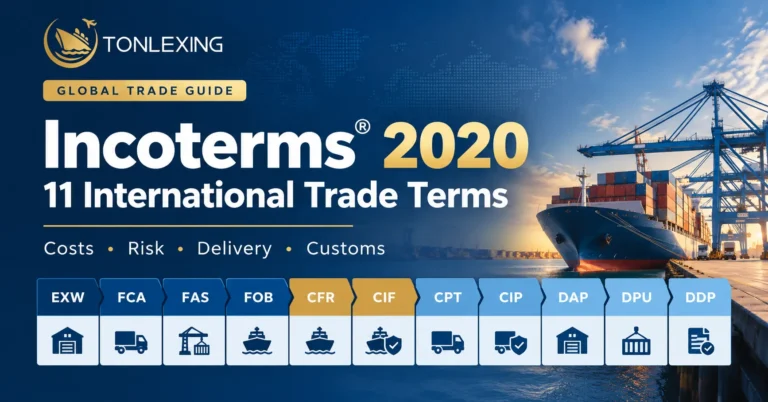


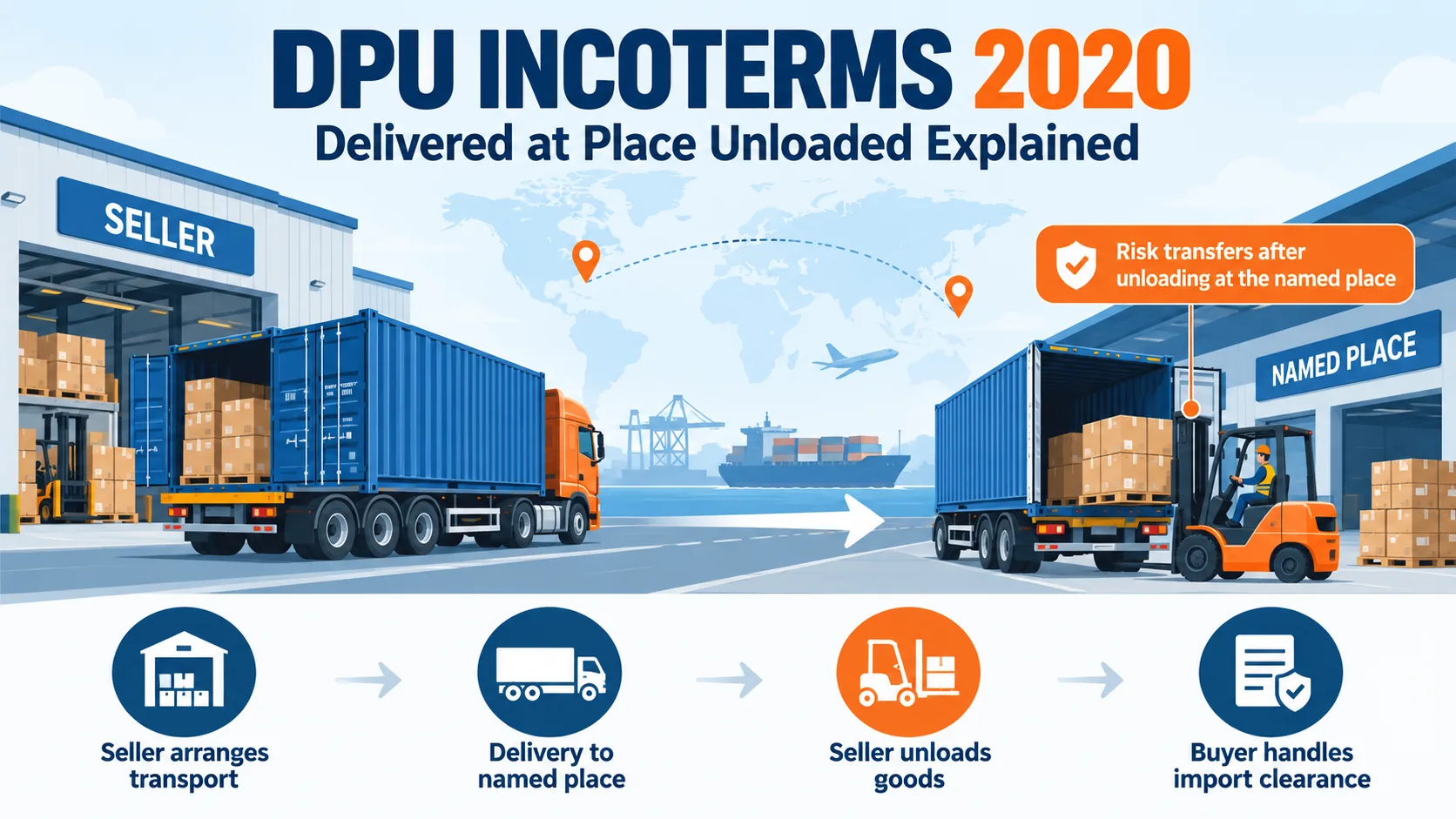
DPU Incoterms 2020: Delivered at Place Unloaded Explained
- Verified & Reviewed · Last updated September 2026
DPU (Delivered at Place Unloaded) requires the seller to deliver and unload the goods at the agreed destination. Risk transfers to the buyer only after unloading is completed.
The seller handles export formalities and transportation, while the buyer normally handles import clearance, duties, and taxes.
Seller Unloads
Risk After Unloading
Buyer Handles Import Clearance
- Experienced China-based logistics specialists
10,000+ international shipments handled Global sea, air & DDP shipping solutions 24/7 shipment tracking & customer support
Quick Answer: How Does DPU Work?
DPU places most transportation responsibility on the seller. The seller arranges the movement of the goods to the agreed destination, bears the risk during transportation, and is also responsible for unloading.
The buyer takes over after unloading and normally handles the import side of the shipment.
| Responsibility | Under DPU |
|---|---|
| Export packing | Seller |
| Export customs clearance | Seller |
| Main transportation | Seller |
| Transportation to named destination | Seller |
| Unloading at destination | Seller |
| Import customs clearance | Buyer |
| Import duties and taxes | Buyer |
| Risk transfer | After unloading |
| Cargo insurance | Not mandatory |
| Transport modes | Any mode |
Compared with many other Incoterms, DPU gives the seller additional responsibility at destination because the seller must complete the unloading operation before delivery is finished.
Table of Contents
What Is DPU Incoterms?
DPU stands for Delivered at Place Unloaded. It is one of the Incoterms 2020 rules used to define how transportation costs, risks, customs responsibilities, and delivery obligations are divided between a seller and a buyer.
Under DPU, the seller delivers the goods when they have reached the agreed destination and have been unloaded from the arriving means of transport. The named delivery point can be a buyer’s warehouse, factory, distribution center, project site, terminal, airport cargo facility, or another specifically agreed location.
This flexibility is important because DPU is not limited to ports or terminals. However, the parties should identify the destination as precisely as possible. A vague delivery point can lead to disagreements over unloading, local transportation, waiting time, and additional handling costs.
DPU Seller and Buyer Responsibilities
Under DPU, the seller is responsible for transporting the goods to the named destination and unloading them there, while the buyer handles import customs clearance and assumes the risk after unloading is completed.
Seller Responsibilities Under DPU
The seller takes responsibility for the shipment from origin through final unloading at the agreed destination.
Export clearance: Complete export customs formalities and provide the required export documents.
Main transportation: Arrange and pay for transportation to the named place of destination.
Transit formalities: Handle any required transit procedures during the journey.
Unloading: Arrange and pay for unloading the goods from the arriving means of transport.
Risk and costs: Bear the transportation risks and costs until unloading has been completed.
Shipping documents: Provide the commercial invoice, packing list, and other agreed transport documents.
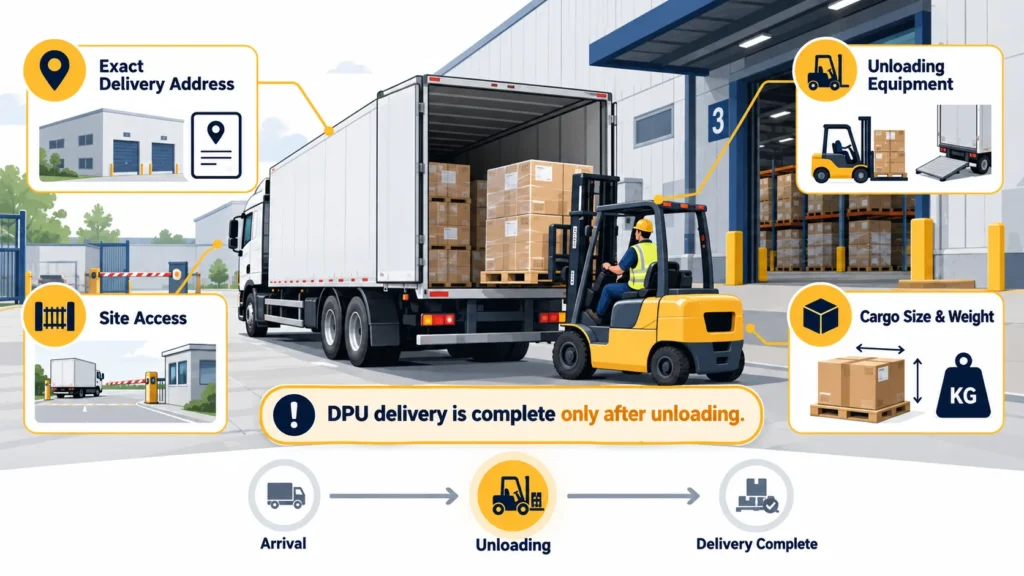
For heavy machinery, oversized cargo, or fragile goods, the seller should confirm in advance whether forklifts, cranes, loading docks, or other unloading equipment will be required.
Buyer Responsibilities Under DPU
The buyer’s main responsibilities begin with import clearance and continue after the seller completes unloading.
Payment: Pay for the goods according to the sales contract.
Import clearance: Complete import customs declarations and obtain any required licences or permits.
Duties and taxes: Pay import duties, VAT, GST, and other applicable destination taxes.
Customs documents: Provide information or documents required by destination customs.
Onward transport: Arrange further transportation after the agreed DPU delivery point, if needed.
Risk after unloading: Assume the risk and subsequent costs once the goods have been unloaded.
The key distinction is simple: the seller remains responsible until unloading is complete, while the buyer handles import clearance and takes over the risk after unloading.
DPU Risk Transfer: When Does Risk Pass to the Buyer?
Under DPU, risk transfers from the seller to the buyer after the goods have been unloaded at the named place of destination. Arrival by itself is not enough.
For example, if a truck carrying industrial machinery reaches the buyer’s warehouse but the machinery is still on the truck, the seller continues to bear the risk. If the cargo is damaged during unloading, that risk generally remains with the seller because DPU delivery has not yet been completed.
Once the cargo has been unloaded at the agreed location, delivery is complete and the buyer assumes the risk.
The basic risk flow can be summarized as:
Seller → Export → Main Transport → Destination Transport → Unloading → Buyer
This is one of the main differences between DPU and DAP. Because unloading can be a high-risk stage for heavy, fragile, or oversized cargo, both parties should confirm the unloading method and equipment before shipment.
Who Pays What Under DPU?
The seller pays the costs required to transport the goods to the named destination and unload them there. The buyer normally pays costs related to import customs clearance, duties, taxes, and any transportation required after DPU delivery.
| Cost or Charge | Seller | Buyer |
|---|---|---|
| Export packing | ✓ | |
| Origin pickup | ✓ | |
| Export customs clearance | ✓ | |
| Export-related charges | ✓ | |
| Main international freight | ✓ | |
| Transit transportation | ✓ | |
| Destination transportation | ✓ | |
| Unloading at agreed destination | ✓ | |
| Import customs clearance | ✓ | |
| Import duties | ✓ | |
| VAT or other import taxes | ✓ | |
| Transportation after DPU delivery | ✓ |
DPU does not require either party to purchase cargo insurance. However, because the seller bears the risk until unloading is complete, the seller may choose to arrange insurance covering that part of the journey.
Both parties should also clarify possible destination charges before shipment. Waiting time, storage, special lifting equipment, restricted access, and additional handling can significantly affect the final logistics cost.
How DPU Shipping Works Step by Step
A DPU shipment normally moves through six main stages.
Cargo preparation: The seller prepares the goods, export packaging, commercial invoice, packing list, and other required documents. Heavy or fragile products may require pallets, plywood cases, reinforced packaging, or moisture protection.
Export customs clearance: The seller completes export customs formalities and handles the documentation required to move the cargo out of the origin country.
Main transportation: The seller arranges sea, air, road, rail, or multimodal transportation to the destination country.
Import clearance: The buyer normally completes import customs clearance and pays the applicable duties and taxes. Coordination between the buyer, seller, freight forwarder, and customs broker can help prevent delays.
Delivery to the named place: After the necessary customs procedures are completed, the seller arranges transportation to the exact location stated in the sales contract.
Unloading and risk transfer: The seller arranges the labor and equipment needed to unload the cargo. Once unloading has been completed, DPU delivery is finished and the risk transfers to the buyer.
The exact operational process can vary by country, cargo type, and mode of transport, but the delivery point remains the same: the goods must be unloaded before the seller’s DPU obligation is complete.
DPU vs DAP vs DDP
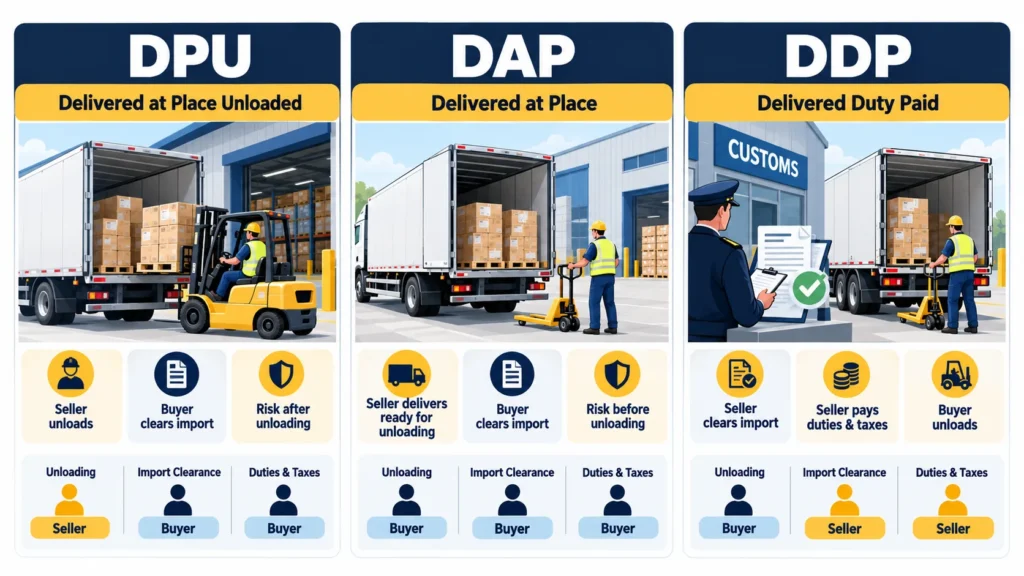
DPU, DAP, and DDP all place substantial transportation responsibility on the seller, but they divide unloading and import customs responsibilities differently.
| Responsibility | DPU | DAP | DDP |
|---|---|---|---|
| Export clearance | Seller | Seller | Seller |
| Main transportation | Seller | Seller | Seller |
| Delivery to destination | Seller | Seller | Seller |
| Unloading | Seller | Buyer | Buyer |
| Import clearance | Buyer | Buyer | Seller |
| Import duties and taxes | Buyer | Buyer | Seller |
| Risk transfer | After unloading | Before unloading | Before unloading |
DPU vs DAP
The main difference between DPU and DAP is unloading responsibility.
Under DAP, the seller transports the goods to the named destination and makes them available to the buyer on the arriving means of transport, ready for unloading. The buyer normally handles the unloading operation.
Under DPU, the seller must also unload the cargo before delivery is complete. This difference becomes especially important for machinery, large pallets, oversized equipment, glass, industrial products, or other shipments that require cranes or specialized handling equipment.
DPU vs DDP
The main difference between DPU and DDP is import customs responsibility.
Under DPU, the seller manages transportation and unloading, but the buyer normally handles import clearance and pays duties and taxes. Under DDP, the seller is generally responsible for import customs clearance and applicable duties and taxes, while the buyer normally handles unloading.
A simple way to remember the difference is:
DPU: seller unloads; buyer handles import clearance.
DDP: seller handles import clearance; buyer normally unloads.
For a broader comparison, see our guide to DAP vs DDP Incoterms and our overview of DDP shipping from China.
DPU vs DAT: What Changed in Incoterms 2020?
DPU replaced DAT, Delivered at Terminal, when Incoterms 2020 was introduced. The core delivery principle remained similar: the seller transports the goods to the agreed destination and completes unloading before delivery is considered complete.
The main change was the terminology. Under DAT, the word “Terminal” could imply that delivery had to take place at a port terminal, airport terminal, container yard, or similar facility. DPU uses the broader term “Place,” making it clear that the delivery point can also be a warehouse, factory, distribution center, project site, or another agreed location.
This gives buyers and sellers more flexibility when selecting the destination, but it also makes the exact named place of delivery more important. The contract should clearly identify where unloading will take place to avoid disputes over transportation, handling, and additional destination charges.
Customs Clearance and Import Duties Under DPU
Under DPU, customs responsibilities are divided clearly between the seller and the buyer. The seller handles export customs clearance and any export formalities required to move the goods out of the origin country, while the buyer is responsible for import customs clearance at destination.
The buyer normally needs to arrange:
Import customs declarations
Import licences or permits, where required
Product compliance documents and certificates
Payment of import duties
VAT, GST, or other local import taxes
Customs inspections or other destination formalities
This means that although the seller pays for transportation to the named destination and completes unloading, DPU does not include import duties or taxes in the seller’s responsibilities.
Import clearance should therefore be prepared before the cargo reaches the destination. Missing documents, incorrect HS codes, product restrictions, or delayed tax payments can hold the shipment at customs and may result in storage, waiting, or other destination charges.
If the buyer prefers the seller to also handle import clearance and pay duties and taxes, DDP may be more appropriate, provided the seller is legally able to act as the importer or arrange the required customs procedures in the destination country. For more details, see our guide to DDP shipping from China.
Common DPU Mistakes and How to Avoid Them
Most DPU problems come from unclear delivery instructions or assumptions about who is responsible for destination operations.
Using an unclear delivery location: Writing only “DPU Los Angeles” may be too broad because a city can contain ports, terminals, warehouses, and many possible delivery points. The contract should identify the warehouse, terminal, project site, or exact address whenever possible.
Not confirming unloading requirements: Because the seller is responsible for unloading, the required equipment should be confirmed before transportation is booked. Heavy or oversized cargo may require a crane, forklift, loading dock, or tail-lift vehicle.
Assuming DPU includes import duties: DPU does not normally make the seller responsible for import customs clearance, duties, or taxes. These obligations generally remain with the buyer.
Ignoring destination access restrictions: Some delivery locations require appointments, restrict vehicle sizes, have limited unloading hours, or impose specific safety requirements. These conditions can affect both transportation cost and delivery time.
Failing to define additional charges: Waiting time, storage, redelivery, special handling, crane charges, and similar expenses should be discussed before booking whenever possible.
Clear delivery instructions and a precise allocation of responsibilities reduce the risk of unexpected costs after the cargo reaches its destination. Buyers comparing several trade terms can also read our EXW vs FOB vs DDP guide.
Frequently Asked Questions
What does DPU mean in Incoterms?
DPU means Delivered at Place Unloaded. The seller transports the goods to the agreed destination and unloads them there. Risk transfers to the buyer once unloading has been completed.
Who unloads the goods under DPU?
The seller is responsible for unloading the goods at the named place of destination. This is the defining feature of DPU and one of its main differences from DAP.
Is DPU the same as DAP?
No. Under DAP, the seller delivers the goods ready for unloading, but the buyer normally handles unloading. Under DPU, the seller must complete unloading before delivery is finished.
What is the difference between DPU and DDP?
Under DPU, the seller transports and unloads the goods, while the buyer normally handles import customs clearance and taxes. Under DDP, the seller generally handles import clearance, duties, and taxes, while the buyer normally handles unloading.
Who pays import duties under DPU?
The buyer normally pays import duties, VAT, GST, and other destination taxes because import customs clearance is generally the buyer’s responsibility under DPU.
Related Logistics Guides
Useful freight, customs and importing resources related to this shipping guide.
Related Guide
DAP vs DDP Incoterms
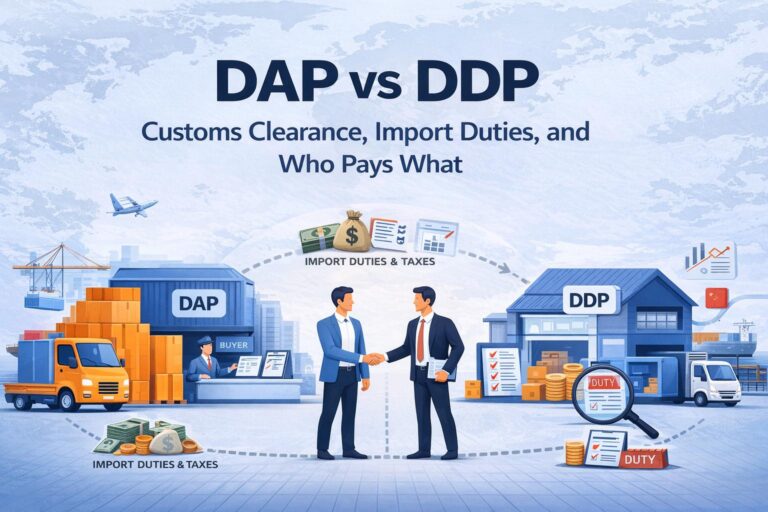
DAP vs DDP: Customs Clearance, Import Duties, and Who Pays What Verified & Reviewed · Last updated January 2026 Choosing between DAP and DDP dete...
Read guide →
Related Guide
DDP vs DDU vs DAP: Key Differences Explained (2025 Guide)
International shipping can be confusing, especially when it comes to trade terms like DDP, DDU, and DAP. These Incoterms define who is responsibl...
Read guide →
Related Guide
DDP Shipping from China
DDP shipping from China includes customs clearance, import duties, and final delivery. It is a convenient door to door service with clear and pre...
Read guide →
Useful Resource
Exw Ex Works Incoterms
Explore this related Tonlexing logistics guide for freight, customs and importing support.
Learn more → Useful Resource Customs Clearance Step by StepCustoms Clearance Step by Step: The Complete Process Verified & Reviewed · Last updated February 2026 Customs clearance step by step helps intern...
Learn more →