

EXW vs FOB vs DDP: Which Incoterm Is Best for Your Shipment?
- Verified & Reviewed · Last updated August 2026
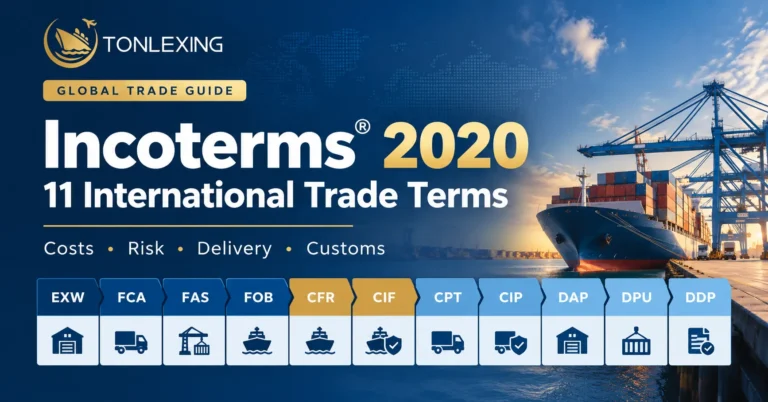
EXW, FOB, and DDP are widely used international commercial terms in international trade. Published as part of the Incoterms rules by the International Chamber of Commerce, they divide shipping costs, responsibilities, and risks differently between buyers and sellers.
When comparing EXW vs FOB vs DDP, the lowest supplier quotation is not always the lowest overall cost. Importers should also consider export formalities, international freight, customs clearance, import duties, destination charges, final delivery, and the point where transport risk moves from the seller to the buyer.
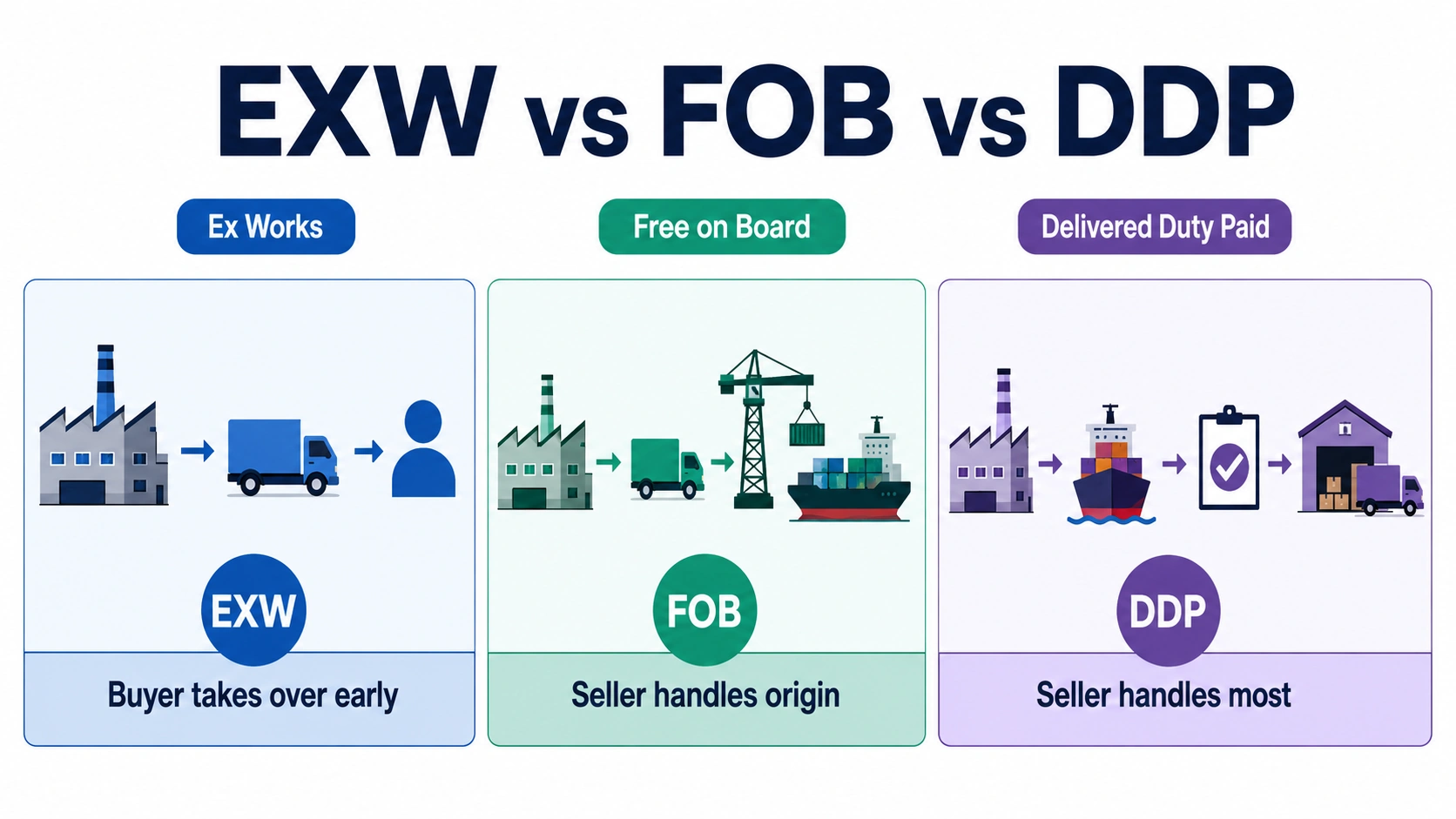
EXW / Ex Works
FOB / Free on Board
DDP / Delivered Duty Paid
- Experienced China-based logistics specialists
10,000+ international shipments handled Global sea, air & DDP shipping solutions 24/7 shipment tracking & customer support
Table of Contents
EXW vs FOB vs DDP at a Glance
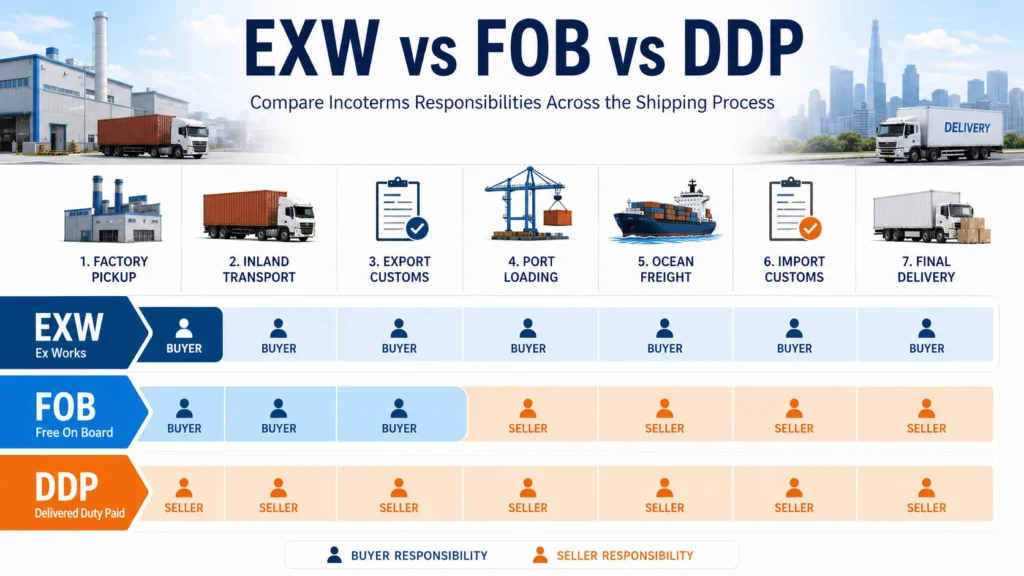
The following table shows the key differences between these three Incoterms and how shipping responsibility is divided.
| Factor | EXW | FOB | DDP |
|---|---|---|---|
| Pickup from seller | Buyer | Seller | Seller |
| Export clearance | Buyer | Seller | Seller |
| Origin transport | Buyer | Seller | Seller |
| Loading on vessel | Buyer | Seller | Seller if applicable |
| Main international freight | Buyer | Buyer | Seller |
| Import clearance | Buyer | Buyer | Seller |
| Import duties and taxes | Buyer | Buyer | Seller |
| Final delivery | Buyer | Buyer | Seller |
| Buyer logistics control | Highest | High | Lowest |
| Buyer workload | Highest | Medium | Lowest |
| Typical fit | Experienced importers | Regular sea freight importers | Buyers wanting simpler delivery |
EXW normally produces the lowest-looking supplier price because fewer logistics services are included. FOB includes more origin responsibilities while allowing the buyer to control the main freight. DDP includes most transportation and import responsibilities in the seller’s scope.
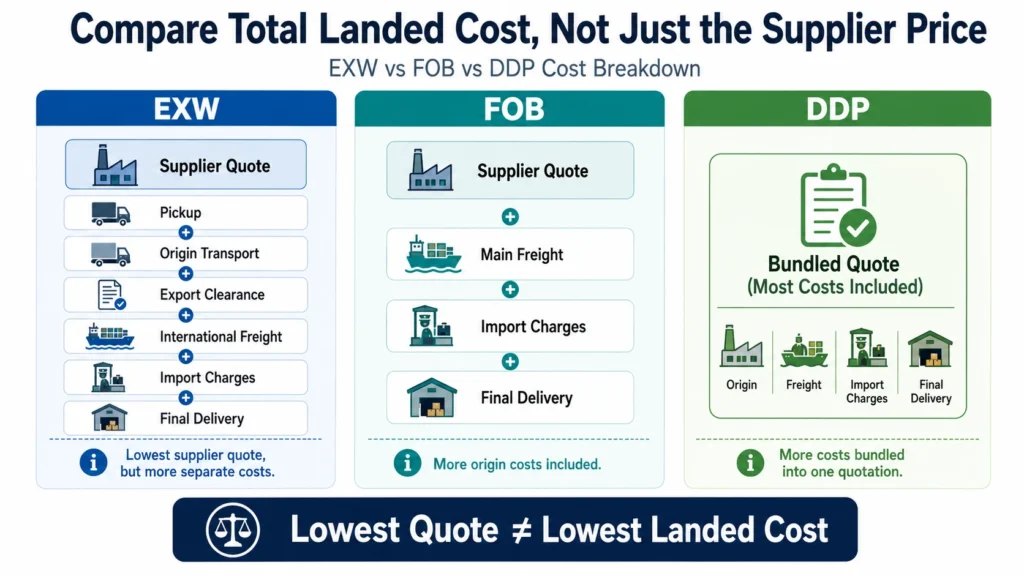
For this reason, importers should compare total landed cost, rather than simply the EXW, FOB, or DDP price shown on the supplier’s quotation.
What Does EXW Mean in Shipping?
EXW, or Ex Works, places most transportation responsibility on the buyer. Under Ex Works EXW delivery terms, the seller makes the goods available at the seller’s premises or another named place.
The buyer may then need to arrange:
Pickup from the factory or warehouse
Loading and origin transportation
Export procedures and documentation
Export customs clearance
Origin handling charges
International shipping
Cargo insurance if required
Import clearance
Import duties and taxes
Destination delivery
Ex Works gives the buyer maximum control over shipping logistics, but it also requires greater logistics expertise and coordination.
One important point is that the seller is generally not required under EXW to load the goods onto the buyer’s collecting vehicle unless this has been separately agreed. Buyers should therefore confirm both the named place and the loading arrangement before pickup.
What Does an EXW Price Include?
An EXW price normally covers the goods made available at the agreed seller’s premises. It does not represent the full cost of importing the shipment.
Depending on the supplier’s quotation, EXW pricing may exclude:
Factory pickup
Inland transportation
Export documentation
Customs declaration
Origin terminal handling
International freight
Destination charges
Import duties
Delivery to the buyer’s address
This explains why an EXW price may look cheaper than FOB or DDP even when the final landed cost is not.
Importers should calculate all freight costs outside the supplier’s EXW quotation before deciding which option is more economical.
Export formalities also deserve attention. Under Ex Works, the buyer is responsible for arranging the export process. In practice, local documentation and cooperation from the supplier or another eligible exporting party may still be necessary.
For shipments from China, these requirements should be confirmed before factory pickup is arranged.
What Does FOB Mean in Shipping?
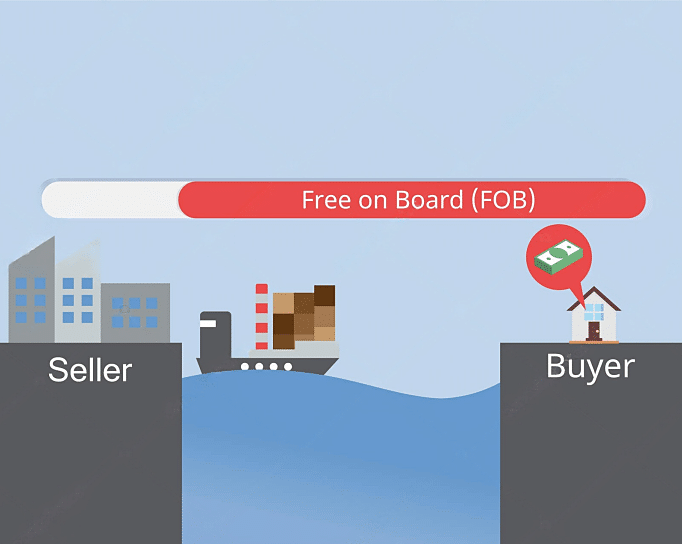
FOB, or Free on Board, is an Incoterm used for sea and inland waterway transport. Under Free on Board FOB terms, the seller handles the origin side until the goods are delivered on board the nominated vessel at the named port of shipment.
The seller generally handles:
Inland transportation to the named port
Export documentation
Export customs clearance
Origin procedures before shipment
Delivery and loading on board the nominated shipping vessel
The buyer generally handles:
Main ocean freight
Cargo insurance if required
Destination port charges
Import customs clearance
Import duties and taxes
Inland transportation in the destination country
Delivery to the final destination
The buyer assumes the transport risk once the goods are on board the nominated vessel at the agreed port of shipment.
This delivery point also marks where the seller’s responsibility ends for transport risk and the buyer takes responsibility for the onward journey.
Free on Board is commonly used by experienced sea freight importers because the seller handles the export side while the buyer retains control over the freight forwarder, ocean freight, and destination logistics.
For some containerized shipments where the seller hands the cargo to a carrier or terminal before it is loaded on the vessel, FCA may be more appropriate than FOB. The correct term should reflect the actual delivery point.
What Does DDP Mean in Shipping?
DDP, or Delivered Duty Paid, places the greatest shipping responsibility on the seller. Under DDP Delivered Duty Paid terms, most of the international shipment remains under the seller’s responsibility until the goods reach the named destination.
The seller typically handles:
Origin pickup
Export clearance
International transportation
Destination handling
Import formalities
Applicable import duties and taxes
Final delivery to the named place
The buyer has far less logistics work to manage than under EXW or FOB.
Delivered Duty Paid can therefore provide a convenient door-to-door shipping process. However, convenience does not remove the need to verify the import arrangement.
Before accepting a DDP quotation, buyers should confirm:
Who handles import clearance
Who acts as importer of record where required
Whether import duties and taxes are included
Which destination charges are covered
Where the seller’s responsibility ends
Import requirements vary by destination country. The seller must be able to complete the import process legally and comply with local customs requirements.
Under DDP, delivery normally occurs when the goods are placed at the buyer’s disposal at the named destination, ready for unloading. The buyer is generally responsible for unloading unless otherwise agreed.
EXW vs FOB: What Is the Difference?
The key difference between Ex Works EXW and Free on Board FOB is how much of the origin shipping process the seller handles.
Under EXW, the buyer takes responsibility at the seller’s premises. Under FOB, the seller continues handling the origin side through export clearance and delivery on board the vessel.
Export Clearance
Under EXW, the buyer generally arranges export clearance.
Under FOB, the seller is responsible for export formalities and clears the goods for shipment.
This is one of the key differences that can make FOB easier for importers when the supplier already has the documentation and export capabilities required at origin.
Origin Transportation and Costs
With EXW, the buyer may need to arrange factory pickup, transportation to the port, the origin export process, and handling charges.
Under Free on Board FOB, the seller handles these origin responsibilities until the agreed delivery point on board the vessel.
The FOB supplier price may therefore be higher, but fewer origin freight costs remain for the buyer to arrange separately.
Freight Control
Both EXW and FOB allow the buyer to retain significant control over the main international shipment.
With EXW, the buyer or freight forwarder controls the shipment from factory pickup onward.
With FOB, the supplier handles the origin side while the buyer controls ocean freight and destination arrangements.
Risk Transfer
Under EXW, transport risk moves to the buyer once the goods are placed at the buyer’s disposal at the named place.
Under FOB, risk transfers when the goods are delivered on board the nominated vessel.
For many established importers buying from China, FOB offers a practical balance between the seller’s responsibility at origin and the buyer’s control over international freight.
FOB vs DDP: What Is the Difference?
The main difference between FOB vs DDP is who manages the shipment after the goods are loaded at the origin port.
Under FOB, the buyer handles the main ocean freight and destination side, including:
International freight
Destination charges
Import clearance
Import duties
Inland transportation
Delivery to the buyer
Under DDP, the seller handles most of these responsibilities through final delivery to the named destination.
FOB therefore gives the buyer greater control over freight forwarder selection, shipping routes, freight costs, customs brokerage, and destination transportation.
DDP reduces the buyer’s workload but provides less direct control over shipping operations.
A FOB quotation may appear much lower than a DDP quotation because many costs after origin are not included. The two should only be compared after freight, customs, duties, taxes, and inland delivery are considered.
EXW vs DDP: What Is the Difference?
EXW and DDP place responsibility at almost opposite ends of the shipping process.
Under EXW, the buyer handles most logistics from the seller’s premises onward.
Under DDP, most transportation and import responsibilities remain with the seller until the shipment reaches the agreed destination.
EXW gives the buyer maximum control but requires stronger freight forwarding and customs capabilities.
DDP offers greater convenience, but the buyer should still verify how import procedures, duties, taxes, and destination delivery are being handled.
The better option depends on how much shipping responsibility each party is prepared to manage, rather than simply which supplier price appears lower.
How Costs and Risk Transfer Under EXW, FOB and DDP
Shipping costs and risk move between the buyer and seller at different stages under each Incoterm.
With EXW, the buyer assumes cost and risk relatively early. The buyer may therefore bear pickup, origin procedures, international freight, and destination expenses.
With FOB, the seller pays the agreed origin costs and remains responsible for transport risk until the goods are delivered on board the vessel. From that point onward, the buyer manages the main carriage and destination side.
With DDP, the seller pays for and handles most of the entire shipping process until the goods reach the named destination and are placed at the buyer’s disposal ready for unloading.
Importers should distinguish between four separate issues:
Who pays each shipping cost
Who bears the transport risk
Who handles customs clearance
When ownership of the goods transfers
Incoterms define delivery obligations, cost allocation, and risk transfer. They do not by themselves determine payment terms or legal ownership, which should be addressed separately in the sales contract.
Transport insurance should also be considered independently. The party bearing the transportation risk should decide whether its own cargo insurance or other suitable coverage is required for the international shipment.
Which Is Cheaper: EXW, FOB or DDP?
EXW usually has the lowest initial supplier price, but it does not necessarily produce the lowest total landed cost.
An EXW quotation can look attractive because many logistics costs remain outside the seller’s price.
The buyer may still need to pay for:
Factory pickup
Origin transportation
Export formalities
Origin handling
International freight
Destination charges
Customs procedures
Duties and taxes
Delivery to the destination
A FOB price normally includes more of the origin process, so it may be higher than EXW while reducing the number of charges the buyer needs to manage separately.
A DDP price is usually more inclusive because the seller pays for and coordinates much more of the shipping process.
A more useful comparison is:
Supplier price + origin charges + international freight + destination charges + customs costs + import duties and taxes + inland delivery
This provides a clearer view of total landed cost than comparing the supplier’s Incoterm price alone.
For example, a supplier quoting EXW may appear substantially cheaper than one quoting DDP, but the two offers cannot be compared fairly until pickup, freight forwarding, customs costs, duties, and destination transportation have been added.
Which Incoterm Should You Choose?
In international trade, the right Incoterm depends on the buyer’s shipping experience, desired level of control, transport mode, customs capabilities, and destination requirements.
Choose EXW When
EXW can suit experienced importers that already work with a reliable freight forwarder at origin and want maximum control from factory pickup onward.
It can also work when goods from several suppliers need to be collected and consolidated before international shipping.
However, the buyer should first confirm whether the export arrangement is practical and whether the supplier can provide the documentation needed for the shipment.
Choose FOB When
FOB can suit importers that want the seller to handle export procedures and origin transportation while retaining control over ocean freight and destination logistics.
For regular sea freight shipments, it often provides a practical balance between buyer control and seller responsibility.
This is one reason Free on Board remains common when experienced importers source goods from China and already have their own freight arrangements.
Choose DDP When
DDP can suit buyers that prefer a simpler process and want the seller or logistics provider to manage most transportation and customs procedures through the named destination.
Before choosing DDP, the buyer should verify that import requirements, duties, taxes, and delivery responsibilities are clearly defined.
A reliable freight forwarder can compare the responsibilities and total landed costs under each option before the sales contract and shipping arrangement are confirmed.
Common Mistakes When Comparing EXW, FOB and DDP Quotes
Choosing an Incoterm only by comparing supplier prices can create unexpected freight costs or customs problems later.
Common mistakes include:
Comparing only the product price. Each term includes a different level of logistics responsibility.
Assuming EXW is always cheaper. Factory pickup, origin requirements, and handling charges can reduce the initial price advantage.
Using FOB for every shipping method. FOB is designed for sea and inland waterway transport.
Ignoring destination costs under FOB. Ocean freight is only one part of the buyer’s total cost after shipment.
Accepting DDP without checking the import arrangement. Duties, taxes, importer requirements, and local procedures still need to be handled correctly.
The Incoterm should be agreed before arranging shipping so the buyer, seller, freight forwarder, and customs broker understand where each party’s responsibility begins and ends.
Frequently Asked Questions
Is EXW Cheaper Than FOB?
EXW often has a lower supplier quotation because fewer logistics services are included. However, the buyer must still arrange factory pickup, origin requirements, handling, and international transportation. Once these costs are included, EXW is not automatically cheaper than FOB.
What Does an EXW Price Include?
An EXW price generally covers the goods made available at the seller’s premises or another named location. Pickup, export clearance, international freight, import procedures, duties, and destination delivery normally remain outside the seller’s EXW responsibility.
Is FOB Cheaper Than DDP?
A FOB quotation is normally lower because the buyer still manages international freight, destination charges, import clearance, duties, and inland delivery. The correct comparison should therefore be based on total landed cost rather than the initial supplier quotation.
Who Handles Customs Clearance Under EXW, FOB and DDP?
Under EXW, the buyer generally arranges both export and import procedures. Under FOB, the seller handles export customs clearance while the buyer manages clearance at destination. Under DDP, the seller handles both export and import formalities as part of the agreed delivery responsibility.
Can FOB Be Used for Air Freight?
FOB is intended for sea and inland waterway transport. It is not the appropriate Incoterm for air freight. Depending on how the cargo is handed over to the carrier, Free Carrier, or FCA, may be more suitable for an air shipment.
Related Logistics Guides
Useful freight, customs and importing resources related to this shipping guide.
Related Guide
What Is FOB? Importing from China: A Comprehensive Guide
When importing goods from China, understanding trade terms is essential to managing logistics, costs, and responsibilities effectively. One of th...
Read guide →
Related Guide
DDP vs CIF vs FOB: Which Incoterm Is Best for Your China Shipment?
DDP vs CIF vs FOB: Which Incoterm Is Best for Your China Shipment? Verified & Reviewed · Last updated July 2026 Choosing between DDP, CIF and FOB...
Read guide →
Related Guide
DAP vs DDP Incoterms
DAP vs DDP: Customs Clearance, Import Duties, and Who Pays What Verified & Reviewed · Last updated January 2026 Choosing between DAP and DDP dete...
Read guide →
Useful Resource
DDP vs DDU vs DAP: Key Differences Explained (2025 Guide)
International shipping can be confusing, especially when it comes to trade terms like DDP, DDU, and DAP. These Incoterms define who is responsibl...
Learn more → Useful Resource DDP Shipping from ChinaDDP shipping from China includes customs clearance, import duties, and final delivery. It is a convenient door to door service with clear and pre...
Learn more →