Related Guide
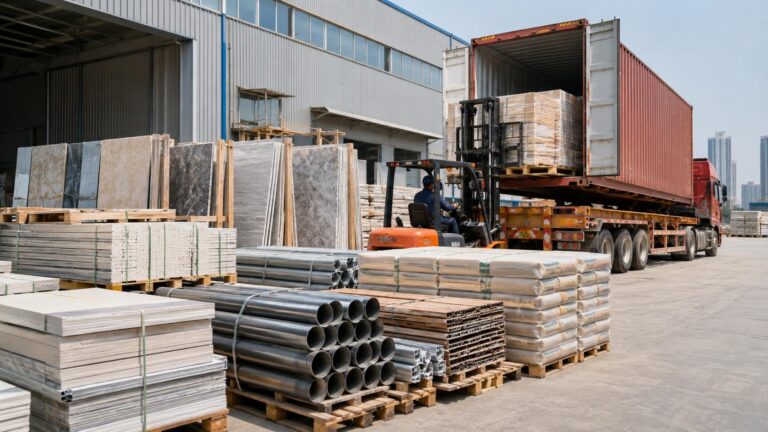
Building Materials Shipping from China
Building Materials Shipping from China Verified & Reviewed · Last updated May 2026 Building materials shipping from China helps importers, contra...
Read guide →An added benefit for eligible new customers shipping with Tonlexing.
Check Eligibility & Get a Quote →Subject to cargo eligibility, insurer approval and policy terms.
Coverage and insured value depend on the cargo, route and written insurer confirmation before shipment. Policy exclusions, deductibles and claims terms apply. The US$500,000 figure is a maximum coverage limit, not a guaranteed claim payment. Insurance premiums are not represented as free unless expressly confirmed in your quote.


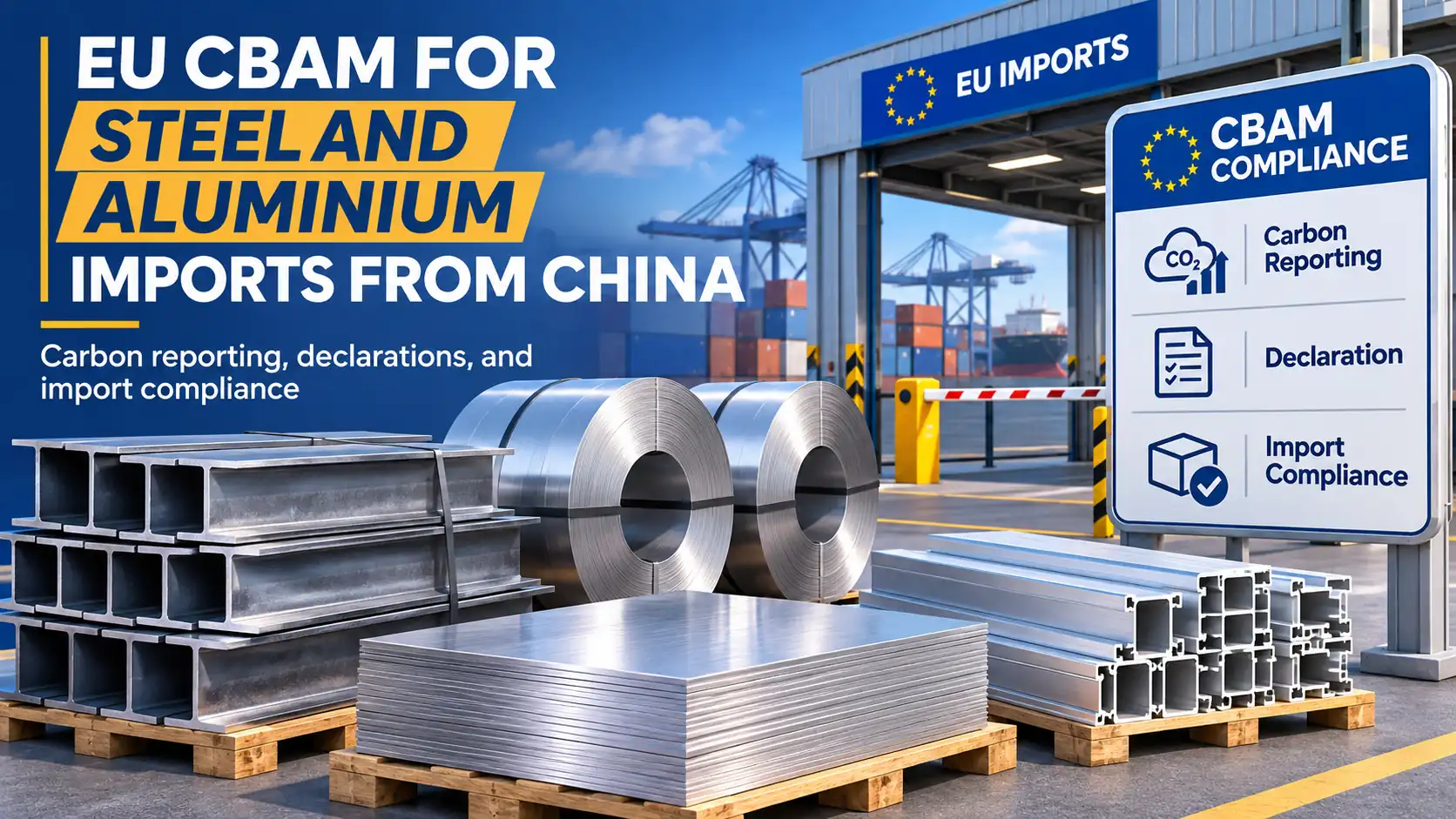
Since January 1, 2026, the EU’s Carbon Border Adjustment Mechanism (CBAM) has entered its definitive phase, affecting covered steel and aluminium imports from China.
EU importers must meet CBAM requirements, while Chinese suppliers need to provide reliable production and emissions data. Understanding product coverage and carbon costs helps both parties prepare for compliance.
CBAM Compliance
Steel & Aluminium Imports
Carbon Costs
The Carbon Border Adjustment Mechanism is an EU policy that places a carbon cost on selected imported goods according to their embedded greenhouse gas emissions. It complements the EU Emissions Trading System (EU ETS), under which covered European producers must account for the carbon generated by their operations.
One of its main objectives is to prevent carbon leakage. This occurs when companies move carbon-intensive activities to countries with less stringent climate policies or when lower-cost imports replace goods manufactured under EU standards.
Steel and aluminium are included because their manufacturing processes can generate significant carbon emissions. Different production routes, energy sources, and raw materials create substantial differences in carbon intensity.
China’s steel sector and aluminium industry are particularly relevant because Chinese exports include large volumes of energy-intensive materials. The CBAM framework therefore introduces additional reporting requirements and may influence the competitiveness of Chinese suppliers in the European market.
Importantly, CBAM is not a fixed additional import tariff. The financial obligation depends on embedded emissions, EU carbon prices, free allowances, and eligible carbon prices already paid in the country of production.
CBAM applies to specific products listed in Annex I of Regulation (EU) 2023/956. Coverage is determined by the Combined Nomenclature (CN) code rather than a general commercial product description.
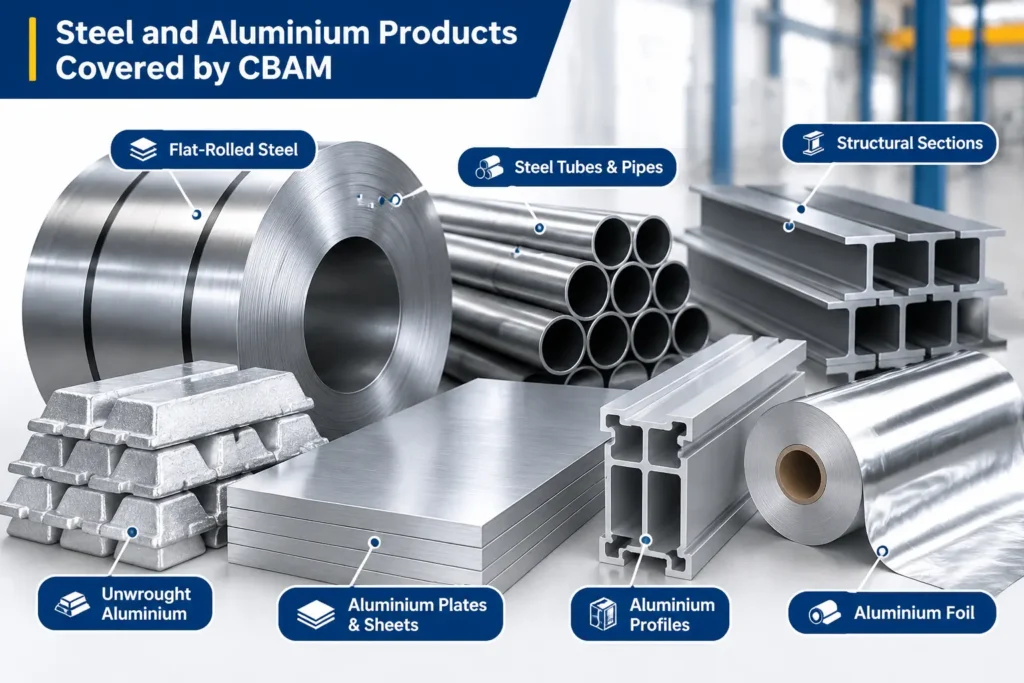
Covered products include selected goods under CN Chapter 72 and Chapter 73, such as:
Pig iron and certain iron products
Steel bars, rods, and structural sections
Steel tubes and pipes
Certain pipe fittings and metal structures
Selected products under CN Chapter 76 are also covered, including:
Unwrought aluminium
Aluminium powders and flakes
Aluminium bars, rods, and profiles
Aluminium wire
Aluminium plates, sheets, and strips
Aluminium foil, tubes, and pipes
Certain aluminium structures and articles
Not every product within these chapters automatically falls under CBAM. Importers should check the exact eight-digit EU CN code against Annex I before shipping.
Correct classification determines whether goods are subject to the relevant reporting and certificate requirements.
The definitive CBAM regime began on January 1, 2026. Unlike the transitional period, which focused mainly on reporting, the new phase introduces financial obligations based on the embedded carbon of covered imports.
Key implementation dates include:
| Date | CBAM Requirement |
|---|---|
| January 1, 2026 | Definitive CBAM regime begins |
| February 1, 2027 | CBAM certificates become available for purchase |
| September 30, 2027 | First annual CBAM declaration and certificate surrender deadline |
The first annual declaration covers covered goods imported during 2026. Although certificates become available in 2027, imports made during 2026 already contribute to the first financial obligation.
The EU introduced a single mass-based threshold of 50 tonnes per importer per calendar year for covered goods in the iron and steel, aluminium, cement, and fertiliser sectors.
The threshold is calculated across the relevant product categories, not separately for each material. Importers exceeding it must meet the applicable CBAM requirements.
EU importers exceeding the threshold must obtain authorised CBAM declarant status or work through an eligible indirect customs representative.
Authorised declarants are responsible for submitting annual declarations and surrendering the required certificates. Chinese suppliers should coordinate with European customers before shipment to ensure that the necessary product and reporting information is available.
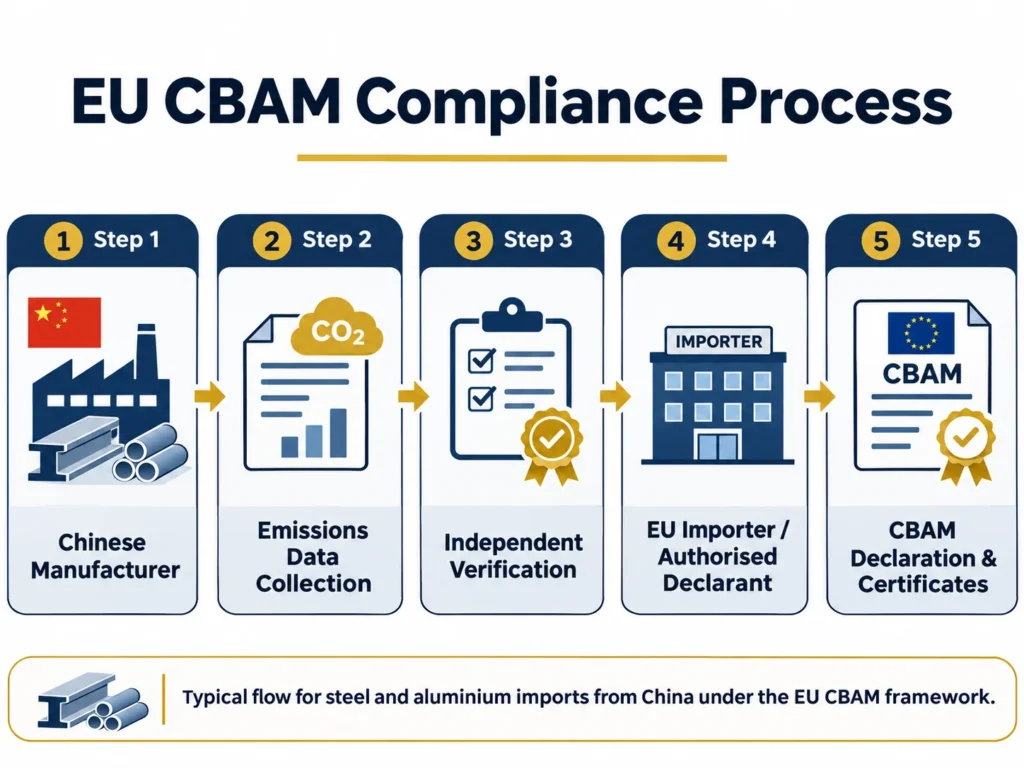
CBAM separates legal compliance responsibilities from the practical collection of manufacturing information.
The authorised CBAM declarant, usually the EU importer or an eligible indirect customs representative, is responsible for:
Obtaining the required CBAM authorisation.
Checking product CN codes and import quantities.
Collecting verified data from Chinese suppliers.
Preparing and submitting annual CBAM declarations.
Purchasing and surrendering the required certificates.
Maintaining supporting compliance records.
Chinese manufacturers do not normally purchase or surrender EU CBAM certificates themselves. However, they must provide the information European buyers need to calculate embedded emissions.
This includes factory details, fuel consumption, manufacturing processes, precursor materials, and supporting verification reports.
Although the EU importer has the statutory responsibility, both parties should clarify how related carbon costs are reflected in quotations and commercial agreements.
Embedded emissions represent the greenhouse gases associated with manufacturing a covered product. The CBAM mechanism uses EU-specific calculation methods and may include relevant precursor materials.
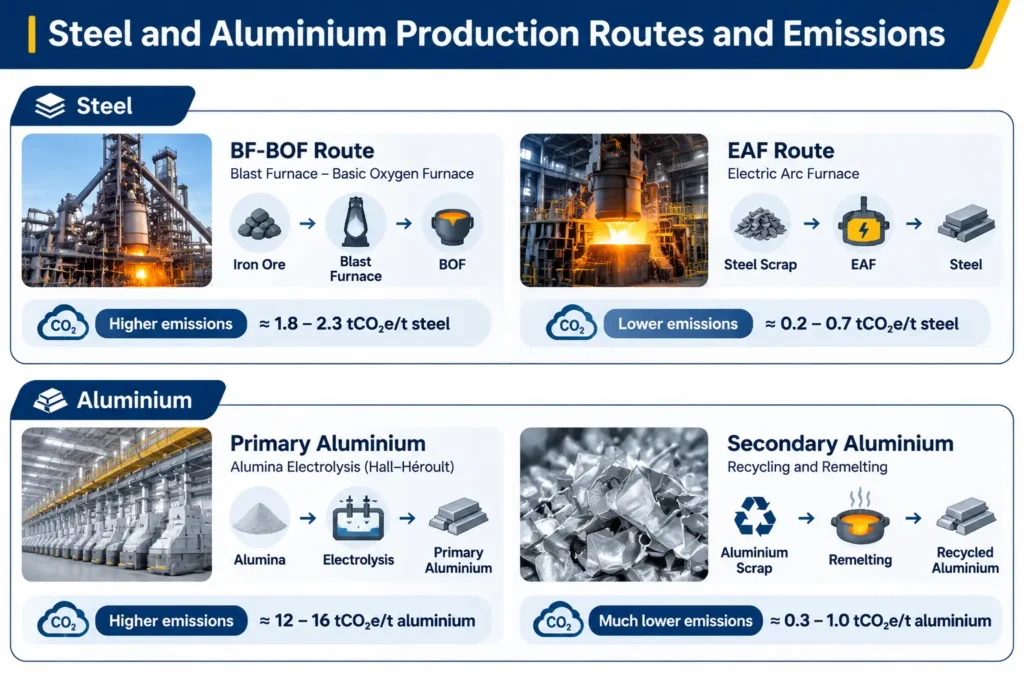
For steel, direct emissions can arise from fuel combustion and chemical reactions during ironmaking and steelmaking.
Production routes have different carbon intensities. Blast furnace and basic oxygen furnace (BF-BOF) production generally have a different carbon footprint from electric arc furnace (EAF) production using scrap or direct reduced iron.
For aluminium, direct emissions are associated with primary smelting, carbon anode consumption, and certain perfluorocarbons (PFCs) generated during manufacturing.
Secondary aluminium made from recycled material can have a different carbon footprint from primary aluminium. However, calculations must follow the applicable EU methodology rather than general industry estimates.
Direct emissions come from manufacturing processes and associated fuel use. Indirect emissions mainly result from electricity consumption.
For iron and steel and aluminium goods listed in Annex II of the CBAM Regulation, indirect electricity-related emissions are generally excluded from the final goods’ calculation. However, relevant precursor materials may still have separate reporting requirements.
Manufacturers should therefore maintain accurate energy and material records to support the applicable calculations.
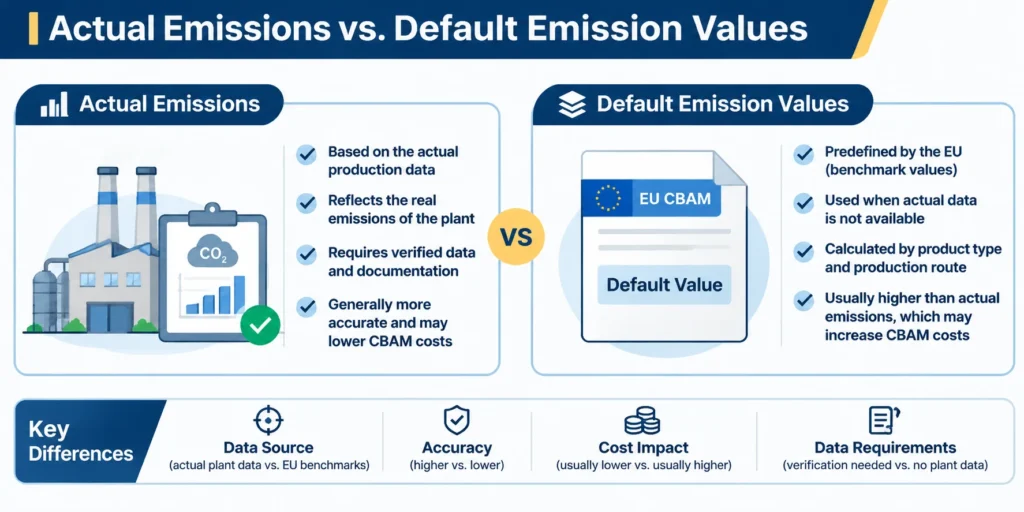
EU importers can generally use actual verified emissions or the default emission values published by the European Commission, subject to the applicable rules.
Actual figures are calculated using information from the manufacturing installation. This allows importers to report the carbon associated with specific goods rather than relying on general country or product estimates.
Chinese manufacturers should:
Establish an emissions monitoring system.
Collect fuel consumption, material usage, and process data.
Calculate embedded emissions using the EU methodology.
Arrange verification by an appropriately accredited independent verifier.
Provide verified reports to European customers.
Default values are used when actual figures are unavailable or cannot be used under the applicable CBAM rules.
These values vary by country, product classification, and production route. They should not be treated as one universal figure for all Chinese steel and aluminium products.
For iron and steel and aluminium, the applicable default values include the following mark-ups:
2026: 10%
2027: 20%
2028 onwards: 30%
Using actual verified data may help importers avoid relying on higher default values, particularly when manufacturers have more efficient processes or lower-carbon production routes.
CBAM costs depend on embedded emissions, the applicable free allocation adjustment, and the certificate price for the relevant import quarter. They are not calculated using a single additional tariff rate.
A simplified estimate is:
CBAM Cost per Tonne = (Embedded Emissions − Free Allocation Adjustment) × CBAM Certificate Price
Three factors determine the calculation:
Embedded Emissions: Importers use verified actual figures or the EU’s country-specific default values. Default values for these sectors include a 10% mark-up in 2026, rising to 20% in 2027 and 30% from 2028.
Free Allocation Adjustment: This reflects the free allowances still available to EU producers under the EU ETS. The 2026 CBAM factor is 97.5%, applied through the relevant product and production-route benchmarks.
CBAM Certificate Price: The certificate value follows the weighted average of EU ETS auction prices. It is calculated quarterly in 2026 and weekly from 2027 onwards.
The European Commission has published the following quarterly prices:
| Import Period | Certificate Price |
|---|---|
| Q1 2026 | €75.36/tCO₂e |
| Q2 2026 | €75.28/tCO₂e |
| Q3 2026 | €82.32/tCO₂e |
| Q4 2026 | To be published on January 4, 2027 |
Each price corresponds to the import quarter for which the certificates are required, rather than simply the date of purchase.
Using the Q3 2026 certificate price of €82.32/tCO₂e, the following examples illustrate estimated costs for selected Chinese products using default emissions values.
| Product Category | CN Heading | Estimated CBAM Cost per Tonne |
|---|---|---|
| Hot-rolled flat steel | 7208 | €178.63 |
| Unwrought primary aluminium | 7601 | €157.48 |
| Aluminium plates and sheets | 7606 | €246.88 |
These are indicative calculations based on the 2026 default-value mark-up and relevant free allocation adjustments. Actual obligations depend on the precise CN code, production route, applicable benchmark, and verified data.
EU importers and Chinese suppliers can take several steps to manage their financial exposure:
Provide verified actual emissions: Where actual installation-level figures are lower than the applicable default values, verified data may reduce certificate requirements.
Check product classification: Confirm the correct CN code and applicable benchmark before estimating costs.
Improve production efficiency: Energy-saving processes, recycled materials, and lower-carbon technologies can reduce embedded emissions.
Keep carbon price records: Carbon prices effectively paid outside the EU may qualify for deductions when the relevant eligibility and evidence requirements are met.
CBAM is changing the conditions for Chinese suppliers selling to the European market. Its impact extends beyond reporting and can influence export pricing, procurement decisions, and long-term competitiveness.
Higher carbon-related costs: Manufacturers using carbon-intensive processes may face greater financial pressure when supplying the EU, particularly when default values apply.
Changing buyer requirements: European importers may favour suppliers that can provide reliable production records and independently verified data.
More transparent quotations: Buyers may consider embedded carbon and certificate costs when comparing offers, making pricing and manufacturing information more important during contract negotiations.
Pressure to upgrade production: China’s steel sector and aluminium industry may need to improve energy efficiency, increase recycled material use, and adopt lower-carbon technologies.
These changes may affect Chinese exports and the wider metal industry. Suppliers that prepare early can respond more effectively to European purchasing requirements and maintain their position in the market.
Manufacturers should establish a consistent process for collecting and maintaining the information required for CBAM compliance.
Important records include:
Product information: Descriptions, CN codes, quantities, and reporting periods.
Installation details: Factory information and relevant manufacturing processes.
Production data: Annual output, production routes, and material consumption.
Energy records: Fuel types, electricity consumption, and related carbon information.
Process data: Direct greenhouse gas emissions from steelmaking and aluminium production.
Precursor information: Relevant materials, suppliers, quantities, and associated carbon figures.
Verification documents: Monitoring plans, calculations, and independent verification reports.
Carbon price evidence: Records of eligible carbon prices effectively paid, where applicable.
These records should be consistent across production, purchasing, and reporting departments. Suppliers should also agree with European customers on data formats and reporting periods.
For the logistics side, Tonlexing can support China–EU shipments through freight coordination, shipping documentation, and delivery arrangements. Emissions calculations, independent verification, and certificate obligations remain the responsibility of the relevant operators and authorised CBAM declarants.
The European Commission has proposed extending CBAM to selected steel- and aluminium-intensive downstream products from January 1, 2028.
Potentially affected goods include certain fasteners, metal wire, springs, and household articles. The proposal aims to address carbon leakage risks further along the manufacturing supply chain.
On September 15, 2026, the European Parliament adopted amendments to the proposal and referred it back for interinstitutional negotiations.
The expansion is not yet an effective legal requirement. Chinese manufacturers exporting processed metal products should monitor the legislative process and check whether their product categories may be affected if the proposal is adopted.
No. Only products listed under the relevant CN codes in Annex I of Regulation (EU) 2023/956 are covered. Importers should verify the exact customs classification.
The authorised CBAM declarant, usually the EU importer or an eligible indirect customs representative, is responsible for purchasing and surrendering certificates. Chinese exporters provide the required manufacturing information.
The threshold is 50 tonnes per importer per calendar year across the relevant covered goods in the iron and steel, aluminium, cement, and fertiliser sectors.
For the iron and steel and aluminium goods listed in Annex II, indirect electricity-related emissions are generally excluded from the final goods’ calculation. Relevant precursor materials may still have separate reporting requirements.
The first annual declaration, covering covered goods imported during 2026, must be submitted by September 30, 2027. The corresponding certificates become available for purchase from February 1, 2027.
Useful freight, customs and importing resources related to this shipping guide.
Building Materials Shipping from China Verified & Reviewed · Last updated May 2026 Building materials shipping from China helps importers, contra...
Read guide →
DDP Shipping from China to Europe Verified & Reviewed · Last updated June 2026 DDP shipping from China to Europe helps importers move cargo door...
Read guide →
If you’re involved in international shipping, you’ve probably encountered the term HS Code on shipping documents, customs forms, or commercial in...
Read guide →
Navigating the customs clearance process is a critical step in international shipping. Whether you’re importing goods from China to the USA, EU...
Read guide →International Shipping Documents Checklist Verified & Reviewed · Last updated January 2026 International shipping fails for boring reasons: a shi...
Learn more → Useful Resource Documents Required to Import from China (2025 Guide)Importing goods from China can be highly profitable—but only when you understand the necessary documents and import requirements. Whether you’re...
Learn more →WhatsApp us