
Related Guide
How to import and ship furniture from China?
Importing furniture from China has become a profitable venture for retailers, interior designers, and business owners worldwide. As China is the...
Read guide →An added benefit for eligible new customers shipping with Tonlexing.
Check Eligibility & Get a Quote →Subject to cargo eligibility, insurer approval and policy terms.
Coverage and insured value depend on the cargo, route and written insurer confirmation before shipment. Policy exclusions, deductibles and claims terms apply. The US$500,000 figure is a maximum coverage limit, not a guaranteed claim payment. Insurance premiums are not represented as free unless expressly confirmed in your quote.


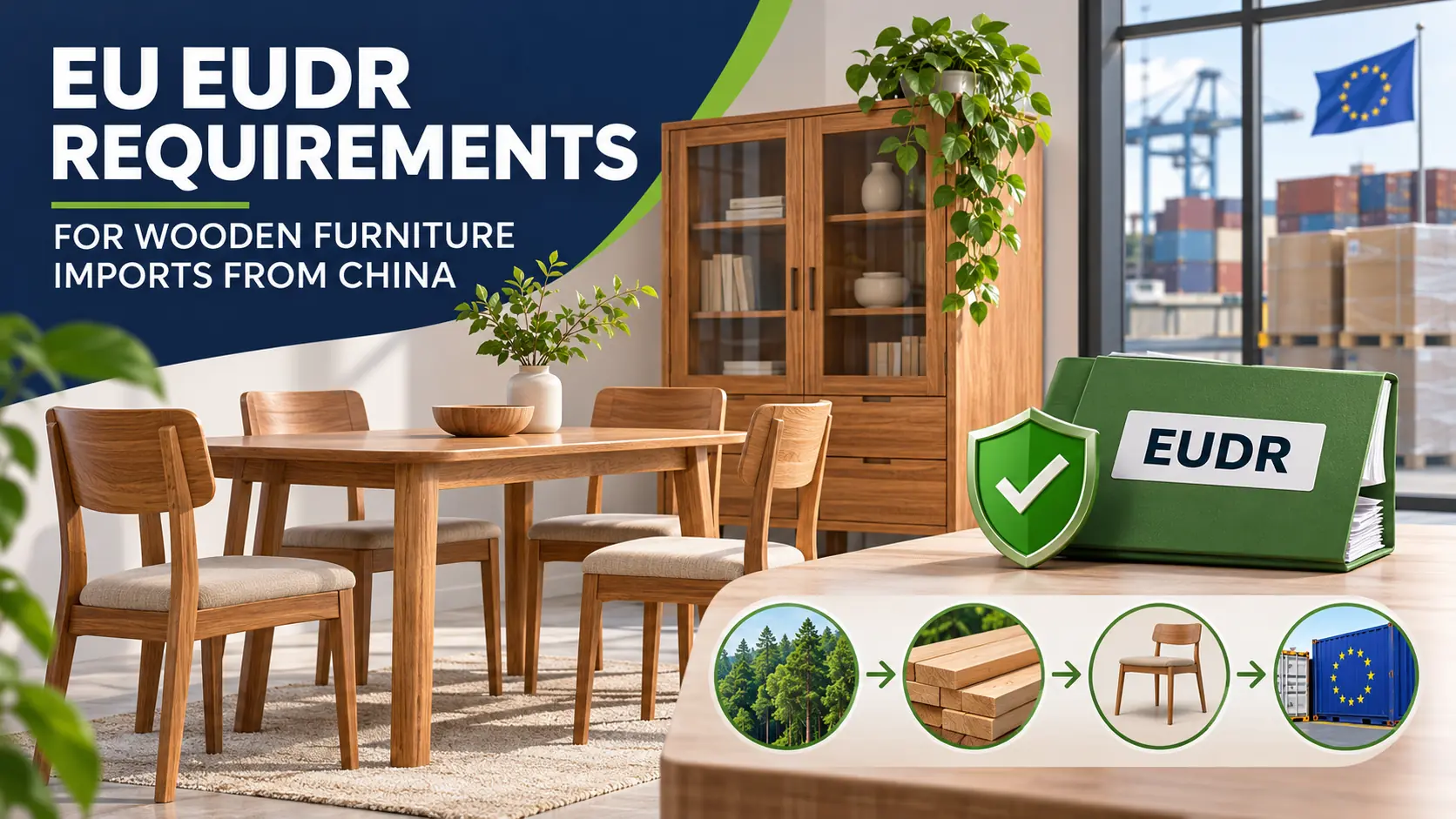
Importing wooden furniture from China into the EU requires EUDR compliance. Covered products must use legally produced, deforestation-free wood that can be traced to its harvesting locations.
EU operators must complete due diligence and submit a DDS or applicable simplified declaration before placing products on the EU market. Chinese suppliers must provide timber origin, species, geolocation data and supporting documents.
EUDR Compliance
Wood Traceability
DDS Requirements
Yes. The EU Deforestation Regulation applies to specific wooden furniture products listed in Annex I of Regulation (EU) 2023/1115, including office furniture, kitchen cabinets, bedroom furniture, wooden seats and furniture parts.
Wood is one of the seven commodities covered by the regulation, alongside cattle, cocoa, coffee, oil palm, rubber and soya. The legislation aims to address deforestation and forest degradation by preventing non-compliant products from entering the European Union market.
The country where furniture is manufactured does not determine the origin of its wood. For example, a cabinet assembled in China using imported timber must still meet EUDR requirements based on the actual harvesting location.
The applicable requirements depend on the product classification, timber origin and the role of the business placing the goods on the EU market.
The EU Deforestation Regulation covers specific wooden furniture categories listed in Annex I. These include furniture under CN headings 9401 and 9403, together with certain wooden components and parts.
| Furniture category | Relevant CN code |
|---|---|
| Wooden swivel seats with variable height adjustment | ex 9401 31 00 |
| Wooden seats convertible into beds, excluding garden and camping seats | ex 9401 41 00 |
| Upholstered seats with wooden frames | ex 9401 61 00 |
| Other seats with wooden frames, not upholstered | ex 9401 69 00 |
| Other wooden seats | ex 9401 80 00 |
| Other wooden seat parts | ex 9401 91 90 |
| Wooden office furniture | ex 9403 30 |
| Wooden kitchen furniture | ex 9403 40 |
| Wooden bedroom furniture | ex 9403 50 |
| Other wooden furniture | ex 9403 60 |
| Wooden furniture parts | ex 9403 91 |
The prefix ex indicates that EUDR applies only to the products described in Annex I under the relevant customs heading, rather than every product classified under that code.
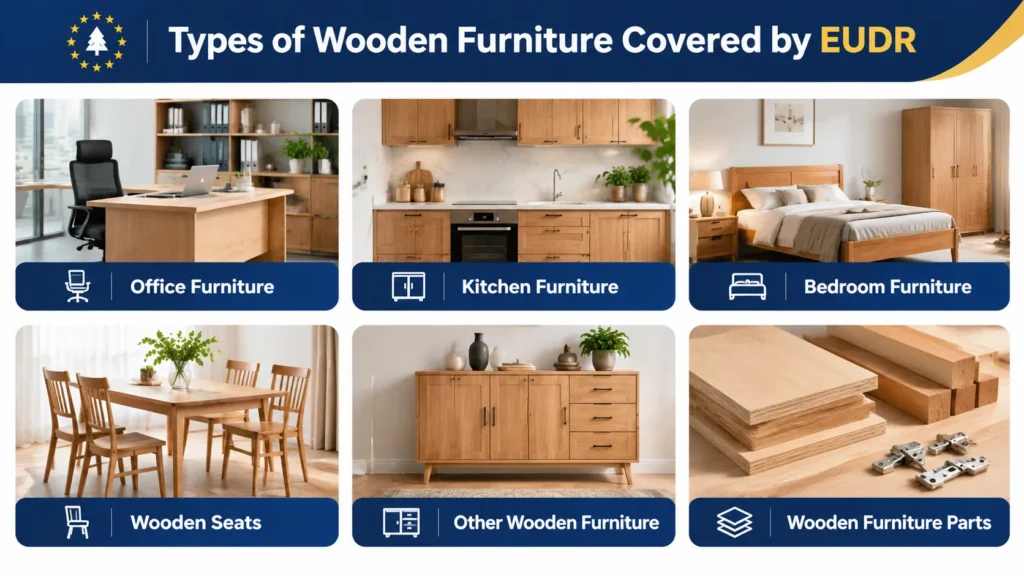
When importing furniture from China, the product’s construction and material composition should be checked against the applicable CN classification.
Common examples include:
Solid wood: Dining tables, wardrobes, cabinets and wooden beds.
Engineered wood: Furniture made with MDF, particleboard, plywood and veneered panels.
Wooden frames: Upholstered sofas, armchairs and other covered seats with wooden structures.
Wooden components: Doors, drawers, panels and other relevant furniture parts.
For composite furniture, importers should consider the relevant wood materials rather than checking only the visible wooden surfaces.
The updated Annex I excludes used and second-hand products from the listed furniture categories. Furniture made exclusively from bamboo or rattan is also outside the wood commodity scope.
Packaging materials such as cardboard boxes and wooden pallets are generally excluded when used exclusively to support, protect or carry another product placed on the market. However, packaging sold independently may require a separate classification assessment.
Prefabricated wooden buildings under CN code ex 9406 10 00 are also listed in Annex I, but they belong to a separate product category rather than ordinary furniture.
Importers should confirm the correct CN code and material composition before shipping, as an incorrect classification can affect both customs declarations and EUDR compliance.
Covered wooden furniture must meet three main conditions before it can be placed on the EU market.
Wood must not originate from land that was subject to deforestation after December 31, 2020, which is the EUDR cut-off date.
For timber, the regulation also addresses forest degradation resulting from harvesting after this date. Importers must have verifiable information about the relevant harvesting locations to demonstrate compliance.
Timber must comply with the applicable legislation of its country of production.
Depending on the source country, legality evidence may include:
Timber harvesting permits and authorisations.
Land-use rights and forest management records.
Environmental protection and forest conservation documents.
Relevant labour and human rights requirements.
Evidence concerning the rights of Indigenous Peoples and local communities.
Applicable tax, trade and customs records.
Unlike the old EU Timber Regulation, which primarily focused on illegal logging, EUDR also addresses deforestation and forest degradation.
The responsible operator must complete the applicable due diligence and submit a DDS or simplified declaration through the EUDR Information System.
The declaration records the relevant product information and confirms that the applicable compliance requirements have been met. Its reference number must be available for the corresponding customs declaration.
The country where furniture is manufactured is not necessarily the country where its wood was harvested.
Chinese manufacturers may use domestic timber or imported raw materials from several third countries. For example, a dining table assembled in China may contain timber harvested elsewhere and processed into panels before reaching the furniture manufacturer.
Under EUDR, the importer must identify the actual country of production for the relevant wood input rather than relying only on the furniture’s manufacturing location.
China is classified as a low-risk country under Commission Implementing Regulation (EU) . This classification can allow simplified due diligence when all relevant commodities originate from low-risk countries and the conditions concerning circumvention and mixing are satisfied.
However, low-risk status does not mean that EUDR compliance is unnecessary.
If a Chinese manufacturer uses timber from standard-risk or high-risk countries, the importer must assess those actual source countries rather than applying China’s classification to the entire shipment.
This distinction is particularly important when furniture factories purchase wood from multiple suppliers or use imported panels and other processed materials.
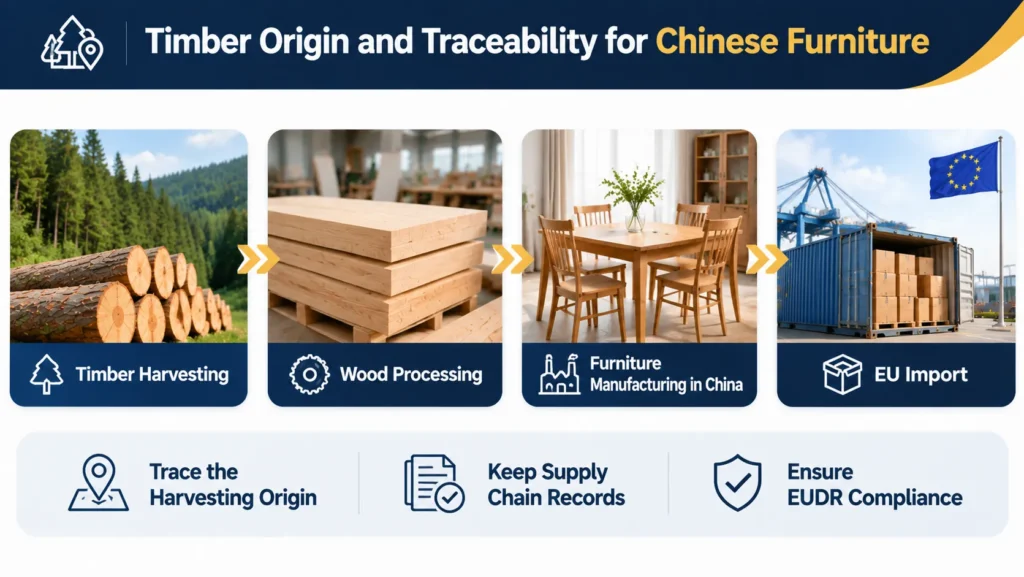
EUDR compliance involves different responsibilities across the furniture supply chain. For wooden furniture imported from China, the main parties are EU importers, Chinese manufacturers and suppliers, and downstream operators or traders.
The EU importer acting as the operator is generally responsible for ensuring that covered furniture meets EUDR requirements before it is placed on the EU market.
Its main responsibilities include:
Identifying products covered by Annex I.
Collecting timber origin and supplier information.
Conducting the required due diligence and risk assessment.
Submitting the Due Diligence Statement through the EUDR Information System.
Keeping relevant compliance records for five years.
Chinese manufacturers provide the information needed by EU importers to verify the origin and compliance of wooden materials.
They should supply accurate details about wood species, harvesting countries, geolocation data and supporting documents demonstrating legal timber production.
If furniture contains wood from multiple suppliers or countries, the relevant source information should be recorded to support traceability.
Downstream operators and traders handle covered furniture that has already undergone due diligence before entering the EU market.
They generally do not need to submit a new DDS for products already covered by an upstream declaration. However, they must retain the required supplier and customer information, together with applicable DDS reference numbers, in accordance with their EUDR obligations.
These requirements help maintain traceability as wooden furniture moves through the European supply chain.
Chinese suppliers should prepare a traceability file before production and shipment. The information must allow the EU importer to connect the finished furniture with the actual timber sources.
The main information to collect includes:
| Required information | Details to prepare |
|---|---|
| Product description | Product type, model and material composition |
| CN code | Applicable EU customs classification |
| Wood species | Common name and full scientific name |
| Raw materials | Solid wood, MDF, plywood, veneers and other relevant wood inputs |
| Quantity | Net mass and applicable supplementary unit |
| Country of production | Country where the wood was harvested |
| Geolocation | Coordinates of all relevant harvesting plots |
| Harvest period | Date or time range of timber harvesting |
| Supplier details | Company name, postal address and contact information |
| Legality evidence | Relevant harvesting and land-use documents |
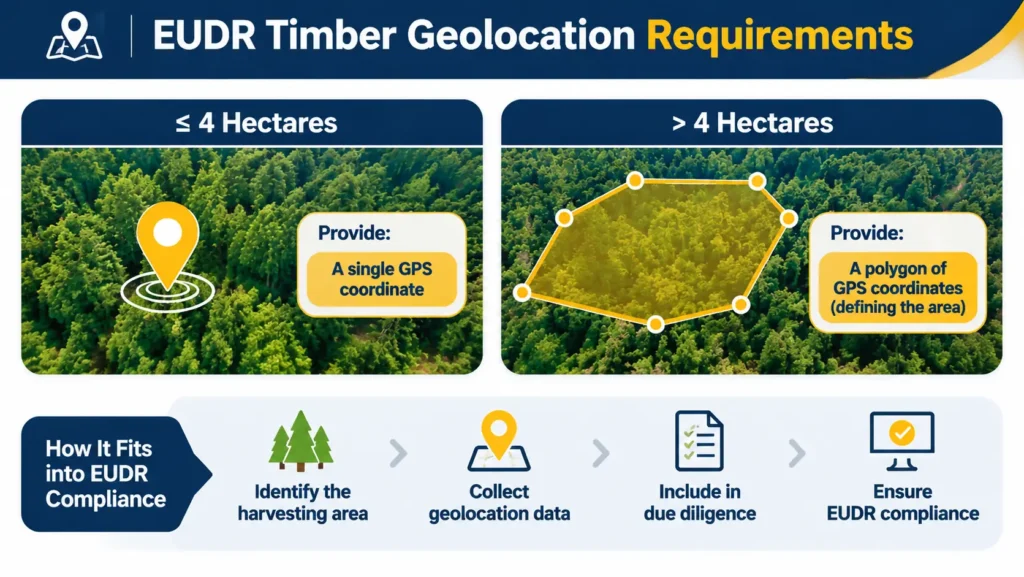
Geolocation is a key part of EUDR traceability. Coordinates are required for all relevant plots where the timber was harvested, not only plots exceeding four hectares.
The format depends on plot size:
Plots of four hectares or less: A single latitude and longitude point can be used.
Plots larger than four hectares: Polygon coordinates must describe the perimeter of the harvesting plot.
All relevant plots must be identified when wood from multiple locations is used.
For example, a cabinet may contain a solid wood structure, plywood panels and veneered components sourced from different suppliers. Each relevant timber origin must be accounted for.
Maps, satellite imagery and harvesting records can help support the assessment, but they do not replace the required geolocation information.
For furniture manufacturers sourcing materials from multiple locations, establishing reliable supplier records is essential. Importers can also review our guide to sourcing furniture from Foshan and shipping overseas for additional supplier and sourcing considerations.
Importers should establish a due diligence system before placing covered goods on the European Union market. The process involves checking product eligibility, verifying timber origins and assessing the risk of non-compliance.
Check the furniture’s CN code against Annex I and review its material composition. Identify all relevant wood materials and components that fall within the regulation.
Work with Chinese manufacturers and their suppliers to identify the wood species, harvesting countries and relevant forest plots. Where materials come from multiple sources, keep their origin information separately recorded.
Review the available product records, geolocation data, harvesting information and legality evidence. Check that the documents are consistent and sufficiently detailed to establish the timber’s origin.
Evaluate the country of production, supplier reliability, deforestation risk and supply chain complexity. Low-risk country classification may allow simplified due diligence, provided the applicable conditions are met. Standard-risk and high-risk sources require the corresponding risk assessment.
If the assessment identifies more than negligible risk, take additional measures such as requesting supporting documents, obtaining independent verification or improving timber traceability. Products must not be placed on the EU market if the risk cannot be reduced to negligible.
After completing the required checks, the responsible operator submits the DDS through the EUDR Information System on the TRACES platform. The system generates a reference number that must be available for the relevant customs declaration.
Importers should also prepare the separate customs documentation and understand the customs clearance procedures in Europe for imports from China.
Keep the due diligence information, supporting documents, risk assessment results and declaration references for at least five years. These records should be available if requested by EU competent authorities.
The EUDR application dates depend on the size of the EU operator and whether the imported timber products were previously covered by the EU Timber Regulation (EUTR).
For wooden furniture imported from China, this distinction is important because many products under CN heading 9403 were already subject to EUTR, while certain wooden seats under heading 9401 were not.
| Furniture category | Large and medium-sized operators | Qualifying micro and small operators |
|---|---|---|
| Wooden office, kitchen and bedroom furniture (9403 30, 9403 40, 9403 50) | 30 December 2026 | 30 December 2026 |
| Other wooden furniture and parts (9403 60, 9403 91) | 30 December 2026 | 30 December 2026 |
| Wooden seats and seat parts previously covered by EUTR (9401 61, 9401 69 and relevant wooden parts) | 30 December 2026 | 30 December 2026 |
| Other covered wooden seats not previously covered by EUTR (9401 31, 9401 41 and 9401 80) | 30 December 2026 | 30 June 2027 |
The June 30, 2027 extension applies to qualifying micro and small operators established as such by December 31, 2024. It does not apply to products already covered by the former EUTR.
The EUDR replaces the old EU Timber Regulation from December 30, 2026. However, special transitional rules apply to certain timber products harvested before June 29, 2023.
Before December 30, 2026: Relevant timber products previously covered by EUTR remain subject to the former timber regulation.
December 30, 2026 to December 30, 2029: EUTR requirements continue to apply to qualifying legacy timber products harvested before June 29, 2023.
From December 31, 2029: These qualifying legacy products must comply with the relevant EUDR requirements.
For timber harvested from June 29, 2023 onwards, the applicable EUDR requirements must be followed when the products are placed on the EU market from December 30, 2026.
Furniture importers should therefore check both the CN code and timber harvesting date when determining the applicable compliance requirements. Preparing supplier records and traceability information in advance can help avoid delays when the regulation becomes applicable.
Non-compliance can create financial, commercial and operational consequences for operators, downstream operators and traders.
Under Article 25, EU Member States must establish effective and proportionate penalties.
Potential consequences include:
Financial penalties: For a legal person, the maximum fine must be at least 4% of its total annual Union-wide turnover in the preceding financial year. The amount may be increased where necessary to exceed the economic benefit gained.
Product confiscation: Non-compliant goods may be confiscated.
Revenue confiscation: Revenues gained from transactions involving non-compliant products may also be confiscated.
Public procurement restrictions: Businesses may be temporarily excluded from public procurement processes and public funding for up to 12 months.
Market restrictions: Authorities may require businesses to stop placing or making non-compliant products available on the market, withdraw them or recall them.
The exact penalties are established and enforced under the applicable laws of individual EU Member States.
For importers, missing timber origin data, unreliable documentation or an incomplete due diligence statement can therefore create more than a customs documentation problem.
Several mistakes can increase the risk of non-compliance:
Relying only on the country of furniture manufacturing: The importer must trace the actual timber harvesting country.
Ignoring internal wood components: Relevant panels, veneers and other wooden materials must be included.
Collecting incomplete geolocation data: Coordinates are needed for all relevant harvesting plots.
Assuming low-risk classification means exemption: Simplified due diligence still has specific information and verification requirements.
Treating FSC or PEFC certification as a replacement: These certifications can support the risk assessment but do not automatically replace EUDR obligations.
Confusing packaging with commercial timber products: Packaging exclusions depend on how the materials are used and placed on the market.
A freight forwarder helps coordinate international transportation, export documentation and delivery arrangements. However, logistics services do not replace the importer’s legal responsibility for EUDR due diligence.
For wooden furniture shipments, logistics support may include:
Collecting cargo from multiple Chinese suppliers.
Arranging warehouse storage and cargo consolidation.
Checking commercial invoices, packing lists and shipping details.
Coordinating sea freight, air freight and destination delivery.
Working with the customs broker on shipment documentation and customs procedures.
Importers sourcing from several Chinese manufacturers can use China warehousing and cargo consolidation services to organise products before international transportation.
For additional information about commercial invoices, packing lists and transport documents, see our international shipping documents checklist. These transport documents support the shipping process but do not replace EUDR compliance records.
Tonlexing provides freight coordination, export documentation support, cargo consolidation, customs coordination and door-to-door shipping solutions for international furniture shipments.
For a broader overview of sourcing, transportation and import arrangements, see our guide to importing and shipping furniture from China.
No. EUDR applies to specific wooden furniture categories and components listed in Annex I. Importers must check the product description, material composition and CN code before determining whether the requirements apply.
Seats with metal frames are generally outside the specific listed categories for wooden seats. However, the actual customs classification and any separately imported wooden components should be checked before determining the scope.
Yes, when they are used exclusively as packaging to support, protect or carry another product placed on the market. Packaging sold independently as a commercial product may still fall within the regulation.
Yes. A DDS can cover multiple shipments or batches if the relevant products, quantities and harvesting locations are properly included. The same reference number can be used in multiple customs declarations, subject to applicable requirements and the one-year maximum coverage period.
No. FSC and PEFC certification can provide supporting evidence for timber sourcing and risk assessment, but they do not automatically replace the required information, due diligence or declaration.
Useful freight, customs and importing resources related to this shipping guide.
Importing furniture from China has become a profitable venture for retailers, interior designers, and business owners worldwide. As China is the...
Read guide →
DDP Shipping from China to Europe Verified & Reviewed · Last updated June 2026 DDP shipping from China to Europe helps importers move cargo door...
Read guide →
EORI Number Explained: Do You Need It to Import from China? Verified & Reviewed · Last updated July 2026 An EORI number is usually required when...
Read guide →
If you’re involved in international shipping, you’ve probably encountered the term HS Code on shipping documents, customs forms, or commercial in...
Read guide →Importing goods from China can be highly profitable—but only when you understand the necessary documents and import requirements. Whether you’re...
Learn more → Useful Resource Customs Clearance Step by StepCustoms Clearance Step by Step: The Complete Process Verified & Reviewed · Last updated February 2026 Customs clearance step by step helps intern...
Learn more →WhatsApp us