
Related Guide
China Sourcing Trip Guide
China Sourcing Trip Guide Verified & Reviewed · Last updated June 2026 China Sourcing Trip Guide for importers: A sourcing trip to China can be o...
Read guide →

Sourcing furniture from Foshan gives international buyers access to extensive furniture markets, specialized factories, competitive prices, and flexible customization.
This guide explains how to source furniture from Foshan and ship overseas, covering supplier verification, furniture markets, samples, quality control, warehouse consolidation, shipping costs, Incoterms, customs clearance, and door-to-door delivery.
Furniture sourcing
Quality control & consolidation
Shipping & customs
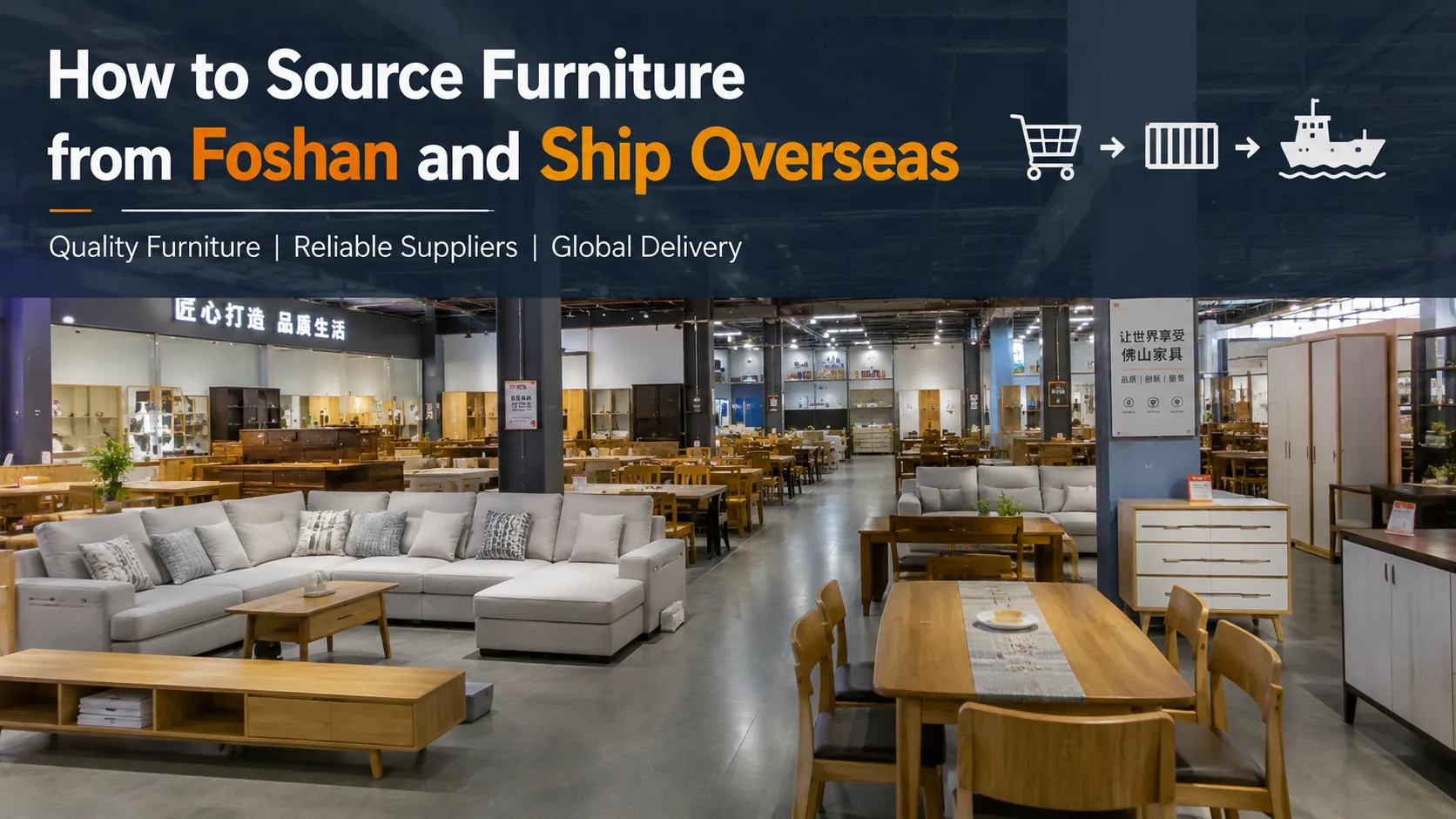
Foshan is known as China’s furniture capital because it has extensive factory clusters and one of the world’s largest furniture wholesale districts. The Lecong furniture market area stretches for more than 10 kilometers and includes thousands of vendors, showrooms, wholesalers, and specialist suppliers.
Buyers can source sofas, beds, wardrobes, dining table sets, chairs, hotel furniture, office furniture, lighting, outdoor furniture, and building materials in the same region. Products cover modern, minimalist, classic, luxury, and custom styles for houses, apartments, hotels, offices, and residential projects.
Foshan furniture can sometimes cost 30% to 50% less than similar imported furniture sold by local retailers. The actual saving depends on product quality, order quantity, destination, shipping costs, duties, and local prices. A lower showroom price does not always mean a lower total cost.
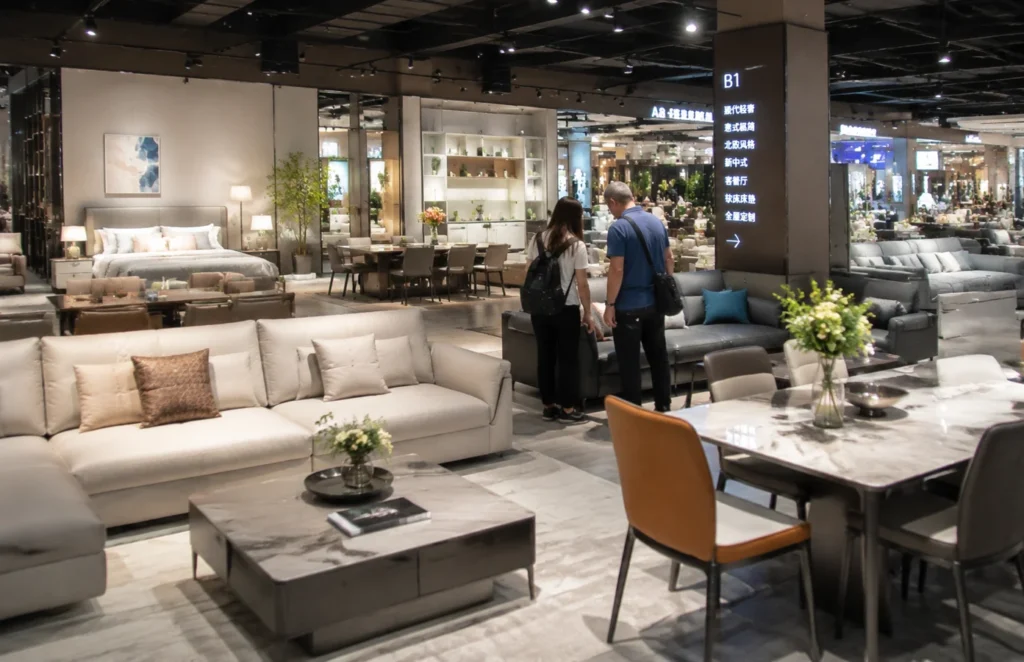
The main sourcing area is Lecong in Shunde District, Foshan City. It contains several furniture city complexes, independent showrooms, wholesale centers, and nearby factories.
Lecong Furniture Market is a long commercial district rather than one building. Buyers can compare different prices, materials, styles, and quality levels in person. Testing sofas, checking table height, opening drawers, and inspecting finishes helps reduce mistakes before purchase.
Louvre Furniture Mall is known for high end furniture, luxury displays, designer collections, and premium interiors. It is useful for interior designers and clients working on large apartments, hotels, villas, and other high-value projects.
Prices are generally higher, but the mall is valuable for design research and premium sourcing.
Sunlink Furniture City offers a broad range of furniture products at different price levels. Many suppliers have export experience and can assist with customization, documentation, and shipping logistics.
Because the complex is large, buyers should prepare a product list and focus on sections matching their budget and preferred styles.
Factory showrooms may offer a lower price and stronger customization, especially for larger order quantities. Some factories specialize in sofas, dining tables, office furniture, hotel furniture, cabinets, or metal products.
Always confirm whether the showroom belongs to the actual manufacturer.
There are three common ways to buy furniture from Foshan.
An in-person visit suits large projects and buyers who want to inspect materials, comfort, and craftsmanship before ordering. Prepare floor plans, room dimensions, reference images, target prices, and a category-based purchase list before traveling.
The market is too large to cover efficiently without a plan. A focused route saves time and makes price comparisons easier.
Remote sourcing works when the buyer has clear specifications. Foshan vendors often use translation apps, catalogs, factory videos, live video calls, and annotated photographs to communicate with overseas clients.
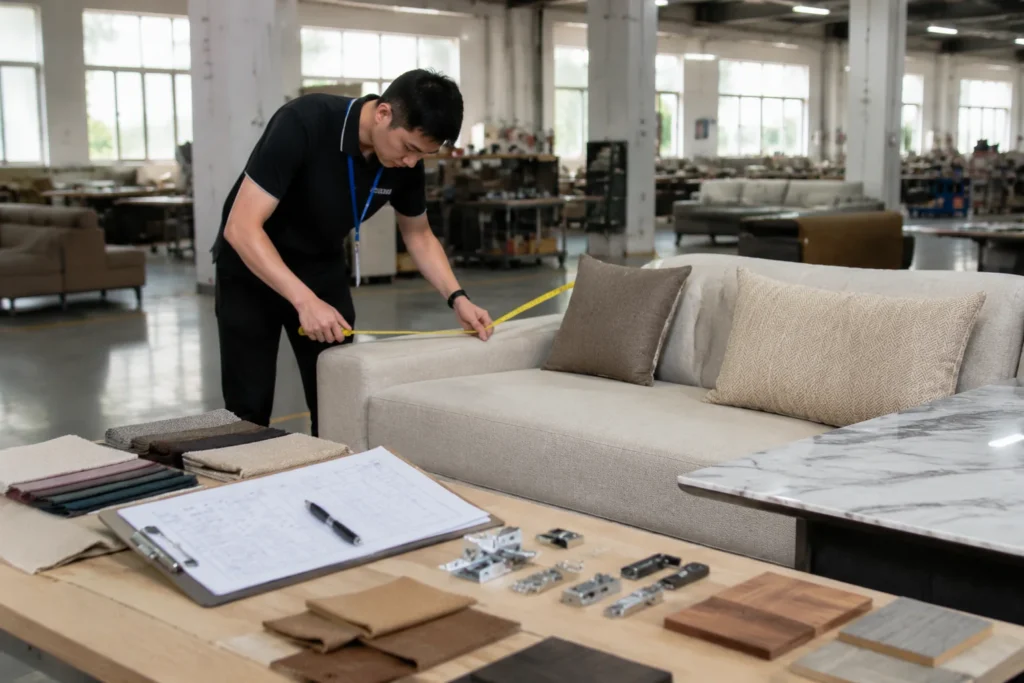
Request a live video call showing the business license, showroom, production area, machinery, current orders, storage space, and packaging area. Ask suppliers to show measurements with a tape measure and provide close-up images of seams, corners, hardware, finishes, frames, and materials.
A local sourcing agent can find suppliers, compare quotations, translate discussions, verify factories, arrange samples, follow production, inspect furniture quality, consolidate orders, and coordinate shipping.
This is useful for first-time buyers and clients purchasing from multiple suppliers. A reliable agent should provide transparent fees, original quotations, inspection reports, and regular updates.
All dimensions, materials, quantities, and payment terms should still be approved in writing.
Foshan includes manufacturers, trading companies, distributors, and showroom operators. Buyers should understand who will actually produce the order.
Ask each supplier for a business license, registered company name, factory address, production photos, export experience, lead time, minimum order quantity, and warranty terms.
Whether the supplier owns or controls production
Which furniture products the factory specializes in
Whether it has export and project experience
Whether it can follow drawings and material specifications
Whether it can provide export-grade packing
How it handles defects and replacement parts
Do not assume that every online seller is a factory. Many B2B sellers operate as trading companies. A trading company can still provide good service, but the buyer should understand the supply chain and pricing structure.
Flexible customization is a major reason for sourcing furniture from Foshan. Suppliers can resize products, change fabrics, adjust colors, modify finishes, and combine wood, metal, stone, glass, leather, or fabric.
Some Foshan manufacturers can also create bespoke furniture from drawings or reference images.
Record every custom detail in a signed specification sheet, including:
Final dimensions and tolerances
Material names, thicknesses, and grades
Fabric or leather codes
Wood and metal finishes
Hardware specifications
Foam type and density
Packaging and carton marks
For solid wood, moisture content is often specified at approximately 8% to 12% after kiln drying, although the correct range depends on the material and destination climate.
For upholstery, request fabric durability information. A Martindale Rub Count of 20,000 or more is often used as a baseline for frequently used residential seating. Commercial furniture may require a higher level.
High Resilience Foam with a density of at least 35 kg/m³ is commonly requested for supportive sofa cushions, but density should match the seat design and desired comfort.
Samples are essential for assessing product quality before large orders. Photographs cannot fully show comfort, scale, texture, color, or craftsmanship.
Request full-scale samples for custom sofas, chairs, beds, cabinets, and dining tables. Use them to verify dimensions, comfort, stability, materials, finishing, hardware, and assembly. The approved sample should become the production standard.
Quality control should then continue through three stages:
Pre-production: Confirm drawings, materials, colors, quantities, construction, and packing.
During production: Inspect frames, panels, foam, welding, stitching, joints, and unfinished components while corrections are still possible.
Pre-shipment: Check appearance, dimensions, function, quantity, accessories, labels, and packaging.
Inspect furniture quality before shipment to avoid defects arriving overseas. Open drawers and doors, test hinges, sit on chairs and sofas, check table stability, compare finishes, and confirm that all hardware is included.
Do not pay the final balance until major problems are corrected.
Furniture orders from Foshan often involve several factories, showrooms, and specialist suppliers. Sending each order separately usually creates repeated pickup fees, inconsistent delivery dates, higher documentation costs, and greater risk of missing goods. The safer approach is to collect everything in one warehouse, upgrade the packaging, and load the furniture under a single shipping plan.
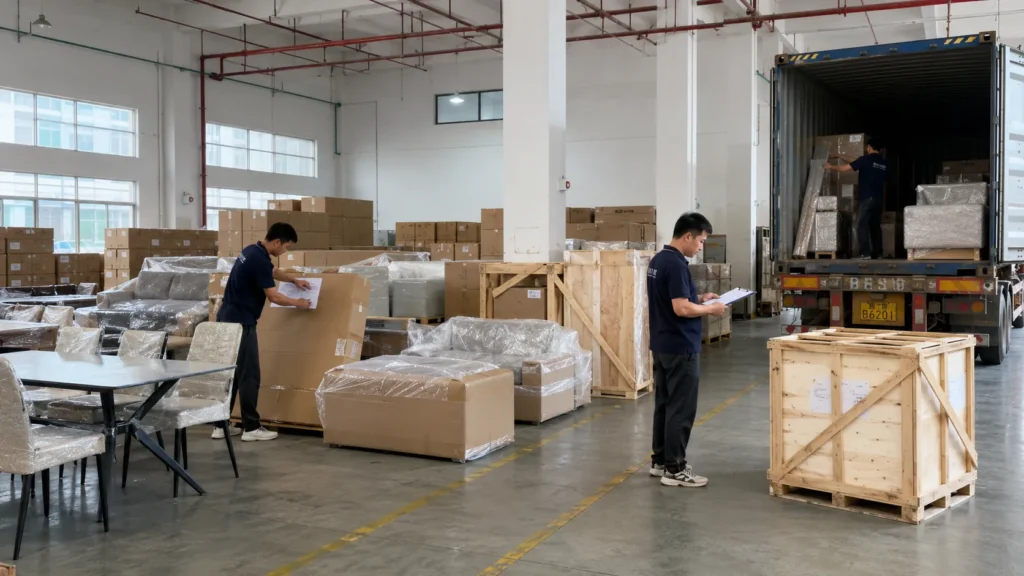
A consolidation warehouse in Lecong, Nanhai, or another nearby area can receive products from all suppliers before export. Each delivery should be checked against the master packing list so shortages, damaged cartons, and incorrect items can be identified before the container leaves China.
The warehouse process should include:
Coordinated supplier deliveries: Ask factories to deliver within a planned five-to-seven-day period to reduce storage costs.
Unique shipping marks: Give each supplier a code linked to the room, product category, or project.
Arrival records: Count packages and photograph the condition of every delivery.
Final cargo measurement: Confirm the total volume in cubic meters before selecting a container.
Room-based labeling: Mark cartons clearly to simplify unloading and installation at the destination.
Consolidating purchases from multiple suppliers also allows the freight forwarder to create a more efficient container loading plan. This can reduce unused space and prevent buyers from paying for several smaller shipments.
Packaging designed for domestic transport is often too weak for a long ocean journey. Cartons may face stacking pressure, vibration, moisture, and repeated handling, particularly when the shipment moves by LCL.
Furniture suppliers should therefore replace light domestic packing with stronger export-grade protection. Depending on the product, the packing may include:
Heavy-duty corrugated cartons: Double-wall or reinforced boxes provide better resistance to compression.
High-density foam protection: Foam sheets should cover painted, polished, glass, and metal surfaces to prevent scratches.
Rigid corner guards: Tables, cabinets, desks, and other hard-edged products need protection on corners and exposed edges.
Moisture-resistant wrapping: Plastic film, woven bags, and container desiccants help reduce moisture exposure during sea transport.
The packaging method should be approved before the order is completed because stronger cartons, foam, and wooden frames can increase the final cargo volume and shipping cost.
Sea freight is the main choice for shipping furniture from China because furniture is bulky. Air freight is usually reserved for samples, urgent accessories, or replacement parts.
| Shipping method | Best for | Main advantage | Main limitation |
|---|---|---|---|
| LCL | Small quantities | Pay only for shared container space | More handling and higher risk of damage |
| 20ft container | Compact residential or commercial projects | Private container with better cargo control | Limited space for bulky sofas and large furniture |
| 40ft container | Medium and large furnishing projects | Lower shipping cost per cubic meter | Requires enough cargo to use the space efficiently |
| 40HQ container | Complete houses, hotels, and large apartments | More loading capacity for bulky furniture | Higher total freight cost |
| Air freight | Samples, replacement parts, and urgent small items | Fast delivery | Very expensive for bulky furniture |
LCL may be the cheapest option for a very small order, but destination handling charges can be high. A full container is usually safer because the goods remain inside one container from loading to arrival, except during customs inspection.
Sea transit often takes three to five weeks on some direct routes. The complete sourcing and shipping timeline can take four to twelve weeks when production, consolidation, booking, transshipment, customs clearance, and final delivery are included.
The Incoterm determines where the supplier’s responsibility ends and where the buyer takes control of the shipment. For furniture orders from multiple Foshan suppliers, the choice affects pickup, export clearance, freight costs, destination charges, and final delivery.
Under EXW, the buyer collects the goods from the supplier’s factory or showroom. The buyer is responsible for domestic pickup, warehouse consolidation, export declaration, international shipping, customs clearance, and delivery.
EXW is often suitable when furniture is purchased from several suppliers. A sourcing agent or freight forwarder can collect each order, bring everything to one warehouse, inspect the cargo, and load it into one container.
Under FOB, the supplier handles delivery to the Chinese port and completes export customs procedures. The buyer takes responsibility after the goods are loaded onto the vessel.
FOB works best when one supplier or exporter manages most of the order. It can be less convenient when furniture comes from many factories because each supplier may use different ports, schedules, and export arrangements.
Under CIF, the supplier pays for ocean freight and basic cargo insurance to the destination port. The buyer still handles destination port charges, customs clearance, import duties, local transport, and unloading.
A CIF quotation may look simple, but buyers should confirm the destination fees before accepting it. Low ocean freight can sometimes be offset by high local handling charges.
Under DDP, the logistics provider arranges transportation from China to the agreed destination and normally includes export handling, international freight, customs clearance, duties, and final delivery.
DDP is convenient for homeowners, interior designers, and business buyers who want one complete shipping solution. However, the quotation should clearly state whether unloading, storage, difficult-access delivery, and installation are included.
For furniture sourced from several Foshan suppliers, EXW combined with warehouse consolidation is often the most flexible option. DDP may be easier when the buyer prefers a single door-to-door price and less involvement in customs and delivery.
The showroom price is only one part of the total cost. Landed cost normally includes:
Furniture prices
Sourcing and inspection fees
Domestic pickup and warehouse handling
Export packing and container loading
Origin charges and ocean freight
Duties, taxes, and port fees
Customs broker fees
Final delivery and unloading
Shipping costs can sometimes equal around 20% to 30% of the furniture value. The percentage may be higher for small quantities, bulky low-value sofas, fragile stone products, or remote delivery locations.
Landed cost can exceed local retail price when shipping, duties, and port fees are not calculated in advance. Compare quotations by complete project cost, not only by the unit price of each table, chair, or sofa.
Export documentation typically includes a commercial invoice and packing list, together with the bill of lading and export declaration.
The commercial invoice should show the buyer, seller, product description, quantity, value, currency, and Incoterm. The packing list should match the physical cargo and include package numbers, dimensions, gross weight, and net weight.
Customs clearance may require import permits and compliance with local regulations. Additional documents may include:
Fumigation or heat-treatment certificate
Material test reports
Product compliance certificates
Import permits
Treatment records for wooden packaging
Timber, mattresses, upholstered furniture, electrical items, and products containing animal-derived materials may face additional controls. Confirm the requirements before production to avoid delays or material changes.
Experienced freight forwarders can coordinate pickup, consolidation, export documents, port handling, shipping, and destination delivery. Tonlexing can arrange LCL, full-container, and door-to-door furniture shipping from Foshan according to cargo volume and destination.
The most expensive problems usually begin with unclear specifications or incomplete logistics planning.
Common mistakes include:
Choosing suppliers only by price
Ordering without approved samples
Paying the balance before inspection
Accepting vague material descriptions
Using domestic packing for sea freight
Ignoring destination charges
Shipping from multiple factories without consolidation
Booking a container before confirming final volume
Forgetting spare hardware and installation instructions
Assuming a showroom is the factory
Successful furniture sourcing from Foshan requires one coordinated plan covering design, suppliers, materials, quality, warehouse handling, shipping, and customs clearance.
Yes. Overseas buyers can purchase through showrooms, factories, exporters, or a sourcing agent. Buying directly works best when specifications, payment terms, quality control, and logistics are clearly organized.
It can be 30% to 50% cheaper at the product level in some markets, especially for large projects and custom orders. Buyers should compare landed cost rather than showroom prices alone.
Sea transit may take around three to five weeks on some routes. The complete sourcing and shipping timeline can take four to twelve weeks after production, consolidation, customs clearance, and final delivery are included.
LCL is suitable for small quantities, but the goods receive more handling. A full container is usually safer and offers a lower cost per cubic meter for larger orders.
A sourcing agent is not mandatory, but one can help with communication, factory verification, samples, quality control, consolidation, and shipping coordination, especially when buying remotely or from multiple suppliers.
Useful freight, customs and importing resources related to this shipping guide.
China Sourcing Trip Guide Verified & Reviewed · Last updated June 2026 China Sourcing Trip Guide for importers: A sourcing trip to China can be o...
Read guide →
Importing furniture from China has become a profitable venture for retailers, interior designers, and business owners worldwide. As China is the...
Read guide →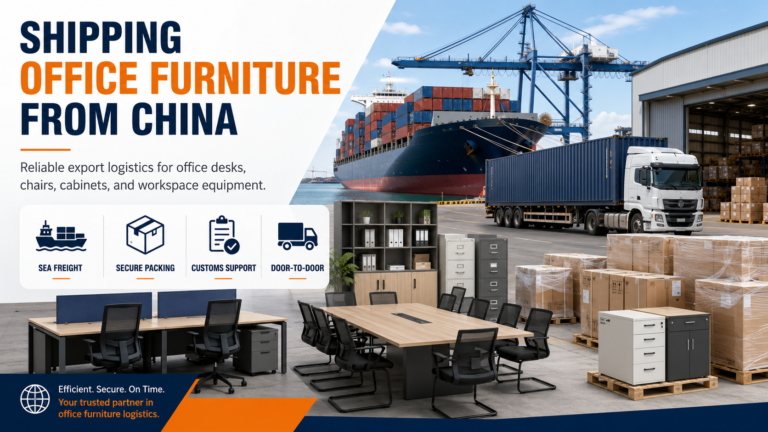
Learn how to ship office furniture from China by sea freight, air freight, FCL, LCL, and door-to-door delivery. Compare costs, customs clearance...
Read guide →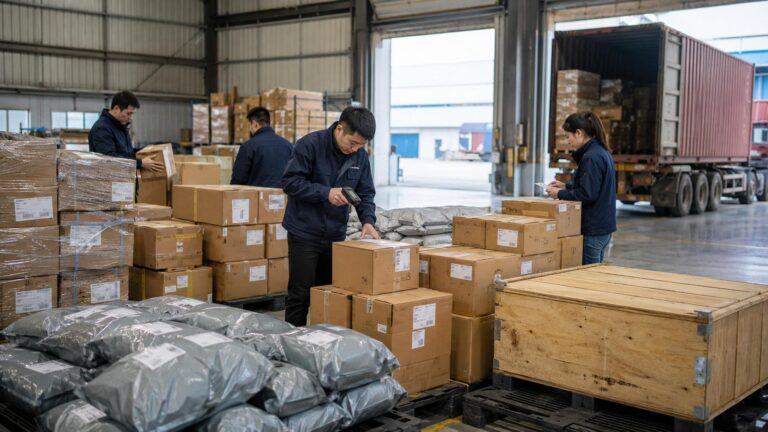
Shipping from Multiple Suppliers in China Verified & Reviewed · Last updated May 2026 Shipping from multiple suppliers in China can be difficult...
Read guide →China Warehouse Consolidation Service Verified & Reviewed · Last updated May 2026 China warehouse consolidation service helps importers collect g...
Learn more → Useful Resource Sea Freight Shipping from ChinaSea freight is the most cost effective shipping method for large volumes and container load cargo. It is ideal for businesses looking to reduce s...
Learn more →WhatsApp us