
Related Guide
How to import and ship furniture from China?
Importing furniture from China has become a profitable venture for retailers, interior designers, and business owners worldwide. As China is the...
Read guide →

Shipping office furniture from China requires the right balance of freight cost, cargo protection, customs clearance, and final delivery planning.
This guide explains how to ship office desks, chairs, cabinets, workstations, and commercial furniture from China by sea freight, air freight, FCL, LCL, and door-to-door service, including packaging, import duties, shipping costs, and customs documents.
Sea Freight / FCL & LCL
Customs Clearance
Door to Door Delivery
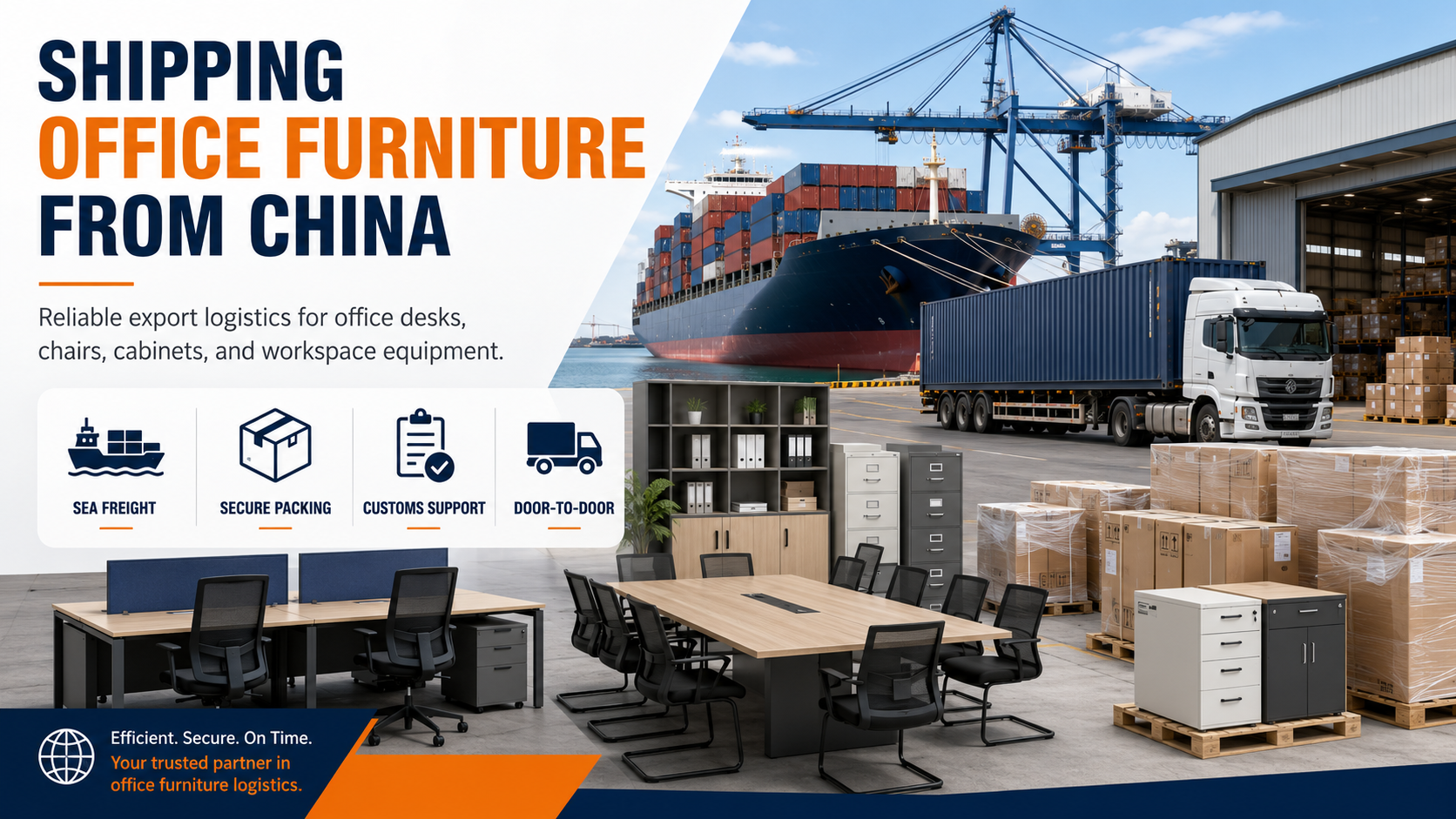
China is one of the world’s largest furniture exporters and an important supplier in the global furniture market. Many Chinese manufacturers produce office desks, ergonomic chairs, filing cabinets, hotel furniture, commercial furniture, and customized workspace solutions for international buyers.
For many furniture importers, China offers clear advantages:
Competitive prices for bulk office furniture orders
Large production capacity for commercial projects
A wide range of materials, styles, and finishes
OEM and customized design options
Mature supply chains for panels, metal parts, hardware, fabric, leather, and packaging
Access to major trade fairs such as the China International Furniture Fair
Importing office furniture from China can create strong cost savings, especially when buyers combine reliable sourcing, proper quality control, and an experienced freight forwarder to manage the international shipping process.
Office furniture shipments usually include different materials, sizes, structures, and packing methods. Before choosing a shipping method, importers should understand how each furniture type affects container space, packaging, customs classification, and final delivery.
Common office furniture shipped from China includes:
Office desks and executive desks
Ergonomic chairs, mesh chairs, and task chairs
Conference tables and meeting tables
Filing cabinets and steel storage cabinets
Office workstations and partition systems
Reception desks and front counters
Office sofas and lounge seating
Wooden cabinets and display units
Training tables and folding tables
Hotel and commercial furniture for business spaces
Flat-packed or knock-down furniture is usually easier and more cost effective to ship because it reduces shipment volume and improves container utilization. Fully assembled furniture takes more space and often requires stronger protection during the shipping journey.
Choosing the right shipping method is the most important step when shipping furniture from China. The best option depends on shipment volume, budget, destination, delivery deadline, and the value of the goods.
Sea freight is the most common and cost effective method for office furniture shipping. It is suitable for large-volume orders, full container shipments, wholesale furniture imports, and commercial project cargo.
Office furniture takes up a lot of container space, so sea freight usually offers a much lower cost per cubic meter than air freight. For most furniture imports, ocean freight is the first option to consider.
Sea freight is suitable for:
Bulk office desks and chairs
Filing cabinets and storage systems
Conference tables and partitions
Commercial furniture orders
Multiple supplier consolidation
Regular furniture importing programs
Typical ocean transit time is about 20 to 45 days, depending on the origin port, destination port, carrier schedule, route, weather, and seasonal demand.
Air freight is much faster than sea freight, but it is usually not suitable for large office furniture shipments. Because air freight is calculated by chargeable weight, bulky furniture can become very expensive even when the actual weight is not high.
Air freight is mainly used for:
Urgent product samples
Small high-value items
Replacement parts
Trade show materials
Prototype furniture
Time-sensitive project cargo
For most office furniture imports, air freight can cost several times more than sea freight. It is mainly justified for urgent or high-value shipments despite the premium cost. Typical air freight transit times are about 5 to 10 days on major routes.
Door-to-door shipping is a convenient option for importers who want one freight forwarder to manage the full shipping process. This service can include pickup in China, export customs, ocean freight or air freight, customs clearance, import duties if arranged under DDP, and final delivery.
Door-to-door shipping is useful when buyers do not want to handle every part of the import process by themselves. It is also helpful when goods are collected from multiple suppliers in China.
Office furniture is commonly shipped by FCL or LCL. Choosing the wrong option can increase shipping fees and damage risk.
FCL means Full Container Load. The buyer uses an entire container for one shipment. This is usually the best option when the cargo volume is large enough.
FCL shipping is suitable when:
Shipment volume is above 15 to 18 CBM
The goods are bulky or fragile
The buyer wants better container control
The cargo comes from one or several nearby suppliers
The order includes desks, cabinets, chairs, or workstations
The buyer wants to reduce warehouse handling
FCL shipping is often more economical above a certain volume because the cost is based on the full container, not each cubic meter. It also reduces handling because the goods are loaded once and shipped as one container load.
LCL means Less than Container Load. Your cargo shares container space with other importers’ goods. It is suitable for smaller shipments that do not fill a full container.
LCL shipping is suitable when:
Shipment volume is usually between 2 and 15 CBM
The buyer is testing a new supplier
The order is small or mixed
The buyer does not want to wait for more cargo
The shipment includes samples or limited stock
LCL has a lower starting cost, but the cost per cubic meter is higher than FCL. It also has more handling at warehouses, which can increase the risk of furniture damage. For LCL office furniture shipping, strong packaging is essential.
Factory price is only part of the total expense when importing furniture from China, and shipping costs for office furniture from China depend on cargo volume, shipping method, origin city, destination country, container type, customs clearance requirements, final delivery address, and fuel prices.
Because furniture is bulky, shipping costs are often calculated by volume rather than actual weight. For air freight, the cost is based on chargeable weight. For sea freight, the cost is usually based on CBM for LCL or container type for FCL.
The main cost components are freight, packing, port charges, customs duties, and last-mile delivery.
| Shipping Option | Best For | Cost Level | Typical Use |
|---|---|---|---|
| LCL Sea Freight | Small office furniture orders | Low to medium | Samples, small batches, trial imports |
| 20ft FCL | Medium-volume orders | Medium | Desks, cabinets, mixed office furniture |
| 40ft FCL | Large shipments | Medium | Bulk furniture imports |
| 40HQ FCL | Bulky chairs, desks, and panels | Cost effective | Better container utilization |
| Air Freight | Urgent samples or spare parts | High | Fast delivery only |
| Door-to-Door | Buyers needing full service | Medium to high | Customs and final delivery included |
In many cases, total landed cost can represent 25% to 45% of the product value, especially for bulky furniture with low unit value, and it includes ocean freight, import duties, and customs brokerage fees. This is why container utilization, packing method, and shipment planning are so important.
Transit time depends on the shipping method and final destination. Sea freight is slower but more economical, while air freight is faster but much more expensive.
| Destination Area | Sea Freight Transit Time | Air Freight Transit Time |
|---|---|---|
| USA West Coast | 18–30 days | 5–10 days |
| USA East Coast | 30–45 days | 5–10 days |
| Europe | 30–45 days | 5–10 days |
| Middle East | 18–35 days | 4–8 days |
| Southeast Asia | 5–15 days | 2–5 days |
| Australia | 15–30 days | 4–8 days |
Transit time does not always include pickup, customs clearance, port handling, and final delivery. For door-to-door shipments, importers should add extra time for container unloading, customs inspection, and inland transportation.

Proper export packaging is essential when shipping office furniture from China. Office furniture is often large, heavy, and vulnerable to scratches, corner damage, moisture, and vibration during international shipping. Since ocean freight usually takes 20–45 days and cargo is handled multiple times, packaging should be designed to withstand stacking, loading, and long-distance transportation.
The outer carton is the first layer of protection and should be selected according to the furniture’s size and weight.
Recommended standards include:
5-ply double-wall corrugated cartons for standard office desks, chairs, cabinets, and shelving.
7-ply heavy-duty cartons for large conference tables, stone tabletops, and oversized furniture.
Cartons should meet recognized ECT or Mullen strength standards to resist compression during stacking.
Reinforce every carton with PP or PET packing straps to prevent the carton from opening during transit.
Internal cushioning prevents furniture parts from moving inside the carton and minimizes damage caused by vibration.
Common protective materials include:
EPE foam corner protectors for desk tops, cabinet edges, and exposed corners.
Bubble wrap or EPE foam sheets for painted, laminated, glass, or metal surfaces.
Foam blocks or EPS inserts to eliminate empty space inside the carton.
Separate hardware bags for screws, bolts, hinges, handles, and assembly accessories to prevent scratching.
Different furniture requires different packing methods based on its structure and materials.
Knock-down furniture should be separated with foam sheets between each panel to prevent rubbing during transport, and this packing approach can reduce shipping volume by about 40–60%.
Upholstered furniture should be protected with PE film and soft wrapping to avoid stains and fabric damage.
Glass panels and stone tabletops should be packed in reinforced plywood crates with clear fragile labels, while wooden crates provide maximum protection for high-value items.
Solid wood furniture should receive additional edge protection to reduce the risk of impact damage, and dining tables and other finished surfaces need extra protection against scratches and finish damage.
Moisture is one of the biggest risks during sea freight. Temperature changes inside a shipping container can create condensation, which may damage wooden furniture, upholstery, and metal components.
To reduce moisture-related damage, exporters should:
Place container desiccants inside the shipping container.
Wrap sensitive furniture with PE moisture-barrier film.
Avoid loading damp cartons or untreated wooden packaging.
Use ISPM 15 compliant wooden packaging whenever solid wood pallets or crates are required.
Proper moisture protection helps prevent mold, swelling, rust, and surface damage during long ocean transit.
Customs clearance is a key step in the import process. If the documents are incomplete or the HS code is wrong, the shipment may be delayed at the destination port.
Common documents for customs clearance include:
Commercial invoice
Packing list
Bill of Lading or Air Waybill
Sales contract if required
Certificate of origin if required
Import license if applicable
Product compliance documents if required
A customs broker can assist with duty calculations, tariff classification, and customs declarations. For smooth customs clearance, the product description on the commercial invoice should match the packing list, HS code, and actual cargo.
For shipments to the United States by ocean freight, Importer Security Filing is required before vessel departure. Wood products may also need to comply with the Lacey Act, depending on the material and product classification.
Import duties depend on the destination country, HS code, customs value, product material, and applicable trade policy. Different furniture types may have different duty rates.
Office furniture may be classified differently depending on whether it is made of:
Solid wood
Metal
Plastic
Composite wood
Upholstered materials
Glass
Mixed materials
For wooden furniture and composite wood products, importers should pay special attention to destination country regulations. Some markets have rules related to wood origin, formaldehyde emissions, labeling, and product safety.
Before shipping, importers should confirm:
Correct HS code
Import duty rate
VAT or GST
Anti-dumping duty if applicable
Wood or material compliance requirements
Required certificates or declarations
Whether wooden packaging must be treated
Checking these details before shipment helps avoid customs holds, penalties, storage charges, and delivery delays.
Incoterms define buyer and seller responsibilities in international shipping. Choosing the right Incoterm helps avoid confusion about who pays for freight, customs clearance, insurance, and final delivery.
| Incoterm | Meaning for Office Furniture Imports |
|---|---|
| EXW | Buyer pays all costs from the seller’s factory |
| FOB | Seller covers costs until goods are loaded on the vessel |
| CIF | Seller pays ocean freight and minimum insurance to the destination port |
| DAP | Seller arranges delivery to the buyer’s location, but duties and taxes are paid by the buyer |
| DDP | Seller or forwarder covers shipping, customs clearance, duties, taxes, and delivery |
FOB is often suitable for experienced importers who already have a freight forwarder. EXW gives buyers more control but requires more logistics management. DDP is simpler for buyers who want door-to-door delivery with fewer customs responsibilities.
For office furniture, the quote should clearly state whether customs clearance, import duties, destination charges, and final delivery are included.
A successful shipping process starts with reliable furniture sourcing. Importers should not only compare factory prices but also check production capacity, export experience, packaging quality, and quality control systems when they source or import furniture and decide where to buy furniture.
Common sourcing channels include:
Alibaba and B2B platforms
Furniture malls in Foshan, Guangzhou, and other cities
Trade fairs such as CIFF
Direct Chinese manufacturers
Sourcing agents
Existing supplier networks
On Alibaba, Gold Suppliers may offer Trade Assurance protection for added transaction security.
Before placing a bulk order, buyers should request samples, confirm materials, review drawings, check packing methods, and arrange pre shipment inspections when needed. Third party inspection services can help verify product quality, carton condition, quantity, labels, and loading details before shipment.
Many importers sourcing furniture from China or looking to import furniture buy from multiple suppliers. For example, desks may come from Foshan, office chairs from Anji, cabinets from Guangzhou, and partitions from Shenzhen. In this case, cargo consolidation can reduce shipping fees and improve control.
A freight forwarder can collect goods from different factories, store them in one warehouse, check carton labels, and load everything into one container. This improves furniture logistics by coordinating pickups, warehousing, and container loading across suppliers. This is especially useful for office projects, hotel projects, commercial renovations, and mixed furniture orders.
Multiple supplier consolidation can help buyers:
Reduce repeated shipping costs
Improve container utilization
Simplify customs documents
Combine different furniture types
Control final delivery more easily
Avoid separate shipments arriving at different times
For large commercial furniture imports, consolidation is often more efficient than shipping each supplier’s goods separately.
Sea freight is usually the best way to ship office furniture from China. It is more cost effective than air freight and suitable for bulky furniture such as desks, chairs, cabinets, and workstations.
FCL is better for large or fragile office furniture shipments because it reduces handling and gives the buyer full container control. LCL is suitable for smaller shipments, but the cargo needs stronger packaging.
When estimating shipping office furniture from China, buyers should look at the main cost components, not just the factory price. The cost depends on shipment volume, shipping method, container type, origin city, destination port, customs clearance, import duties, and final delivery address. Office furniture shipping costs are often based on volume because the goods are bulky.
Sea freight usually takes about 20 to 45 days, depending on the destination. Shipments to the USA West Coast are usually faster than shipments to the East Coast or Europe.
Yes. A freight forwarder can collect cargo from multiple suppliers, consolidate the goods in one warehouse, and ship them together by LCL or FCL. This can reduce freight costs and simplify the shipping process.
Useful freight, customs and importing resources related to this shipping guide.
Importing furniture from China has become a profitable venture for retailers, interior designers, and business owners worldwide. As China is the...
Read guide →
Kitchen Cabinet Shipping from China: Complete Import Guide Verified & Reviewed · Last updated May 2026 Kitchen cabinet shipping from China requir...
Read guide →
Medical furniture—such as hospital beds, examination tables, patient chairs, and other healthcare furnishings—plays a critical role in providing...
Read guide →
China has long been a leading global supplier of a wide range of products, including carpets and rugs. As one of the oldest and most well-establi...
Read guide →How to Source Furniture from Foshan and Ship Overseas Verified & Reviewed · Last updated July 2026 Sourcing furniture from Foshan gives internati...
Learn more → Useful Resource Shipping Furniture from China to USAShipping furniture from China to USA is one of the most in-demand logistics services in today’s global trade market. In recent years, large-scale...
Learn more →WhatsApp us