Related Guide
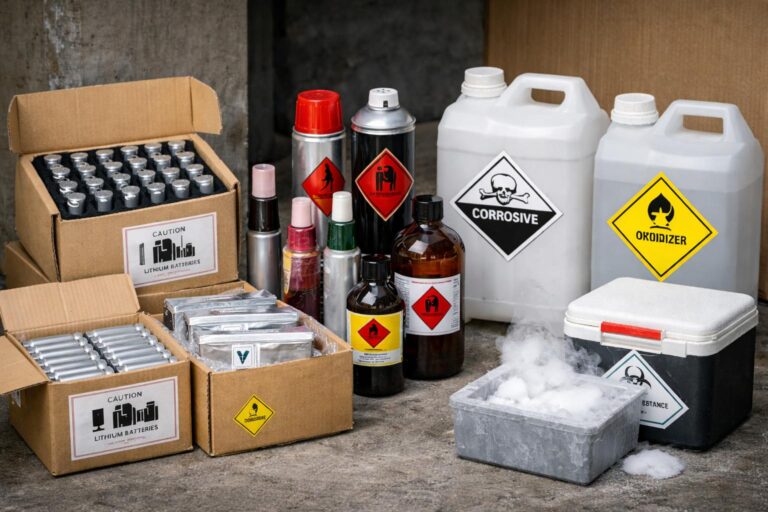
Shipping Dangerous Goods From China
Shipping Dangerous Goods From China Verified & Reviewed · Last updated February 2026 Shipping dangerous goods from China requires strict complian...
Read guide →

Shipping electric forklifts from China requires careful planning because electric forklifts are heavy, battery-powered material handling machines with specific loading, battery compliance, and customs clearance requirements.
This guide explains how to ship electric forklifts from China, covering FCL container shipping, lithium battery documents, charger voltage, DG booking, container loading, shipping costs, transit time, and door-to-door delivery.
Shipping method
Battery documents
Customs clearance
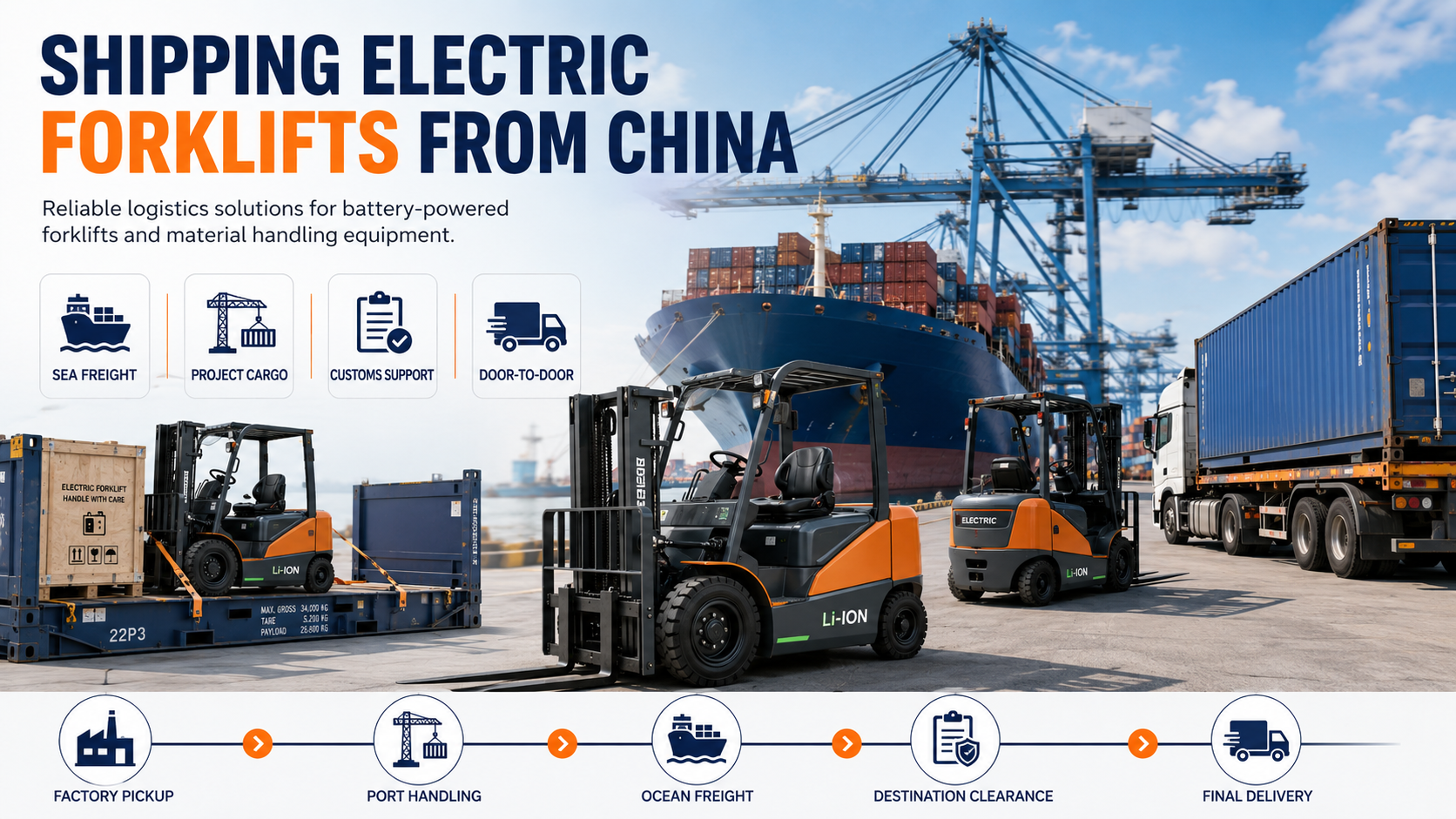
Electric forklifts are not ordinary warehouse goods. They combine heavy machinery, large dimensions, and rechargeable batteries in one shipment. This means the freight forwarder must check both machinery transport requirements and battery transport rules before arranging shipping.
The main shipping challenges include:
Heavy weight and large cargo dimensions
Lithium battery or lead-acid battery compliance
Dangerous goods booking requirements
Container loading and cargo securing
Export documentation from China
Import customs classification
Destination port handling and inland delivery
For customs classification, electric forklifts are commonly classified under HS code 8427.10, which covers self-propelled trucks powered by an electric motor. The final customs code should still be confirmed based on the exact model and destination customs rules.
Different electric forklift types require different loading plans. A compact pallet truck is much easier to ship than a heavy-duty counterbalance forklift, while a reach truck may require special attention because of its mast height.
| Electric Forklift Type | Common Use | Shipping Notes |
|---|---|---|
| Counterbalance forklifts | Warehouses, factories, ports, distribution centers | Usually shipped by FCL container; capacity often ranges from 1 to 10 tonnes |
| Reach trucks | High-rack warehouses and narrow aisles | Mast height can be high, sometimes up to 12 metres, so partial disassembly may be needed |
| Electric pallet trucks | Short-distance pallet movement | Compact units; a 40ft container may hold many units depending on dimensions |
| Pallet stackers | Light warehouse stacking and loading | Usually easier to load than large counterbalance forklifts |
| Order pickers | E-commerce fulfillment and parts distribution | Must check platform height, battery type and packing method |
| Forklift spare parts | Chargers, forks, tires, controllers, battery parts | Can ship by air freight, courier, LCL or together with the main forklift |
For a single unit, a 20ft container is often enough if the forklift height and weight are suitable. For multiple electric forklifts, a 40ft or 40HQ container usually gives a better shipping cost per unit.
The right shipping method depends on the forklift dimensions, battery type, quantity, destination and delivery time. For most complete electric forklifts, sea freight is the most practical choice.
FCL is the preferred shipping method for most electric forklifts from China. A full container load gives better control over loading, securing, sealing and destination handling. It also reduces the risk of damage compared with LCL, because the forklift does not need to be moved through multiple warehouses with other cargo.
FCL is suitable for:
One heavy electric forklift
Multiple counterbalance forklifts
Lithium battery forklifts with DG booking approval
Reach trucks, pallet stackers and warehouse trucks
Shipments with chargers, attachments and spare parts
Buyers who need safer cargo handling
A standard 40ft container may hold around 6–10 counterbalance forklifts, depending on model size, mast height, fork length, tire type and whether the supplier removes some components before loading.
LCL is not usually recommended for complete electric forklifts. Even when the cargo volume looks small, forklifts are heavy and difficult to handle in shared warehouse operations. The risk of damage, extra handling and destination charges can be higher than expected.
LCL can still work for:
Forklift spare parts
Chargers
Small attachments
Tires
Controllers
Light pallet truck components
For a complete forklift, ask your freight forwarder to compare LCL, 20ft FCL and 40ft FCL before making the final decision.
Flat rack shipping is used when the forklift is too tall, too wide or too heavy for a standard container. This may apply to large-capacity electric forklifts, special attachments or machines that cannot be safely driven into a container.
Flat rack shipping costs more than standard container shipping because it requires special lifting, lashing, carrier approval and port handling.
Air freight is rarely used for complete electric forklifts because of size, weight and battery restrictions. It may be used for compact electric pallet jacks, urgent spare parts or replacement chargers.
For compact electric pallet jacks or parts, air freight from China may cost around USD 5–10 per kg, depending on chargeable weight, airline capacity, battery documents and destination airport. Lithium battery cargo is subject to stricter air transport rules based on configuration and watt-hour rating.
Door-to-door shipping is suitable for importers who want one freight forwarder to manage the full process from the Chinese supplier to the final warehouse.
A door-to-door solution can include:
Factory pickup in China
Export customs declaration
Battery document review
FCL ocean freight
Import customs clearance
Duties and taxes support
Port handling
Truck delivery
Unloading coordination
For electric forklifts, door-to-door delivery should be arranged by a forwarder familiar with heavy machinery and battery-powered vehicles.
Choosing the right battery type is just as important as selecting the right forklift. It affects shipping compliance, charging efficiency, warehouse productivity, maintenance costs, equipment lifespan, and even customs clearance.
Most modern electric forklifts from China are available with either lithium battery or lead acid technology. Before placing an order, buyers should also confirm the battery management system (BMS), charger voltage, charging plug, and local power requirements to avoid costly modifications after delivery.
| Feature | Lithium Battery | Lead Acid Battery |
|---|---|---|
| Initial Price | Higher | Lower |
| Charging Time | Faster charging, usually 1–3 hours | Normally 6–10 hours |
| Maintenance | Almost maintenance-free | Requires regular watering and maintenance |
| Battery Life | Longer service life | Shorter service life |
| Productivity | Supports opportunity charging during breaks | Best suited for single-shift operation |
| Efficiency | Higher energy efficiency | Lower energy efficiency |
| DG Compliance | Requires UN38.3 and battery transport documents | Less restrictive, but transport documents may still be required |
| Best For | Modern warehouses, multi-shift operations | Small warehouses and budget-sensitive businesses |
Lithium batteries have become the preferred option for many warehouse operators because they offer faster charging, longer service life, lower maintenance requirements, and higher operational efficiency. Lead acid batteries remain popular for businesses with lower daily usage because of their lower purchase price.
If the forklift is equipped with a lithium battery, the shipment may require additional dangerous goods review before the carrier accepts the booking.
Depending on the battery configuration and transport regulations, carriers may require:
Battery Specification Sheet
Safe Transport Certificate if required
DG Declaration if required by the carrier
Battery label and forklift nameplate photos
Your freight forwarder should review all battery documents before confirming the booking. Missing or incorrect documentation can delay loading or result in the shipment being rejected.
Many lithium electric forklifts are equipped with an integrated Battery Management System (BMS).
The BMS helps:
Monitor battery voltage and temperature
Prevent overcharging and deep discharge
Improve battery safety
Extend battery lifespan
Optimize charging efficiency
Provide fault diagnostics
Although the BMS does not usually affect customs clearance directly, buyers should request the technical specifications from the manufacturer for future maintenance and warranty support.
One of the most common mistakes when importing forklifts from China is ordering the wrong charger.
Chinese manufacturers usually configure chargers according to the customer’s destination market. Before production begins, confirm:
Charger input voltage
Charger output voltage
Battery voltage
Plug type
Charging current
Local electrical standards
For example:
| Destination | Common Industrial Power Supply |
|---|---|
| United States & Canada | 480V, 3-Phase, 60Hz or 240V, 3-Phase |
| Europe | 400V, 3-Phase, 50Hz |
| United Kingdom | 400V, 3-Phase, 50Hz |
| Australia | 400V, 3-Phase, 50Hz |
| Southeast Asia | Depends on local regulations |
A 48V battery must be paired with a compatible 48V charger, while the charger input voltage must match the local power supply. Incorrect charger specifications may reduce charging efficiency, increase operating costs, and delay equipment commissioning after delivery.
Proper container loading is essential when shipping electric forklifts from China. Electric forklifts are heavy machines with concentrated axle loads, so poor loading can damage the container floor, shift during ocean transport, or increase the risk of cargo damage. Before the forklift leaves the factory, both the supplier and freight forwarder should confirm that the selected container is suitable for the machine’s dimensions, battery type, and total weight.
Most electric forklifts are transported by Full Container Load (FCL) because it provides better protection and minimizes handling during transit.
As a general reference:
A 20ft container is suitable for a single unit or small electric forklifts.
A 40ft container can usually accommodate 6–10 counterbalance forklifts, depending on their capacity, mast height, and loading configuration.
Compact electric pallet trucks may allow 15–25 units in one 40ft container.
Oversized forklifts may require a flat rack container if they exceed standard container dimensions.
The right container should always be selected according to the forklift specifications rather than the quantity alone.
Before loading begins, the manufacturer should inspect the forklift and prepare it for international transportation.
Typical preparation includes:
Lowering the mast to reduce overall height
Removing attachments if necessary
Securing the battery compartment
Protecting the dashboard, lights, and control panel
Packing chargers, spare parts, and accessories separately
Recording the forklift serial number and loading photos
For taller models, partial disassembly may be required so the forklift can safely pass through the container door.
Once the forklift enters the container, it must be positioned correctly to distribute weight evenly and prevent movement during transport.
A professional loading plan normally includes:
Wheel chocks to prevent rolling
Wooden blocking beneath the wheels
Heavy-duty lashing straps or chains
Corner protection where required
Proper lashing points on the container
Final tension inspection before sealing
Proper blocking and bracing reduce the risk of shifting caused by vessel movement, rough weather, or port handling.
Before the container is sealed, the freight forwarder or loading supervisor should complete a final inspection to ensure everything complies with shipping requirements.
The inspection should confirm:
Forklift dimensions match the booking information
Container load is evenly distributed
Battery has been secured correctly
Chargers and spare parts are packed safely
Container number and seal number are recorded
Loading photos have been taken
DG requirements have been completed for lithium battery forklifts
A complete loading inspection helps reduce customs delays, insurance disputes, and cargo damage claims after arrival.

To ship electric forklifts from China smoothly, prepare the required documents before booking the container. Because electric forklifts include batteries, the freight forwarder may need both standard shipping documents and battery compliance documents.
Basic documents usually include:
Bill of Lading
Certificate of origin if required
Export customs declaration
Marine cargo insurance certificate if purchased
For lithium battery forklifts, carriers may also request:
UN38.3 test report
SDS or MSDS
Battery specification sheet
Battery transport certificate
Battery label and forklift nameplate photos
For Europe, CE documentation may also be required. Make sure the product name, quantity, battery type, weight, and HS code match across all documents to avoid customs clearance delays.
Shipping costs vary by origin city, Chinese port, destination port, forklift size, battery type, container choice, carrier acceptance and final delivery address.
FCL is normally quoted per container, not per CBM. Some forwarders may calculate an internal space cost for budgeting, but the actual sea freight rate for a full container is usually based on 20ft, 40ft or 40HQ container pricing.
| Cost Item | Estimated Range | Notes |
|---|---|---|
| China inland pickup | USD 200–800 | Depends on factory location and distance to the Chinese port |
| Ocean freight, 20ft container | USD 1,200–3,800 | Suitable for a single unit or compact shipment |
| Ocean freight, 40ft or 40HQ | USD 1,800–5,800 | Better for multiple forklifts or full container load |
| DG surcharge for lithium battery forklifts | USD 200–400 | Depends on carrier, route and document review |
| Air freight for compact pallet jacks or parts | USD 5–10/kg | Only suitable for urgent or compact cargo |
| China export customs | USD 80–200 | Usually arranged by supplier or forwarder |
| Destination customs brokerage | USD 100–300 | Varies by country and broker |
| Port handling and local charges | USD 150–500+ | Depends on destination port |
| Marine cargo insurance | 0.2%–0.5% of cargo value | Recommended for heavy machinery |
| Final delivery | Quoted by address | May require truck, forklift, crane or ramp |
Importers should also budget for customs brokerage, port handling fees, import duties, taxes, inspection fees, delivery charges and unloading costs.
Delivery time depends on the origin port, destination port, sailing schedule, carrier route, customs clearance and inland delivery distance.
| Route | Typical Ocean Freight Transit Time | Notes |
|---|---|---|
| China to USA West Coast | 14–18 days | Faster ocean route, but inland delivery may add time |
| China to Houston | 28–38 days | Often used for central and southern US distribution |
| China to USA East Coast | 28–40 days | Depends on route and port congestion |
| China to Canada | 20–38 days | Inland rail delivery may be needed |
| China to UK | 30–45 days | Usually via major UK container ports |
| China to Europe | 30–45 days | Depends on port and final warehouse location |
| China to Australia | 18–30 days | Common for warehouse and industrial equipment |
| China to UAE | 18–28 days | Suitable for Gulf distribution |
| China to Mexico | 25–40 days | Inland trucking may be a major cost factor |
Custom specifications can add 6–10 weeks before shipping because the factory may need extra production time for battery capacity, mast height, tire type, charger voltage, cabin design, attachments, color, branding or safety options.
A general freight forwarder may not be enough for electric forklift shipping. The forwarder must understand heavy machinery, lithium battery compliance, carrier approval, container loading and destination delivery.
A qualified freight forwarder should help you:
Review forklift dimensions and weight
Check battery type and documents
Confirm DG booking acceptance before loading
Choose the right shipping method
Plan container loading and securing
Arrange FCL, flat rack, air freight or door-to-door delivery
Support customs clearance
Estimate duties, taxes and local charges
Coordinate unloading at the final warehouse
The cheapest quote is not always the right solution. A low price without DG approval, loading control or destination cost transparency can lead to delays, fines, port storage and cargo damage.
A clear process helps importers avoid delays and unexpected costs.
Confirm forklift model, capacity and specifications
Check battery type, battery capacity and charger voltage
Collect UN38.3, SDS or MSDS and battery transport documents
Confirm HS code and import requirements
Choose FOB, EXW, CIF or DDP terms
Select the right container or shipping method
Confirm DG booking acceptance if lithium battery rules apply
Arrange factory pickup or port delivery
Load the forklift with blocking and bracing
Complete China export customs declaration
Ship by ocean freight, air freight or other suitable method
Complete import customs clearance
Pay duties, taxes and local charges
Arrange final delivery and unloading
This workflow is especially important for warehouse operators, equipment dealers, logistics companies and industrial buyers importing forklifts from China for commercial use.
Yes. Electric forklifts can be shipped from China by FCL sea freight, flat rack, RoRo on limited routes, air freight for compact units, or door-to-door delivery. Most complete forklifts are shipped by container because sea freight offers better cost control.
Lithium battery forklifts may require Class 9 dangerous goods handling depending on the battery configuration, watt-hour rating, transport mode and carrier rules. Importers should confirm DG booking acceptance before loading the container.
Common documents include the commercial invoice, packing list, Bill of Lading, certificate of origin, HS code, export customs declaration, UN38.3 report, SDS or MSDS, battery transport certificate and equipment specifications.
A standard 40ft container may hold around 6–10 counterbalance electric forklifts, depending on size, capacity, mast height, fork length and whether partial disassembly is required. Compact electric pallet trucks can fit more units.
For the EU and EEA market, electric forklifts may need CE marking and related technical documentation if they fall under applicable EU product rules. Importers should confirm compliance before shipment.
Useful freight, customs and importing resources related to this shipping guide.
Shipping Dangerous Goods From China Verified & Reviewed · Last updated February 2026 Shipping dangerous goods from China requires strict complian...
Read guide →
Shipping Energy Storage Systems from China Verified & Reviewed · Last updated March 2026 Shipping energy storage systems from China requires care...
Read guide →
China is now a global leader in vehicle manufacturing and exports, becoming the largest automobile exporter in 2023 with over 5.22 million vehicl...
Read guide →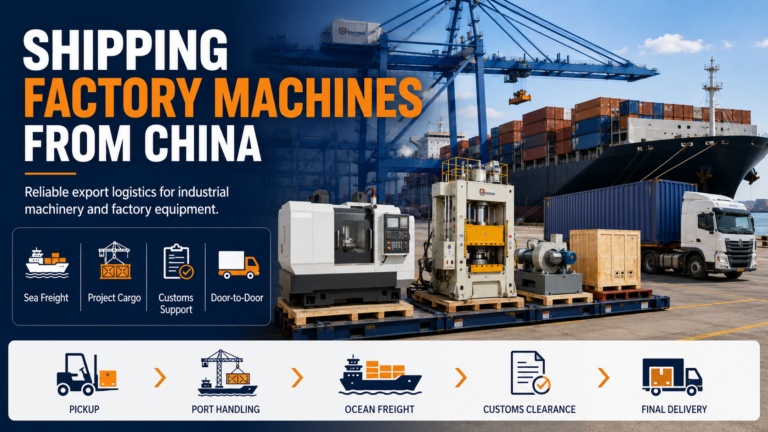
Shipping Factory Machines from China Verified & Reviewed · Last updated July 2026 Shipping factory machines from China requires careful planning...
Read guide →Shipping Oversized Cargo from China Verified & Reviewed · Last updated February 2026 Shipping oversized cargo from China depends on cargo dimensi...
Learn more → Useful Resource Electric Motorcycle Shipping from ChinaElectric Motorcycle Shipping from China Verified & Reviewed · Last updated May 2026 Electric motorcycle shipping from China requires the right fr...
Learn more →WhatsApp us