

Hong Kong HKG Air Cargo Rates & Transit Times
- Verified & Reviewed · Last updated January 2026
Hong Kong HKG air cargo rates and transit times vary depending on airline capacity, service level, cargo handling requirements, and total shipping charges at Hong Kong International Airport.
This updated guide explains Hong Kong HKG air cargo in a practical, shipper-first way, covering scheduled services and charter services, major routing options to the USA, Europe, and the Middle East, and what is included in typical air cargo quotes, such as the air freight rate, fuel and security surcharges, origin handling, and export documentation support. It also breaks down the operating steps that protect performance, including cut-off planning, aircraft capacity considerations, milestone tracking, and operational excellence routines that reduce delays.
Shipping services / Mode
Transit time range
Air freight rates
- Experienced China-based logistics specialists
Table of Contents
Why Hong Kong International Airport Is a Strategic Airport for Air Cargo
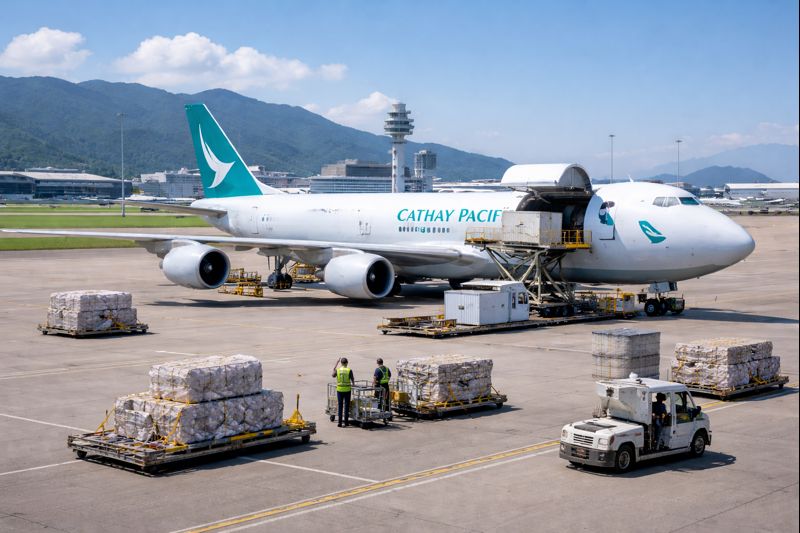
Hong Kong International Airport is a high-throughput airport designed to handle large volumes of air cargo with consistent handling routines. This is why hong kong hkg air cargo is widely used for time-sensitive work across the year.
Key advantages shippers rely on:
Dense airline network and frequent departures, which supports recovery when schedules shift
Mature terminal operations that improve handling speed and reduce exceptions
Scalable services options from standard uplift to priority lanes and charter uplift
Strong connectivity across Asia with stable access to major long-haul markets in Europe and the Middle East
When people say “HKG is fast,” they usually mean the whole system can operate smoothly if your cargo is ready and your documentation is correct. That readiness is what separates average results from operational excellence.
Scheduled Services vs Charter Services for Hong Kong HKG Air Cargo
Most hong kong air cargo moves through scheduled services. These are regular routes with consistent weekly patterns. Scheduled services are ideal for repeat shipments and predictable replenishment cycles. When you book early and tender before cut-off, scheduled services deliver strong performance.
Charter services are used when timing is non-negotiable or cargo is operationally difficult. Shippers choose charter services for urgent replenishment, project cargo, oversized shipments, and peak weeks where space is tight. Charter services can protect timelines, but they require tight coordination with the airline, the airport handling team, and your forwarder.
A practical operating rule:
Use scheduled services for stable flow and cost control
Use charter services when you must control uplift and reduce timing risk
Many high-performing teams use both and continue to adjust the mix as demand changes across the year.
What You Can Ship via Hong Kong Air Cargo
Hong Kong air cargo supports a wide range of commodities. Most shipments fall into:
General air cargo
Electronics, apparel, spare partas, and standard commercial goods. This is where hong kong hkg air cargo delivers the best balance of speed and cost.
Special handling air cargo
High-value cargo, temperature-sensitive goods, and shipments needing extra security procedures. These shipments can still move quickly through Hong Kong International Airport, but they require higher discipline in packaging and paperwork.
Regulated cargo
Some goods require additional checks and strict compliance. If your documentation does not match your cargo, the airport workflow will slow down quickly.
No matter the category, your outcome depends on whether your team can provide correct details early and keep the cargo acceptance process clean.
How Hong Kong HKG Air Cargo Operates at Hong Kong International Airport
To run hong kong air cargo consistently, focus on the operational steps that decide whether you catch the flight.
Step 1: Booking and airline selection
Choose an airline based on lane reliability, routing simplicity, and capacity stability. Direct options often reduce transfers and improve performance. Capacity planning is not only price shopping. It is a decision about how your shipment will be loaded and whether your cargo is likely to roll.
Step 2: Cargo acceptance and cut-off control
Hong Kong International Airport is efficient, but strict. If your dimensions and weight do not match your booking, your shipment may be re-rated or reworked, which can cost you a day. Good operators set internal deadlines earlier than the airport cut-off to protect uplift.
Step 3: Screening, build-up, and handover
Cargo is screened, then built into ULDs or pallets. Packaging quality and labeling clarity reduce rework and speed up build-up. When your cargo is ready, the airport process moves fast.
Step 4: Departure, arrival, and release
Flight time is only part of the journey. Arrival handling and clearance often decide final delivery timing. Strong documents reduce holds and protect lead times.
This workflow is how experienced teams operate at scale and keep results stable across many shipments and many times during the year.
Use this table as a planning baseline for hong kong(HKG) air cargo. Actual results depend on capacity, direct routing, destination clearance, and whether you meet airport cut-offs.
| Destination Region | Airport-to-Airport Transit Time | Door-to-Door Transit Time | Main Variables |
|---|---|---|---|
| USA | 1–4 days | 4–9 days | airline allocation, rollovers, customs release |
| Europe | 2–5 days | 5–10 days | routing complexity, screening, arrival handling |
| Middle East | 2–6 days | 6–12 days | capacity shifts, routing options, last-mile delivery |
| Asia | 1–3 days | 3–7 days | cut-off timing, uplift frequency, destination handling |
Below is a single rate table with specific numeric ranges. These figures are typical market ranges in USD per kilogram for general cargo from Hong Kong. Final prices vary by season, space availability, and airline allocation.
| Chargeable Weight Band | USA USD/kg | Europe USD/kg | Middle East USD/kg |
|---|---|---|---|
| 45–99 kg | 6.8–8.6 | 6.2–8.0 | 5.2–6.8 |
| 100–299 kg | 5.6–7.1 | 5.2–6.7 | 4.6–6.0 |
| 300–499 kg | 4.9–6.3 | 4.6–6.0 | 4.1–5.4 |
| 500–999 kg | 4.3–5.7 | 4.1–5.5 | 3.8–5.0 |
| 1000 kg+ | 3.9–5.2 | 3.8–5.0 | 3.5–4.6 |
How to interpret rates correctly:
Charges follow chargeable weight, the higher of gross weight or volumetric weight
Direct uplift can cost more, but it often improves delivery times and reduces rollover risk
In peak weeks, space priority and allocation matter more than the lowest headline price
If you want better cost control, focus on packaging efficiency and stable tender timing. That is where teams create savings repeatedly across many shipments, many times, and across the entire year.
Airlines, Aircraft, and Fleet: Why Capacity Planning Changes Results
Air cargo reliability is shaped by airline decisions and aircraft constraints. Some weeks have more space, some weeks do not. The carrier’s fleet mix also matters because different aircraft types offer different usable cargo volume and loading profiles.
What to evaluate when you choose a lane plan:
Airline flight density on your lane and how often schedules change
Aircraft cargo layout and typical loading constraints for bulky cargo
Fleet strategy and how the carrier balances freighter lift and belly capacity
Transfer risk if your routing uses multiple handovers
A provider that can explain these items clearly will usually deliver better performance, because the plan is built on operations, not only on pricing.
Most delays in hong kong hkg air cargo are document-driven. The airport moves quickly, and inconsistencies are discovered quickly.
Core documents:
Commercial invoice with clear product descriptions and consistent values
Packing list with correct carton count, weight, and dimensions
Air waybill details aligned with booking data
Any compliance papers required by commodity and destination
Common delay triggers:
Vague descriptions that increase inspection risk
Totals that do not reconcile between invoice and packing list
Consignee details that differ across documents
Booked dimensions that do not match real cartons
Teams that standardize a document pre-check process continue to reduce exceptions over time.
Track the Milestones That Improve Performance
If you want consistent delivery outcomes, track milestones, not only flight arrival. Milestone tracking improves accountability, makes exception handling faster, and helps your team operate with fewer surprises.
Track these points:
Booking confirmation and allocation status
Terminal acceptance completion at the airport
Screening completion and build-up completion
Actual departure confirmation
Arrival release milestone
Customs release and delivery handover
A simple milestone dashboard, powered by consistent data capture, is one of the fastest ways to improve performance across the year.

Operational Excellence: A Practical Hong Kong Air Cargo Playbook
Operational excellence is not a slogan. It is a repeatable method your people follow on every shipment.
Set tender deadlines earlier than cut-off
This protects you from last-minute rework and keeps your uplift probability higher.
Choose services by shipment risk
Use scheduled services for predictable flow. Use charter services when the shipment is high-stakes and timing cannot slip.
Standardize packaging
Strong cartons, clean labels, and stable pallets reduce handling friction and reduce claims. This improves outcomes repeatedly across many shipments.
Run a fixed document pre-check
Make it part of the workflow. Do it every time. This is how teams stop “random delays” from happening again and again.
This discipline is what turns Hong Kong air cargo into a stable system your business can rely on.
Hong Kong HKG Air Cargo vs DHL: When Each Makes Sense
Some shippers compare hong kong hkg air cargo with integrator options like DHL. DHL can be effective for smaller urgent parcels and controlled door-to-door shipments. For larger consignments, airline air cargo often provides better cost efficiency and scalability.
Many teams use a hybrid approach:
DHL for small, urgent shipments
Hong Kong HKG air cargo for bulk replenishment and regular lanes
This approach is powered by matching the service to the shipment profile, not forcing one solution for every shipment.
Frequently Asked Questions
HKG is the airport code for Hong Kong International Airport used in airline routing, air waybills, and shipment systems.
Choose charter services when timing is non-negotiable, cargo is oversized or project-based, or capacity constraints make scheduled services unreliable.
Missed cut-offs, booking details that do not match the physical cargo, and documentation inconsistencies are the most common causes.
Tender earlier, confirm airline allocation, standardize documents, use consistent packaging, and track operational milestones.
Rates move with capacity cycles, seasonal demand, and airline allocation. A stable lane plan and early booking help control volatility.
Related Air Freight & Airport Guides
Get an HKG Air Freight Quote
Accurate air freight rates by chargeable weight (USD/kg)
Scheduled services or charter services for faster uplift
Milestone tracking to improve transit performance
Get tailored routing options, clear transit time ranges, and transparent Hong Kong HKG air cargo pricing.