Related Guide
Shipping from China to UAE
Shipping from China to UAE is fast and cost effective with air freight and sea freight options. Explore shipping time, costs, and door to door se...
Read guide →

Importing from China to the UAE requires the right trade license, customs registration, product compliance and shipping documents before the goods leave China.
This guide covers China to UAE shipping methods, freight costs, transit times, customs clearance, import duty, VAT and final delivery.
Shipping Costs
Customs & VAT
Import Process
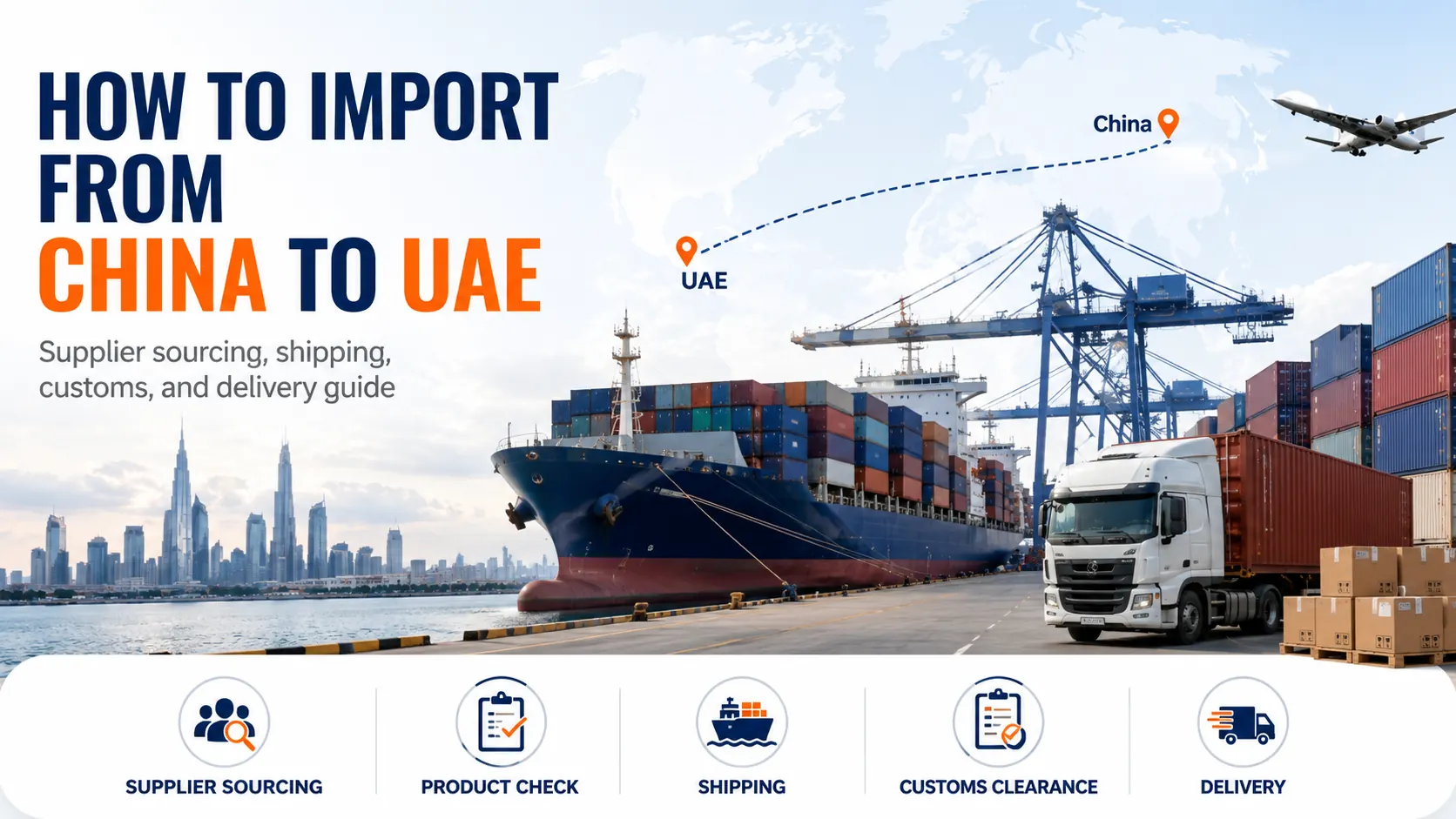
Before placing an order, determine which company will act as the importer in the United Arab Emirates and whether the goods are intended for the UAE mainland, a free zone or re-export. Commercial importing normally requires an appropriately licensed UAE business, and customs registration is handled by the authority responsible for the emirate where the cargo is cleared. This decision should be made before shipping goods from China because it affects the declaration and destination handling.
Product requirements should be checked at the same time. Food, cosmetics, electrical products, medical equipment, wireless devices and other regulated goods may require additional permits, conformity documents or labeling before they can enter the UAE market.
A company importing commercial goods into the United Arab Emirates generally needs a valid trade license covering the relevant business activity. The importer must also be registered with the customs authority responsible for the emirate where the goods will enter.
For cargo arriving in Dubai, the importer normally needs to complete registration with Dubai Customs and obtain the appropriate customs or importer code before submitting regular commercial import declarations.
The exact setup depends on the location and business structure, but importers should normally confirm:
The trade license covers the goods being imported
Customs registration is active
The importer details match the shipping and commercial documents
Any required customs or importer code has been obtained
The company is authorized to clear the cargo at the chosen entry point
A freight forwarder or customs broker can assist with the clearance process, but the importing company should make sure its registration is in place before shipping from China.
The customs arrangement depends partly on whether goods enter the UAE mainland or a free trade zone. Mainland cargo is normally cleared for circulation in the local market, while goods entering a free zone can be handled according to the applicable free-zone and customs procedures.
Free trade zones are widely used in the United Arab Emirates for warehousing, regional distribution and re-export. A UAE free trade zone can therefore be useful when goods will be stored or redistributed rather than immediately released into the mainland.
However, importers should not assume that every free-zone transaction is automatically exempt from all taxes or customs obligations. The final destination and planned movement of the goods should be confirmed before the shipping arrangement is finalized.
Businesses planning to import from China should check UAE import regulations before a purchase order is finalized. A product that can be exported from China is not automatically approved for unrestricted import or sale in the UAE market. Checking these rules early helps prevent cargo from reaching the border without the required approval.
Confirm the commercial product description, intended use, HS classification and UAE destination market first. If your goods require permits, testing, conformity approval or special labeling, completing those steps before shipping from China can reduce the risk of customs delays.
The United Arab Emirates distinguishes between prohibited and restricted goods. Restricted products may be imported only after receiving approval from the competent authority, while prohibited products cannot normally be imported.
Additional controls can apply to categories such as:
Medicines and medical equipment
Food and agricultural products
Wireless and telecommunications devices
Cosmetics and personal-care products
Chemicals and pesticides
Certain automotive products
Dangerous and controlled goods
The UAE Government confirms that restricted goods require prior approval from the relevant authority.
The exact requirement therefore depends on the product category and intended use, not simply on the fact that the goods are manufactured in China.
Some regulated products are subject to UAE technical regulations and may require a UAE Certificate of Conformity.
The Ministry of Industry and Advanced Technology, or MOIAT, provides conformity services for products subject to technical regulations. For applicable goods, current requirements can include a valid trade license and a test report issued by an accredited laboratory.
This does not mean every import from China requires ECAS or another conformity certificate. The importer should first identify whether the specific product falls within a regulated category.
The HS code affects tariff classification, import requirements and permits. The description on the commercial invoice should accurately identify the goods and support the HS classification used for customs purposes.
Dubai has been transitioning toward a 12-digit integrated customs tariff. However, this should not be interpreted as meaning every Dubai declaration must currently use a 12-digit code.
Dubai Customs Notice No. 02/2026 extended the flexibility to use 8-digit HS classifications until further notice, and Dubai Customs continues to accept declarations submitted with 8-digit HS codes during this period.
For a current shipment, confirm the required classification with the customs broker or relevant authority rather than relying on an older implementation timetable.
The easiest way to manage importing from China is to plan the complete process before production begins. This gives the buyer time to solve licensing, product, quality and shipping issues while the goods are still at origin.
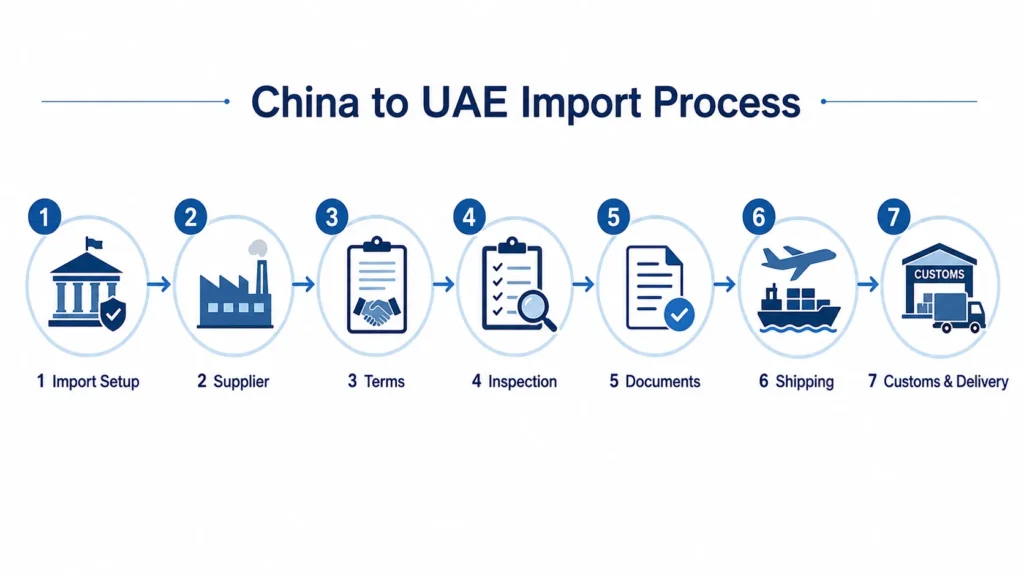
Identify the UAE business that will act as importer and verify its trade license, customs registration and any product-specific approvals.
This should be completed before production finishes, particularly for regulated products that may require testing, permits or conformity documents.
Potential manufacturers and suppliers can be found through Alibaba, Made-in-China, exhibitions, sourcing companies or direct factory contacts.
Compare suppliers based on business registration, manufacturing capability, specifications, samples, MOQ, production time and export experience instead of selecting only the lowest price.
The purchase agreement should clearly define product specifications, quantity, packaging, price, payment terms and production lead time.
The buyer and seller should also agree on an Incoterm such as EXW, FOB, CIF or DDP so that transportation responsibilities and related charges are clear.
A pre-shipment inspection can check quantity, workmanship, dimensions, labeling, packaging and other agreed specifications before cargo leaves China.
Inspection is a useful quality-control measure for many commercial orders, but it should not be presented as a universal UAE customs requirement for all ordinary imports.
The factory, importer and freight forwarder should coordinate the commercial and shipping documents before departure.
Product descriptions, quantities, weights and values should remain consistent across the commercial invoice, packing list and transport documents.
Choose sea freight, air freight or express shipping based on shipment volume, weight, product value and delivery deadline.
A freight forwarder can arrange factory pickup, China export handling, carrier booking, shipping documentation and destination coordination.
After the shipment arrives in the UAE, the importer or appointed clearing agent submits the customs declaration and required documents.
Once customs clearance is completed and applicable duties and taxes have been handled, the goods can be released for delivery to a warehouse, store, project site or other final destination.
If you plan to import from China regularly, factory selection matters as much as freight planning. China has a broad manufacturing base for electronics, machinery, construction materials, furniture, textiles, household products and many other categories.
Buyers can source directly from factories, trading companies or online marketplaces, but price should not be the only selection criterion. When comparing suppliers, check whether the company can consistently manufacture the required specification at commercial scale.
Important points to verify include:
Company and factory information
Product specifications and materials
Minimum order quantity
Sample quality
Production capacity and lead time
Packaging and labeling
Payment terms
Export experience
Before booking shipping from China to the UAE, the factory should also provide accurate shipment information, including carton or pallet quantity, gross weight, package dimensions and pickup address. If products come from several suppliers, consolidation can combine them before export.
Batteries, liquids, powders, chemicals, magnetic products, oversized cargo and other special goods should be declared before quotation because they may require additional documents, carrier approval or special shipping arrangements.
Incoterms determine how responsibilities, risk and transport costs are divided between the buyer and seller. Selecting the correct term matters because a low factory price can still produce a high landed price when origin or destination charges are not understood.
Under EXW, the seller makes the goods available at the factory or another agreed location. The buyer or freight forwarder handles pickup and most of the following shipping process.
EXW can be useful when a shipment from several factories is consolidated in China before export to the UAE.
FOB is widely used for sea freight. The seller handles the agreed origin responsibilities up to the named Chinese port, while the buyer manages the main international shipping and destination arrangements.
For many UAE importers, FOB provides clearer control over ocean shipping rates and carrier selection for cargo moving from China to the UAE.
Under CIF, the seller arranges ocean freight and insurance to the named destination port. CIF does not mean every charge is included until the goods reach the buyer’s warehouse.
Customs clearance, import taxes, port handling and local delivery can still be payable by the importer, so destination charges should be checked carefully.
DDP can provide a more integrated door to door arrangement in which the seller takes extensive responsibility for transportation and import formalities.
Before using DDP, confirm who will legally act as importer, how the declaration will be filed and whether duty, VAT and final delivery are actually included.
Incoterms allocate commercial responsibilities between buyer and seller, but they do not replace UAE import regulations.
Sea freight and air freight are the main shipping methods for commercial cargo moving from China to the United Arab Emirates. Express shipping is more suitable for samples, documents and smaller parcels.
The best shipping method depends on shipment volume, chargeable weight, product value, delivery deadline and total budget. Importers should compare the complete China to UAE shipping process rather than selecting a service only by the headline freight rate.
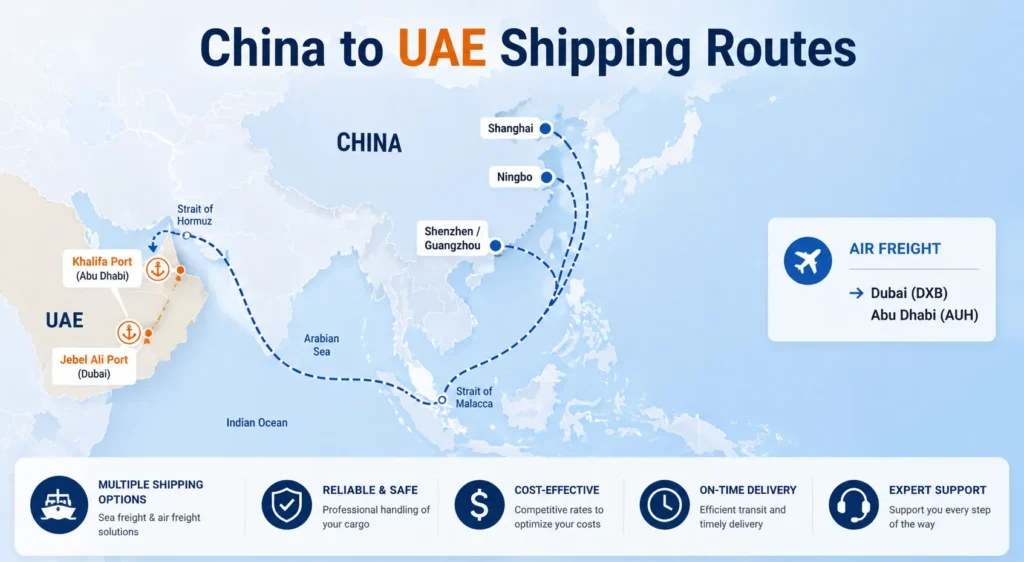
Sea freight from China to the UAE is generally the most economical shipping method for larger, heavier or high-volume cargo. Importers can choose between FCL and LCL according to the amount of space required.
FCL – Full Container Load is suitable when shipment volume justifies using an entire 20ft or 40ft container. It provides dedicated container space and is commonly used for larger commercial orders moving from China to the UAE.
LCL – Less than Container Load allows smaller cargo to share container space with other goods. LCL shipping is normally calculated according to volume or weight/measurement and can be practical when the order does not require a full container.
Major departure ports in China include:
Shanghai
Ningbo
Shenzhen
Guangzhou
Qingdao
In the UAE, Jebel Ali Port in Dubai and Khalifa Port in Abu Dhabi are two important gateways for container shipping.
Air freight from China to the UAE is suitable for urgent, high-value or time-sensitive cargo. It is frequently used for electronics, replacement parts, fashion products, samples and urgent inventory replenishment in the UAE market.
Air freight pricing is normally based on chargeable weight, which compares the actual gross weight with volumetric weight.
Because airline space, schedules and demand change frequently, air shipping rates should be confirmed close to the booking date.
Express courier shipping can be practical for samples, documents and smaller e-commerce parcels.
For larger commercial cargo, a door to door service can combine factory pickup in China, export processing, international transportation, customs coordination and final delivery in the UAE.
A door to door quotation should clearly state which charges are included. Before choosing door to door shipping between China and the UAE, importers should confirm whether customs clearance, customs duty, VAT, airport or port handling and local delivery are covered.
Goods shipped from China can enter the UAE through several major seaports and airports. The best gateway depends on the shipping method, final delivery location, carrier schedule and whether the cargo will enter the mainland or a free trade zone.
For sea freight, Jebel Ali Port in Dubai and Khalifa Port in Abu Dhabi are the main gateways for containerized cargo. Air freight can move through major airports in Dubai and Abu Dhabi, giving importers several options for urgent or high-value shipments.
Jebel Ali Port is the main container port serving Dubai and one of the most important logistics hubs in the Middle East. It handles large volumes of FCL and LCL cargo arriving from China and is closely connected with the Jebel Ali Free Zone.
For businesses importing goods from China to Dubai, Jebel Ali is often the most practical sea freight gateway because it provides convenient access to Dubai, Sharjah and other markets in the northern UAE.
Cargo arriving at Jebel Ali can be cleared for the UAE mainland, moved into the free zone for storage or distribution, or re-exported to other countries.
Khalifa Port is a major commercial and container gateway serving Abu Dhabi and nearby industrial areas.
It can be a suitable option for shipments with final delivery in Abu Dhabi, Al Ain or surrounding logistics and manufacturing zones. Routing cargo directly through Khalifa Port may also reduce unnecessary inland transportation when the consignee is located closer to Abu Dhabi than Dubai.
The choice between Jebel Ali and Khalifa Port should therefore be based on the final destination, available sailing schedule and total delivery cost rather than the ocean freight rate alone.
Air freight from China can enter the United Arab Emirates through major airports serving Dubai and Abu Dhabi.
Dubai is an important hub for international air cargo and express shipping, while Abu Dhabi provides another option for commercial goods requiring faster transportation.
When choosing an airport, importers should compare:
Flight availability from the Chinese departure city
Air freight rate and chargeable weight
Cargo handling requirements
Customs clearance arrangements
Distance to the final delivery address
For urgent cargo, the fastest international flight is not always the fastest overall solution. An airport closer to the final warehouse or customer may reduce local delivery time after customs clearance.
In practice, Jebel Ali Port is usually the main sea freight gateway for Dubai-bound cargo, while Khalifa Port is more suitable for many Abu Dhabi destinations. Air freight offers greater flexibility when delivery speed is the priority.
China to UAE shipping costs vary according to departure port, destination, cargo type, container size, carrier capacity and seasonal demand. The following figures are 2026 reference ranges for planning, rather than fixed quotations. Actual rates should always be confirmed before booking.
Sea freight is generally more economical for larger commercial orders, while air freight and express shipping reduce transit time for urgent goods.
| Shipping Method | Estimated Cost | Transit Time | Best Used For |
|---|---|---|---|
| 20ft FCL | USD 3,300–4,000 / container | 12–18 days | Larger commercial orders and machinery |
| 40ft FCL | USD 4,200–6,000 / container | 12–18 days | High-volume and bulk cargo |
| LCL Sea Freight | USD 30–60 / CBM | 10–16 days | Smaller commercial cargo |
| Standard Air Freight | USD 4–6 / kg | 2–4 days | Urgent and higher-value goods |
| Express Courier | USD 6–10 / kg | 2–5 days | Samples, documents and small parcels |
The freight rate does not represent the complete cost of importing goods into the UAE. Destination handling, customs charges and the selected Incoterm can all affect the final amount you pay.
UAE Duties and VAT: Many imported goods are subject to a 5% customs duty, while the standard UAE VAT rate is 5%. The actual amount depends on the product classification, customs value and applicable rules.
Port and Airport Charges: Cargo arriving at Jebel Ali Port, Khalifa Port or a UAE airport may incur terminal handling, documentation, clearance and other destination fees.
Incoterms: EXW, FOB, CIF and DDP divide responsibilities differently. For example, an EXW price may require you to arrange inland transportation from the Chinese factory, while CIF normally covers the main ocean freight but not all destination charges.
For the most accurate quotation, provide the product name, pickup city, cargo weight and dimensions, shipping volume, and final delivery address in the UAE.
Accurate shipping documents are essential because UAE customs authorities use them to verify the importer, product description, quantity, origin, classification and declared value of the shipment.
Current UAE commercial import guidance lists documents including the commercial invoice, certificate of origin, detailed packing list, applicable import permit and bill of entry or air waybill.
| Document | Usually Provided By | Main Purpose |
|---|---|---|
| Commercial Invoice | Chinese seller or factory | Product description, quantity and invoice value |
| Packing List | Chinese seller or factory | Packing method, weight and quantity |
| Certificate of Origin | Exporter | Confirms country of origin |
| Bill of Lading / Air Waybill | Carrier or freight forwarder | Transport and routing information |
| Import Permit | Importer / relevant authority | Required for applicable restricted goods |
The commercial invoice should use a clear product description instead of vague terms such as “parts” or “accessories” when a more accurate description is available.
The packing list should match your goods, and the bill of lading or air waybill should show the correct consignee and routing for the shipment.
Food, regulated products and restricted goods can require additional certificates or approvals. Documentation should therefore be checked before shipping from China to the UAE rather than after the shipment reaches the United Arab Emirates.
After the cargo arrives in the UAE, the importer or appointed customs broker must submit the customs declaration before the goods can be released. For shipments entering through Dubai, declarations are handled through Dubai Customs, while cargo arriving in Abu Dhabi follows the procedures of the relevant Abu Dhabi customs authority.
Customs reviews the importer details, HS classification, declared value and supporting documents. Restricted or regulated goods may also require approval from the responsible authority before clearance.
For most commercial cargo, the clearance process can be summarized in four stages:
Submit the customs declaration.
The importer or customs broker files the declaration using the commercial and shipping documents.
Customs reviews the cargo details.
The HS code, product description, country of origin and customs value may be checked. Additional permits are required for restricted goods.
Pay applicable duty and VAT.
Customs calculates the amount due according to the product classification and import value. Physical inspection may also be requested.
Cargo release and final delivery.
Once clearance is completed, the goods can leave the port or airport and move to the warehouse, store or other destination.
For Dubai imports, Dubai Customs currently lists the invoice, packing list, certificate of origin and applicable permits among the supporting documents for a customs declaration.
Many general commercial goods imported into the United Arab Emirates are subject to a 5% customs duty, although the tariff can vary by product. UAE Government guidance notes that customs rates can range from exemption to 5%, 50% or 100% depending on the type of goods.
For standard goods subject to the 5% rate, duty is generally calculated using the customs value, which includes the value of the goods together with freight and insurance.
The UAE also applies a standard 5% VAT to most taxable imports. Import VAT is calculated separately from customs duty and is generally imposed on the customs value plus applicable customs duties and other relevant import amounts.
Goods entering a UAE free trade zone can be handled differently from cargo released directly into the mainland.
For example, goods may enter a free zone for storage, processing or re-export without being immediately cleared for local UAE circulation. If those goods are later transferred from the free zone into the mainland, an Import to Local from Free Zone declaration is required and applicable customs duty may become payable. Dubai Customs specifically provides for this type of declaration.
This distinction is important for businesses using logistics hubs such as Jebel Ali Free Zone. The importer should decide whether the cargo is intended for local UAE sale, free-zone storage or re-export before choosing the customs arrangement.
Before the goods leave China, confirm the HS code, customs value, importer registration and any required permits with your freight forwarder or customs broker. This helps reduce unexpected charges and clearance delays after arrival.
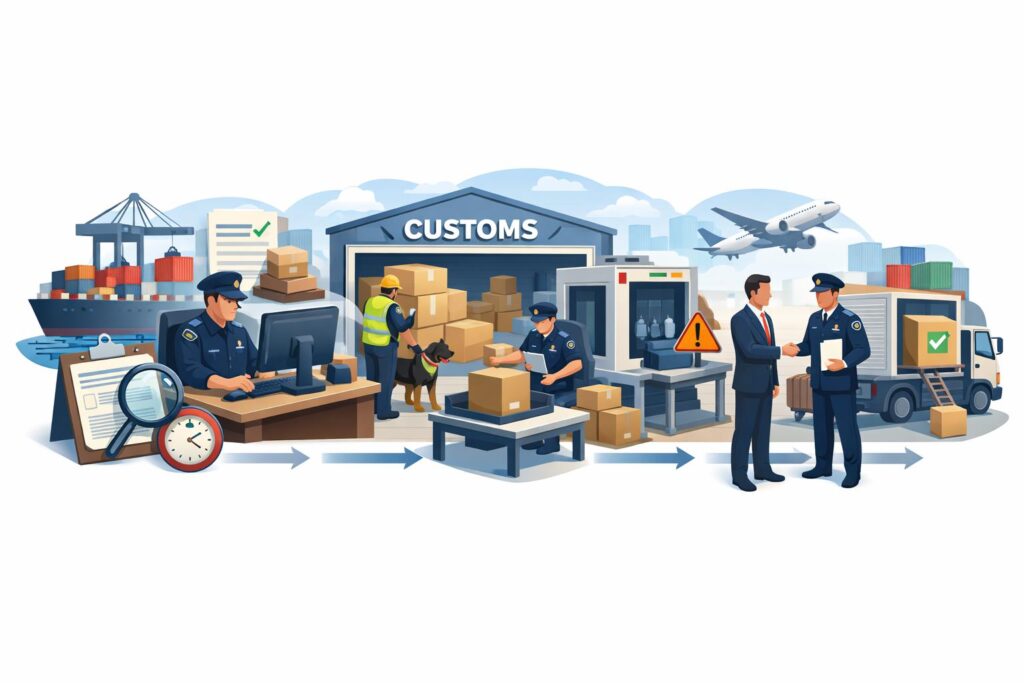
Many problems start before a shipment is booked. Checking UAE product rules, documents and shipping responsibilities early is usually cheaper than resolving them after your goods arrive.
Common mistakes include:
Ordering before checking UAE import regulations. Regulated goods may require permits, testing or conformity approval.
Using the wrong HS code. Incorrect classification can affect tariffs and regulatory requirements.
Providing inconsistent documents. The commercial invoice, packing list and shipping documents should describe the same goods accurately.
Choosing CIF or DDP without checking the service scope. A low headline quotation can exclude destination handling or local charges.
Failing to declare special cargo. Batteries, liquids, chemicals and oversized goods should be identified before booking.
Skipping quality control. Customs paperwork cannot fix a manufacturing problem discovered after the goods arrive.
A freight forwarder should also be evaluated based on routing, documentation support, destination coordination and the complete shipping service rather than only the lowest rate.
Importing from China to the UAE involves several parties, including the factory, trucking provider, warehouse, carrier, customs broker and final-delivery provider. Coordinating these stages through one logistics partner can make international shipping easier for your business to manage.
Tonlexing supports commercial cargo moving from major manufacturing regions in China to Dubai, Abu Dhabi and other destinations in the United Arab Emirates. Depending on the shipping method and service required, we can coordinate:
FCL and LCL sea freight
Air freight and express shipping
Factory pickup across China
Multi-factory cargo consolidation
Export documentation support
Cargo tracking
Customs-clearance coordination
Door to door delivery
Whether you are importing goods from China for retail, wholesale, manufacturing or project use, the shipping plan should match the size, urgency and final destination of the cargo.
Send Tonlexing the product name, pickup location, carton or pallet quantity, gross weight, dimensions and UAE delivery address to receive a current shipping solution and quotation.
Yes. Normal commercial importing requires the appropriate UAE business setup and trade license. The importer may also need customs registration with the authority responsible for the emirate where the shipment is cleared.
Common documents include a commercial invoice, packing list, certificate of origin and bill of lading or air waybill. Restricted or regulated goods may also require additional permits or conformity documents.
For the 2026 reference rates used in this article, a 20ft FCL container is around USD 3,300–4,000, while a 40ft FCL container is around USD 4,200–6,000.
Actual China to UAE shipping rates vary by departure port, carrier, sailing date and container availability.
Many ordinary imported goods are subject to a general 5% customs duty, although exemptions and different rates apply to specific product categories. The correct rate should be confirmed using the product’s HS classification.
FCL sea freight from China to UAE is commonly around 12–18 days for the main port-to-port movement based on the reference range used in this guide. Standard air freight is around 2–4 days.
Total door to door time is longer because factory pickup, export processing, customs clearance and final delivery must also be included.
Useful freight, customs and importing resources related to this shipping guide.
Shipping from China to UAE is fast and cost effective with air freight and sea freight options. Explore shipping time, costs, and door to door se...
Read guide →
Shipping Documents From China to the UAE Verified & Reviewed · Last updated February 2026 Shipping documents from China to the UAE are the key to...
Read guide →
Shipping Costs from China to UAE (2026 Guide) Verified & Reviewed · Last updated June 2026 Shipping costs from China to UAE usually start from $3...
Read guide →
Sea Freight From China to UAE Verified & Reviewed · Last updated April 2026 Sea freight from China to UAE depends on shipping costs, transit time...
Read guide →Air Freight from China to UAE: Cost, Transit Time & Door-to-Door Shipping Verified & Reviewed · Last updated June 2026 Air freight from China to...
Learn more → Useful Resource DDP Shipping from China to UAEDDP Shipping from China to UAE Verified & Reviewed · Last updated June 2026 DDP shipping from China to UAE is an all-inclusive door-to-door logis...
Learn more →WhatsApp us