

EXW Container Shipping from China: Complete Guide for Importers
- Terverifikasi & Direview · Terakhir diperbarui April 2026
EXW pengiriman kontainer dari Cina means the buyer is responsible for arranging pickup, export customs clearance, international freight, import clearance, and final delivery from the supplier’s factory to the destination.
This updated guide explains how EXW shipping from China works, what costs importers should prepare for, how EXW differs from FOB and FCA, and why working with a reliable freight forwarder can reduce delays, hidden charges, and customs risks.
Ketentuan Pengiriman EXW
Izin Pabean Ekspor
Freight Cost & Delivery
- Spesialis logistik berpengalaman yang berbasis di Tiongkok
Daftar Isi
What Does EXW Mean in Shipping from China?
EXW means Ex Works. It is one of the international trade terms used to define where the seller’s responsibility ends and where the buyer’s responsibility begins.
Under EXW Incoterm, the seller fulfills the delivery obligation when the goods are made available at an agreed place. This place is usually the seller’s factory, supplier’s warehouse, or another designated location in China.
After the goods are ready for pickup, the buyer arranges the transportation process.
In practical shipping from China, EXW means the buyer is usually responsible for:
picking up the goods from the Chinese supplier
arranging inland transportation to the nearest port
preparing export documentation
handling export customs clearance
paying origin charges and port fees
booking sea freight or air freight
arranging import customs clearance
paying import duties and customs duties
arranging final delivery to the final destination
EXW gives the seller minimum responsibility and gives the buyer maximum responsibility. This is why EXW shipping can offer more control, but it also requires stronger logistics planning.
How EXW Container Shipping from China Works
EXW container shipping from China starts at the supplier’s location, not at the departure port. This is the biggest difference between EXW and Pengiriman FOB.
Under FOB, the supplier usually handles export clearance and delivery to the port. Under EXW, the buyer or freight forwarder must manage the China-side logistics before the cargo reaches the shipping vessel.
Confirm EXW Terms with the Chinese Supplier
Before booking shipping, the buyer should confirm the exact EXW terms with the Chinese supplier.
Important details include:
alamat pengambilan
delivery point
cargo ready date
jumlah paket
dimensi dan berat
nama produk
nilai kargo
export license status
loading conditions at the factory
whether the supplier can provide export documents
This step is important because some suppliers only provide a simple EXW price but do not clearly explain what they can or cannot support after production.
Arrange Pickup from the Seller’s Factory
Under EXW shipping, the buyer arranges pickup from the seller’s factory or supplier’s warehouse.
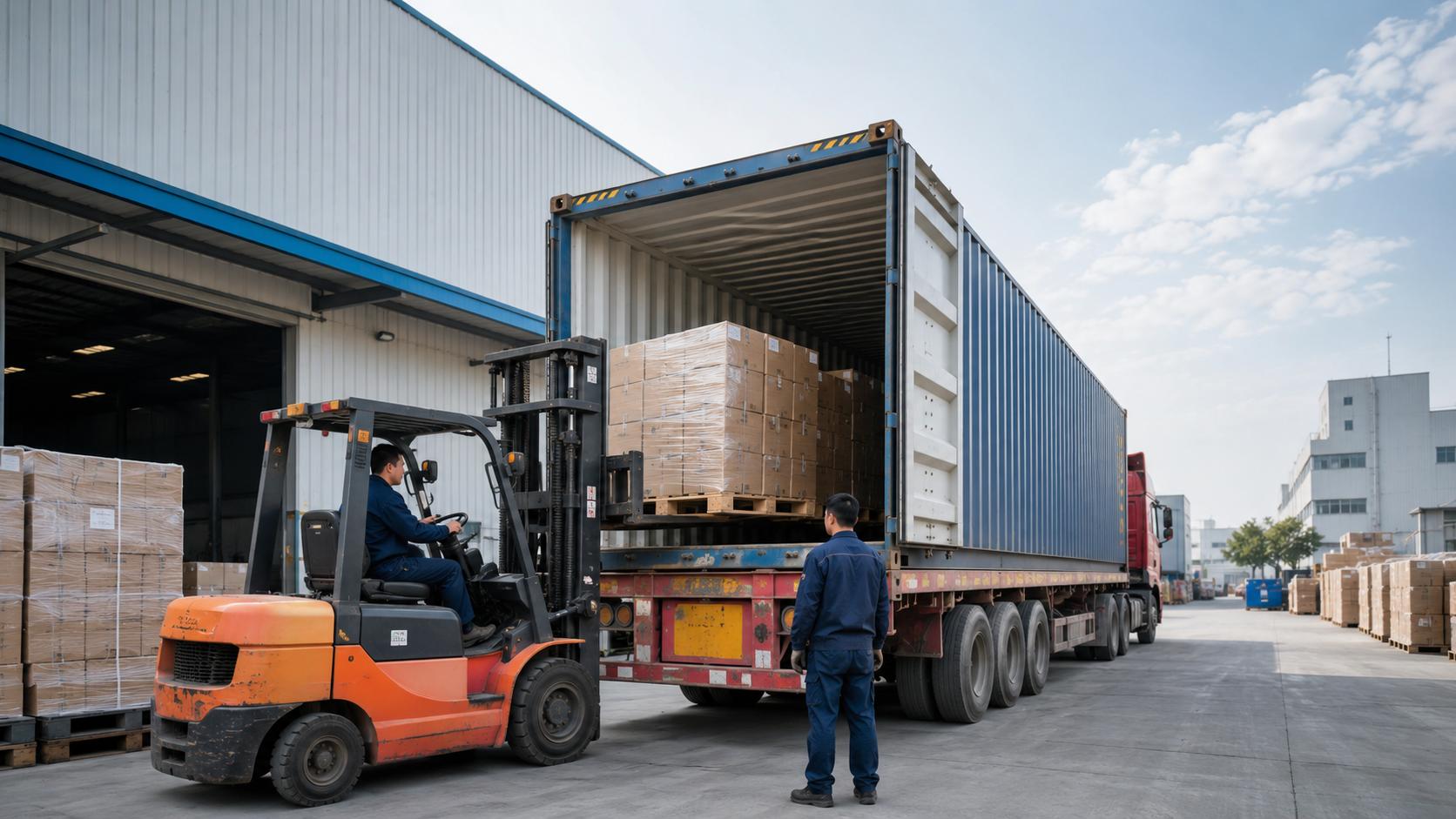
Untuk Pengiriman FCL, a trucker may deliver an empty container to the factory for loading. For pengiriman LCL, the goods are usually picked up by truck and delivered to a consolidation warehouse.
If the supplier is far from Shanghai Port, Ningbo Port, Shenzhen Port, Qingdao Port, Guangzhou Port, Xiamen Port, or another departure port, inland transportation costs may increase.
The pickup location, nearest port, cargo volume, and loading conditions all affect the final freight cost.
Siapkan Dokumentasi Ekspor
Export documentation is a key part of EXW shipping from China.
Dokumen umum meliputi:
daftar pengepakan
kontrak penjualan
export declaration information
deskripsi produk
nilai kargo
informasi pemasok
buyer information
sertifikat asal jika diperlukan
product certificate if required
For regulated goods, Chinese customs may require additional documents. Products with batteries, magnets, liquids, powder, wood packaging, brand logos, or special materials should be checked before shipment.
Handle Export Customs Clearance
Ekspor bea cukai is usually the buyer’s responsibility under EXW terms.
If the supplier has an export license, they may cooperate with the freight forwarder to complete the export declaration. If not, the freight forwarder may need to arrange a qualified export company to handle the customs declaration.
This is why checking export clearance before pickup is important for EXW shipping from China.
Move Cargo to the Departure Port
After pickup and document checking, the cargo is moved to the departure port.
For FCL shipments, the loaded container is delivered to the container yard before the cut-off time. For LCL shipments, the cargo is sent to a CFS warehouse for measuring, weighing, checking, and consolidation.
Common departure ports include Shanghai Port, Ningbo Port, Shenzhen Port, Guangzhou Port, Qingdao Port, Tianjin Port, and Xiamen Port.
Arrange International Shipping and Final Delivery
Once export customs clearance is completed, the cargo is shipped by sea freight or air freight.
Sea freight is commonly used for container shipping because it is more cost-effective for large volumes. Air freight is better for urgent or smaller shipments.
After the cargo arrives at the destination country, the buyer or customs broker handles import customs clearance. The cargo is then released from the destination port and delivered to the final destination.
Buyer and Seller Responsibilities Under EXW Terms
EXW is different from many other shipping terms because the buyer assumes almost the full transportation responsibility after the goods are made available.
| Tanggung jawab | Seller Under EXW | Buyer Under EXW |
|---|---|---|
| Goods production and basic packing | Ya | Tidak |
| Pengambilan kargo dari pabrik atau gudang | Tidak | Ya |
| Loading and inland transportation in China | Biasanya tidak | Ya |
| Export documentation and export customs clearance | Dukungan terbatas | Ya |
| Sea freight, air freight, and port charges | Tidak | Ya |
| Import customs clearance, duties, and final delivery | Tidak | Ya |
The key point is simple: under EXW terms, the seller only makes the goods available at the agreed delivery point, while the buyer arranges the rest of the shipping process.
This is why EXW shipping from China is not only a trade term issue. It is also a logistics management issue.
EXW Shipping Cost from China: What Should Importers Pay For?
The EXW price from a Chinese supplier usually only covers the product cost. It does not mean the goods have been exported, shipped, cleared, or delivered.
To understand the real shipping cost, importers need to calculate all associated costs from the seller’s factory to the final destination.
Origin Costs in China
Origin costs are the costs that occur before the cargo leaves China.
Common origin costs include:
pickup fee from the supplier’s warehouse
inland transportation cost to the nearest port
loading or unloading fee
biaya penanganan gudang
export documentation fee
export customs clearance fee
Chinese customs declaration charge
CFS charge for LCL cargo
container loading cost for FCL cargo
port fees at the departure port
Origin costs can vary greatly depending on the supplier’s location, cargo size, package type, and whether the supplier has export rights.
Freight Cost and Destination Charges
After the cargo leaves China, importers still need to consider international shipping and destination charges.
Ini mungkin termasuk:
biaya pelabuhan tujuan
biaya penanganan terminal
biaya pialang pabean
import customs clearance fee
bea
bea
pajak impor
asuransi kargo
final delivery fee
For FCL shipments, the freight cost is usually based on container type, route, carrier, departure port, destination port, and market rate.
For LCL shipments, the cost is usually based on CBM, chargeable weight, warehouse handling, destination charges, and minimum billing rules.
A low EXW price does not always mean a low landed cost. Importers should compare the total cost from factory pickup to final delivery, not only the supplier’s product price.
EXW FCL and LCL Shipping from China
EXW shipping can be used for both Pengiriman FCL dan LCL. The right option depends on cargo volume, weight, urgency, destination, and budget.
EXW FCL Shipping
FCL means full container load. It is suitable when the buyer has enough goods to use a full 20ft, 40ft, or 40HQ container.
Under EXW FCL shipping, the freight forwarder may arrange an empty container to the supplier’s factory. The goods are loaded into the container, sealed, and transported to the departure port.
EXW FCL shipping is often used for:
mebel
mesin-mesin
bahan bangunan
produk pencahayaan
barang rumah tangga
peralatan kebugaran
alat
large wholesale shipments
kargo besar
FCL gives the buyer better control over container loading and may reduce cargo handling compared with LCL.
EXW LCL Shipping
LCL means less than container load. It is suitable for smaller shipments that do not fill a full container.
Under EXW LCL shipping, the freight forwarder picks up the goods from the supplier and sends them to a consolidation warehouse. The cargo is then shipped together with goods from other importers.
EXW LCL shipping is suitable for:
pesanan sampel
small wholesale shipments
first-time imports
mixed products
banyak pemasok
multiple shipments that need consolidation
LCL is flexible, but importers should pay attention to warehouse fees, minimum charges, destination port charges, and final delivery costs.

EXW vs FOB vs FCA: Which Shipping Term Is Better?
EXW, FOB, and FCA are all common trade terms used in shipping from China. The main difference is where responsibility transfers from seller to buyer.
Under EXW, the buyer arranges pickup, export customs clearance, and international shipping.
Under FOB, the seller usually delivers the goods to the departure port, handles export customs, and loads the cargo onto the shipping vessel. The buyer takes responsibility after the goods are loaded on board.
Under FCA, Free Carrier, the seller delivers the goods to a named carrier or designated location. FCA can be more practical than EXW when the seller can support export clearance but does not want to handle full port-side responsibility.
| Istilah Pengiriman | Tanggung Jawab Penjual | Tanggung Jawab Pembeli | terbaik Untuk |
|---|---|---|---|
| EXW | Terendah | Paling tinggi | Buyers with strong China logistics support |
| FOB | Medium | Medium | Most container shipping from China |
| FCA | Medium | Medium | Clearer handover before main transport |
| pengiriman DDP | Higher for seller or forwarder | Harga lebih rendah untuk pembeli. | Buyers wanting door-to-door delivery |
For most importers, FOB is easier than EXW because the supplier handles export customs clearance and port delivery. EXW may be better when the buyer is working with multiple suppliers, consolidating cargo, or using one freight forwarder to control the full shipping process from the seller’s factory to the final destination.
When Should Importers Choose EXW Shipping?
EXW shipping from China is not always the easiest option, but it can be useful in the right situation.
Importers may choose EXW shipping when the Chinese supplier only offers an EXW price, or when the buyer wants a freight forwarder to manage the full transportation process from the supplier’s warehouse.
EXW is also useful when buying from different suppliers. For example, if an importer purchases goods from suppliers in Guangzhou, Foshan, Shenzhen, and Dongguan, the freight forwarder can collect the cargo, consolidate it, and ship everything together from Guangzhou Port or Shenzhen Port.
EXW shipping may be suitable when:
the supplier only provides an EXW price
the buyer wants full control over shipping resources
the buyer needs to consolidate cargo from multiple suppliers
several multiple shipments need to be combined
the supplier cannot arrange export logistics
the buyer wants to compare shipping company options
the cargo requires special export handling
the buyer needs door-to-door shipping from China
the buyer works with a professional freight forwarder in China
The most important condition is logistics support. EXW shipping works better when the buyer has a reliable freight forwarder that can handle pickup, export customs, documentation, freight booking, import clearance, and final delivery.
Common Risks of EXW Container Shipping from China
EXW shipping gives the buyer control, but it also brings more risk. Many importers choose EXW because the EXW price looks lower, but later discover that the total cost is higher than expected.
Export Clearance Problems
Export clearance can become difficult if the supplier does not have an export license or cannot provide proper export documentation.
If this issue is discovered after pickup, the cargo may be delayed at the warehouse or port. The buyer may also need to pay extra costs to arrange a qualified exporter.
This is why export customs clearance should be checked before the truck is arranged.
Hidden Origin Charges
The EXW price does not include pickup, inland transportation, warehouse handling, export customs, port fees, or container loading.
These associated costs can make the final landed cost much higher than expected.
Before confirming EXW terms, importers should ask the freight forwarder for a full shipping cost breakdown.
Loading and Pickup Issues
Under EXW, the seller may only make the goods available at the supplier’s warehouse. The seller may not be responsible for loading the goods onto the pickup truck.
If the cargo is heavy, oversized, fragile, or packed in wooden cases, forklifts, labor, or special loading equipment may be needed.
Loading conditions should be confirmed before pickup.
Customs Compliance Risk
Some goods require pre shipment inspection, product certificates, MSDS, battery documents, brand authorization, fumigation certificates, or other customs documents.
If the goods do not meet export customs or import customs requirements, the shipment may face inspection, delay, extra charges, or rejection.
Komunikasi Pemasok yang Buruk
EXW shipping requires coordination between the buyer, Chinese supplier, freight forwarder, trucker, customs broker, warehouse, and shipping company.
If the supplier provides wrong package details, delays loading, or does not cooperate with documentation, the shipping process may be affected.
Good communication before pickup can prevent many problems.
How a Reliable Freight Forwarder Helps with EXW Shipping
Perusahaan pengiriman barang yang dapat diandalkan is especially important for EXW container shipping from China because the buyer needs support on both logistics and documentation.
Under EXW terms, the freight forwarder is not only booking freight. The forwarder often becomes the buyer’s local logistics partner in China.
Tonlexing can help importers manage the full EXW shipping process, including supplier pickup, export customs clearance, export documentation review, konsolidasi gudang, sea freight booking, air freight arrangement, import customs coordination, and final delivery.
Perusahaan pengiriman barang profesional dapat membantu dalam hal:
checking cargo details before pickup
confirming the seller’s factory address
arranging inland transportation in China
communicating with the Chinese supplier
checking whether an export license is needed
preparing export documentation
handling export customs clearance
booking sea freight or air freight
choosing a suitable departure port
comparing FCL and LCL shipping options
mengatur asuransi kargo
coordinating with a customs broker
supporting import customs clearance
arranging delivery to the final destination
For importers without a local team in China, working with a reliable freight forwarder can reduce hidden costs, missed schedules, export clearance delays, and communication problems.
Pertanyaan yang Sering Diajukan
EXW container shipping from China means the seller makes the goods available at the seller’s factory or supplier’s warehouse, and the buyer arranges pickup, export customs clearance, international shipping, import customs clearance, and final delivery.
EXW means Ex Works. It is a trade term where the seller has minimum responsibility and the buyer assumes most costs and risks after the goods are made available at the agreed delivery point.
Under EXW terms, export customs clearance is usually the buyer’s responsibility. In real China shipping operations, the buyer’s freight forwarder often helps arrange export clearance through the supplier or a qualified export company.
EXW may look cheaper because the supplier’s EXW price only covers the goods. However, the buyer must still pay pickup, inland transportation, export customs, port fees, freight cost, import customs clearance, duties, and final delivery. FOB is often easier for most importers.
Yes. EXW can be used for sea freight, including FCL and LCL shipping. The freight forwarder can arrange pickup, export documentation, container loading, shipping vessels, customs clearance, and delivery.
Related EXW Shipping & Freight Guides
Get an EXW Shipping Quote from China
- Factory pickup from Chinese suppliers
- Export customs clearance support
- FCL, LCL, air freight, and final delivery
Get a clear EXW shipping cost breakdown from supplier pickup to final destination, with export clearance, freight, and delivery options handled by Tonlexing.