
Related Guide
China to USA Heavy Machinery Shipping Guide
The United States is one of the largest importers of heavy machinery, sourcing equipment from China’s leading manufacturers to meet demands in in...
Read guide →

When shipping machinery to the USA, wooden crates must meet ISPM 15 requirements if they contain regulated solid wood. Proper treatment and IPPC marking help prevent customs delays and packaging issues.
Learn about wood packaging exemptions, approved treatments, IPPC marks, and U.S. import requirements.
ISPM 15 Compliance
Wooden Crate Requirements
U.S. Import Rules
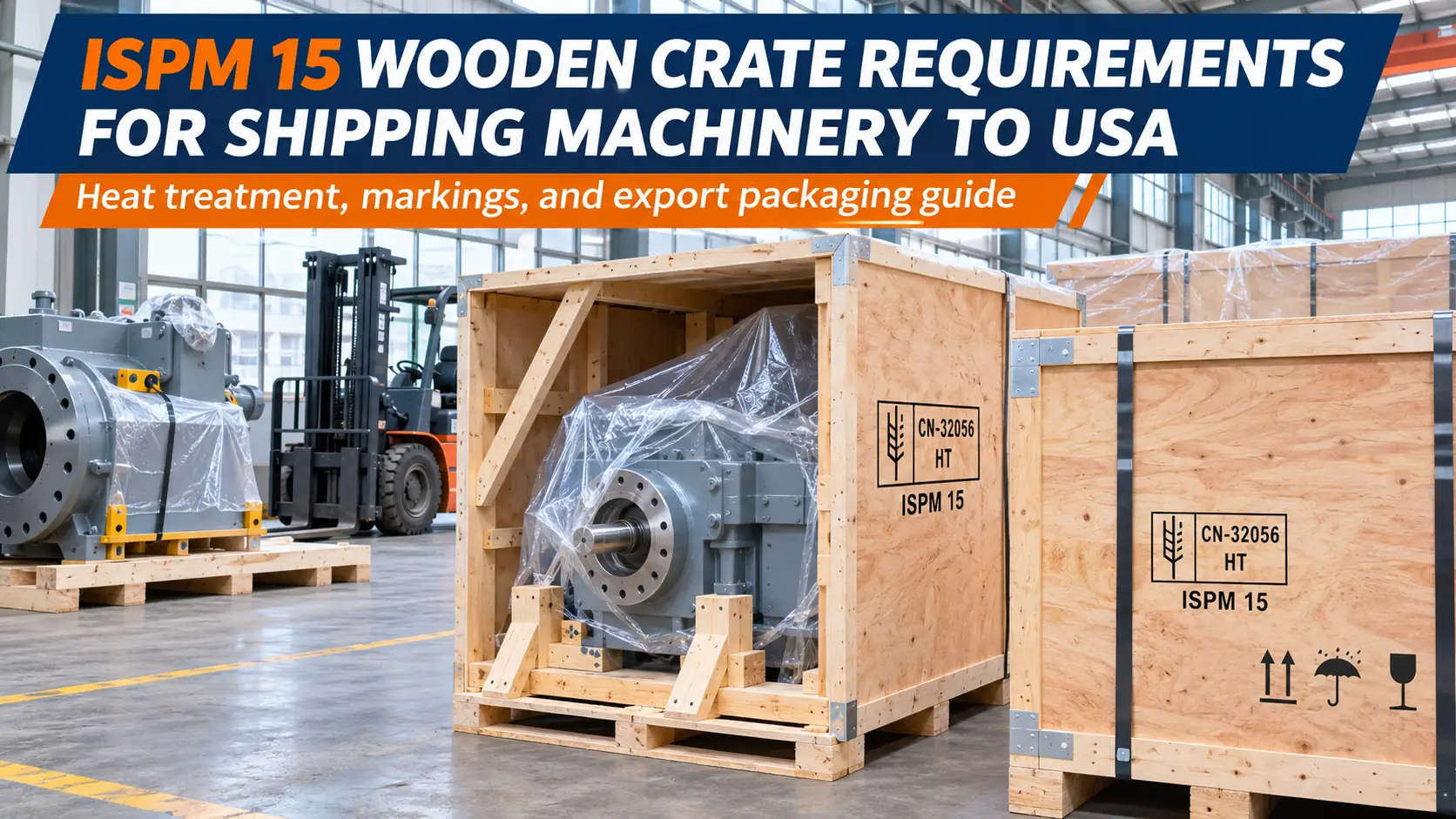
Usually, yes. Wooden crates used to export machinery to the United States must comply with ISPM 15 when they contain regulated solid wood packaging over 6 mm thick and no exemption applies.
Before booking freight, confirm three points for all wood packaging materials:
Treatment: Regulated wood has received an approved phytosanitary treatment under the exporting country’s official program.
Marking: The packaging displays a clear, valid IPPC mark with the required country, provider and treatment codes.
Condition: The crate is free from live pests and other signs of pest infestation.
Plywood, oriented strand board (OSB), medium-density fiberboard (MDF) and particle board are generally exempt when manufactured using glue, heat, pressure or a combination of these processes. The exemption does not automatically cover solid timber framing or supports attached to those panels.
ISPM 15 is an international standard designed to reduce the spread of plant pests through wood packaging used in global trade. It regulates the packaging material, not the product inside it.
For machinery exports, regulated items can include:
Solid wood export crates and boxes
Wooden pallets, skids and runners
Timber frames and support beams
Internal blocking and bracing
Solid wood dunnage used to secure cargo
The standard generally covers raw wood packaging over 6 mm thick. This is why the base, runners and internal supports of heavy machinery crates need particular attention. Use ISPM 15 certified wood for regulated parts and confirm that the finished crates are properly marked.
No. A machine, motor, pump or production line does not require ISPM 15 treatment. The requirement applies to the wood used to protect, support or secure it during transportation.
A machine bolted to a timber skid may require compliant packaging even without a full wooden box.
Many international wood crates combine processed panels with solid timber frames. The panels are generally exempt, while regulated timber used for the base, runners or internal bracing must meet ISPM 15 requirements.
Using an exempt panel for the outer walls does not make every part of the crate exempt. Ask the supplier to identify each wood component before assembly. ISPM 15 certified wood crates need traceable treatment and marking.
Not every wood-based packaging product requires treatment. Processed wood manufactured with glue, heat or pressure is generally exempt because the production process reduces the risk of carrying pests.
| Material | Typical ISPM 15 Status |
|---|---|
| Solid timber over 6 mm | Treatment and marking generally required |
| Wooden pallets and skids | Generally regulated when made from solid wood |
| Plywood panels | Generally exempt |
| OSB | Generally exempt |
| MDF | Generally exempt |
| Particle board | Generally exempt |
| Plastic or metal packaging | Outside the scope of ISPM 15 |
For machinery, engineered panels may form the walls, while solid timber provides the load-bearing base. Assess the materials separately. The exemption does not extend to untreated timber attached to processed panels; a box with untreated runners can still have a compliance issue.
Regulated wood must receive a treatment recognized under ISPM 15 and the exporting country’s official program. An authorized provider must carry out the process and mark the treated wood.
Heat treatment is widely used for export wood crates. The wood must reach a core temperature of at least 56°C for 30 continuous minutes throughout its profile.
Ordinary kiln or air drying does not make heat treated wood ISPM 15 compliant. The process must be recorded under an approved program.
Methyl bromide fumigation follows a controlled schedule based on temperature, gas concentration and exposure time. An authorized provider must perform it.
Dielectric heating uses radio-frequency or microwave energy. The wood must reach at least 60°C throughout its profile for one minute, verified with specialized equipment.
Wood packaging must also meet debarking requirements. Confirm approved options with the exporting country’s official program.
| Method | Code | Key Requirement |
|---|---|---|
| Heat treatment | HT | 56°C for at least 30 continuous minutes throughout the wood profile |
| Methyl bromide fumigation | MB | Approved fumigation schedule |
| Dielectric heating | DH | 60°C for at least one minute throughout the wood profile |
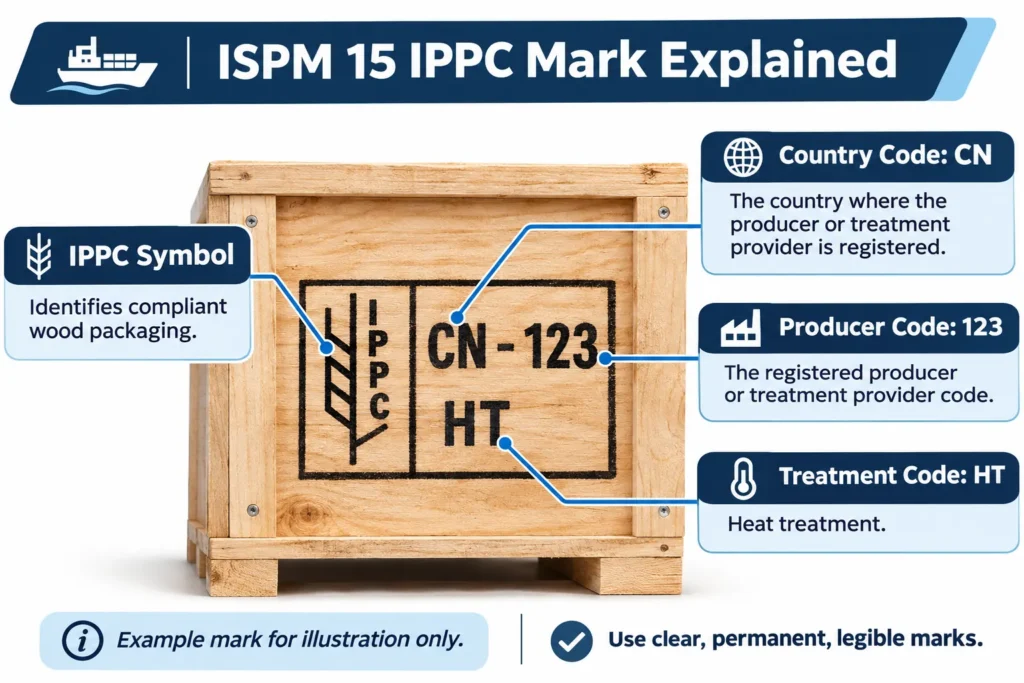
The IPPC mark shows that regulated wood packaging has been treated under an approved program. It is sometimes informally called a “bug stamp,” but it is an official mark—not a supplier logo or handwritten note.
The mark includes:
IPPC symbol: The internationally recognized symbol.
Country code: The two-letter ISO country code.
Producer or treatment provider code: The registered code assigned under the country’s official program.
Treatment code: The method used, such as HT, MB or DH.
An illustrative code might look like XX-000 HT. This is only an example, not a valid certificate or registration number.
It must be legible, permanent and visible to inspectors, not covered by paint, wrapping or shipping labels. Place marks on two opposite sides where required by the standard and applicable program.
A treatment certificate, invoice or supplier declaration does not replace the required mark. Before dispatch, request clear photographs of completed crates.
Heavy machinery requires strong export packaging to withstand lifting, loading, and long-distance transportation. When building wooden crates for shipments to the USA, manufacturers should consider both structural strength and ISPM 15 requirements.
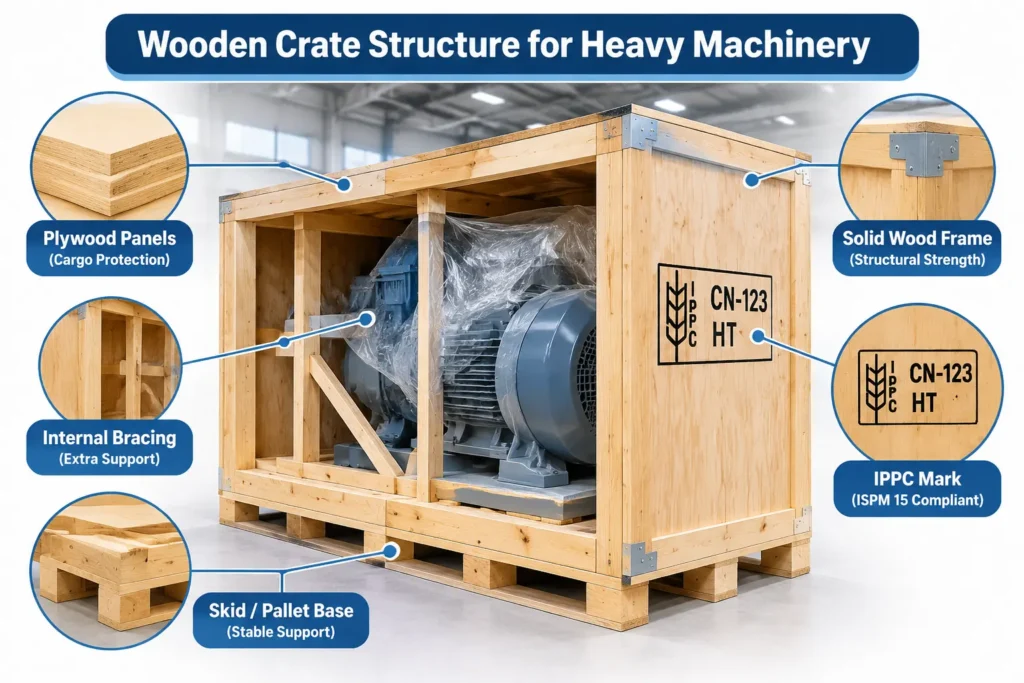
Plywood panels are commonly used for crate walls and covers, while solid timber provides structural support. The materials should be selected according to the machine’s weight, dimensions, and handling requirements.
Any regulated solid wood components thicker than 6 mm, including timber frames, runners, and support blocks, must receive approved ISPM 15 treatment and display the required IPPC mark. Processed wood products such as plywood are generally exempt.
The crate base must support the machinery’s gross weight and distribute the load safely during transportation. Depending on the equipment, the structure may include:
Reinforced solid wood skids for forklift handling
Timber beams to distribute the machine’s weight
Bolted supports to prevent movement
Internal blocking and bracing for stability
Solid wood used for regulated structural components must also meet applicable ISPM 15 requirements.
For long-distance sea freight, machinery should be protected against moisture, corrosion, and movement inside the crate. Depending on the equipment, suitable export packaging may include:
Moisture-resistant wrapping and desiccant bags
VCI protection for exposed metal surfaces
Protective covers for electrical components
Shock-absorbing materials around sensitive parts
Before closing the crate, check that the machinery is securely fixed and that the IPPC marks remain visible. Taking photographs of the internal supports, completed packaging, and official marks provides useful evidence for pre-shipment checks.
Use this checklist before the wood crates leave the supplier’s factory.
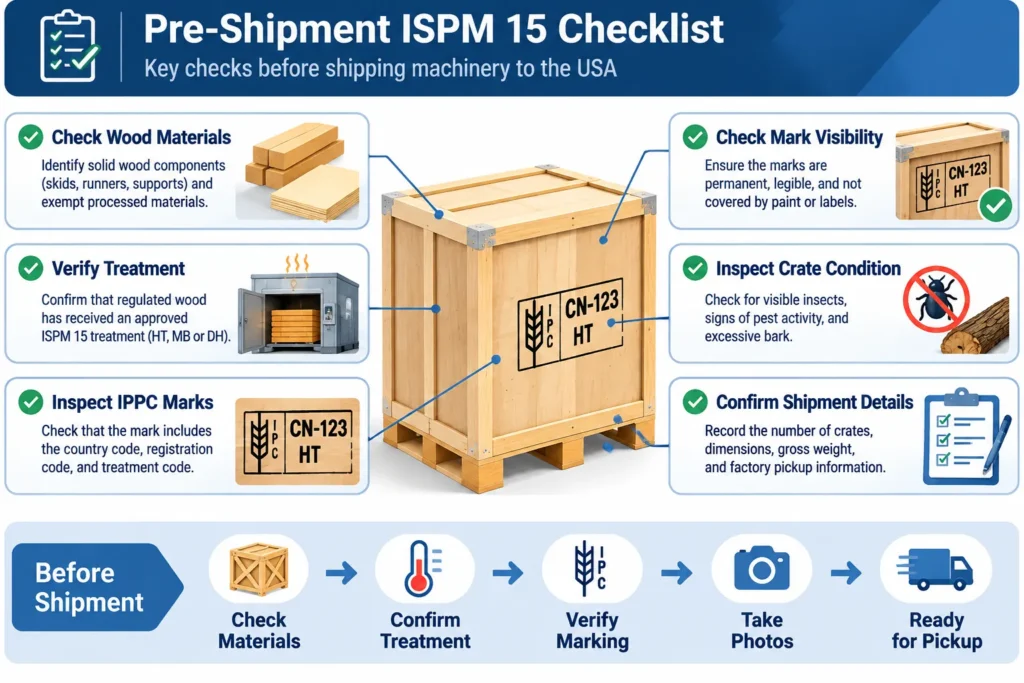
USDA’s Animal and Plant Health Inspection Service (APHIS) administers U.S. plant-health requirements, while U.S. Customs and Border Protection (CBP) carries out border inspection and enforcement. These phytosanitary measures help prevent pests from entering the country.
If officials find untreated regulated wood, an invalid mark or live pests, they may require corrective action. Depending on the case, this can include re-exportation or destruction of affected wood packaging. An Emergency Action Notification may be issued where applicable.
The shipment may face delays, storage, handling and transportation costs. U.S. authorities decide the required action; importers should not assume a crate can always be fumigated after arrival. Confirm the materials and treatment before cargo leaves China to reduce non-compliant packaging risks.
For related import procedures, see our guide to customs clearance from China to the USA.
Responsibility is shared across the export supply chain:
Exporter: Confirms that the packaging selected for the shipment meets destination requirements.
Packaging manufacturer: Uses suitable materials and arranges approved treatment and marking for regulated timber.
Importer: Ensures that imported goods and their wood packaging meet U.S. requirements.
Freight forwarder: Coordinates collection and transportation and can help identify visible packaging or documentation issues before dispatch.
A forwarder can coordinate logistics and pre-shipment checks, but cannot replace an authorized treatment provider or government authority. Confirm the treatment status of international wood crates with the supplier.
After confirming the wooden crate meets ISPM 15 requirements, the next step is to choose a suitable shipping method. The best option depends on the machinery’s dimensions, gross weight, loading requirements, and delivery destination.
FCL Sea Freight: Suitable for large machinery and heavy equipment that can fit inside a standard shipping container.
LCL Sea Freight: Suitable for smaller crated machinery that does not require a full container, subject to cargo handling and consolidation requirements.
Open-Top or Flat-Rack Shipping: Used for oversized machinery that cannot fit into standard containers.
Air Freight: An option for smaller or urgent machinery when the cargo meets airline size, weight, and handling restrictions.
Before booking, prepare the following details:
Machinery name and description
Number of wooden crates
Dimensions of each crate (L × W × H)
Gross weight per crate and total weight
Factory pickup address in China
Final delivery address in the USA
Photos of the completed crates and IPPC marks
Special loading or unloading requirements
Accurate cargo information helps determine the appropriate container type, transportation cost, and handling arrangements.
Tonlexing provides international freight forwarding services for machinery and industrial equipment, including factory pickup, export handling, sea freight, air freight, and destination delivery arrangements.
Whether you are shipping a single machine or multiple crates from different suppliers, our team can help coordinate the transportation process from China to the USA.
Send us your cargo dimensions, gross weight, crate specifications, and delivery destination to receive a suitable shipping solution.
Regulated solid wood generally needs approved treatment and a legible official mark applied under the exporting country’s program. The mark identifies the country, registered provider and treatment method. The wood must also meet debarking and pest-related requirements.
No. The standard generally applies to raw wood packaging over 6 mm thick. Plywood, OSB, MDF and particle board are usually exempt, but solid timber used in the same crate must be assessed separately.
Plywood is generally exempt because it is manufactured using glue, heat, pressure or a combination of these processes. However, solid wood framing, skids or internal supports attached to a plywood crate may still be regulated.
Machinery itself does not need an IPPC mark. However, regulated wood used to support or protect it must be treated and marked. Packaging made entirely from exempt materials does not need this mark.
U.S. authorities may inspect the packaging and require action such as re-exportation or destruction of affected wood. The shipment may also incur delays and extra costs. The final decision rests with the responsible authorities.
Useful freight, customs and importing resources related to this shipping guide.
The United States is one of the largest importers of heavy machinery, sourcing equipment from China’s leading manufacturers to meet demands in in...
Read guide →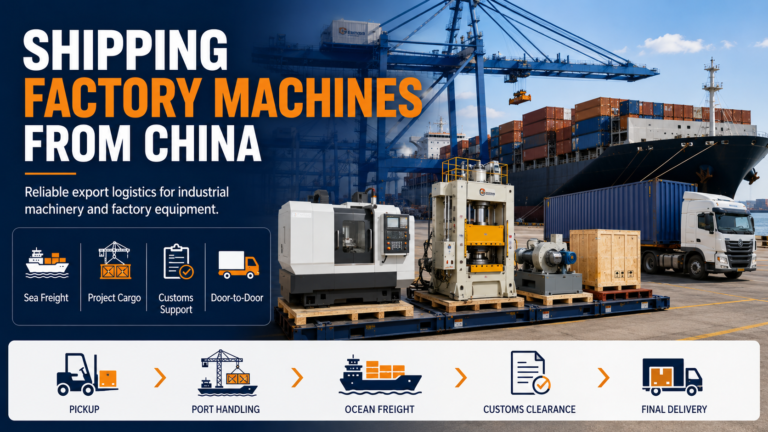
Shipping Factory Machines from China Verified & Reviewed · Last updated July 2026 Shipping factory machines from China requires careful planning...
Read guide →
Shipping Heavy Cargo from China to USA Verified & Reviewed · Last updated March 2026 Shipping heavy cargo from China to USA depends on the shippi...
Read guide →
Shipping Oversized Cargo to USA Verified & Reviewed · Last updated March 2026 Shipping oversized cargo to USA depends on cargo dimensions, weight...
Read guide →Why Ship Excavators and Bulldozers from China? How to ship excavators and bulldozers from China has become a strategic decision for many global b...
Learn more → Useful Resource Sea Freight Shipping from China to the USASea Freight Shipping from China to the USA Verified & Reviewed · Last updated June 2026 Sea freight shipping from China to the USA is one of the...
Learn more →WhatsApp us