
Related Guide
Importer of Record IOR in the USA
Importer of Record IOR in the USA Verified & Reviewed · Last updated March 2026 Importer of Record (IOR) in the USA determines who is legally res...
Read guide →

A non-resident importer of record allows a foreign company to import goods into the United States while taking responsibility for customs entry, duties, documentation, and compliance.
This guide explains how the NRI structure works, including importer registration, customs assigned importer numbers, resident agent requirements, customs bonds, broker authorization, and the main steps foreign companies should complete before shipping goods to the USA.
NRI Requirements
Importer Setup
Customs Compliance
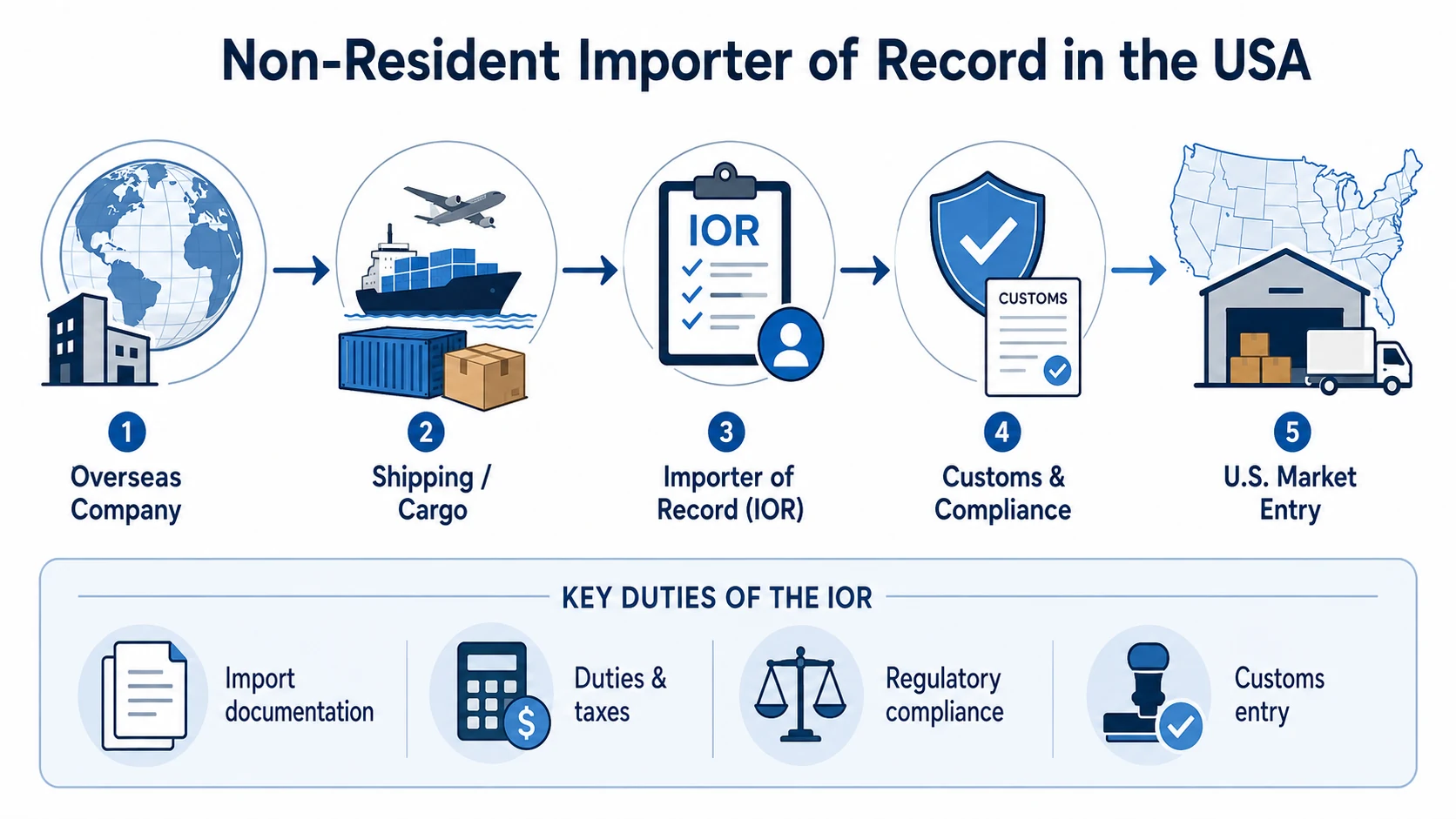
A non-resident importer is a foreign business that takes the legal role of importing goods into a country where it is not established as a normal local company. In the United States, the more precise term is often foreign Importer of Record.
The IOR is not simply the name on a commercial invoice. It is the party that makes or authorizes the entry and is responsible for information used to determine admissibility and tariff treatment. U.S. law requires the qualifying IOR to use reasonable care when providing entry information.
A foreign business may use this model without maintaining the same physical presence as a conventional U.S.-based company, but it still has to meet U.S. import requirements.
Typical reasons for using an NRI structure include:
Selling directly to U.S. customers
Supplying a U.S. warehouse or distribution center
Controlling landed cost and delivery
Managing repeat shipments under one importer identity
Supporting a properly structured DDP sale
For a broader explanation of the role, see Tonlexing’s Importer of Record in the USA.
| Item | Non-Resident Importer | U.S. Resident Importer |
|---|---|---|
| Main business location | Outside the United States | Established in the United States |
| U.S. operating company | Not necessarily required | Normally already established |
| Importer identification | IRS number where applicable or CBP-assigned number | Commonly EIN-based |
| Resident agent | Required for a nonresident corporation under current rules | Not required on the same basis |
| Bond | Required for nonresident corporation consumption entry under 19 CFR 141.18 | Depends on the entry |
| Entry responsibility | Remains with the NRI | Remains with the U.S. IOR |
The main benefit is control, not the removal of responsibility. A foreign company using the NRI model takes on many of the same responsibilities as a resident importer.
Yes. Current 19 CFR 141.18 provides a route for a nonresident corporation to enter merchandise for consumption. The regulation requires a resident agent authorized to accept service of process and a CBP Form 301 bond with a resident corporate surety.
An NRI arrangement may make sense when the seller makes regular U.S. sales, wants clearer landed pricing or ships inventory to a warehouse before domestic distribution. It may be less suitable when the U.S. purchaser already has an established import program or when product registrations are tied to a particular domestic entity.
Before choosing the structure, confirm:
Who has the right to make entry
Who will receive the goods in the United States
Who will pay the applicable duties and charges
Whether the product has agency-specific import requirements
The decision should be based on the complete import process, not simply on whether the business can obtain an importer number.
An NRI setup involves several connected requirements. A Customs Assigned Importer Number is important, but it is not the entire process.
CBP Form 5106 is used to create or update importer identity information within CBP systems. A foreign business that needs a CBP-assigned number can use the applicable importer identity process.
This number is commonly referred to as a Customs Assigned Importer Number, or CAIN.
Company details should remain consistent across registration, shipping documents and entry data. A mismatch in the company name, address or identifying information can create unnecessary problems when goods arrive.
Current 19 CFR 141.18 requires a nonresident corporation making a consumption entry to have a resident agent authorized to accept service of process.
For a nonresident principal granting Customs Power of Attorney, 19 CFR 141.36 also requires the designated agent to be a resident authorized to accept service of process.
This requirement is separate from maintaining a conventional U.S. office.
For a consumption entry by a nonresident corporation, current 19 CFR 141.18 requires a customs bond on CBP Form 301 with a resident corporate surety. The bond secures increased and additional duties that may later be found due.
The appropriate arrangement should be checked before booking, especially because Executive Order 14411 directs tighter treatment of foreign IOR use of continuous bonds.
Foreign companies commonly appoint a licensed customs broker to file entries and communicate with CBP on their behalf.
The broker can facilitate the filing process, but the NRI remains responsible for its own entry obligations. Appointing a representative does not remove the foreign company’s responsibility for accurate information and compliance.
The imported goods must also meet U.S. requirements. Depending on the product, Partner Government Agencies may require permits, registration, testing, labeling or other documentation. CBP maintains import guidance for requirements administered by these agencies.
Before importing, check:
HTS classification
Customs value
Country of origin and marking
Product description
Required permits or certificates
Safety and environmental requirements
Antidumping or countervailing duty exposure where relevant
A CAIN and bond do not make restricted or non-compliant goods admissible.
Executive Order 14411, Strengthening Customs Enforcement, was signed on June 3, 2026. It directs DHS and CBP to strengthen IOR eligibility and enforcement, with several measures specifically addressing foreign IORs.
The order directs DHS to:
Prohibit foreign IORs from filing informal entries
Restrict reliance on continuous bonds unless CBP permits it
Require CTPAT validation where eligible or use of a CTPAT-validated and licensed customs broker for formal entries
Collect additional ownership, business and expected import-volume information
Establish enhanced and recurrent vetting
Create a CBP good-standing standard
Increase bonding or domestic-asset requirements
The timing matters. Several eligibility, good-standing and vetting measures have a 180-day implementation window, while certain foreign-IOR actions are directed to occur promptly.
As of August 2026, the current text of 19 CFR 141.18 still contains the existing resident-agent and CBP Form 301 bond framework for nonresident corporations. The eCFR version available in early August was current through amendments made in July 2026.
The practical point is simple:
Do not assume that an NRI setup used in a previous year will automatically work for a new shipment in 2026. Confirm the current requirements before booking.
If your company is preparing a new China-to-USA shipment, Tonlexing can coordinate pickup, freight and shipping documents after your entry structure has been confirmed.
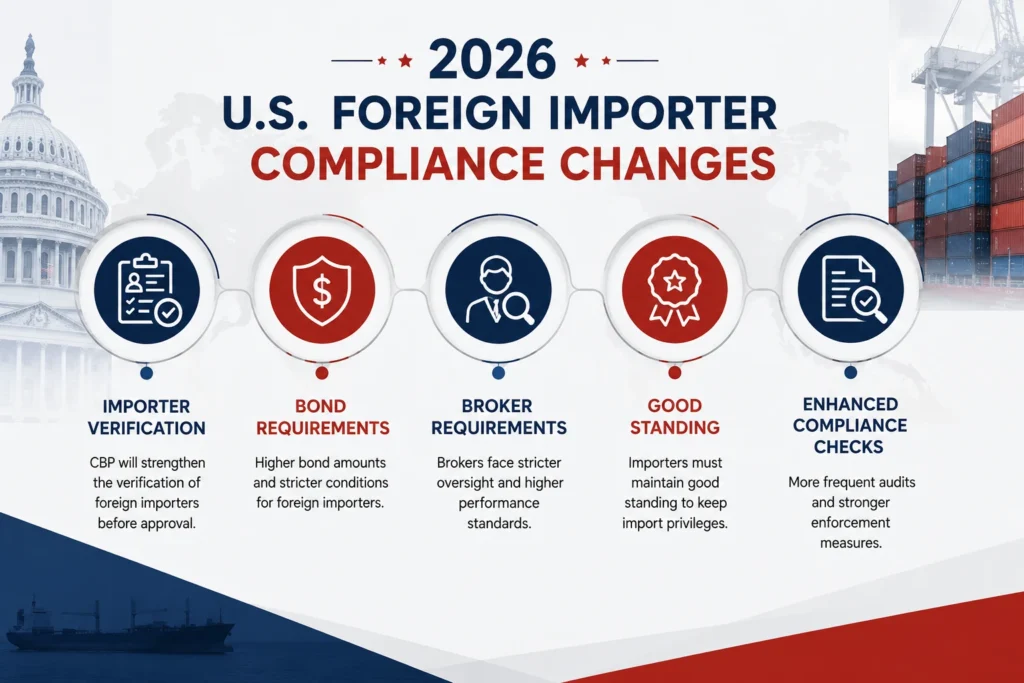
The setup should be completed before the goods leave the supplier. Resolving the structure after arrival can lead to document corrections, holds and additional destination charges.
Review the sales contract, ownership of the goods, Incoterm, U.S. consignee and delivery model.
The party taking the role should have the right to make entry and be prepared to meet the related obligations.
Choose a qualified representative that can handle the planned entry and foreign-company documentation.
Provide detailed information about the business, product, expected import volume and U.S. destination before the shipment is booked.
Complete CBP Form 5106 where required and obtain the appropriate importer number. CBP uses Form 5106 to create or update importer identification information.
Keep the registered company name and address consistent with commercial records and shipping documents.
Confirm the resident agent and execute the required Customs Power of Attorney so the authorized representative can file entries on the company’s behalf.
For a nonresident corporation, additional documentation may also be needed to establish that the person executing the POA has authority to act for the company.
Confirm the bond type and amount before departure.
Foreign businesses should not automatically assume that an old continuous-bond arrangement remains suitable for a new entry in 2026.
Check the HTS classification, declared value, origin, commercial invoice, packing list, required certificates and U.S. consignee details.
Once these items are ready, the shipment can move through China export handling, international freight, U.S. customs clearance and final delivery.
For transportation planning, see Shipping from China to the USA.
Once the foreign company acts as IOR, it assumes responsibility for the accuracy of the information supporting the entry. A broker may file entries, but the business still needs its own procedures for ensuring compliance.
| Responsibility | What to Check |
|---|---|
| HTS classification | Correct U.S. tariff code |
| Valuation | Value supported by the transaction and commercial invoice |
| Country of origin | Correct origin and required marking |
| Duties and fees | Applicable tariffs and entry charges |
| Documentation | Consistent product, quantity, value and party information |
| Product compliance | Relevant federal agency requirements |
| Recordkeeping | Import documentation retained and available for review |
Classification matters because it affects duty treatment and may trigger additional trade measures or agency rules. Declared value should also be supported by the commercial transaction rather than selected simply to reduce import charges.
U.S. law places a reasonable-care obligation on the qualifying IOR when making entry.
Responsibility also continues after release. Under the general rule in 19 CFR 163.4, entry-related documentation is normally retained for five years from the date of entry, subject to specified exceptions.
For duty planning on China-origin goods, see Tonlexing’s China to USA Import Duties Guide.
A short review before departure can prevent expensive corrections after arrival. The company, goods and documentation should all match before the carrier takes control of the shipment.
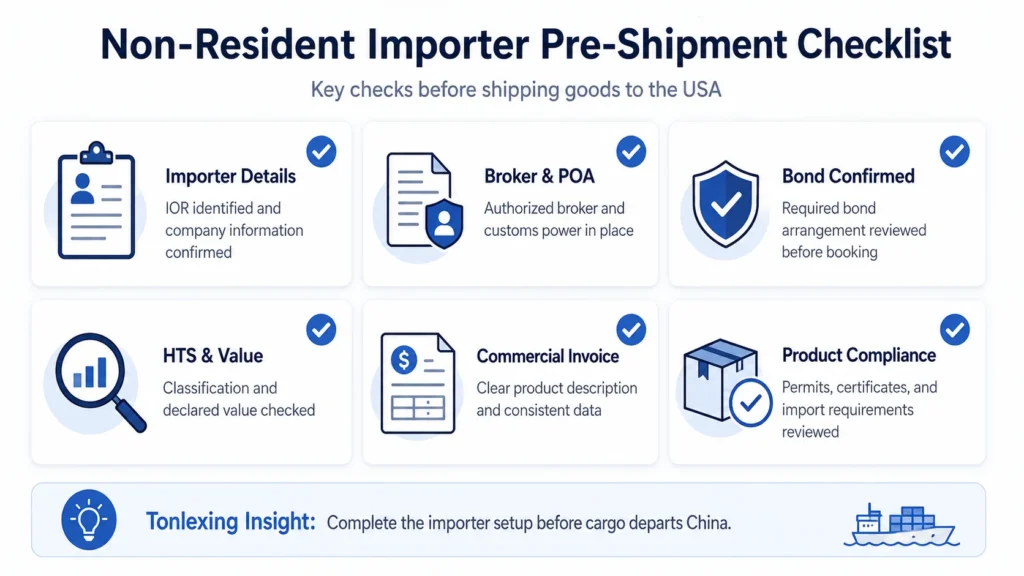
Before shipping, confirm that:
IOR and U.S. consignee are clearly identified
Importer number matches the registered company details
Resident agent arrangement is complete
Customs Power of Attorney is in place
Entry structure has been accepted
Required bond has been confirmed
HTS classification has been reviewed
Value and country of origin are supported
Product-specific requirements have been checked
Commercial invoice has a clear product description
Packing list matches the physical cargo
Required permits or certificates are available
Final delivery details are confirmed
For document preparation, see Tonlexing’s Commercial Invoice Template for Importing from China to the USA.
One of the most costly mistakes is shipping before the entry structure is confirmed. Other common problems include:
Assuming freight forwarders automatically become the IOR
Treating a CAIN as the complete NRI setup
Confusing the consignee with the party responsible for entry
Copying a supplier’s HS code without checking the U.S. HTS
Using vague invoice descriptions such as “parts” or “accessories”
Declaring a value that is not supported by transaction documents
Missing product permits or regulatory documents
Assuming DDP automatically solves IOR eligibility
Relying on outdated bond procedures
Incorrect classification, valuation or documentation can lead to delays, additional assessments and monetary penalties. These issues are usually easier to correct while the goods are still in China.
For a foreign seller, the import setup and transportation plan should be built together. The importer identity, entry instructions, commercial invoice, consignee, bill of lading or air waybill and final delivery address all need to be consistent.
A practical sequence is:
IOR Setup → Entry Confirmation → Product Check → Documents → Freight Booking → U.S. Entry → Final Delivery
This approach is especially useful for repeat shipments and DDP sales.
DDP defines commercial responsibilities between seller and buyer, but it does not by itself make a foreign seller legally eligible to act as IOR. See Who Is the Importer of Record on a DDP Shipment? for a more detailed explanation.
Tonlexing Logistics supports China-to-USA shipping by sea freight, air freight and door-to-door services, including supplier pickup, cargo consolidation and destination delivery. For an NRI shipment, the transport plan can be coordinated with the documentation and entry arrangement established for the shipment.
The roles should remain clear: Tonlexing coordinates the freight movement, the authorized U.S. representative handles licensed customs business where required, and the NRI remains responsible for its own entry obligations.
Preparing a shipment? Send Tonlexing Logistics the product name, cargo weight and dimensions, pickup city in China and U.S. destination. We can recommend a shipping method and build the freight plan around your confirmed import arrangement.
Yes. Current 19 CFR 141.18 permits a nonresident corporation to enter merchandise for consumption if it meets the applicable resident-agent and bond requirements. Companies should also check the latest 2026 implementation requirements before shipping.
Not necessarily. The current nonresident framework does not require a conventional U.S.-incorporated operating company simply to make a consumption entry. However, the resident-agent requirement and other applicable regulations still apply.
CBP Form 5106 is used to create or update importer identity information. A foreign business that requires a CBP-assigned number can use the applicable CBP registration process.
For a nonresident corporation making a consumption entry under current 19 CFR 141.18, a CBP Form 301 bond with a resident corporate surety is required. The appropriate arrangement should be checked before a new setup because 2026 policy changes specifically address foreign IOR bonds.
Potentially, yes. DDP can make the seller responsible for arranging import clearance and paying import charges, but Incoterms do not determine whether the seller is legally eligible to act as IOR. The foreign seller should confirm the entry structure and product requirements before shipping.
Useful freight, customs and importing resources related to this shipping guide.
Importer of Record IOR in the USA Verified & Reviewed · Last updated March 2026 Importer of Record (IOR) in the USA determines who is legally res...
Read guide →
On a DDP shipment, the seller is responsible for arranging import clearance and paying the applicable import duties and taxes in the destination...
Read guide →
Customs Bond for USA Imports: The Complete Guide Verified & Reviewed · Last updated March 2026 If you import into the United States, a customs bo...
Read guide →
Customs Broker vs Freight Forwarder Verified & Reviewed · Last updated April 2026 Customs broker vs freight forwarder is a common question for im...
Read guide →Introduction to Customs Clearance How to clear customs when importing from China is one of the most critical steps in international trade. Whethe...
Learn more → Useful Resource How to Reduce Import Duty When Shipping from China to the USAImporting goods from China to the USA? Don’t let high import duties eat into your profits. Whether you’re a small business or an established impo...
Learn more →WhatsApp us