HTS Code for Imports from China: A Complete Guide for U.S. Importers
Verified & Reviewed · Last updated April 2026
When importing goods from China to the United States, the HTS code is a key part of the customs declaration process. It determines how your product is classified, what tariff rate applies, and whether additional China tariffs such as Section 301 duties may be charged.
A supplier’s China HS code can be useful as a reference, but U.S. imports require the correct 10-digit HTS code. Before shipping, importers should verify the code using the U.S. Harmonized Tariff Schedule to avoid misclassification, customs delays, and unexpected duty costs.
HTS Code Lookup
HS vs HTS Code
China Tariff Check
Experienced China-based logistics specialists
10,000+ international shipments handled Global sea, air & DDP shipping solutions 24/7 shipment tracking & customer support
Table of Contents
What Is an HTS Code?
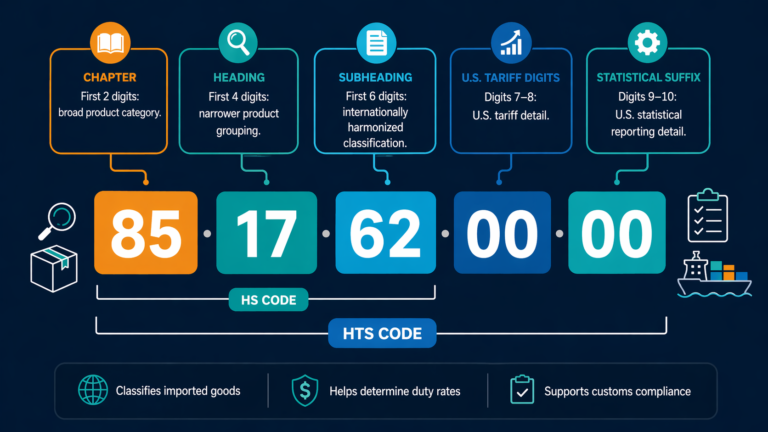
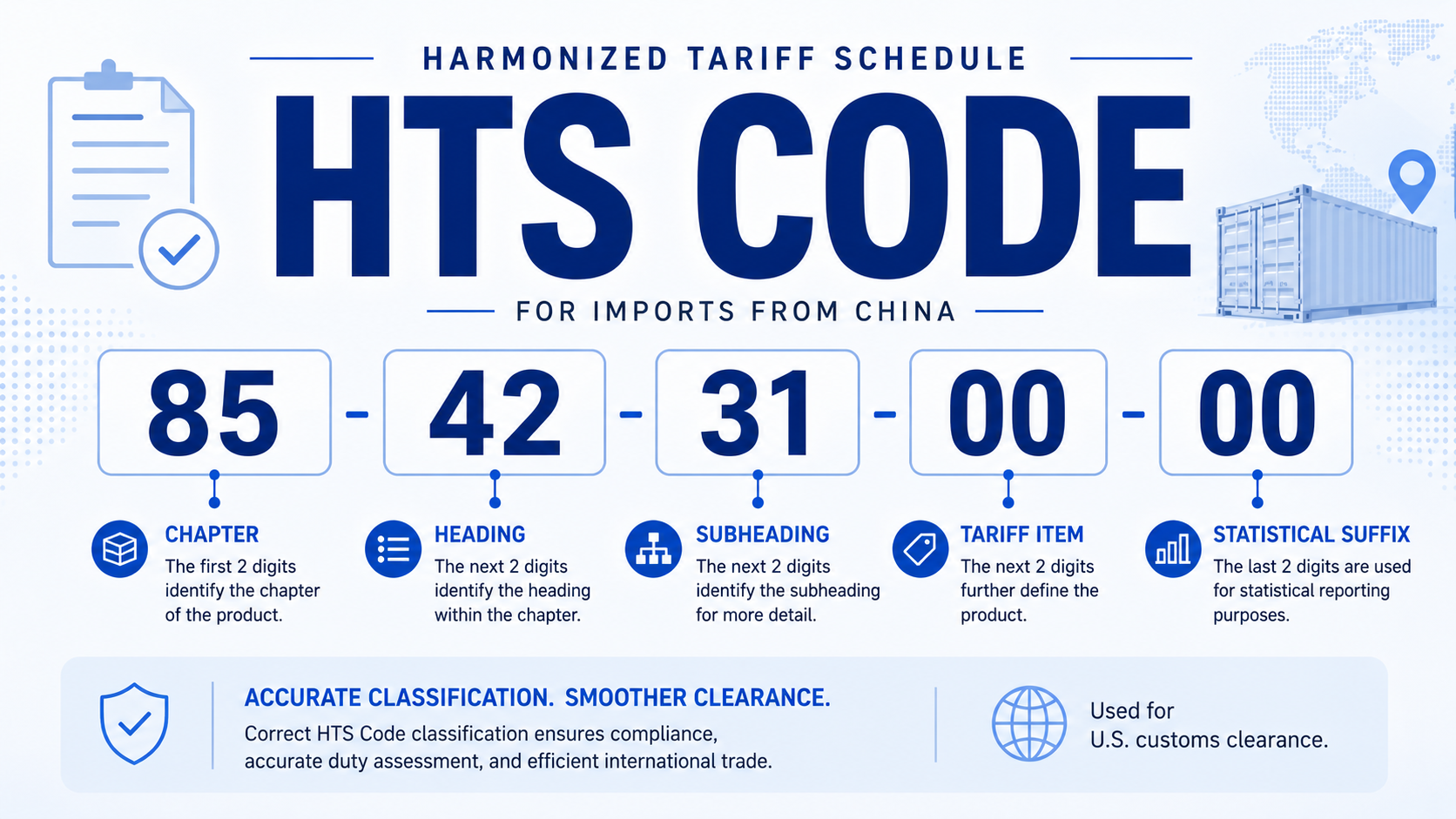
An HTS code is a numerical product code used for goods imported into the United States. It helps U.S. Customs and Border Protection identify the product, apply the correct import tariff, and determine whether additional tariff measures may apply.
The first six digits of an HTS code are based on the international HS code. The additional digits are specific to the United States and provide more detailed product categories for imports, trade statistics, and tariff calculation.
A complete HTS code can affect:
Base tariff rate
Section 301 tariffs
Import tariff exposure
Customs declaration accuracy
Trade statistics reporting
Product compliance review
Possible customs delays
This is why the code should be checked before the shipment leaves China, not after the goods arrive at the U.S. port.
HS Code vs HTS Code vs China HS Code
Importers often confuse HS codes, China HS codes, and HTS codes. They are related, but they are not the same. The key difference is the country and purpose of use.
Code Type
Length
Main Use
HS Code
6 digits
International trade classification used globally as the foundation for customs and statistics
China HS Code
10–13 digits
China export declaration, tax refund, and domestic trade supervision
HTS Code
10 digits
U.S. import classification, duty calculation, Section 301 tariffs, and customs entry
Key Differences
HS Code: The global “DNA” for product classification. The first six digits are universal and consistent across all countries.
China HS Code: Built on the international HS code with extra digits for China-specific export and tax requirements. Not recognized outside China.
HTS Code: The U.S.-specific import code based on the HS code. Determines duty, statistical reporting, and additional tariffs such as Section 301 duties for imports from China.
Tip for U.S. Importers: Never rely solely on a supplier-provided China HS code. Always verify the correct 10-digit HTS code using the USITC HTS search tool to ensure accurate customs declaration and tariff calculation.
Why HTS Codes Matter for Imports from China
The HTS code affects the full landed cost of your shipment. It is not just a customs form detail.
A correct HTS code helps determine:
Base duty rate
Section 301 China tariffs
Chapter 99 additional tariff code requirements
Customs declaration accuracy
Import tariff exposure
Trade statistics reporting
Possible free trade agreement eligibility for other countries
Product compliance requirements
Risk of customs delay or reclassification
For China-origin goods, the HTS code is especially important because many products manufactured in China may be subject to additional Section 301 tariffs. USTR provides the official Section 301 China tariff action pages, and the USITC provides China tariff references linked to HTS classification.
This means that a product with a low base duty rate may still become expensive after additional China tariffs are applied.
How to Find the Correct HTS Code for Imports from China
Finding the correct HTS code requires more than searching a product name. The classification may depend on material, use, structure, function, technical specifications, and whether the item is a finished product, accessory, component, or part thereof.
Start With a Clear Product Description
Before checking the HTS code, prepare accurate product information. A vague description can lead to the wrong classification.
Useful details include:
Product name
Main use
Material composition
Product function
Size and structure
Technical specifications
Product photos
Catalog or datasheet
Supplier’s China HS code
Whether the item is a finished product or part thereof
For example, “plastic part” is not enough. A better description would explain whether it is a machine part, household article, packaging item, electrical equipment component, or automotive accessory.
Use the China HS Code as a Starting Point
The China HS code from your supplier can help you identify the general product category. In many cases, the first six digits may point you toward the correct international HS code.
However, you should not copy the China HS code directly into a U.S. customs declaration without checking the U.S. HTS code. China customs and U.S. customs may use different national subheadings, statistical suffixes, and declaration requirements.
Search the Official U.S. HTS Database
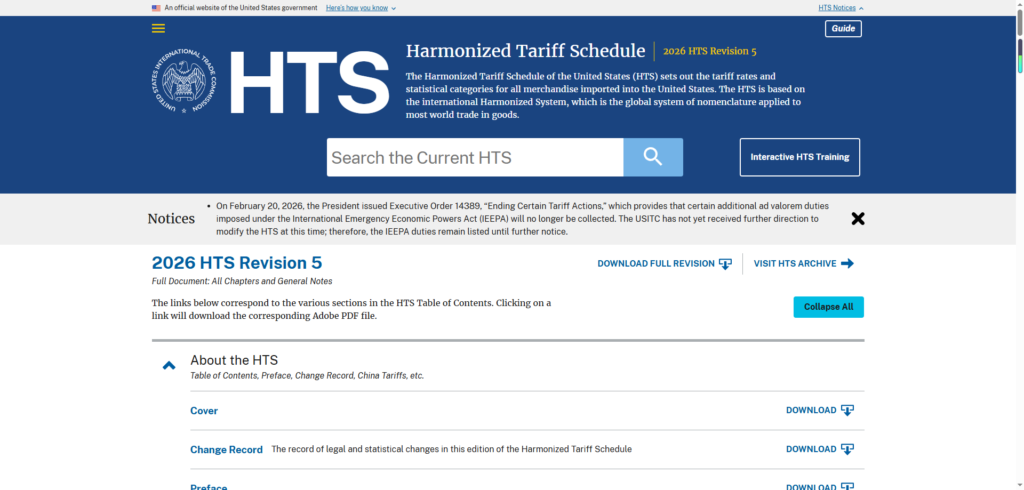
Use the USITC HTS search tool to check the Harmonized Tariff Schedule. Search by product name, material, function, and related terms.
For example, instead of searching only “bag,” you may need to compare:
Travel goods
Handbags
Backpacks
Textile bags
Plastic bags
Similar containers
Small wording differences can lead to different duty rates.
Review the General Rules of Interpretation
The General Rules of Interpretation are used to classify goods in the Harmonized System. They help determine how to classify mixed materials, sets, unfinished goods, and products that may fit more than one heading.
This is important for products such as:
Machinery with accessories
Electrical machinery with multiple functions
Sets packed for retail sale
Composite goods
Articles thereof made from different materials
Parts thereof used with specific machines
If a product has multiple materials or functions, the correct HTS code may depend on the essential character of the item.
Check CBP Rulings for Similar Products
The Customs Rulings Online Search System, also known as CROSS, allows importers to search past U.S. Customs and Border Protection rulings. These rulings can help you understand how CBP has classified similar imported goods.
CROSS is useful when a product is difficult to classify, such as machine parts, textile goods, electrical equipment, tools, mixed-material items, or products with multiple possible uses.
Check Section 301 China Tariffs
After identifying the base HTS code, check whether the product is subject to additional China tariffs. Many China-origin products require an additional Chapter 99 HTS code when Section 301 duties apply.
This step is critical for imports from China because the total tariff may include:
General duty rate
Section 301 additional duty
Other special tariff measures
Anti-dumping or countervailing duties if applicable
Customs fees and processing charges
Do not assume that a product is duty-free only because the base rate looks low.
Example: How to Search for Tea in the HTS Tool
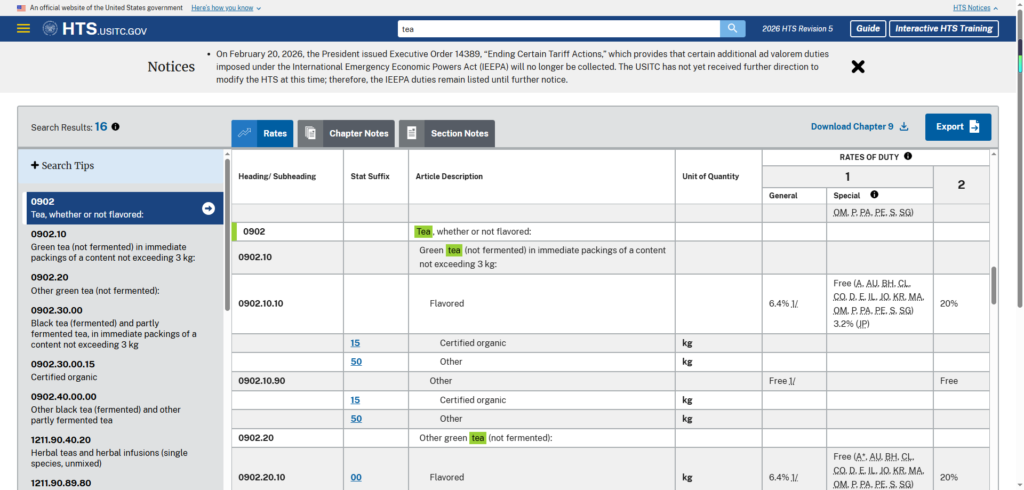
Step 1: Search for the product term In the HTS search bar, enter a clear keyword such as tea. This helps you find the main heading related to the product category.
Step 2: Find the main heading In the search results, look for the heading that best matches the product. In this example, 0902 covers tea, whether or not flavored, which is the main category for standard tea products.
Step 3: Narrow the product type After identifying the heading, review the subheadings shown in the left panel. This is where the classification becomes more specific. For tea, the results may separate:
green tea
black tea
flavored tea
herbal teas
immediate packings not exceeding 3 kg
other bulk or non-retail forms
Step 4: Match the description to the actual product Suppose the product is green tea in retail packaging under 3 kg. In that case, you would review 0902.10 rather than stopping at the broader heading 0902. If the product is black tea, flavored tea, or herbal tea, the correct result may be different.
Step 5: Check the article description and notes Before choosing a code, compare the article description carefully with the actual product details. Then review any relevant chapter notes or section notes if the classification is still unclear. This is especially important when products look similar but differ in material, ingredients, or packaging form.
Step 6: Confirm before using the code A search result is only the starting point. Before using the code in shipping documents or customs filing, make sure the product type, packaging, and description all match. If the product includes additional ingredients or does not fit neatly into the listed description, it may need a different classification.
Product Categories That Often Need Careful Classification
Some products imported from China require extra attention because the correct code depends on detailed product information.
Electrical Machinery and Equipment: Chapter 85
Electrical machinery, chargers, adapters, LED products, motors, control boards, sound recorders, television image equipment, and similar electronic items often require technical specifications. Voltage, function, components, wireless features, and end use can all affect the correct code.
Mechanical Appliances and Machine Parts: Chapter 84
Mechanical appliances and parts thereof can be difficult to identify under the right heading. A component may be treated as a machine part, a general-use article, or a more specific product depending on function and design.
Textiles, Travel Goods, and Containers: Chapters 61–63 and Heading 4202
Textiles, apparel, bags, travel goods, and similar containers often depend on fabric type, outer material, construction, gender, use, and design. A woven bag, leather handbag, backpack, or plastic case may each require a different code.
Food Products and Edible Fats: Chapters 15, 19, and 21
Prepared foodstuffs, prepared edible fats, vegetable fats, edible fats, and similar products may require review under food-related chapters. Ingredients, processing method, packaging, and labeling can all affect the correct HTS code and customs requirements.
Metals, Precious Materials, and Stones: Chapters 71–83
Base metals, metals clad with precious metals, precious metals, semi precious stones, cultured pearls, and articles thereof require accurate material details. The final code may depend on composition, value, processing level, and intended use.
Ceramic, Wood, Paper, and Fibrous Materials: Chapters 44, 48, and 69
Ceramic products, wood charcoal, paper products, pulp of wood, fibrous cellulosic material, other fibrous cellulosic material, and similar materials may fall under different chapters depending on product form and processing level.
Other Specialized Categories
Some products appear in less obvious sections of the Harmonized Tariff Schedule, including raw hides, animal gut, prepared feathers, artificial flowers, plaiting materials, walking sticks, riding crops, sun umbrellas, musical instruments, surgical instruments, collectors pieces, live animals, and similar articles. Section VI products may also involve chemicals, reaction products, or cleavage products that require closer review.
These examples show why HTS classification should be based on exact product details, not only a supplier’s China HS code or short product description. Product photos, material details, specifications, and intended use should be checked before selecting the final code.
Common Mistakes When Finding an HTS Code
Searching by brand or model name Searching by a product name alone often leads to weak or misleading results. It is usually better to search by the product’s general description, material, and use.
Treating the supplier’s HS code as the final code A supplier’s code can be a reference, but it may not match the tariff system of the destination country. The final code should always be verified before filing.
Skipping notes and exclusions A heading may look correct at first glance, but chapter notes and exclusions can change the result completely. Ignoring them increases the risk of using the wrong code.
Confusing function with material Products that serve a similar purpose may still be classified differently because of material or essential character. This is why appearance alone is not enough.
Stopping at the first possible match The first result is not always the best result. A more accurate code often appears only after comparing nearby headings and subheadings.
Waiting too late to verify If classification is checked only when the shipment is ready, there may be too little time to fix mistakes. It is safer to confirm the code before documents are prepared.issues.
Frequently Asked Questions
What is the HTS code for imports from China?
There is no single code for all imports from China. Each product has its own HTS code based on material, function, use, and design. The country of origin affects tariff treatment, but the product category determines the base code.
Is an HS code the same as an HTS code?
No. An HS code is the international six-digit product foundation. An HTS code is the U.S. import code and usually contains 10 digits.
Can I use the China HS code from my supplier?
You can use the China HS code as a reference, but you should verify the correct U.S. HTS code before customs declaration. The China HS code may not match the final U.S. import requirement.
Are Schedule B codes used for imports?
No. Schedule B codes are mainly used for U.S. exports and trade statistics. For imports into the United States, importers should use the correct HTS code.
What is the role of the U.S. Census Bureau?
The U.S. Census Bureau maintains Schedule B numbers for export reporting and trade statistics. This is different from the HTS code used for U.S. imports.