Related Guide
Shipping from China to Europe (2025 Guide)
International shipping from China to Europe remains one of the most vital trade routes in global logistics. With Europe being a massive consumer...
Read guide →

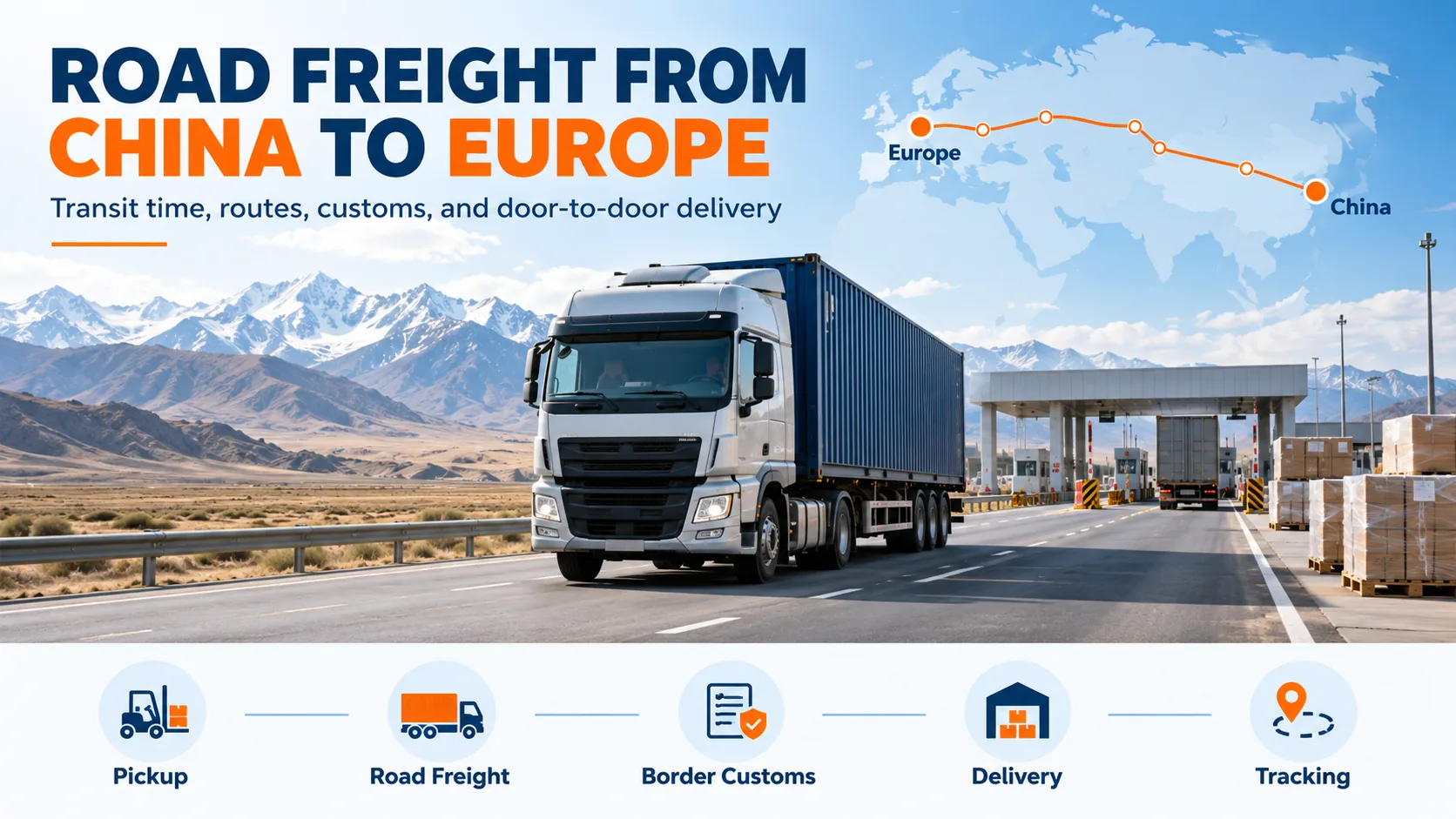
Road freight from China to Europe typically takes 13–23 days on selected routes, offering a flexible alternative to sea and air freight. Transit times depend on border crossings, customs clearance, and the final destination.
Explore China–Europe trucking routes, FTL and LTL shipping options, TIR customs procedures, and door-to-door delivery services.
Trucking Routes
Transit Time
FTL & LTL Shipping
Shipping costs depend on distance, cargo type, truck capacity, fuel surcharges, and border handling requirements. FTL is generally quoted per truck, while LTL uses volume-based or weight-based pricing.
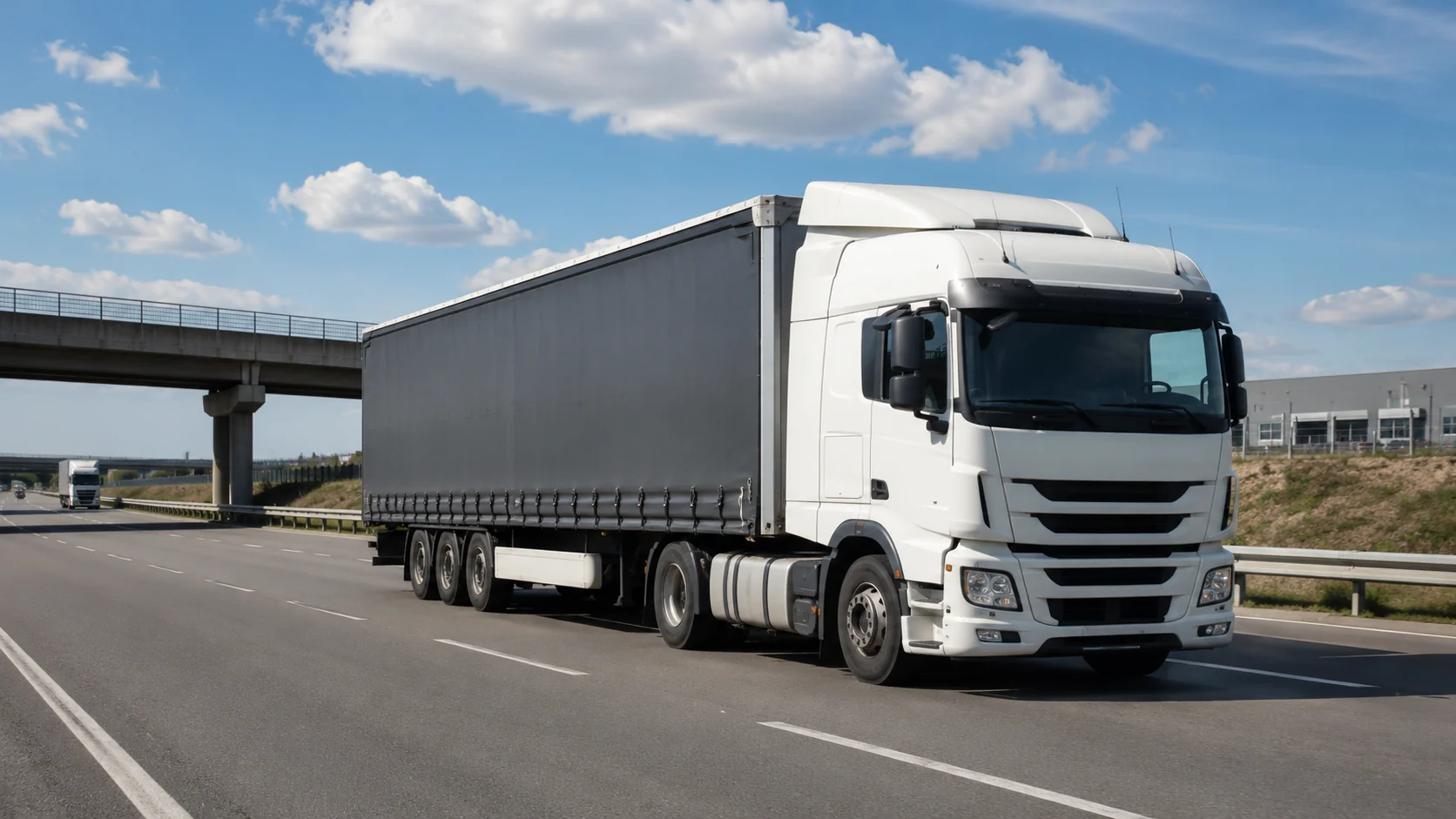
A standard 13.6-meter semi-trailer typically provides around 85–86 CBM of loading space, with a practical payload of approximately 22–25 tonnes, depending on equipment and road regulations.
| Shipping Route | Estimated FTL Cost |
|---|---|
| Xi'an / Yiwu / Wuhan → Germany / Poland | $12,000–$16,000/truck |
| Shenzhen / Guangzhou → Germany / Poland | $14,000–$18,000/truck |
| China → Europe via alternative corridors | $18,000–$24,000+/truck |
These supplied market estimates are for preliminary budgeting, not verified October 2026 rates. The first two ranges reflect historical northern-route benchmarks. EU sanctions restrict certain operations through Russia and Belarus, so current routing and carrier eligibility must be confirmed.
Alternative routes through the Caspian Sea or southern Central Asia may cost more because of ferry charges, additional border crossings, and vehicle transfers.
LTL combines goods from multiple importers in shared trucks, reducing costs for smaller commercial shipments.
| Pricing Method | Estimated Rate |
|---|---|
| By volume | $180–$300/CBM |
| By weight | $1.50–$3.50/kg |
| Minimum shipment | Usually 1–2 CBM |
For example, 5 CBM costs approximately $900–$1,500 using the volume-based reference rate, before additional charges. Weight-based pricing is an alternative calculation, not an extra charge to be added.
Actual prices depend on cargo density, minimum charges, destination, and the carrier’s billing rules.
LTL combines goods from multiple importers in shared trucks, reducing costs for smaller commercial shipments.
A trucking quotation may include:
International transport: Main freight charges, fuel, and road tolls
Customs clearance: Export and import declarations
TIR and border handling: Transit paperwork, trailer exchanges, and handling
Cargo insurance: Indicatively 0.1–0.3% of cargo value, depending on coverage
Final delivery: Transportation to the consignee or distribution center
Import duties, VAT, storage, and special handling may be charged separately.
For DDP shipping from China to Europe, confirm whether customs duties, import VAT, and the importer-of-record arrangements are included.
Get a freight quote from Tonlexing with your pickup city, European destination, cargo weight, volume, and preferred shipping date.
International trucking uses several corridors connecting China with Central Asia, Eastern Europe, and Western European markets.
The three main route options are the Northern Corridor, Middle Corridor, and Southern Corridor. Each has different costs, transit restrictions, and infrastructure requirements.
Historical route: China → Kazakhstan → Russia → Belarus → Poland → Germany
The Northern Corridor has traditionally provided a direct overland connection between China and European logistics hubs.
Khorgos is a major border crossing supporting road freight from China to Kazakhstan and onward transportation.
However, EU sanctions restrict Russian and Belarusian road transport operators and certain trailers. As a result, this route cannot be treated as universally available for commercial shipments.
Carrier eligibility, cargo restrictions, and customs arrangements must be verified before booking.
Route: China → Kazakhstan → Caspian Sea → Azerbaijan → Georgia → Türkiye → Europe
The Trans-Caspian Middle Corridor provides an alternative to northern routes and connects China with European markets through Central Asia and the Caucasus.
Its main characteristics include:
Access through Kazakhstan, Azerbaijan, Georgia, and Türkiye
TIR-supported transit procedures on eligible movements
Alternative routes avoiding Russian and Belarusian transit
Additional ferry and port handling requirements
In June 2024, the International Road Transport Union (IRU) reported that three Chinese TIR trucks completed a 6,600 km journey in approximately 14 days through Kazakhstan and the Caspian Sea to Azerbaijan and Georgia.
The Middle Corridor combines trucking with a ferry crossing, so it is not an entirely overland journey.
Illustrative route: China → Kyrgyzstan → Uzbekistan → Turkmenistan → Iran → Türkiye → Europe
The Southern Corridor offers another possible transportation option, connecting Chinese logistics centers with European destinations through Central Asia and Türkiye.
However, multiple border crossings, mountain roads, transport permits, and compliance requirements can increase shipping costs and delays.
Transit through Iran also requires specific sanctions, insurance, and payment checks. Actual route availability must be confirmed with qualified freight forwarders.
| Corridor | Main Transit Countries | Key Consideration |
|---|---|---|
| Northern | Kazakhstan, Russia, Belarus | Established infrastructure but major restrictions |
| Middle | Kazakhstan, Azerbaijan, Georgia, Türkiye | Caspian ferry and multimodal handling |
| Southern | Central Asia, Iran, Türkiye | Multiple borders and complex compliance |
The best route depends on the cargo, destination, available vehicle capacity, and current cross-border transport restrictions rather than distance alone.
Road freight from China to Europe typically takes 12–22+ days on selected corridors, depending on the shipping route, border crossings, customs clearance, and final destination. FTL services generally offer faster departures, while LTL shipments may require additional consolidation time.
| Route Corridor | Estimated Transit Time | Main Border Gateway |
|---|---|---|
| Central Corridor (via Kazakhstan, Russia & Belarus) | 12–16 days | Khorgos / Alashankou |
| Northern Corridor (via Russia & Belarus) | 16–20 days | Manzhouli / Erenhot |
| Trans-Caspian Corridor (via Kazakhstan, Caspian Sea & Türkiye) | 18–22+ days | Khorgos |
These are indicative planning estimates based on the supplied corridor comparison, not verified current door-to-door schedules. Routes through Russia and Belarus face EU transport restrictions, while Trans-Caspian services include ferry transportation.
Several factors can influence delivery schedules:
Border crossings: Customs inspections and truck queues
FTL vs LTL: Cargo consolidation and scheduled departures
Ferry connections: Caspian Sea schedules and port delays
Customs clearance: Documentation errors and cargo inspections
Weather conditions: Seasonal road closures and transportation disruptions
Final delivery times also depend on the pickup city in China and the destination in Europe.
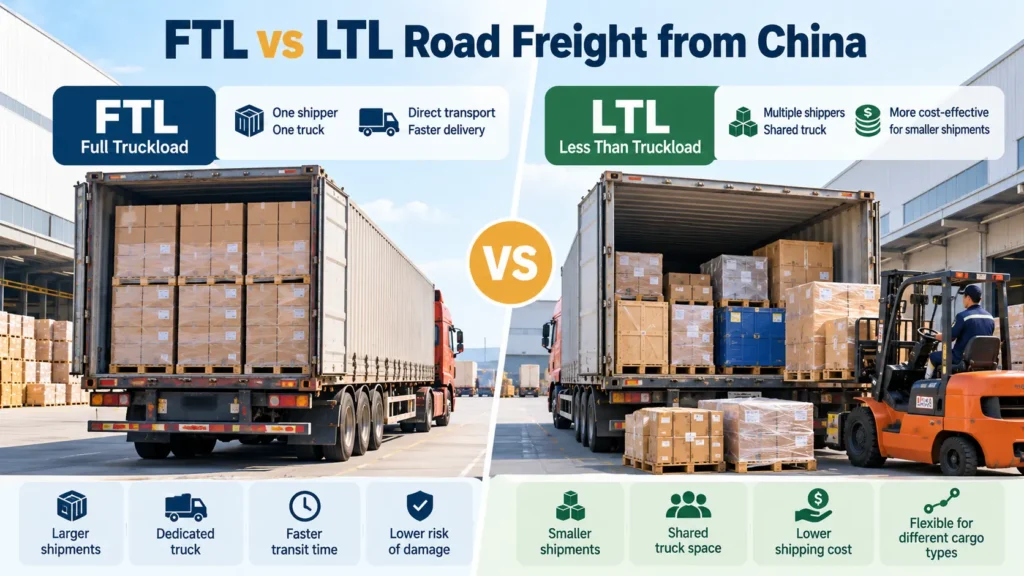
Choosing between Full Truckload (FTL) and Less Than Truckload (LTL) depends on shipment size, cargo volume, and delivery requirements.
FTL provides dedicated vehicle capacity, while LTL shares available truck space across multiple customers.
A standard European 13.6-meter semi-trailer commonly offers the following loading capacity:
| Truck Specification | Typical Capacity |
|---|---|
| Internal length | Approximately 13.6 m |
| Loading volume | Approximately 85–86 CBM |
| Practical payload | Approximately 22–25 tonnes |
| Euro pallets | Up to 34 |
| Industrial pallets | Up to 26 |
Actual dimensions and permitted payload depend on the trailer model and operating route. Manufacturer specifications from Schmitz Cargobull support the 13.62-meter length and 34 Euro-pallet reference.
FTL is generally suitable for machinery, automotive components, furniture, industrial equipment, and larger commercial orders.
| Feature | FTL | LTL |
|---|---|---|
| Truck capacity | Dedicated | Shared |
| Pricing | Per truck | Per CBM or kg |
| Best for | Larger shipments | Smaller shipments |
| Departure | More flexible | Scheduled consolidation |
| Cargo handling | Usually fewer transfers | More handling possible |
| Cost efficiency | Better with high truck utilization | Better for smaller volumes |
LTL is useful for importers shipping several pallets, while FTL may provide lower unit transportation costs for larger cargo volumes.
For oversized or unusually heavy goods, available vehicle capacity and axle-load restrictions must be checked separately.
Door-to-door shipping services combine factory collection, export clearance, international trucking, customs coordination, and final distribution.
This option is useful for businesses supplying European warehouses, manufacturers, and distribution centers without arranging each transportation stage separately.
A typical shipment follows six steps:
Cargo pickup: Collection from factories or warehouses in China
Loading: FTL truck loading or LTL consolidation
Export clearance: Chinese customs documentation and declarations
International transport: Trucking through the selected route
Import clearance: Required transit and EU customs procedures
Final delivery: Transportation to the consignee’s address
For businesses arranging door-to-door shipping from China to Germany, the quotation should clearly specify the receiving address, customs responsibilities, and included charges.
Cross-border transportation may involve tractor changes, trailer exchanges, or physical cargo transfers at selected border crossings.
A tractor change does not necessarily require unloading the goods, while transloading can increase handling time and damage exposure.
For valuable or sensitive shipments, confirm:
GPS tracking or milestone updates
Trailer seals and cargo handover procedures
Number of planned transfers
Insurance coverage and exclusions
Delivery appointments and unloading arrangements
TIR customs seals help maintain transit control but do not replace cargo insurance.
International shipping from China to Europe involves export procedures, customs transit, EU security filings, and destination import clearance.
Freight forwarders and customs brokers must verify the cargo’s tariff classification, origin, customs value, and compliance requirements before dispatch.
TIR is an international customs transit system designed to simplify the movement of goods across participating countries.
Qualifying shipments can travel in approved sealed vehicles or loading units under a recognized transit guarantee.
TIR can reduce repeated customs formalities and simplify border procedures, but it does not eliminate inspections, import duties, or VAT.
Typical documents include:
Commercial invoice and packing list
HS codes and country-of-origin information
Chinese export customs declaration
CMR consignment note where applicable
TIR Carnet or other transit documentation where applicable
Import permits and product compliance certificates where required
Documentation must match the actual cargo description, quantity, value, and packaging. Errors can delay export clearance or EU import processing.
Businesses involved in EU customs operations must confirm applicable EORI registration requirements.
The EU Import Control System 2 (ICS2) requires advance safety and security information through an Entry Summary Declaration (ENS).
For road shipments, the ENS generally must be lodged at least one hour before arrival at the customs office of first entry. Since June 2026, relevant submissions must follow the applicable ICS2 or eligible combined NCTS Phase 6 procedures.
For further details, refer to the European Commission’s ICS2 guidance.
Import duties depend on tariff classification and applicable trade measures. Import VAT depends on the destination country’s rules and the customs arrangements.
Additional product requirements may include CE marking, RoHS, REACH, and other applicable EU regulations.
The EU Carbon Border Adjustment Mechanism (CBAM) entered its definitive regime in January 2026. It applies to selected goods, including iron and steel, aluminium, cement, fertilisers, electricity, and hydrogen. A 50-tonne annual threshold applies to specified categories, with separate treatment for electricity and hydrogen.
Imports to the United Kingdom are subject to separate UK customs rules.
When shipping from China to Europe, importers should compare transportation options using total shipping costs, delivery schedules, cargo volume, and destination requirements.
International road transport offers flexible inland distribution, while rail, ocean freight, and air transport serve different shipment needs.
Transit Time: Around 13–23 days
Best for medium-to-large shipments requiring flexible inland delivery and a balance between cost and speed.
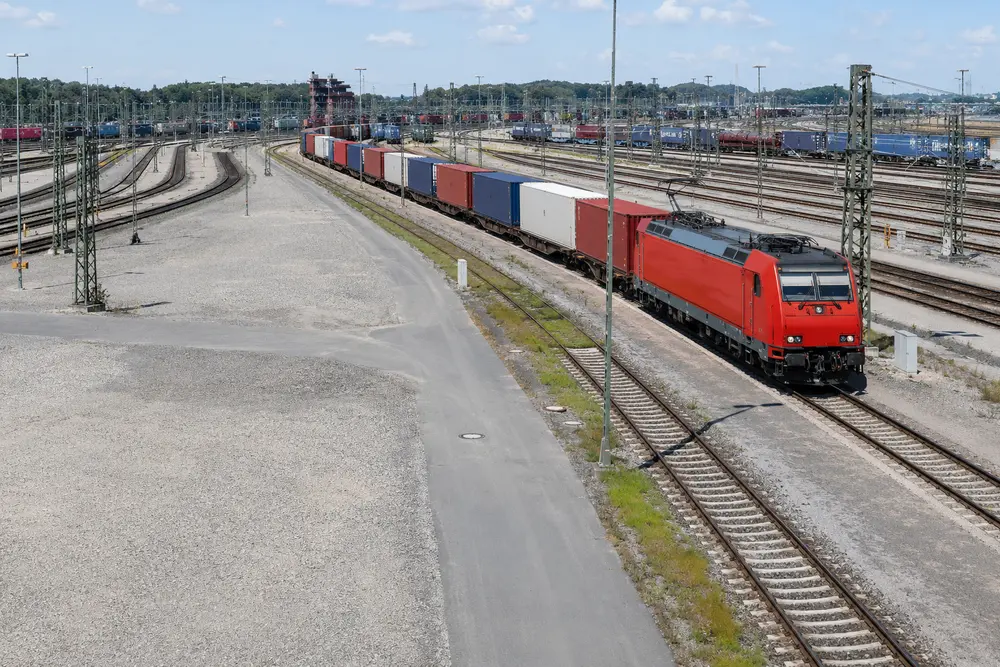
Transit Time: Around15–30 days
Best for regular containerized shipments seeking cost-effective transport between China and Europe.
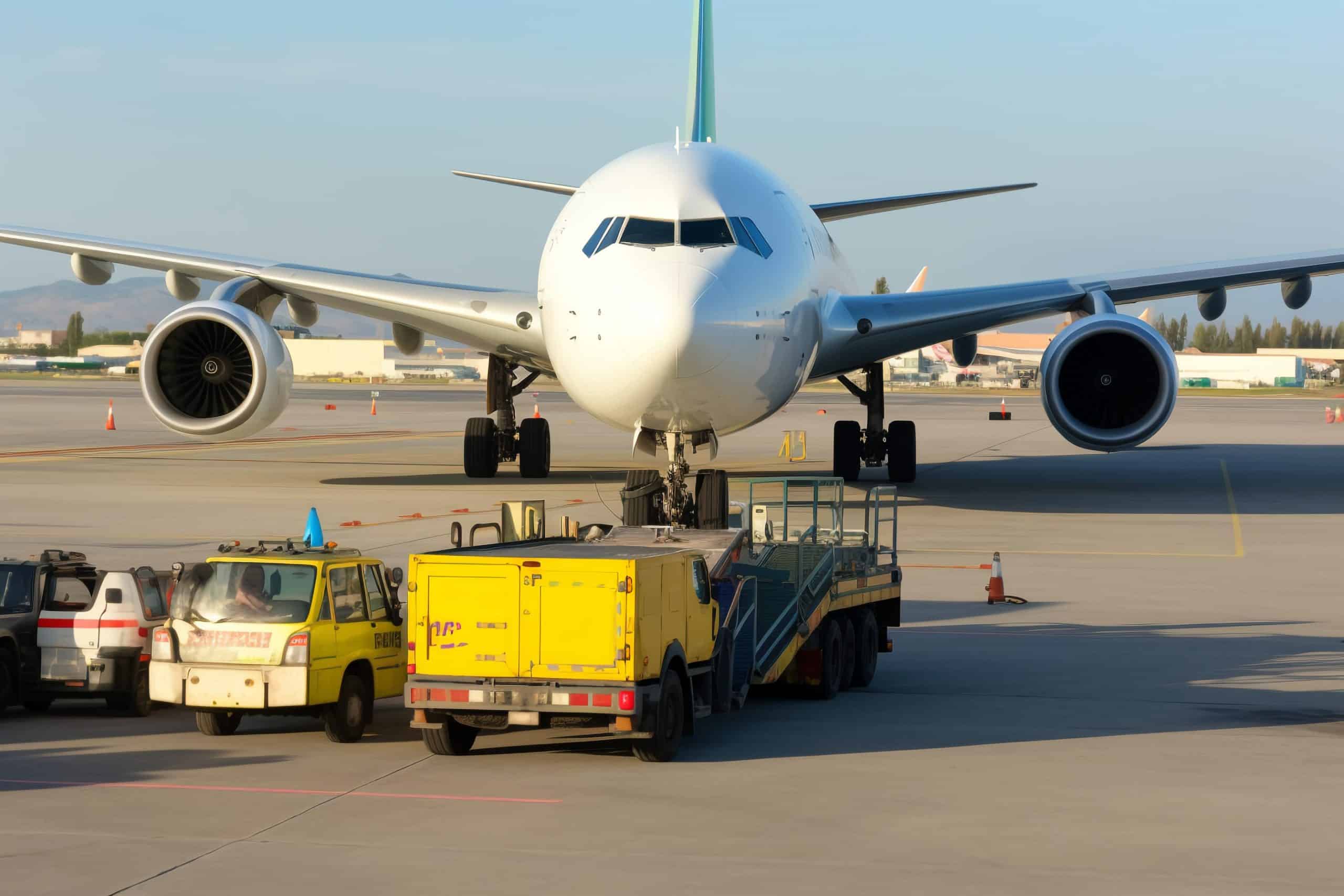
Transit Time: Around 3–7 days
Best for urgent, lightweight, or high-value goods that need the fastest delivery.
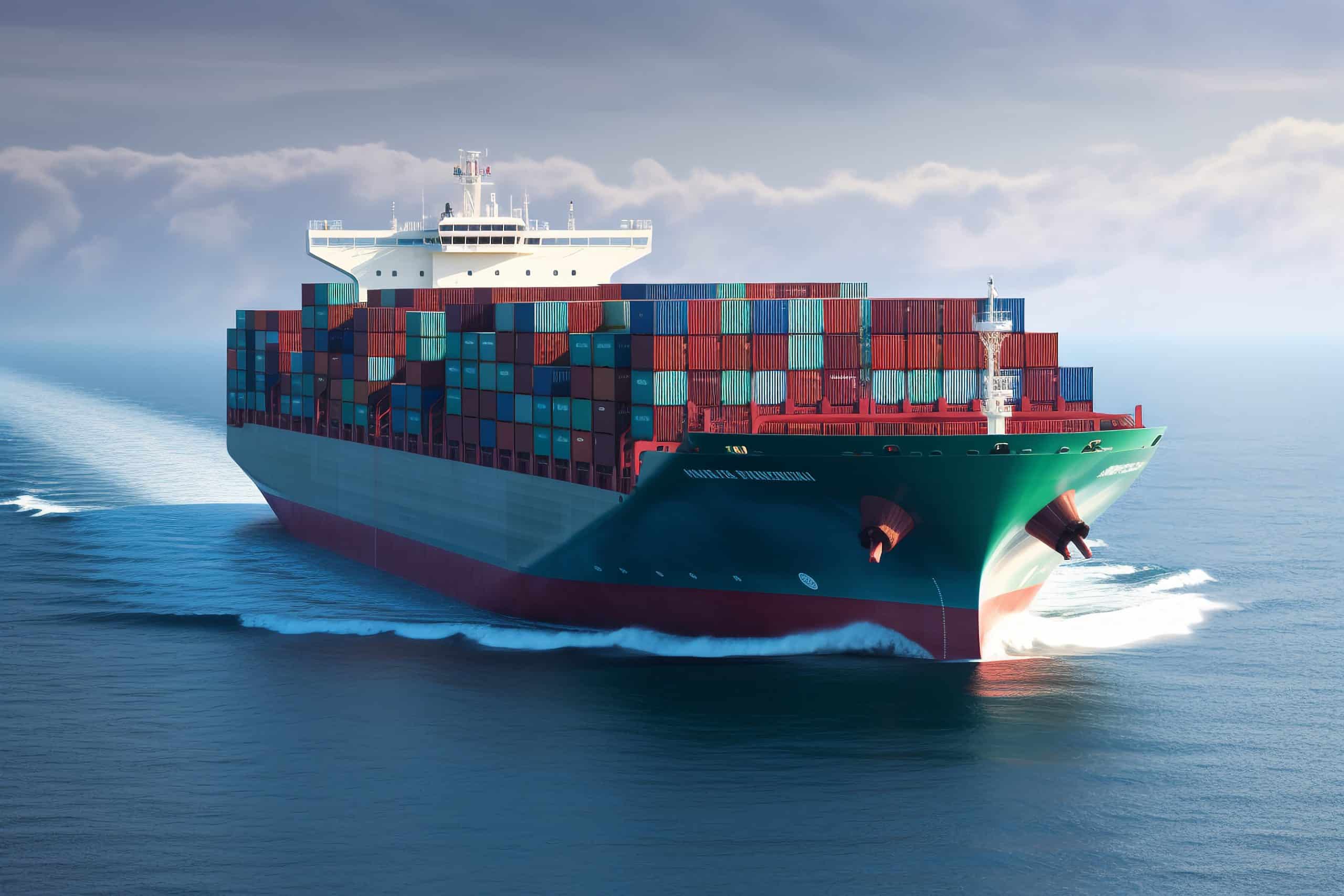
Transit Time: Around 30–45 days
Best for large-volume, non-urgent shipments where lower transportation costs are the priority.
Road transportation may be preferable when:
Cargo needs faster transport than conventional sea freight
Air freight is too expensive for the shipment size
Goods are destined for inland warehouses
FTL or LTL capacity matches the shipment
Available routes offer suitable delivery schedules
Rail freight from China to Europe can be competitive for regular containerized cargo moving between established rail terminals.
Sea freight is generally economical for larger FCL shipments, while air freight provides faster transportation for urgent products.
For importers comparing shipping from China to Europe, the most useful measure is total landed cost rather than the international freight rate alone.
International trucking supports commercial goods that require flexible collection, inland distribution, or shorter transportation times than conventional sea shipping.
Common cargo includes:
Industrial machinery and spare parts
Automotive components
Electrical products and electronics
Furniture and household goods
Retail inventory and consumer products
Palletized manufacturing materials
Some transport networks also handle temperature-controlled cargo, oversized machinery, and dangerous goods. These require specialized equipment, permits, and carrier approval.
To compare available shipping options, prepare:
Pickup city and European destination address
Cargo description and HS code
Gross weight and total CBM
Number and dimensions of pallets or cartons
Cargo value and special handling requirements
Preferred departure date and Incoterms
Tonlexing can help evaluate international trucking arrangements, customs procedures, FTL and LTL options, and door-to-door transportation based on shipment requirements and available routes.
Contact Tonlexing for a China–Europe freight quotation to compare shipping costs, transit times, and suitable transport arrangements for your cargo.
Selected corridors have reported transit times of approximately 13–23 days. Actual schedules depend on routing, border conditions, customs clearance, and final destination.
The supplied market benchmarks range from $12,000 to $24,000+ per truck, depending on the route. Current prices and legally available services require carrier confirmation.
Indicative rates are $180–$300 per CBM or $1.50–$3.50 per kg, depending on cargo density, destination, and the carrier’s billing method.
Generally, yes, especially for larger commercial shipments. Rail and sea freight may provide lower transportation costs for less urgent cargo.
Eligible door-to-door trucking services can be arranged, but border procedures, trailer exchanges, or multimodal connections may be necessary.
Useful freight, customs and importing resources related to this shipping guide.
International shipping from China to Europe remains one of the most vital trade routes in global logistics. With Europe being a massive consumer...
Read guide →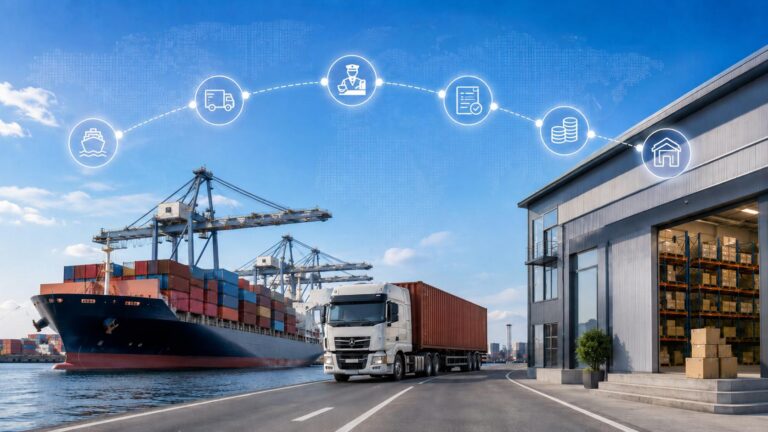
DDP Shipping from China to Europe Verified & Reviewed · Last updated June 2026 DDP shipping from China to Europe helps importers move cargo door...
Read guide →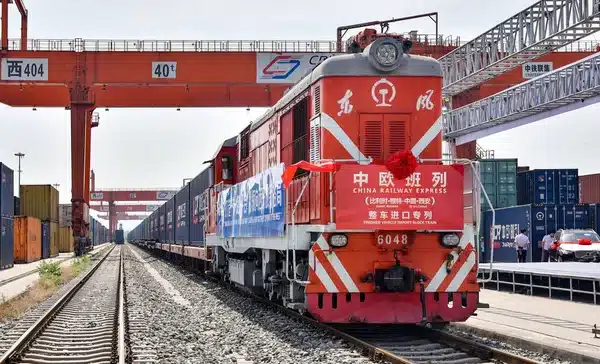
Railway freight has become an increasingly popular shipping solution for businesses looking to transport goods from China to Europe. The rise of...
Read guide →
As Central Asia rises in strategic importance, road freight from China to Kazakhstan has become one of the most efficient and flexible logistics...
Read guide →If you’re shipping goods from China to Russia, you’ve probably noticed that road freight is becoming one of the top logistics choices in 2025. It...
Learn more → Useful Resource Truck Freight LCL Shipping of Lighting Fixtures from Guangzhou, China to BelarusKey Shipment Details Transportation Mode: Truck Freight (Less than Container Load – LCL) Origin: Guangzhou, China Destination: Minsk, Belarus Car...
Learn more →WhatsApp us