

Shipping Documents From China to France
- Verified & Reviewed · Last updated January 2026
Shipping documents from China to France decide whether your cargo clears fast or gets delayed. As France is in the European Union, imports from China require a consistent document set for customs clearance.
This 2026 guide covers the key paperwork you need, plus how HS codes, customs duties, VAT, shipping costs, and transit times affect your shipment. You will also see common shipping methods and how to avoid avoidable delays.
Documents checklist
Customs clearance
Shipping costs & transit times
- Experienced China-based logistics specialists
Table of Contents
Why shipping documents matter for China to France shipping
For most importers, delays are rarely random. They come from one of these issues:
Product descriptions are too generic, so customs cannot confirm classification
HS code is missing or inconsistent across documents
Invoice value and payment terms do not look reasonable for the goods
Packing list weights and carton count do not match the actual shipment
Missing importer data such as EORI or VAT details
Missing compliance files for regulated consumer goods or high tech goods
Transport document does not match consignee, weights, or routing
When documents are clean, customs clearance is typically faster, delivery planning becomes easier, and your final cost becomes more predictable. In international trade, predictability is what protects your supply chain.
What France customs checks first
France customs clearance focuses on four essentials:
Goods identification
Confirmed through product description and HS code.Customs value
Based on the declared goods value and relevant costs up to the EU entry point.Origin
Used for controls and duty treatment.Importer responsibility
Driven by importer identity, EORI, and VAT setup.
If any file contradicts another, the shipment may be held for review or inspection, which can lead to storage and handling fees and higher risk during port congestion.
Essential shipping documents from China to France
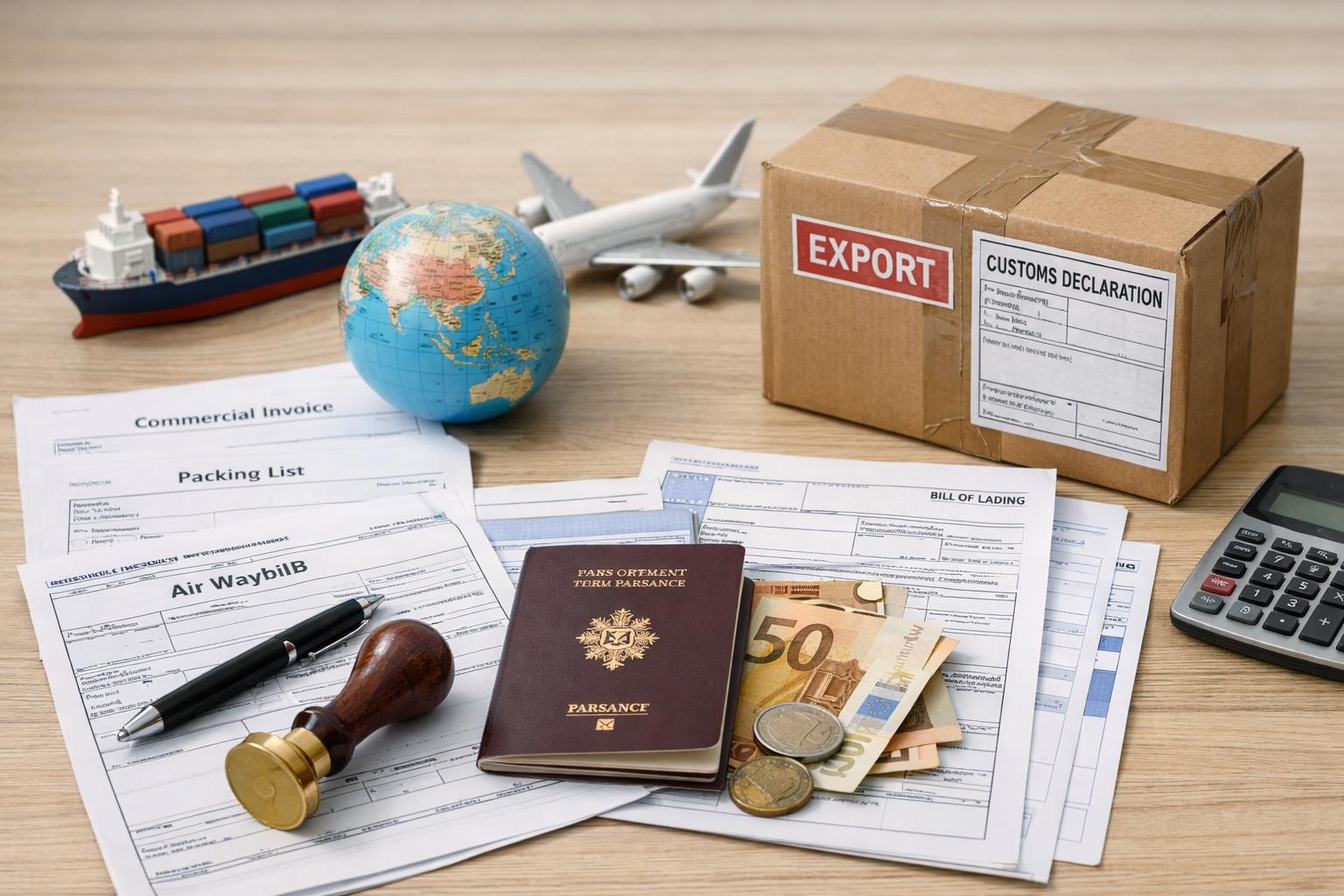
Most commercial shipments use a standard document set. If the key data stays consistent across all files, customs clearance in France is smoother and the risk of delays and extra fees drops.
Commercial invoice
The commercial invoice is the primary document used to confirm customs value, calculate customs duties, and apply VAT. Include:
Seller and buyer legal name and address
Consignee and importer details
Incoterms and a clear delivery location in France
Accurate product description with materials and function
HS code for each item
Country of origin
Quantity, unit price, line totals, total value
Currency and payment terms
Freight and insurance amounts when relevant
Packing list
The packing list must match the commercial invoice and the physical shipment. It helps confirm carton count, weights, and dimensions, especially for LCL and smaller shipments. Include:
Carton and pallet count
Net weight and gross weight
Dimensions and total CBM
Marks and carton numbers
Item breakdown aligned with the invoice
Transport document
The transport document proves carriage and supports release at destination.
Bill of Lading for sea freight
Air Waybill for air freight
Make sure pieces, weight, consignee, and routing match the invoice and packing list. For a container load, confirm container number and seal number.
Certificate of Origin
A Certificate of Origin confirms where the goods were manufactured. It may be requested for certain product categories, checks, or duty treatment.
Insurance certificate
An Insurance Certificate supports claims for loss or damage and can help reduce disputes about declared value when questions arise during customs clearance.
Shipping Documents Checklist for China to France
If you want a quick double-check before shipping, use the checklist below. The fastest way to avoid delays is to keep the same product description, HS code, quantities, and weights consistent across all documents.
| Document | Who Provides It | Why it matters for France customs clearance |
|---|---|---|
| Commercial Invoice | Supplier or exporter | Confirms value, HS code, incoterms, origin, and the basis for customs duties and VAT |
| Packing List | Supplier or exporter | Confirms carton count, weights, dimensions, and matches shipping goods to the invoice |
| Bill of Lading | Carrier or freight forwarders | Sea freight transport proof used for customs clearance and release |
| Air Waybill | Airline or freight forwarders | Air freight transport proof used for customs clearance and release |
| Certificate of Origin | Supplier or authorized issuer | Confirms origin and may support controls or duty treatment |
| Insurance Certificate | Shipper or insurer | Supports claims and value logic, helps reduce disputes on declared value |
Customs duties, import duties, and VAT in France
Import taxes and duties have a direct impact on total landed cost for French importers. In practice, many importers find taxes matter more than the freight line.
Customs duties and how they are calculated
Customs duties depend on HS code classification and the customs value base. In many cases, duties are calculated using the goods value plus costs incurred up to the EU entry point. Some declarations reference value thresholds such as €150, but treatment can vary by scenario, so confirm with your customs broker before shipping.
VAT in France
Many importers use 20 percent as a working VAT estimate for goods imported into France from a non-EU country. Actual VAT rates can vary by product category. Confirm the applicable VAT treatment for your HS code.
Why HS code matters
The Harmonized System HS code drives duty rate, compliance checks, and how goods are described in the customs declaration. A wrong HS code can trigger reclassification, re-assessment of duties, and delays during customs clearance. It can also create repeat issues across future shipments if the same code is copied forward.
Entry and compliance requirements in the European Union
Because France is in the European Union, your importer typically needs:
EORI number used for customs transactions
VAT setup aligned with the importer role
Product compliance documents when regulated
Common examples that may apply:
CE compliance for many regulated goods, especially electronics
MSDS for chemicals, liquids, adhesives, and some consumer goods
Sanitary, phytosanitary, and inspection certificates for food and plants
Import licenses for restricted goods including certain chemicals and textiles
ENS safety and security filing data for non-EU arrivals at the first EU point of entry
If you are not sure what applies, ask your freight forwarders to run a compliance check before booking.
Shipping methods from China to France
Choosing the right shipping mode affects shipping costs, transit times, and how smoothly customs clearance goes after arrival in France. In practice, pick the mode based on three factors: shipment size, urgency, and budget.
1) Express shipping
Best for documents, samples, and small urgent shipments.
Transit time: typically 3–5 days
How it’s billed: mainly by chargeable weight, so bulky cartons get expensive
Best use cases: small parcels, urgent replenishment, trial orders
Main trade-off: fastest option, but highest cost per kg for most cargo
2) Air freight
Best for time sensitive goods and many high value shipments that are too big for express.
Transit time: typically 5–7 days airport to airport
Cost reference: many shippers use around $6.95 per kg as a planning number for general cargo on some lanes
What changes the price: chargeable weight, fuel surcharge, space capacity, season
Main trade-off: faster than sea freight, but usually the most expensive standard option
Tip: If you need delivery to a France address, add pickup and last-mile time to get realistic door-to-door timing.
3) Rail freight
Best when you want a balance between speed and cost efficiency.
Transit time: typically 12–16 days on many routings
Best use cases: medium urgency shipments, stable supply chain planning
Main trade-off: cheaper than air freight, faster than sea freight, but schedule variability can happen due to terminal handling
Rail can be a strong middle option when you need better lead time than sea freight but cannot justify air rates.
4) Sea freight
Best value for general cargo, heavy items, and larger volumes.
Transit time: typically 25–28 days port to port on some routings
Planning time: many importers plan 30–40 days end to end to include terminal handling, customs clearance, and inland delivery
Main trade-off: lowest cost per unit, but the longest transit times
LCL vs FCL in sea freight
Sea freight is also where you see the biggest difference between LCL and FCL.

Key ports in France and destination planning
Key ports in France
Le Havre: common choice for FCL and LCL, good for deliveries to Paris and northern or central France
Marseille Fos: practical for southern France, can reduce inland delivery distance
Dunkirk: an alternative northern port depending on carrier schedules and capacity
Key airports in France
Paris Charles de Gaulle (CDG): the main air cargo gateway, best for Paris and nationwide distribution
Lyon Saint-Exupéry (LYS): a strong alternative for central and eastern France, can reduce inland trucking time
Destination planning tips
Terminal handling and appointment scheduling
Potential port congestion during peak periods
Customs clearance timing and broker cutoffs
Inland trucking to destination cities
Your freight forwarders should confirm routing and the best option among different carriers based on your cargo type and service level needs.
Shipping process from China to France
A clear shipping process reduces mistakes and helps reliable delivery.
Step 1: confirm shipment details
Before you ask for a quote, prepare:
Product name and category
HS code if available
Whether cargo is fragile goods, high tech goods, or controlled items
Shipment size with cartons, weights, and dimensions
Pickup city in China and delivery address in France
Step 2: choose shipping methods
Select based on:
Urgency and transit times
Budget and cost efficiency
Risk tolerance and seasonal capacity
A good rule is simple:
Express shipping for documents and urgent small parcels
Air freight for urgent commercial cargo
Rail freight for balanced speed and budget
Sea freight for heavy cargo and stable planning
Step 3: request itemized shipping rates
To compare shipping companies, you need an itemized quote. Ask for:
Origin charges
Main freight
Destination charges
Customs clearance cost
Delivery cost if door to door shipping is needed
Fuel surcharge and handling fees if applicable
This is the only reliable way to compare shipping solution offers and avoid surprise final cost.
Step 4: prepare documents and run a consistency check
Before cargo departs, confirm:
Commercial invoice totals match payment and terms
Packing list matches carton count and weights
HS code is consistent across files
Transport document matches consignee and routing
Compliance files are ready if required
Step 5: customs clearance and delivery
Once the shipment arrives, your broker files the entry and pays duties and VAT as applicable. Fast responses to questions help avoid storage charges and improve reliable services.
Door to door shipping and DDP shipping
Door-to-door shipping offers a streamlined experience by managing the entire process from the supplier warehouse in China to the recipient doorstep in France.
Door to door service
Door to door service typically includes:
Pickup in China
Export handling
Main transport
Customs clearance support
Final delivery in France
This reduces coordination work and is useful for importers who want a single logistics solutions provider.
DDP shipping
Delivered Duty Paid means the seller assumes responsibilities, risks, and costs of shipping goods until delivery to a specified location in France, often including payment of shipping costs, export and import duties, and taxes, plus clearing customs.
DDP shipping can be effective, but only when roles are clear:
Who is importer of record
Which party provides EORI and VAT details
How duty and VAT are funded and documented
How delivery is handled for destination cities and appointment rules
If these points are unclear, shipping and customs clearance can stall even under DDP terms.
Why choose a freight forwarder for China to France shipping
A freight forwarder keeps your China to France shipment organized from start to finish. Instead of coordinating separate parties for booking, export handling, international shipping, customs clearance, and delivery, you get one plan that reduces delays and keeps overall shipping costs more predictable.
A freight forwarder helps you:
Choose the right shipping method based on shipment size, urgency, and budget
Keep shipping documents consistent so customs clearance is smoother
Avoid common issues like wrong HS code, unclear product descriptions, and mismatched weights
Get clearer shipping rates with an itemized cost view, not a vague total
Track shipment status and respond quickly when schedules change
If you need a partner that runs this process in a document-first way, Tonlexing can pre-check your commercial invoice, packing list, and HS code before shipment, coordinate customs clearance in France, and support door to door shipping when required.
How to reduce shipping costs without increasing risk
Reducing costs is realistic if you focus on the drivers that matter.
Improve packaging to reduce chargeable volume for air freight
Consolidate smaller shipments and use LCL only when it makes sense
Move stable demand to sea freight or full container load
Avoid peak season by booking early, especially around Chinese New Year
Ask for itemized quotes to spot unnecessary handling fees
Keep documents consistent to avoid inspections that add storage costs
Platforms like Alibaba can help sourcing, but shipping success still depends on documentation quality and the competence of the operator. The safest way to reduce costs is to standardize your process and work with experienced partners.
Frequently Asked Questions
Most commercial shipments require a commercial invoice, packing list, and a bill of lading or air waybill. A certificate of origin and insurance certificate may be needed depending on product type and routing.
Start with the HS code and a realistic customs value. Duties depend on classification, and VAT is often applied based on the import value rules. Ask your broker to confirm rates for your goods.
For urgent cargo, air freight or express shipping is common. For heavy cargo and stable volume, sea freight is usually best. Rail freight can be a balanced option for many importers.
The most common reasons are HS code issues, unclear product descriptions, inconsistent weights, and missing importer information such as EORI or VAT details.
Choose by shipment size and urgency:
Express shipping: about 3–5 days for small urgent shipments
Air freight: about 5–7 days for time-sensitive or high value goods
Rail freight: about 12–16 days for balanced speed and cost efficiency
Sea freight: about 25–28 days port to port, and 30–40 days if you include customs clearance and delivery
Related China to France Shipping Guides
Get a China to France Shipping Documents Checklist
Faster customs clearance in France
Clean invoice and packing list formats
HS code and VAT readiness to avoid delays
Send your cargo details and we will confirm the required documents for your shipment.