

Shipping from China to Stockholm
- Verified & Reviewed · Last updated June 2026
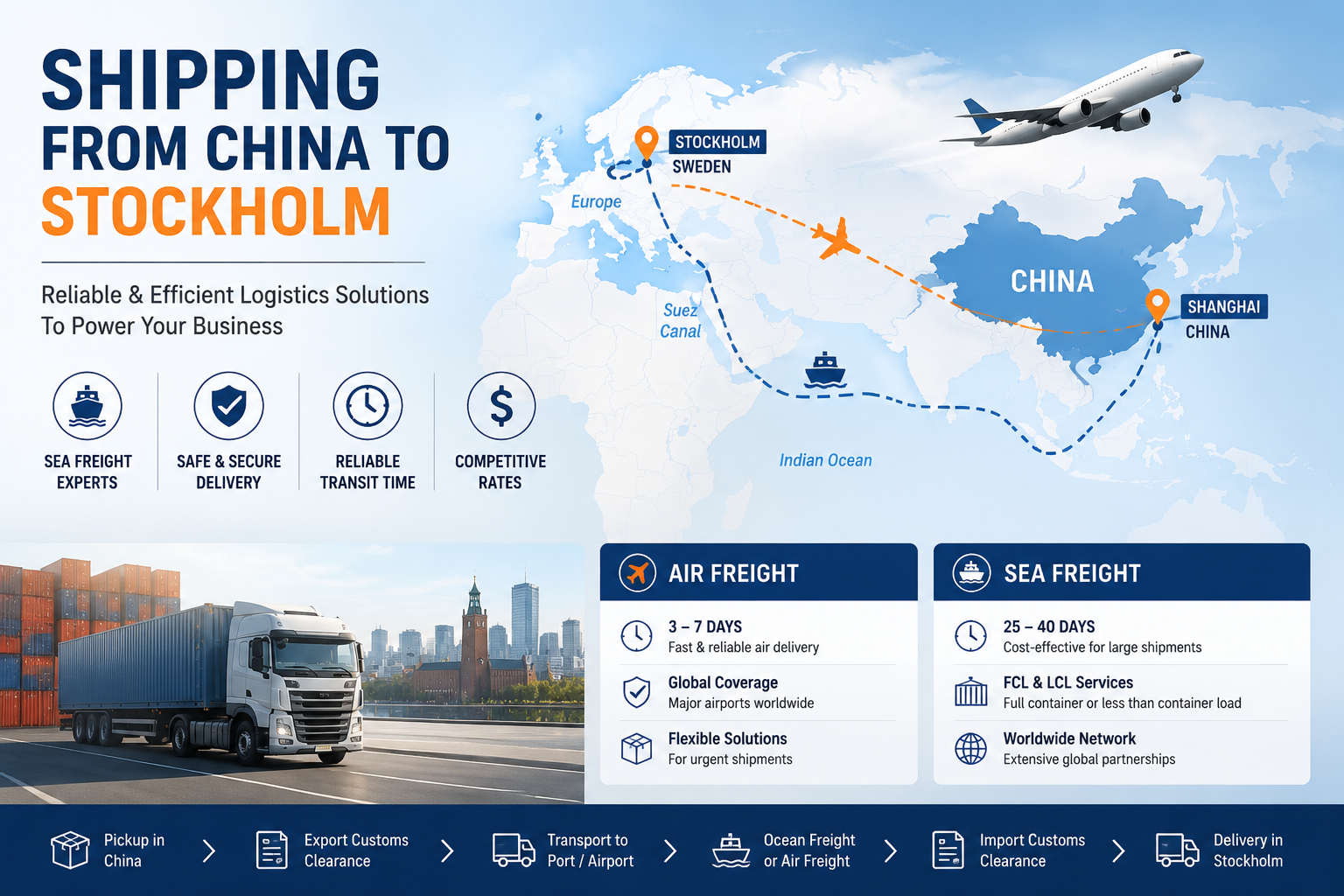
Shipping from China to Stockholm varies depending on shipping method, cargo size, transit time, customs clearance, and final delivery requirements.
This guide explains shipping costs, transit time, customs clearance, customs duties, import taxes, shipping routes, required documents and how to choose a reliable freight forwarder for China to Sweden shipments.
Shipping method / Mode
Transit time range
Customs & DDP delivery
- Experienced China-based logistics specialists
Table of Contents
Main Shipping Methods from China to Stockholm
When shipping goods from China to Stockholm, importers have multiple options depending on cargo size, urgency, budget, and customs requirements. Understanding each shipping method helps you choose the most cost-effective and reliable solution.
There are five main shipping methods for China to Stockholm shipments:
Express Courier
Express courier services, such as DHL, FedEx, and UPS, are ideal for small packages, urgent samples, and documents. They provide door-to-door delivery, including pickup, export customs clearance in China, international transport, import customs clearance in Sweden, and final delivery.
Key features:
Transit time: 1–5 days
Cost: Approximately $13.33 per kg
Best for: Small parcels, urgent shipments, and lightweight e-commerce orders
Express courier is the fastest option but generally more expensive than air freight for larger shipments.
Air Freight
Air freight is suitable for larger shipments that need faster delivery than sea freight but are too heavy for express courier. It is commonly used for electronics, fashion goods, machinery parts, medical supplies, and retail inventory.
Highlights:
Transit time: 3–7 days
Cost: Around $7.40 per kg for shipments over 1,000 kg
Best for: Urgent commercial cargo, high-value products, and time-sensitive inventory
Air freight usually departs from major Chinese airports (Shanghai, Guangzhou, Shenzhen, Beijing) and arrives at Stockholm Arlanda Airport or via European air hubs.
Sea Freight
Sea freight is the most cost-effective method for large or heavy shipments. Cargo typically departs from major ports in China (Shanghai, Ningbo, Shenzhen, Qingdao, Tianjin) and arrives at Stockholm Norvik, Gothenburg, or other Northern Europe ports.
Sea freight options:
LCL (Less than Container Load): Share container space with other importers, charged per cubic meter. Ideal for small shipments (1–15 CBM). Transit: 26–31 days.
FCL (Full Container Load): Dedicated 20GP, 40GP, or 40HQ container. Suitable for large-volume or heavy cargo. Transit: 25–27 days. Cost: $2,700–$5,445 depending on container size.
Sea freight is slower but highly economical for bulk shipments.
Rail Freight
Rail freight offers a balance between cost and transit time. Trains from inland China cities such as Xi’an, Chengdu, Chongqing, Zhengzhou, and Yiwu transport cargo through Europe and onto Sweden.
Key points:
Transit time: 12–17 days
Cost: Usually lower than air freight
Best for: Medium-volume cargo, e-commerce stock, industrial goods
Rail freight is faster than sea freight and more cost-efficient than air freight, making it a practical option for medium shipments.
DDP Door-to-Door Shipping
DDP (Delivered Duty Paid) is a comprehensive solution where the freight forwarder handles export customs, international shipping, import customs, duties, VAT, and final delivery to Stockholm.
Advantages:
Predictable total landed cost
Simplified customs process for importers
Available via air, sea, or rail freight
DDP is especially useful for e-commerce sellers, Amazon FBA businesses, or importers without experience in Swedish customs.
Shipping Costs from China to Stockholm in 2026
Shipping costs from China to Stockholm vary depending on the shipping method, cargo size, weight, volume, container type, origin port, final delivery address, customs duties, and additional services. Understanding these costs helps importers budget accurately and choose the most cost-effective logistics solution.
In June 2026, general market estimates for shipping from China to Stockholm are as follows:
| Shipping Method | Estimated Cost | Best For |
|---|---|---|
| Express Courier | $13.33 per kg | Samples, documents, small urgent parcels |
| Air Freight | $7.40 per kg for shipments over 1,000 kg | High-value goods, time-sensitive inventory |
| Rail Freight | Medium, approx. 50% cheaper than air | Medium-volume cargo, faster than sea |
| Sea Freight LCL | From $80 per CBM | Small sea shipments, consolidated cargo |
| Sea Freight FCL 20GP | $2,700–$3,300 | Heavy cargo, full container loads |
| Sea Freight FCL 40HQ | $4,455–$5,445 | Large-volume cargo, bulk orders |
| DDP Door Shipping | Quoted per kg or CBM | Importers needing customs included |
Factors Affecting Shipping Costs
Several factors influence the final shipping cost:
Cargo Weight & Volume: Air and express freight rates depend heavily on chargeable weight. For sea freight, CBM and container utilization affect cost efficiency.
Shipping Method: Express courier is fastest but most expensive per kg. Sea freight is slowest but cost-effective for large shipments. Rail freight balances speed and cost.
Customs Duties & Taxes: Swedish import duties and 25% VAT on the total value (including freight and insurance) affect total landed cost.
Additional Services: Packaging, consolidation, cargo insurance, pickup from supplier, and delivery to final destination can add to the cost.
Season & Space Availability: Peak season or limited shipping capacity may increase freight rates.
Tips to Optimize Shipping Costs
Importers can reduce shipping expenses by:
Planning shipments in advance to avoid peak-season surcharges.
Using LCL shipping for smaller cargo instead of paying for a full container.
Combining shipments from multiple suppliers through consolidation services.
Checking HS codes to ensure accurate customs duties and avoid delays.
Choosing DDP services to cover all customs fees upfront and prevent hidden costs.
By carefully selecting the shipping method and preparing proper documentation, importers can optimize both cost and delivery time when shipping from China to Stockholm in 2026.
Transit Time from China to Stockholm
Transit time is a critical factor when planning shipments from China to Stockholm. Different shipping methods have varying delivery speeds, and understanding these differences helps importers select the most suitable option based on urgency, cargo size, and budget.
Shipping speed generally decreases as shipment size increases. Express courier offers the fastest delivery, while sea freight takes the longest. Rail freight is a middle-ground solution, faster than sea freight but more cost-efficient than air freight for medium-sized shipments.
Estimated Transit Times by Shipping Method
| Shipping Method | Transit Time | Notes |
|---|---|---|
| Express Courier | 1–5 days | Best for small, urgent parcels or documents. Includes door-to-door delivery. |
| Air Freight | 3–7 days | Suitable for high-value or time-sensitive shipments; includes airport-to-airport transit. |
| Rail Freight | 12–17 days | Cost-effective for medium cargo; faster than sea freight; routes through Europe before Sweden. |
| Sea Freight LCL | 26–31 days | Consolidated cargo; slower due to port handling and deconsolidation. |
| Sea Freight FCL | 25–27 days | Dedicated 20GP or 40HQ containers; includes port-to-port transit; door-to-door delivery may take longer. |
| DDP Door Shipping | 7–50 days | Depending on transport mode; includes customs clearance and final delivery to consignee. |
Factors Affecting Transit Time
Shipping Method: Express courier is fastest, sea freight slowest. Rail freight balances speed and cost.
Origin Port or Airport: Shipments from major Chinese hubs like Shanghai, Guangzhou, Shenzhen, or Beijing may arrive faster due to more frequent connections.
Customs Clearance: Delays in export or import customs clearance can add days to total transit time.
Route and Transshipment: Sea freight may involve transshipment through European ports, affecting delivery time.
Season & Capacity: Peak shipping seasons or limited space can cause delays.
Tips to Ensure Timely Delivery
Plan shipments early, especially during peak seasons.
Provide complete and accurate documentation to avoid customs delays.
Use DDP services if you want predictable door-to-door transit time.
Choose express or air freight for time-critical cargo.
Track shipments with your freight forwarder to proactively handle delays.
Air Freight from China to Stockholm
Air freight from China to Stockholm is often used when the cargo requires fast and reliable delivery. It is suitable for importers who need better speed than sea freight but do not want to pay premium express courier prices.
Cargo can depart from major airports in China and arrive at Stockholm Arlanda Airport or another European air cargo hub. Some routes may use direct flights, while others use connecting flights through European countries.
Common air freight cargo includes:
Electronics
Fashion goods
Medical products
Auto parts
Machinery parts
E-commerce inventory
Urgent replacement parts
Air freight is also useful for supply chain emergencies. When sea freight delays or port congestion affect production or sales, air cargo can help importers restore stock quickly.
Sea Freight from China to Stockholm
Sea freight is one of the most cost-effective methods for shipping large or heavy cargo from China to Stockholm. It is widely used for furniture, machinery, building materials, textiles, tools, packaging materials, auto parts, and bulk commercial shipments. While transit time is longer compared to air freight, sea freight offers significant cost savings for large-volume shipments.
Sea Freight Options
LCL (Less than Container Load)
LCL shipping allows importers to share container space with other shipments. It is charged by the volume your cargo occupies, typically measured in CBM (cubic meters).
Suitable for shipments between 1–15 CBM
More economical for small shipments than paying for a full container
Transit time: 26–31 days
FCL (Full Container Load)
FCL shipping uses a dedicated container, providing better control over cargo and minimizing handling risk. It is recommended for shipments above 15–18 CBM or when security is a concern.
Container Type | Estimated Cost | Transit Time | Best For |
|---|---|---|---|
20GP | $2,700–$3,300 | 25–27 days | Heavy cargo, machinery, metal products |
40GP | $4,300–$5,300 | 25–27 days | General commercial cargo |
40HQ | $4,455–$5,445 | 25–27 days | Large volume cargo, furniture, lightweight bulky goods |
Tips for Sea Freight
Consolidate smaller shipments to reduce LCL costs
Ensure proper packaging to prevent damage during long transit
Provide accurate HS codes for smooth customs clearance
Plan for additional days for port handling and inland delivery
Consider DDP service if you want customs and delivery included
Sea freight is ideal for importers prioritizing cost efficiency over speed, and it remains the preferred shipping method for bulk cargo from China to Stockholm.

Rail Freight Shipping from China to Stockholm
Rail freight shipping from China to Stockholm is becoming an important option for importers who need faster delivery than sea freight but lower cost than air freight. It is especially useful for cargo from inland Chinese cities where railway hubs are closer than seaports.
Rail freight from China to Sweden can depart from cities such as Xi’an, Chengdu, Chongqing, Zhengzhou, Yiwu and Wuhan. After arriving in Europe, cargo is delivered to Stockholm by truck or rail.
Rail freight is commonly used for:
Medium-volume cargo
E-commerce goods
Industrial parts
Automotive components
Retail inventory
Electronics
Machinery accessories
Rail freight may not be suitable for every cargo type. Batteries, liquids, powders, dangerous goods and restricted products need to be checked before booking.
DDP and Door-to-Door Shipping from China to Stockholm
Door shipping from China to Stockholm means the freight forwarder manages pickup from the supplier’s location in China and final delivery to the consignee’s address in Stockholm. This service can be arranged by air freight, sea freight, rail freight or express courier.
DDP shipping goes one step further because it includes customs clearance, customs duties, import taxes and delivery in one quotation. This helps importers avoid hidden costs and unexpected customs payments.
DDP shipping is suitable for importers who want:
A clear total landed cost
Customs clearance handled by the freight forwarder
Final delivery included
Simplified import process
Fewer separate service providers
Better control over the shipping process
However, DDP shipping must be checked carefully. Some cargo types may require certificates, licenses or special customs handling. High-value goods, branded goods, batteries and products with EU safety regulations need extra review before shipment.
Customs Clearance in Sweden
Customs clearance is a crucial step when shipping goods from China to Stockholm. All commercial imports must pass through Swedish Customs, also known as Tullverket, and Sweden follows European Union customs regulations. Proper documentation, accurate HS codes, and declared values are essential to avoid delays or extra charges.
Swedish customs checks shipments for compliance with EU safety standards, correct classification, proper valuation, and applicable import duties and taxes. Importers are required to submit electronic customs declarations and may need an EORI number for all commercial shipments.
Key Steps in Customs Clearance
Document Preparation: Ensure all required documents are accurate, including commercial invoice, packing list, HS code, and transport documents.
Export Clearance in China: Goods must complete export customs clearance before leaving China.
Import Declaration in Sweden: Submit accurate electronic customs declarations to Tullverket.
Duty & Tax Payment: Pay applicable import duties and VAT (standard 25% in Sweden).
Final Delivery: Once cleared, shipments can be delivered to warehouses, offices, retail stores, or private addresses in Stockholm.
Required Customs Documents
Commercial Invoice: Product description, quantity, unit price, total value, Incoterms
Packing List: Number of cartons/pallets, dimensions, weight
Bill of Lading (B/L) or Air Waybill (AWB)
HS Code: Harmonized System code for accurate duty calculation
EORI Number: Required for import declaration
Certificate of Origin: If requested by customs
CE Certificates or MSDS: For electronics, batteries, chemicals, or regulated goods
Common Challenges
Incorrect HS codes or undervalued invoices can cause delays.
Missing documents may result in additional customs inspections.
High-risk or restricted products (batteries, branded goods, chemicals) require pre-approval.
Late submission of electronic import declarations can affect delivery schedules.
Tips for Smooth Customs Clearance
Work with a reliable freight forwarder to manage documentation and compliance.
Confirm product classification and HS codes before shipping.
Use DDP shipping if you prefer customs duties and VAT to be handled upfront.
Keep electronic copies of all documents for faster processing.
By following these steps, importers can ensure efficient and compliant customs clearance in Sweden, minimizing delays and avoiding unexpected charges.
Major Shipping Routes from China to Stockholm
Understanding the major shipping routes from China to Stockholm helps importers choose a more efficient transportation option based on transit time, shipping costs, cargo type and delivery requirements. Stockholm is one of Sweden’s key commercial centers, and cargo can reach the city through ocean freight, air freight, rail freight and inland delivery networks.
Sea Freight Routes to Stockholm
Sea freight shipments from China usually depart from major ports along China’s eastern and southern coastline. Cargo moves through Northern Europe before entering Sweden, then continues by truck or rail to the final destination in Stockholm.
Common origin ports include:
Most ocean shipments arrive through Stockholm Norvik Port, Port of Gothenburg, Port of Helsingborg, Gdansk or Hamburg. Stockholm Norvik serves the Stockholm region, while Gothenburg is Sweden’s largest port and a major gateway for China to Sweden shipments.
Air Freight Routes to Stockholm
Air freight is the fastest international shipping option from China to Stockholm. Cargo normally departs from major Chinese airports and arrives at Stockholm Arlanda Airport, Sweden’s largest cargo airport, either directly or through European air hubs.
Common departure airports include:
Beijing Capital Airport
Zhengzhou Xinzheng Airport
Hong Kong International Airport
Transit time is usually around 5–6 days, including customs clearance and local delivery.
Rail Freight Routes from China to Stockholm
Rail freight shipping is increasingly used for China to Sweden shipments because it provides a balance between speed and cost. Cargo travels through the China-Europe Railway Express network before entering Northern Europe, then moves to Stockholm by local rail or trucking.
Common rail departure hubs include:
Xi’an
Chengdu
Chongqing
Zhengzhou
Yiwu
Wuhan
Rail cargo usually passes through China, Kazakhstan, Russia, Belarus, Poland, Germany, Denmark and Sweden. Typical transit time ranges from 12–17 days, depending on the departure city, rail capacity, customs clearance and final delivery arrangement.
Door-to-Door Shipping Routes
For importers seeking a simpler logistics process, door-to-door shipping combines international transport with local pickup, customs clearance and final delivery. Depending on cargo size and urgency, the freight forwarder may use air freight, rail freight or sea freight as the main transport method.
Common route combinations include:
Air freight plus local delivery
Rail freight plus trucking
Sea freight plus trucking
Sea freight plus rail delivery
DDP shipping routes can also include export customs clearance, import customs clearance, customs duties handling and final delivery to the consignee’s address in Stockholm.
How to Reduce Shipping Costs and Avoid Delays
Reducing shipping costs from China to Stockholm starts with proper planning. Last-minute bookings often lead to higher air freight rates, limited container space, and fewer shipping options. Preparing documents early and selecting the right shipping method helps avoid unnecessary expenses.
One effective way to save cost is consolidation. Importers sourcing from multiple suppliers in China can combine smaller shipments into a single shipment, reducing repeated pickup fees and improving container utilization.
Other useful tips include:
Plan shipments ahead of peak seasons
Use LCL shipping for smaller cargo
Use FCL shipping for larger volumes
Combine goods from multiple suppliers
Ensure proper packaging to control volume
Confirm HS codes before shipping
Compare DDP and non-DDP service options
Purchase cargo insurance for valuable goods
Check customs requirements before booking
To avoid delays, ensure the commercial invoice, packing list, and customs declaration are accurate. Common causes of customs problems include incorrect product descriptions, missing HS codes, or inaccurate declared value.
Why Choose Tonlexing for Shipping from China to Stockholm
Shipping from China to Stockholm can be complex, involving multiple transport modes, customs clearance, duties, and final delivery. Choosing an experienced freight forwarder simplifies the process and ensures your shipments arrive safely and on time.
Tonlexing offers professional logistics solutions tailored to your needs, combining expertise in air, sea, rail, and DDP shipping services. Our team handles export documentation, customs clearance, cargo consolidation, and door-to-door delivery, giving importers peace of mind and predictable total landed cost.
Key advantages of working with Tonlexing:
One-stop service: From supplier pickup in China to final delivery in Stockholm
Customs expertise: Accurate HS code classification, import duties, and VAT handling
Flexible shipping options: Air, sea, rail, LCL, FCL, and DDP door-to-door solutions
Cost optimization: Consolidation services and strategic route planning reduce shipping costs
Reliable tracking and support: Real-time shipment updates and proactive issue management
Experience with multiple cargo types: Electronics, machinery, retail goods, bulk shipments, and e-commerce stock
By partnering with Tonlexing, importers can focus on their business while we manage the logistics, ensuring smooth transit, timely delivery, and compliance with Swedish customs regulations.
Frequently Asked Questions
Shipping costs from China to Stockholm depend on shipping method, cargo weight, volume, customs value and final delivery address. Express courier may cost around $13.33 per kg. Air freight can cost around $7.40 per kg for large shipments. LCL shipping can start from around $80 per CBM. FCL sea freight costs around $2,700–$3,300 for a 20GP container and around $4,455–$5,445 for a 40HQ container.
Express shipping usually takes 1–5 days. Air freight takes around 3–7 days. Rail freight from China to Sweden takes around 12–17 days. Sea freight to Gothenburg and Stockholm averages around 25–27 days, while LCL shipments may take around 26–31 days.
Sea freight is usually the cheapest shipping method for large cargo. LCL shipping is suitable for smaller sea freight shipments, while FCL shipping is more cost effective for full container load cargo. Rail freight can also be a cost effective option for medium shipments.
Express courier is usually the fastest option for small packages. Air freight is the fastest practical shipping method for larger commercial cargo. For urgent shipments over 100 kg, air freight from China to Stockholm is usually more suitable than express courier.
Yes. DDP shipping from China to Stockholm is available for many cargo types. It can include export clearance, international shipping, import customs clearance, customs duties, VAT handling and final delivery. Restricted goods must be checked before shipment.
Related Guides on China Shipping and Customs
Get a Shipping Quote from China to Stockholm
- Air, sea, rail, and DDP shipping options
- Customs clearance and VAT support in Sweden
- Door-to-door delivery to Stockholm
Get tailored shipping rates, transit time, and customs support for your China to Stockholm shipment.