Related Guide
Shipping from China to the USA
Shipping from China to the USA includes air freight, sea freight, and DDP shipping options. Compare shipping costs, transit times, and US customs...
Read guide →

Reliable & Cost-Effective Shipping from China
Tailored Logistics Solutions for Your Business
Shipping routes from China to the USA vary according to the origin port, destination port, final delivery location, cargo type and required delivery time. Most sea freight moves across the Pacific to the U.S. West Coast or continues through the Panama Canal to East Coast and Gulf Coast ports.
In this 2026 guide, we explain how to ship from China to the USA by sea or air, including major Chinese and U.S. ports, approximate distances, transit times and the factors importers should consider when selecting a route.
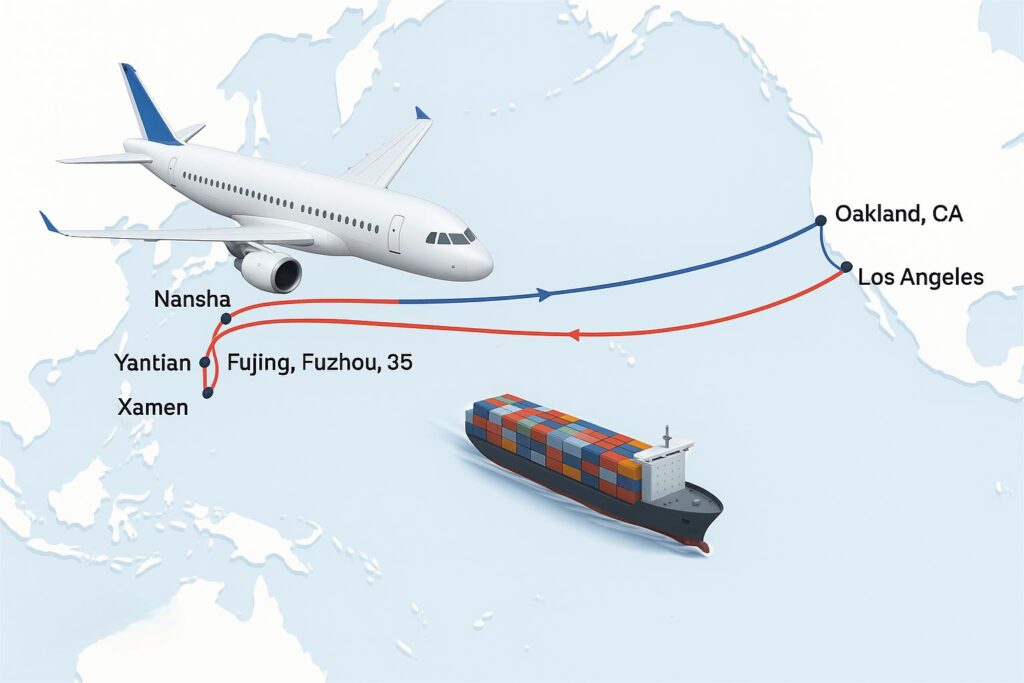
Most shipments from China to the USA move across the Pacific by sea or air. The most suitable route depends on the cargo origin, final U.S. delivery address, shipment size, required delivery time and available carrier schedule.
| Shipping Route | Typical U.S. Entry | Best Suited For | Main Consideration |
|---|---|---|---|
| Trans-Pacific Route | West Coast ports such as Los Angeles and Long Beach | Cargo delivered to the western United States or transferred inland by rail or truck | Shorter ocean route, but inland delivery distance must be considered |
| Panama Canal Route to the East Coast | East Coast ports such as New York, Savannah and Miami | Cargo with final delivery in the eastern United States | Longer ocean transit but potentially shorter inland delivery |
| Panama Canal Route to the Gulf Coast | Gulf Coast ports such as Houston | Shipments delivered to Texas and the southern United States | Compare vessel schedules, destination charges and inland transport |
| Air Freight Route | Major U.S. cargo airports | Urgent, higher-value or time-sensitive shipments | Faster delivery but higher cost and chargeable-weight requirements |
The shortest port-to-port route is not always the best complete shipping solution. Importers should compare the full journey, including pickup in China, export handling, ocean or air freight, customs clearance and final delivery in the United States.
Most sea freight from China to the USA crosses the North Pacific. The selected route usually depends on the Chinese origin port, the U.S. destination port, the final delivery address and the carrier’s sailing schedule.
For importers, the shortest ocean route is not always the most efficient complete route. A shipment arriving at a West Coast port may still need long-distance rail or truck transport, while an all-water route to the East Coast or Gulf Coast may reduce inland delivery distance.
The Trans-Pacific route connects major Chinese ports such as Shanghai, Ningbo and Shenzhen with U.S. West Coast ports, particularly Los Angeles and Long Beach.
It is the most direct sea route between China and the continental United States and is commonly considered for cargo delivered to:
California and other western states
Distribution centers near West Coast ports
Inland destinations connected by rail or truck
This route offers a shorter ocean crossing, but importers should also consider port handling, inland transport distance and the final delivery ZIP code before choosing it.
Cargo bound for the U.S. East Coast usually crosses the Pacific and passes through the Panama Canal before continuing to ports such as New York and New Jersey, Savannah, Charleston, Norfolk or Miami.
Although the ocean journey is longer than a direct West Coast route, it may be more practical for cargo delivered to the eastern United States because it can reduce the distance and cost of inland transportation.
The route decision should therefore compare the complete shipment journey rather than port-to-port transit time alone.
Shipments delivered to Texas and parts of the southern United States may move through the Panama Canal to Gulf Coast ports such as Houston.
This route may be suitable when the final destination is closer to the Gulf Coast than to Los Angeles, Long Beach or an East Coast port. Importers should compare:
Available vessel schedules
Destination port charges
Customs and terminal handling
Rail or truck delivery from the port
Total delivery time to the final address
The Gulf Coast is not automatically cheaper or faster. Its suitability depends on the shipment details and final delivery location.
Some shipments arrive at Los Angeles or Long Beach and then continue to inland destinations by rail or truck. When ocean freight is combined with rail transport across the United States, the service may be described as a mini-landbridge route.
This option can be considered for cargo moving to the Midwest or other inland markets. However, it should be compared with an all-water service to the East Coast or Gulf Coast.
Tonlexing normally compares the complete route based on the cargo size, container type, required delivery time and final U.S. ZIP code before recommending a port and transport combination.
Actual routing may change according to the carrier, vessel schedule, cargo type, port conditions and space availability. Final transit time should be confirmed when the cargo is ready for booking.
For time-sensitive shipments, air freight from China to the USA offers the fastest delivery method. While more expensive than sea freight, air cargo is commonly used for electronics, medical equipment, perishable goods, and high-value items. Understanding the flight route from China to the USA, key airports, and average transit times helps shippers balance cost and urgency.
Several direct and indirect air freight routes connect major Chinese airports with key U.S. destinations. The most commonly used airports include:
In China: Beijing Capital (PEK), Shanghai Pudong (PVG), Guangzhou Baiyun (CAN), and Shenzhen Bao’an (SZX)
In the USA: Los Angeles (LAX), Chicago O’Hare (ORD), New York (JFK), and Dallas/Fort Worth (DFW)
Many trans-Pacific air freight services cross the North Pacific before reaching coastal or inland U.S. cargo hubs. The exact flight path depends on the origin airport, destination airport, airline, and whether the shipment moves on a direct or connecting service.
Air shipping is ideal when transit time is a priority:
Air freight rates are calculated based on chargeable weight, which compares actual weight with volumetric weight. Costs vary according to season, cargo type, available capacity, origin airport, and destination airport.
Although air freight is more expensive than sea freight, it may be suitable for urgent, higher-value, or time-sensitive shipments.
Air freight services between China and the USA may be operated by cargo airlines, passenger airlines with cargo capacity, and express carriers. Common examples include:
Available carriers and direct services vary by airport, cargo type, space availability, and booking date.
Many freight forwarders also provide door-to-door air freight services, combining customs clearance and final-mile delivery.
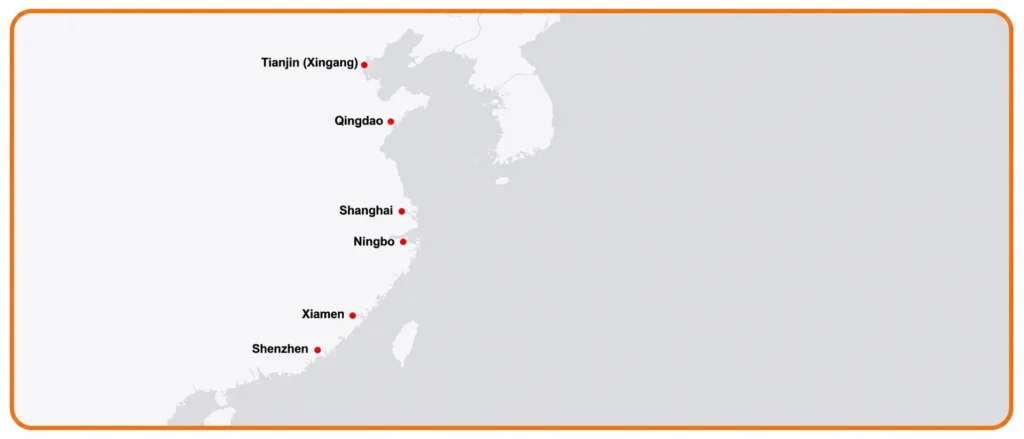
Understanding the origin and destination ports along the China–USA shipping route helps importers plan transit time, inland transportation and overall freight costs. The most suitable port combination depends on the supplier location in China, the final delivery address in the United States, carrier schedules and the required service type.
China’s export network includes several major container ports along its eastern and southern coastlines:
The final origin port is normally selected according to the supplier location, cargo-ready date, available sailing schedule and inland transport cost within China.
Many shipments from China enter the United States through West Coast ports because they are reached by the direct trans-Pacific route:
West Coast ports generally offer the shortest ocean route from China, but the full delivery plan should also consider terminal handling, rail or truck transport and the final U.S. ZIP code.
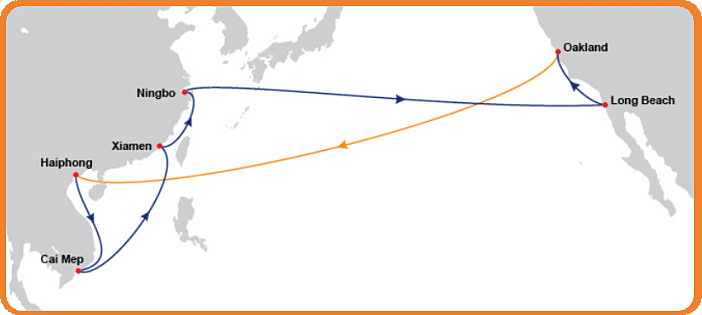
Cargo delivered to the eastern or southern United States can use all-water services through the Panama Canal to East Coast and Gulf Coast ports:
Although these routes involve a longer ocean journey than direct West Coast services, they may reduce inland transportation for cargo with a final destination near the East Coast or Gulf Coast.
The best destination port should be selected by comparing the complete route, including ocean transit, port handling, customs clearance and inland delivery.

One of the most frequently asked questions in international logistics is: “How far is China from the USA, and how long does shipping take?” Sea and air freight distances vary according to the origin, destination and selected route, so the figures below should be used as general planning references.
The sea route distance between China and the USA varies according to the origin and destination ports:
These are approximate port-to-port route distances. They do not include inland pickup, final delivery or possible transshipment movements.
Routes to the U.S. East Coast and Gulf Coast are longer because vessels normally continue through the Panama Canal after crossing the Pacific.
Typical sea freight transit times include:
These are indicative port-to-port transit times. Actual schedules may vary because of the carrier, departure port, destination port, transshipment, weather, port conditions and customs clearance.
Importers should also allow time for container loading, export handling, cargo release and inland transportation.
Air freight is typically much faster than sea freight:
The air route distance from China to the USA commonly ranges from approximately 6,000 to 7,500 miles, depending on the origin airport, destination airport and actual flight path.
Shipping services may use either direct routes or longer all-water routes:
The appropriate route depends on the destination port, final delivery address, required transit time and available service.
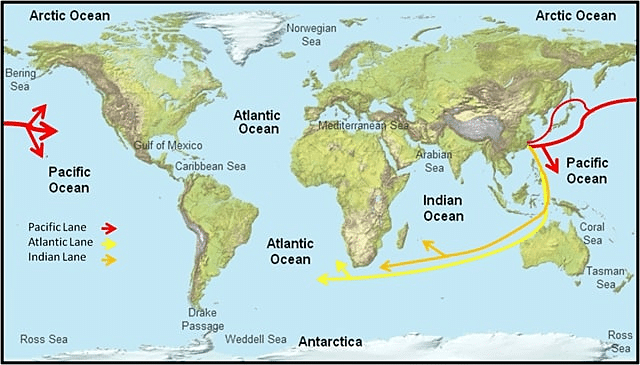
Shipping route maps provide a clear view of how cargo moves from major Chinese ports to the United States. They help importers compare direct Pacific services with longer routes through the Panama Canal and understand how the selected destination port affects the overall journey.
Most cargo vessels departing from Chinese ports use established routes across the Pacific Ocean to reach the United States. The three main routes commonly shown on China–USA shipping maps are:
The actual vessel route may vary according to the origin port, destination port, carrier service and transshipment schedule.
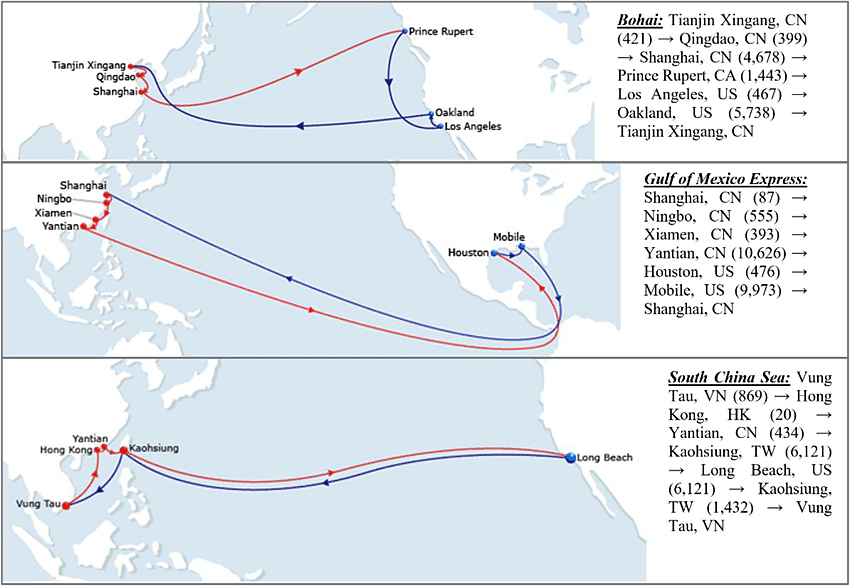
A useful shipping route map from China to the USA should clearly show:
Shipping maps are useful for understanding the general route, but they do not represent a guaranteed vessel schedule. Actual port calls and transit arrangements should be confirmed when the shipment is booked.
Air freight maps typically show trans-Pacific connections between major Chinese airports and U.S. cargo hubs such as Los Angeles, Chicago, New York and Dallas/Fort Worth.
For multimodal shipments, route planning may also include inland rail or truck transport after the cargo arrives at a U.S. port or airport. The complete route therefore depends on both the international transport leg and the final delivery location.
Choosing a shipping route from China to the USA involves more than comparing distance. Importers should also consider freight cost, transit time, cargo volume, available carrier schedules and the final delivery location.
The shortest sea route is not always the most efficient complete route, especially when rail, truck transport, customs clearance and final delivery are included.
Freight cost varies according to several shipment factors:
FCL may provide a better cost per unit when there is enough cargo to use a full container. LCL is more flexible for smaller shipments, but consolidation and deconsolidation may add handling time.
The route should therefore be compared based on the complete shipping cost rather than the ocean freight rate alone.
Port congestion, terminal capacity, weather and vessel schedule changes can affect unloading, cargo release and inland delivery.
Possible effects include:
Congestion conditions are not permanent and may change by port and period. Importers should confirm the current route and schedule when the cargo is ready for booking rather than assuming that one coast is always more congested than another.
An experienced freight forwarder can compare different shipping routes according to the cargo type, destination, required delivery time and customs requirements.
For example, route planning may involve comparing:
Tonlexing also considers the supplier location in China, cargo-ready date, final U.S. ZIP code and required service scope before recommending a route.
The main route options include:
Infrastructure at the destination also affects the complete delivery process. Rail availability, trucking capacity, terminal handling, customs clearance and warehouse location may be as important as the ocean transit time.
The final route should balance transit time, total cost, cargo requirements and delivery reliability.
When shipping goods from China to the United States, the destination port can affect ocean transit time, inland transportation and the complete delivery schedule. Importers normally compare West Coast, East Coast and Gulf Coast ports according to the final delivery location, cargo requirements and available vessel service.
The U.S. West Coast is reached through the direct trans-Pacific route and normally provides the shortest ocean journey from China.
The West Coast may also be used for cargo delivered to inland destinations. However, importers should include rail or truck transportation when comparing the complete route.
Port conditions and terminal handling may vary by season, so the West Coast should not automatically be treated as either the fastest or most congested option for every shipment.
Cargo shipped to the U.S. East Coast normally crosses the Pacific and continues through the Panama Canal to ports such as New York and New Jersey, Savannah, Charleston and Norfolk.
The ocean transit is longer than a direct Pacific service, but the complete route may be more practical when the final delivery address is close to an East Coast port.
Actual suitability depends on the carrier schedule, destination charges, customs clearance and inland delivery requirements.
Gulf Coast ports such as Houston and New Orleans may be considered for cargo delivered to Texas, Louisiana and other parts of the southern United States.
The Gulf Coast is not automatically cheaper or faster than the West Coast or East Coast. The route should be evaluated according to the actual sailing schedule, destination charges and final delivery location.
The most suitable destination port depends on:
For some inland destinations, a West Coast port followed by rail or truck may be suitable. For others, an all-water route to the East Coast or Gulf Coast may reduce inland transport.
Tonlexing compares the complete route, rather than ocean transit time alone, before recommending a destination port.
The sea distance depends on the origin port, destination port and selected shipping route.
Routes to the U.S. East Coast and Gulf Coast are longer because vessels normally continue through the Panama Canal after crossing the Pacific.
Typical port-to-port sea freight transit times are:
Air freight commonly takes around 3–7 days, including normal airport handling and customs clearance.
Actual delivery time may vary according to the carrier schedule, transshipment, weather, port conditions, customs clearance and inland delivery.
The air distance between China and the United States commonly ranges from approximately 6,000 to 7,500 miles, depending on the origin and destination airports.
A direct flight between major Chinese and U.S. airports generally takes around 12–15 hours, while the complete air freight process normally takes several days.
A cargo ship normally takes around two to five weeks to reach the United States, depending on the destination coast and shipping service.
West Coast routes have the shortest ocean crossing. East Coast and Gulf Coast shipments normally use longer all-water routes through the Panama Canal.
Yes. Direct and connecting sea freight and air freight services operate between major Chinese ports and airports and destinations in the United States.
The available service depends on the origin, destination, cargo type, carrier schedule and space availability.
The most suitable port depends mainly on the final delivery address.
Tonlexing compares the complete route, including ocean transit, destination charges, customs clearance and inland delivery, before recommending a port.
Shipping from China to the USA involves more than selecting the shortest sea or air route. The most suitable option depends on the cargo details, supplier location, final U.S. delivery address, required delivery time and service scope.
A West Coast route may provide a shorter ocean transit, while an East Coast or Gulf Coast service may reduce inland transportation. For urgent or higher-value cargo, air freight may be more suitable than sea freight. The route should therefore be compared based on the complete shipment journey.
At Tonlexing, we specialize in crafting tailored logistics solutions for businesses shipping from China to the United States. Our team of experts can:
Recommend the most cost-effective and reliable shipping routes
Offer competitive shipping costs for both air and ocean cargo
Ensure compliance with international trade regulations and customs requirements
Monitor and adapt to real-time changes across major routes like the Pacific Ocean, Panama Canal, and Atlantic trade lanes
Importers who need customs clearance and final delivery can also review our DDP shipping from China to the USA guide.
To recommend a suitable route and prepare a quotation, please provide:
Contact Tonlexing for a customized shipping quote and route recommendation from China to the USA.
Useful freight, customs and importing resources related to this shipping guide.
Shipping from China to the USA includes air freight, sea freight, and DDP shipping options. Compare shipping costs, transit times, and US customs...
Read guide →
Sea Freight Shipping from China to the USA Verified & Reviewed · Last updated June 2026 Sea freight shipping from China to the USA is one of the...
Read guide →
Compare air freight rates from China to the USA, including transit times, chargeable weight, and cost effective air shipping options.
Read guide →
Compare sea freight vs air freight from China to USA by cost, transit time, shipment size, customs clearance, and business use case. Find the bes...
Read guide →How Long Does It Take to Ship from China to USA? Verified & Reviewed · Last updated January 2026 How Long Does It Take to Ship from China to the...
Learn more → Useful Resource 20FT & 40FT Container Shipping Rates from China to USA20ft & 40ft Container Shipping Rates from China to USA Verified & Reviewed · Last updated June 2026 20ft and 40ft container shipping rates from C...
Learn more →WhatsApp us