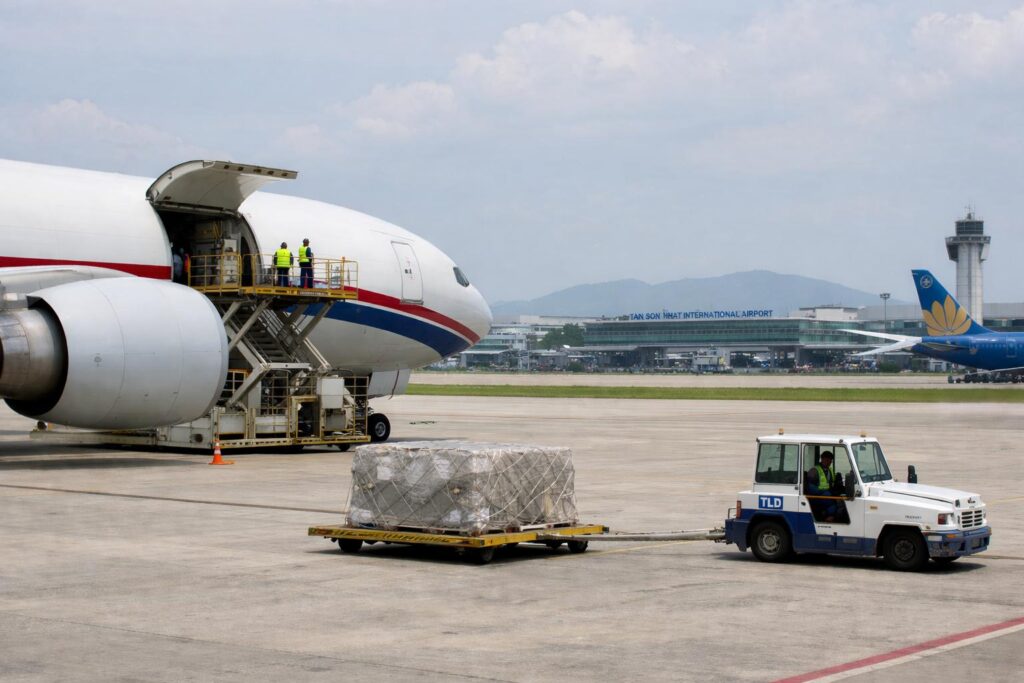
Air freight from China to Vietnam is one of the fastest options in international shipping when you need predictable uplift, frequent schedules, and a clear handover from origin pickup to import release. On the China to Vietnam lane, speed only becomes “real” when the shipping process is organized: correct documents, clean packing, and an importer who can pay taxes and respond quickly.
This guide explains how air freight from China to Vietnam works in practice: the main airports, how shipping costs and freight costs are built, how chargeable weight is calculated, and how the customs clearance process in Vietnam works. You’ll also learn how freight forwarders structure service, how to compare air vs sea freight, and how to choose a reliable freight forwarder for repeat shipments.

Quick snapshot: what most shippers want to know
- Best Vietnam airports: Noi Bai International Airport (HAN), Ho Chi Minh City (SGN), Da Nang International Airport (DAD)
- Typical transit time: 1–3 days airport-to-airport, 3–7 days door to door delivery
- How airlines bill: actual weight vs volumetric weight based on cargo volume
- Biggest delay point: import customs clearance when documents or tax payments are not ready
- Best practice: finalize commercial invoice, packing list, and air waybill details before uplift to ensure smooth customs clearance
When air freight is the right shipping method
Air freight is the best shipping method when time has a direct cost. Many teams choose air transportation for urgent shipments because it protects the supply chain and reduces the risk of missed delivery windows in major cities.
Air transport is most common for:
- urgent shipments and fast replenishment
- high-value, time-sensitive SKUs
- samples and pilot orders
- production-line components where delays are expensive
If you need timely delivery, air freight usually beats slower options because the route is short and airlines operate frequent schedules between China and Vietnam.
When sea freight is smarter on China–Vietnam lanes
Sea freight often wins on unit economics when speed is not critical. If you are moving heavier goods with stable demand, sea freight can reduce logistics costs over time.
Sea freight is commonly used for:
- steady replenishment with flexible delivery windows
- heavier cargo where air freight becomes expensive
- larger orders planned around a container load strategy
Many importers use air or sea freight as a combined plan: air freight for the first batch, then sea freight for the remainder once demand stabilizes.
Airports you should know for China–Vietnam air cargo
Picking the right airport pair is one of the easiest ways to reduce transportation costs and keep the shipping process stable.
Main origin airports in China
Freight forwarders typically export air cargo via:
- Shanghai Pudong (PVG) — best for East China suppliers and stable international uplift. Good choice for regular export volumes and more routing flexibility.
- Guangzhou Baiyun (CAN) — a major South China hub with strong frequency to Vietnam, often a practical option for Pearl River Delta shipments.
- Shenzhen Bao’an (SZX) — commonly used for electronics and fast-moving goods; works well when your supplier is in Shenzhen/Dongguan/Huizhou and you need fast cutoffs.
- Beijing Capital (PEK) / Beijing Daxing (PKX) — suitable for North China origins and project cargo planning, depending on airline space.
For shipping from China, the best origin airport is usually the one closest to your supplier cluster and the one with the most stable uplift for your cargo type.
Main destination airports in Vietnam
Most Vietnam shipping by air goes through:
- Noi Bai International Airport (HAN) — the main gateway for Hanoi and northern Vietnam, often preferred for deliveries into Bac Ninh, Hai Duong, and nearby industrial zones.
- Tan Son Nhat (SGN) — the key airport for Ho Chi Minh City and southern Vietnam; typically offers strong onward trucking and faster distribution for the South.
- Da Nang International Airport (DAD) — a practical hub for central Vietnam distribution, useful when the consignee is closer to Da Nang or when you want to reduce inland trucking distance.
If your consignee is in Ho Chi Minh City, SGN often provides faster onward trucking options. If your consignee is in Hanoi, Noi Bai International Airport is typically the fastest gateway.
Transit time: what’s realistic and what actually changes it
Transit time is not only flight time. Transit time includes warehouse receiving, security screening, export clearance, airline uplift, arrival handling, and the customs clearance process.
Typical planning ranges:
- Airport-to-airport: often 1–3 days after cargo acceptance
- Door to door service: commonly 3–7 days, depending on import customs clearance and local delivery scheduling
- Express delivery: often 2–5 days for small urgent shipments, but still depends on document accuracy and clearance speed
What usually extends transit time:
- incomplete shipping documents
- inconsistent commercial invoice or packing list details
- customs authorities asking for HS code or value clarification
- importer delays in paying import duties or import tax
- regulated goods needing extra checks under customs regulations
For timely delivery, treat transit time as a system. The flight is fast, but paperwork quality and importer readiness decide the outcome.
Shipping costs vs freight costs: what you’re really paying for
When people compare shipping costs, they often look only at the airline line-haul. For air freight from China to Vietnam, that airline line-haul is the freight cost most buyers call “the air freight rate”.
Typical air freight rates from China to Vietnam
Air freight rates change weekly with space and season, but for general cargo on China to Vietnam lanes, many market quotes commonly fall into these ranges.
| Chargeable Weight Tier | Typical Air Freight Rate Range | Notes |
|---|
| 45–99 kg | 1.5–3.5 USD per kg | Small shipments pay a higher per kg level |
| 100–299 kg | 1.0–2.7 USD per kg | Most common B2B tier |
| 300 kg and above | 0.6–2.3 USD per kg | Better pricing with stable volume |
| Express shipping | 3.0–6.5 USD per kg | Faster service, higher cost |
These ranges are used as planning references for air cargo moving from major China airports to Vietnam airports such as HAN, SGN, and DAD. Final rates depend on cargo type, route, and the actual chargeable weight.
What “freight costs” means in your quote
A practical way to review costs is:
- Freight costs: the airline portion billed by chargeable weight
- Local charges: handling, documentation, trucking, and release fees
- Taxes: import duties, customs duties, VAT, and category taxes
Quick example using real quoting logic
If your shipment is 120 kg chargeable weight and the market level is 3.2 USD per kg, the airline freight cost is:
120 kg × 3.2 USD per kg = 384 USD
That number is the freight cost. Your total shipping costs then add local charges and any optional services.
Origin charges when shipping from China
Common origin items in the shipping process include:
- pickup and trucking to the airport warehouse
- warehouse handling and security screening
- export customs declaration and filing with Chinese customs
- document processing fees
For shipping from China, origin charges vary mainly by pickup location, airport choice, and whether your cargo needs special handling.
Destination charges in Vietnam
Typical destination items include:
- terminal handling and document release
- local agent processing
- storage if cargo is not collected quickly
- domestic trucking if you choose direct delivery
Destination charges rise quickly if import customs clearance is delayed and the shipment sits in storage.
A realistic “all-in” budgeting view
For many China to Vietnam shipments, a practical way to budget is:
- freight cost as the main number
- then add local charges and delivery
- then add taxes such as import duties and import tax
That is why two quotes can differ even when the flight route is similar. One quote may show only freight costs, while another includes local charges and door to door delivery.
How airlines bill: chargeable weight, cargo volume, and volumetric weight
Airlines bill air cargo by chargeable weight, which is the greater of:
- actual scale weight
- volumetric weight based on cargo volume
A common formula used in air transportation: Volumetric weight (kg) = L × W × H (cm) ÷ 6000
If your cartons are light but bulky, cargo volume drives the bill, which increases freight costs.
Two ways to reduce surprises:
- measure cartons accurately before booking
- optimize carton dimensions through proper packaging
Proper packaging improves cargo safety and can also reduce volumetric weight.
Step-by-step shipping process for air freight (China → Vietnam)
This is the entire shipping process used by most freight forwarders. If you follow it, the delivery process becomes predictable.
Step 1: Confirm product info and compliance
Before shipping goods, confirm:
- product name, material, and use
- HS code logic and any customs regulations risks
- whether an import license is required
- whether the goods imported include batteries, liquids, powders, or magnets
This prevents rework and supports smooth customs clearance.
Step 2: Prepare complete documentation
To ensure smooth customs clearance, prepare:
- commercial invoice
- packing list
- air waybill details
- any supporting certificates required by customs regulations
Complete documentation is the fastest shortcut to stable transit time.
Step 3: Pickup and airport receiving when shipping from China
Cargo is collected and delivered to the airline warehouse at the origin airport. This is where proper packaging matters most.
What the warehouse typically checks:
- Piece count
- Outer packaging condition
- Labels, including battery and special cargo marks when needed
- Carton dimensions to verify chargeable weight
Why this matters: a wrong dimension estimate changes freight costs and can trigger re-quoting. Proper packaging also improves cargo safety during handling.
Step 4: Export filing and Chinese customs clearance
Your forwarder processes export data and submits the customs declaration. When documents match, Chinese customs clearance is usually straightforward and fast.
Step 5: Airline uplift and flight
Once accepted, air transport is quick. Most timeline risks happen before uplift or during import customs clearance after arrival.
Step 6: Arrival handling and import customs clearance in Vietnam
After landing at HAN, SGN, or DAD, the shipment moves into arrival handling and import customs clearance. This is often the step that decides the final delivery timeline.
What usually affects clearance speed:
- Document consistency across the invoice, packing list, and air waybill
- HS code accuracy and whether the declared value makes sense
- Importer readiness to reply quickly and pay import duties and import tax on time
- Whether customs selects the shipment for inspection
Step 7: Release and delivery steps
After customs release, delivery usually follows one of these three paths:
- Airport to airport
The consignee or local agent picks up the cargo at the airport terminal. - Airport to door
Local trucking delivers the cargo directly from the airport to the final address. - Door to door service
The forwarder manages the full process from release to final delivery, including local handling and trucking.
Customs clearance in Vietnam: how the process works in real life
Most delays on China–Vietnam air cargo happen here. The customs clearance process is usually fast when shipping documents are clean and tax payment is ready.
What Vietnam customs and Vietnamese customs typically check
Vietnam customs and Vietnamese customs officers generally focus on:
- HS code classification and whether it matches the goods imported
- declared value consistency across documents
- whether permits or an import license is required
- whether the shipment triggers inspection based on risk rules
- whether the importer can pay import duties and import tax quickly
If you want smooth customs clearance, avoid vague descriptions like “accessories.” Use product-specific wording.
The customs clearance process, simplified
A typical customs clearance process includes:
- submit shipping documents to the broker system
- classification and value review by customs authorities
- duty and tax assessment
- inspection decision, if selected
- payment confirmation
- release for pickup or direct delivery
To ensure smooth customs clearance, align product name, quantity, and value across the commercial invoice, packing list, and air waybill data.
Import duties, import tax, and other Vietnam taxes
Vietnam taxes depend on the HS code, product category, and declared origin. Plan taxes early, because slow payment is a common reason shipments sit after arrival.
Common taxes and charges include:
- import duties
- import tax, including VAT
- special consumption tax for certain categories
- environmental protection tax for certain categories
Import tariffs and preferential tariffs
Import tariffs vary by HS code. In some cases, preferential tariffs may apply, but only when the origin rules are met and the supporting documents are correct. Preferential tariff rates are not automatic and usually require consistent classification and valid origin proof.
Free trade agreement notes
A free trade agreement may reduce duties for qualifying goods imported, but only if the paperwork and rules of origin are satisfied. If you plan to claim preferential tariffs, confirm the required documents before shipping from China.
Explore more shipping guides:

Shipping documents checklist: what you must get right
Many delays are document problems, not transport problems. Treat shipping documents as part of the shipping process, not an afterthought.
Core shipping documents for most shipments:
- Commercial invoice
- Packing list
- Air waybill
- Any certificates required by customs regulations
- An import license if the category requires it
- MSDS for batteries, chemicals, liquids, or powders when applicable
Air or sea freight: how to choose fast without overpaying
Most buyers compare air or sea freight by price only, but the better comparison includes inventory cost and delay risk.
Use air or sea freight decision rules:
- choose air freight when delays harm your supply chain or sales
- choose sea freight when demand is predictable and weight is high
- use a hybrid plan when launching a product and scaling afterward
Air vs Sea Freight comparison table (China–Vietnam)
| Shipping Method | Typical Transit Time | How It’s Billed | Best For | Notes |
|---|
| Air freight | 1–3 days airport-to-airport; 3–7 days door to door delivery | Chargeable weight (actual vs volumetric) | Urgent shipments, fast replenishment | Cargo volume can raise freight costs quickly |
| Sea freight / ocean freight | 5–12+ days | CBM or container pricing | Heavy cargo, stable supply chain planning | Better unit economics when time is flexible |
| Hybrid: air then sea | Mixed | Mixed | Launch + steady restock | Strong planning required across shipping documents |
Sea freight basics: container load and full container load planning
If you switch to sea freight, planning is mainly about using container space efficiently.
- Container load (LCL): best when your shipment is smaller and you share space with other cargo.
- Full container load (FCL): best when your volume is stable and you want fewer handling touches.
In general, full container load is easier to schedule and track for repeat shipments, while container load via LCL is more flexible for smaller volumes.
Freight forwarders: how to choose the right partner
Freight forwarders are not interchangeable. The difference is execution: accuracy on chargeable weight, document discipline, and how they manage the customs clearance process.
What a reliable freight forwarder does
A reliable freight forwarder usually provides:
- clear scope in the quote so shipping costs are comparable
- accurate weight and dimension confirmation before booking
- document pre-check to ensure smooth customs clearance
- routing guidance between PVG, CAN, SZX, HKG and HAN, SGN, DAD
- practical advice for import customs clearance and delivery steps
Trusted freight forwarder vs cheap quote
A trusted freight forwarder prevents surprise destination fees and rework. A cheap quote may exclude handling, delivery steps, or storage risk.
Tailored shipping solutions
Good freight forwarders offer tailored shipping solutions based on:
- your shipping method target and delivery window
- cargo type and customs regulations
- whether you want airport pickup or door to door service
- your importer readiness to pay import tax and import duties
If you want competitive pricing, request a transparent breakdown of freight costs, origin charges, destination charges, and delivery.
Risk control: cargo insurance, cargo safety, and damage prevention
Even on short lanes, damage and loss happen. Cargo safety improves when you focus on packaging and handling discipline.
Cargo insurance and insurance cover
Cargo insurance can protect high-value shipments, new lanes, and first orders. Insurance cover is especially useful when replacement lead times would disrupt your supply chain.
Practical cargo safety steps
- use proper packaging with edge protection
- minimize empty space inside cartons
- label correctly for handling
- palletize when appropriate for transporting goods
These steps reduce claims and support stable delivery outcomes.
Cost reduction without delaying clearance
Cost reduction should not create delays in the customs clearance process. The best cost reduction levers usually improve speed too.
Strong cost reduction actions:
- reduce volumetric weight by optimizing carton dimensions
- consolidate shipments to reduce minimum charges
- finalize shipping documents early to avoid storage and rework
- choose the closest practical export airport when shipping from China
- confirm taxes and payment readiness before arrival
This lowers logistics costs and protects timely delivery.
Practical notes for Vietnam shipping by region
Vietnam shipping works best when you align the destination airport with the receiving region. This reduces inland transportation costs, shortens the delivery process, and improves timely delivery—especially for urgent shipments.
Recommended airport by region:
- Hanoi and the North: Noi Bai International Airport (HAN)
Best for deliveries into Hanoi, Bac Ninh, Hai Duong, and nearby industrial zones. Less domestic trucking time usually means a smoother delivery process. - Ho Chi Minh City and the South: SGN (Tan Son Nhat)
Best for Ho Chi Minh City and southern distribution. SGN often has more flexible trucking options and faster handover for direct delivery. - Central Vietnam distribution: Da Nang International Airport (DAD)
Best when your consignee is closer to Da Nang or the central corridor. DAD can reduce domestic trucking distance and transportation costs.
Operational tips that protect timely delivery:
- If the consignee is in major cities, schedule trucks around warehouse receiving cutoffs and local traffic peaks to avoid missed appointments and extra waiting fees.
- Confirm who is handling import customs clearance and who will pay duties/VAT before the flight lands—payment delays are a common reason Vietnam shipping timelines slip.
- For shipping China operations, don’t promise a delivery window until you’ve confirmed warehouse cutoff times, document readiness, and importer payment readiness. That’s the difference between “fast” and “actually delivered on time.”
Frequently Asked Questions (FAQ)
How long does air freight from China to Vietnam take?
Transit time is often 1–3 days airport-to-airport after cargo acceptance, and commonly 3–7 days with door to door service. The biggest variable is import customs clearance, not flying time.
What affects shipping costs the most?
Shipping costs depend mainly on chargeable weight, cargo volume, route, and service scope. Freight costs rise quickly when volumetric weight exceeds actual weight. Destination handling and delivery steps also change the final total.
What documents are required for customs clearance in Vietnam?
Most shipments need a commercial invoice, packing list, air waybill, and any certificates required by customs regulations. Some goods imported require an import license. Missing shipping documents is a common reason the customs clearance process slows.
How can I ensure smooth customs clearance?
Use complete documentation, keep product descriptions specific, align values and quantities across documents, and make sure the importer can pay import duties and import tax immediately when assessed. This is the fastest way to get smooth customs clearance.
Should I choose air or sea freight for China–Vietnam shipments?
Choose air or sea freight based on urgency and weight. Air freight is best for urgent shipments and tight deadlines. Sea freight and ocean freight are better for heavier cargo and stable replenishment, especially if you can plan container load cycles or full container load shipments.
Which Vietnam airport should I use: HAN, SGN, or DAD?
Use Noi Bai International Airport for Hanoi and northern Vietnam, SGN for Ho Chi Minh City and the south, and Da Nang International Airport for central Vietnam distribution. Airport choice can reduce trucking time and logistics costs.
Do free trade agreement rules reduce import tariffs?
A free trade agreement may support preferential tariffs and preferential tariff rates for eligible goods imported, but only when origin rules and documents are correct. Confirm HS code eligibility, origin proof requirements, and importer filing details before shipping from China—otherwise the shipment may be assessed under standard import tariffs.
How do I choose freight forwarders for China to Vietnam shipments?
For China to Vietnam lanes, good freight forwarders do three things well: confirm chargeable weight early, check documents before flight, and coordinate import customs clearance quickly. When you compare freight forwarders, ask for a clear quote scope, the exact airport routing, and how they handle customs clearance process delays.
What information should I send freight forwarders to get an accurate China to Vietnam quote?
To avoid re-quotes, send freight forwarders the exact details for China to Vietnam: product name and photos, cartons and dimensions, gross weight, pickup city in China, delivery city in Vietnam, and whether you need airport pickup or door to door delivery. This is the fastest way to price international shipping accurately and keep shipping goods on schedule.
Who pays customs duties for China to Vietnam international shipping?
Customs duties are usually paid by the importer in Vietnam unless your agreement says otherwise. Before shipping goods from China to Vietnam, confirm who pays customs duties, import duties, and import tax, and confirm payment timing. Late payment is one of the most common reasons international shipping delays happen after arrival.
Conclusion
Air freight from China to Vietnam stays fast when you control three things: the right airport routing, accurate chargeable weight, and clean documents for customs clearance. Most delays come from the customs clearance process and tax payment readiness, not the flight.
Tonlexing supports China–Vietnam shipments with clear pricing and a stable shipping process, including airport-to-airport and door to door service. For an accurate quote, send your cargo name, cartons and dimensions, gross weight, pickup city in China, destination city in Vietnam, and whether you need airport pickup or door to door delivery.