
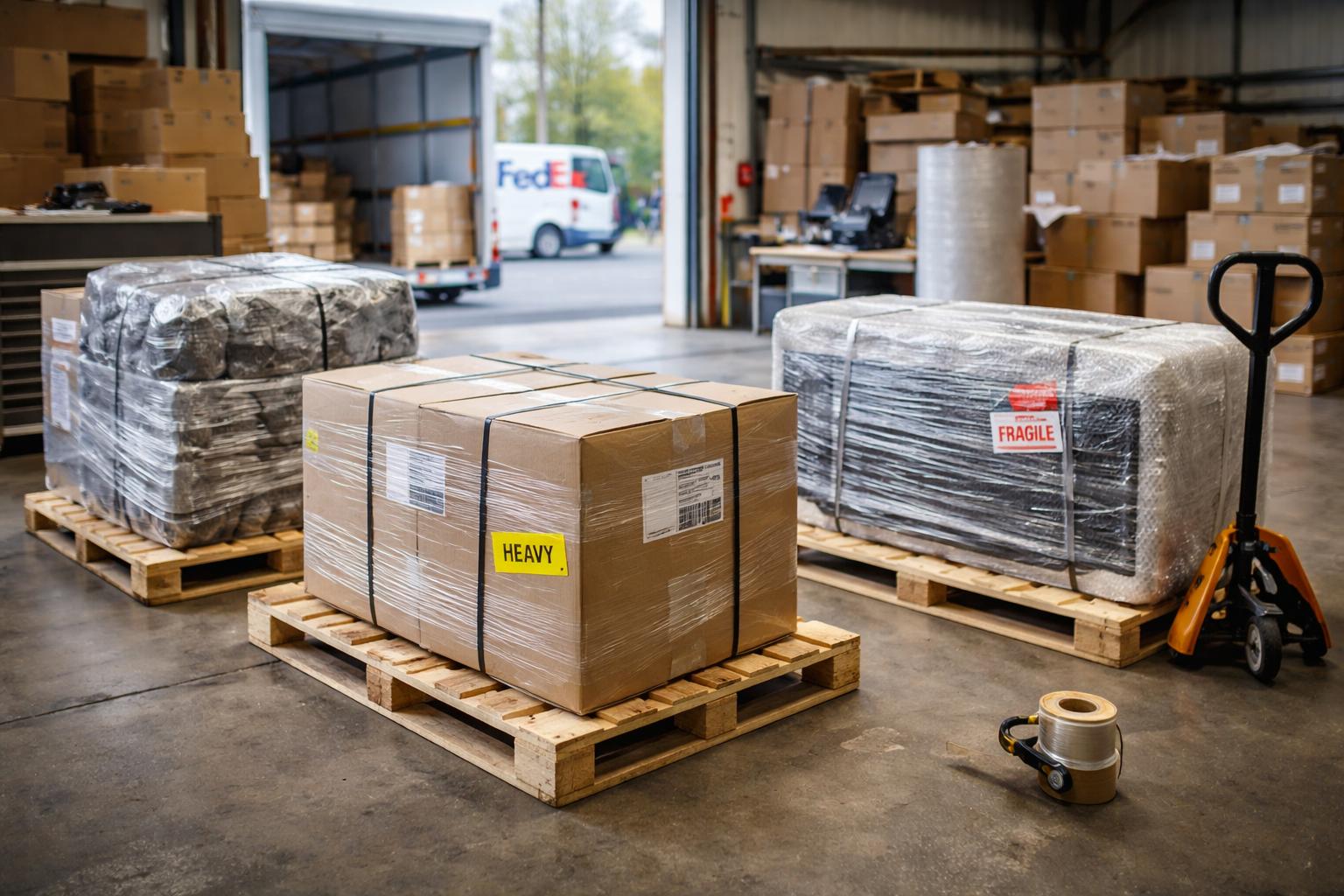
Cheapest Way to Ship Heavy Large Items (2026)

Shipping heavy, large items costs more than standard parcels because carriers price by dimensional weight, oversize rules, and delivery surcharges—not just the scale weight.

This updated 2026 guide explains the cheapest way to ship heavy large items using USPS, UPS, FedEx, and freight services. It covers when USPS Ground Advantage, Priority Mail, and flat rate boxes make sense, when UPS Ground or FedEx Ground is usually cheaper for heavy packages, and when LTL freight and palletized shipments become the most cost-effective option. You’ll also learn how shipping zones, dimensional weight pricing, and additional fees impact total shipping costs—and how to compare rates accurately to avoid rerates.

Cheapest carrier

USPS vs UPS vs FedEx

LTL freight / Oversize fees

Cheapest Way to Ship Heavy Large Items (2026)
10,000+ international shipments handled    Global sea, air & DDP shipping solutions    24/7 shipment tracking & customer support

Table of Contents

Heavy vs Large Packages: How to Choose Ground Shipping or Freight

Shipping gets expensive for two different reasons: your box is heavy, or your box is large. Carriers price these differently, so the cheapest option depends on which one applies to your shipment.

Heavy packages

A package is “heavy” when actual weight is high, typically 70 lb+.
Heavy boxes may cost more because carriers charge higher rates for heavier tiers and may add heavy-handling fees.

Large packages

A package is “large” when its dimensions drive the price, even if it is not very heavy. This usually happens when DIM weight is higher than actual weight.
A common oversize warning sign is a long carton (around 48 in+ on the longest side) or an overall size close to a carrier’s oversize rules. Large boxes are more likely to trigger dimensional weight charges and oversize surcharges.

Weight limits

Parcel services typically accept up to 150 lb per package.
If you are over that limit, you need freight shipping, usually LTL or a palletized shipment.

Choose ground shipping or freight

Use standard ground shipping when:

  • The carton is not oversized

  • You have one heavy box or a small number of cartons

  • You want simple pickup and tracking

This is where USPS Ground Advantage, UPS Ground, UPS Ground Saver, and FedEx Ground are usually the cheapest options.

Use freight when:

  • The box is bulky or long enough to trigger oversize fees

  • You have multiple heavy boxes that should move together

  • Your parcel quote jumps because of DIM weight or extra fees

Freight can be cheaper even under 150 lb when the carton is big enough to make parcel pricing “space-priced” instead of “weight-priced.”



Quick Decision Matrix: Cheapest Options by Weight, Size, and Speed

Use this table as a fast filter before you start shopping.

Your shipmentTypical cheapest optionsWhat usually decides the winner
Under 70 lb, compactUSPS Ground Advantage, sometimes USPS Priority MailShipping zones, carton size, delivery time needs
Heavy but small and fits safelyUSPS flat rate boxes, flat rate shippingFit and protection quality, distance
70–150 lb parcel sizedUPS Ground vs FedEx Ground, sometimes UPS Ground SaverDim weight, carrier surcharges, residential delivery
Bulky or near oversize thresholdsFreight services, LTLOversized packages fees vs freight accessorials
Over 150 lb or multiple cartonsless than truckload, palletized shipmentsPallet footprint, accessorials, business vs residence

If you only do one thing: price two scenarios. One is your current carton. The other is a smaller carton or a palletized option. Often the cheapest carrier changes once the packaging changes.

Shipping Costs Explained: What You Actually Pay For

Most people focus on base shipping rates and miss the full bill. Real shipping costs include:

Base transportation

This is the shipping price for moving your package from origin to destination. It mainly depends on:

  • Distance and shipping zones

  • Service level such as ground, priority, or express

  • Carrier capacity and current demand

Billable weight

Carriers don’t always charge by the scale weight. They charge by billable weight, which is the higher of:

  • Actual weight

  • DIM weight from dimensional weight pricing

If your box is bulky, you may pay for space, not pounds. This is the most common reason large packages feel expensive.

Additional fees and carrier surcharges

These are the deal-breakers. Common carrier surcharges and extra fees include:

  • Oversize and large package charges

  • Additional handling fees for heavy boxes

  • Residential delivery surcharge

  • Remote area surcharge

  • Address correction and delivery change fees

  • Signature services and declared value coverage

Packaging and damage

For heavy items, packaging isn’t just protection—it affects cost. A stronger carton and tighter packing can:

  • Reduce DIM weight by shrinking the box size

  • Lower damage and return risk

  • Prevent delays from broken packaging

Quick takeaway: the cheapest shipping option is the one with the lowest all-in shipping costs after billable weight and extra fees are included, not the lowest base rate you see at the start.

How Dim Weight Changes Everything

If you want to rank for “how dimensional weight works” and also save money in real life, focus here. Dimensional weight pricing is the most important pricing mechanism for large packages.

Carriers calculate a billable weight based on dimensions. If this dim weight is higher than the actual weight, you pay the higher number. That is why people ask “how dimensional weight” increases costs and why dimensional weight charges surprise shippers.

How to reduce costs without risking damage

To reduce costs:

  • Use the smallest strong carton that safely fits the item

  • Reduce carton height with better internal packing

  • Avoid airy void fill that forces a bigger box

  • Measure after taping, not before

A small cut in one dimension can remove a surcharge or lower the billed weight. This is often the fastest path to saving money.

For many domestic shipments, the postal service (USPS) is one of the cheapest ways to ship heavy items—as long as the box is not oversized. USPS pricing works best when your package is compact, your weight is accurate, and you choose the service that matches your speed needs.

USPS Ground Advantage

USPS Ground Advantage is usually the cheapest USPS option when you can accept standard delivery speed.

Use USPS Ground Advantage when:

  • Your package is compact and within normal size rules

  • You want the lowest shipping costs and do not need fast delivery

  • Your item is dense, so the box size does not inflate the billed weight

It is a strong baseline for most everyday heavy shipments that are not oversized.

USPS Priority Mail

USPS Priority Mail is the better choice when you want faster delivery than ground, especially for longer distances.

Choose Priority Mail when:

  • You need faster delivery time than ground

  • Your box is still compact enough to avoid large size penalties

  • You want a simple balance of speed and price

Priority Mail is not always the cheapest, but it often makes sense when time matters.

Priority Mail Express

Priority Mail Express is mainly for speed. It is rarely the cheapest way to ship heavy large items, but it can be the right option when you must meet a tight delivery deadline.

USPS Flat Rate Boxes and Flat Rate Shipping

USPS flat rate boxes can be the cheapest option when the item is heavy but small enough to fit safely. Flat rate pricing is helpful because it does not change much with distance, so it can perform well across multiple shipping zones.

Flat rate is usually best when:

  • Your item is heavy and dense

  • The box closes normally and does not bulge

  • You can protect corners and seams so the box does not fail

Common flat rate options include standard flat rate boxes and the Large Flat Rate Box. If your item fits comfortably, flat rate shipping can beat many ground quotes for long-distance shipments.

Flat rate is usually not ideal when:

  • The fit is tight and the box may split

  • The item needs extra padding that prevents proper closure

  • The shipment is local and ground shipping is already cheap

Simple rule:

  • Use Ground Advantage for the lowest cost when your box is compact and speed is not urgent.

  • Use Priority Mail when you need faster delivery.

  • Use Flat Rate only when the item fits safely and the box closes properly.

UPS Ground vs FedEx Ground

For heavier parcel shipments, the main comparison is UPS Ground vs FedEx Ground. Many people ask, “Is UPS or FedEx cheaper for heavy packages?” The accurate answer depends on lane, size, and fees.

UPS Ground

UPS Ground often performs well for heavy packages that are dense and not oversized. It becomes even more cost effective when you have a business account and can access carrier discounts.

FedEx Ground

FedEx Ground can be very competitive when your box stays within standard dimension rules and avoids oversized penalties. Many shippers see strong pricing through negotiated programs or online tools.

UPS Ground Saver

UPS Ground Saver can reduce costs when delivery time is flexible. If you can accept slower shipping speed, it may be one of your cheapest options on certain lanes.

The key is to compare rates using identical measurements and the correct address type. One inch in carton size can change which carrier looks cheapest.

Oversized Packages, Oversized Shipments, and the Fees That Kill “Cheap” Labels

Oversized packages are where “cheap” shipping quotes break. Many shipments turn expensive because of oversized shipments rules and handling surcharges.

Typical additional fees include:

  • Oversize or large package surcharge

  • Additional handling for heavy packages

  • Irregular shape surcharge

  • Long-package surcharge

  • Residential delivery surcharge

If a carrier requires a heavy package sticker or special markings, follow the rules. Proper labeling helps prevent handling mistakes and improves reliable delivery.

If you are near a threshold, repack and re-measure. A smaller carton can eliminate extra fees and reduce shipping costs immediately.

Chinese logistics companies specializing in transporting heavy and large items - freight forwarders

Freight Services and Less Than Truckload

When parcels become bulky or you have multiple cartons, freight services often become the cheapest category. The most common option is less than truckload.

Why less than truckload is cost effective

Less than truckload consolidates freight shipments from many shippers in one trailer. You pay for the space and handling profile instead of paying parcel oversize penalties. It is often the cheapest way to move:

  • Furniture, appliances, gym equipment

  • Machinery and large boxed equipment

  • Multiple cartons consolidated together

You may see quotes from networks such as FedEx Freight or UPS Freight. In many lanes, carrier choice matters less than accessorial costs.

Freight shipping costs depend on accessorials

The biggest freight cost drivers often include:

  • Residential delivery vs commercial delivery

  • Liftgate needs

  • Appointment delivery

  • Limited access locations

If you can deliver to a business address with dock access, freight shipping can become dramatically cheaper.

Palletized Shipments

If you are shipping multiple packages or multiple heavy boxes, palletizing is often the most cost effective strategy.

Benefits of palletized shipments:

  • Fewer handling touches, reducing damage

  • Better stability for heavy shipments

  • Often lower total shipping costs than buying many parcel labels

  • More predictable freight shipments performance

  • Use a pallet footprint that matches your load

  • Strap the load firmly, then wrap tightly

  • Add corner boards so straps do not cut packaging

  • Keep the load stable and stackable when possible

Palletizing is not only a freight tip. It is a damage-control tip and a cost-control tip. Fewer touches usually means fewer claims and more reliable delivery.

Bulk Shipping Discounts, Carrier Discounts, and Business Account Strategies

Retail counter pricing is rarely the cheapest. If you ship regularly, pricing structure becomes your advantage.

To reduce shipping costs long-term:

  • Open a business account

  • Ask for carrier discounts tied to monthly volume

  • Standardize cartons so billing is predictable

  • Reduce claims and delivery exceptions

  • Use online tools that help you compare rates across multiple carriers

Bulk shipping does not require huge volume. Even moderate volume can unlock better pricing tiers and stable rates. Over time, these structural improvements beat one-off hacks.

How to Compare Rates Correctly and Avoid Rerates

Many shippers lose money because they compare rates with estimated dimensions and weight. Heavy shipments are commonly rerated.

Before buying shipping labels, confirm:

  • Final packed dimensions after taping

  • Final weight on a reliable scale

  • ZIP codes and address type to reflect shipping zones

  • Residential delivery or commercial delivery

  • Delivery time expectations and acceptable shipping speed

Then compare across the key services:

  • USPS Ground Advantage

  • USPS Priority Mail and Priority Mail Express

  • UPS Ground and UPS Ground Saver

  • FedEx Ground

  • Freight services and less than truckload for bulky shipments

If your carton is near an oversize boundary, run two packaging scenarios. Often the cheapest way to ship is simply a smaller carton.

Practical Scenarios: Cheapest Way to Ship Heavy Large Items by Use Case

Scenario A: Heavy but compact item

Cheapest options often include USPS Ground Advantage or a competitive UPS Ground or FedEx Ground label. USPS Priority Mail can be attractive when delivery speed matters.

Scenario B: Large package with moderate weight

Dim weight dominates. Your best move is to reduce carton size and re-check the billable weight. This is usually faster than changing carriers.

Scenario C: Heavy package traveling across several shipping zones

Compare UPS Ground and FedEx Ground first, then test USPS Priority Mail and flat rate shipping if the item fits safely in flat rate boxes.

Scenario D: Multiple heavy boxes for one customer

Check whether palletized shipments through freight shipping beat buying multiple parcel labels. This is especially true for heavier shipments and bulky cartons.

Scenario E: Residential delivery with bulky items

Residential delivery surcharges can be high on both parcel and freight. Test a business address option if possible. Freight can win if parcel triggers oversized packages fees.

Packaging Checklist to Reduce Costs and Improve Reliable Delivery

A cost effective shipping plan uses packaging to control billable weight and reduce damage.

For parcel shipments:

  • Use double-wall cartons for heavy boxes

  • Reinforce seams and corners

  • Prevent internal shifting with solid cushioning

  • Keep the carton as small as safely possible to reduce dim weight

For freight shipments:

  • Strap and wrap securely

  • Protect corners and edges

  • Keep the load stable

  • Use a pallet footprint that matches the load to avoid paying for unused space

If you want “cheapest carrier” results, packaging is your lever. It reduces dimensional weight charges, avoids oversized shipment fees, and improves reliable delivery.

International Shipping and Special Cases: What Changes for International Shipments

For international shipping, heavy items become expensive quickly if you rely on air parcel. For many international shipments, freight services become the cheapest path for bulky loads.

General rules:

  • Small and dense: postal service options may be cost effective

  • Bulky or heavy: freight shipping is often cheaper

  • Multiple cartons: consolidate for lower per-unit cost

International shipping costs also include customs steps, duties, and destination handling, so focus on all-in shipping costs, not only the label price.

Special cases:

  • Media Mail can be very cheap but only for eligible media. It is not a general solution for large packages.

  • Hazardous materials can restrict acceptance and require special packaging and paperwork. When hazmat applies, the cheapest way is the cheapest compliant way.

Quick Cheat Sheet: Cheapest Options Summary

  • Under 70 lb and compact: start with USPS Ground Advantage, then compare UPS Ground and FedEx Ground.

  • Heavy but small: consider USPS flat rate boxes and flat rate shipping, including the Large Flat Rate Box if the fit is safe.

  • 70–150 lb parcel sized: compare UPS Ground vs FedEx Ground, test UPS Ground Saver if delivery time is flexible.

  • Bulky or multiple cartons: compare freight services and less than truckload, especially palletized shipments.

  • Oversized packages: reduce carton size first. If you cannot, freight shipping often becomes cheapest.

Frequently Asked Questions

Compare Shipping Rates for Heavy & Large Items

  • Side-by-side quotes from USPS, UPS, FedEx, and freight

  • DIM weight + oversize fee check to prevent rerates

  • Best-value option based on weight, size, and delivery time

Get accurate pricing with your packed dimensions, shipping zones, and address type—then choose the cheapest option confidently.