

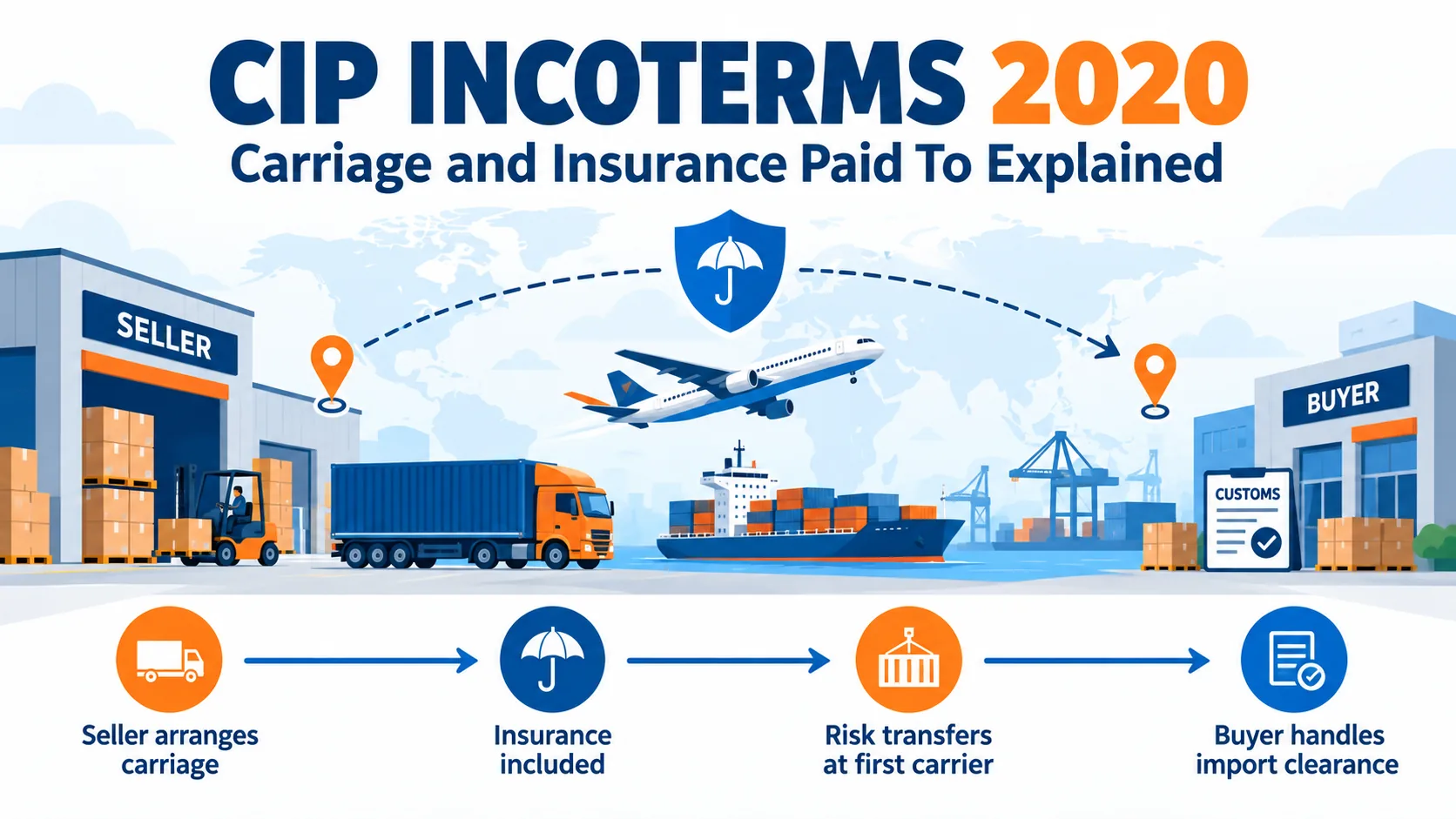
CIP Incoterms 2020: Carriage and Insurance Paid To Explained
- Verified & Reviewed · Last updated September 2026
CIP (Carriage and Insurance Paid To) is an Incoterms 2020 rule where the seller arranges and pays for transportation and cargo insurance to the named destination. However, the risk transfers to the buyer once the goods are handed to the first carrier.
Unlike CIF, CIP applies to all transport modes, including air, sea, rail, road, and multimodal shipping. Understanding CIP responsibilities helps importers manage freight costs, insurance, and shipping risks.
CIP Incoterms 2020
Insurance Requirements
Seller & Buyer Responsibilities
- Experienced China-based logistics specialists
10,000+ international shipments handled Global sea, air & DDP shipping solutions 24/7 shipment tracking & customer support
Quick Answer: What Is CIP Incoterms?
| Item | CIP Rule |
|---|---|
| Full name | Carriage and Insurance Paid To |
| Incoterms version | Incoterms 2020 |
| Transport modes | Any mode of transport |
| Freight cost | Paid by seller |
| Insurance | Arranged and paid by seller |
| Risk transfer | When goods are handed to the first carrier |
| Export customs | Seller responsibility |
| Import customs | Buyer responsibility |
CIP means the seller delivers the goods to a carrier chosen by the seller and pays transportation and insurance costs until the agreed destination. The buyer becomes responsible for the risk after the goods are delivered to the first carrier.
Table of Contents
What Does CIP Mean in Incoterms?
CIP stands for Carriage and Insurance Paid To.
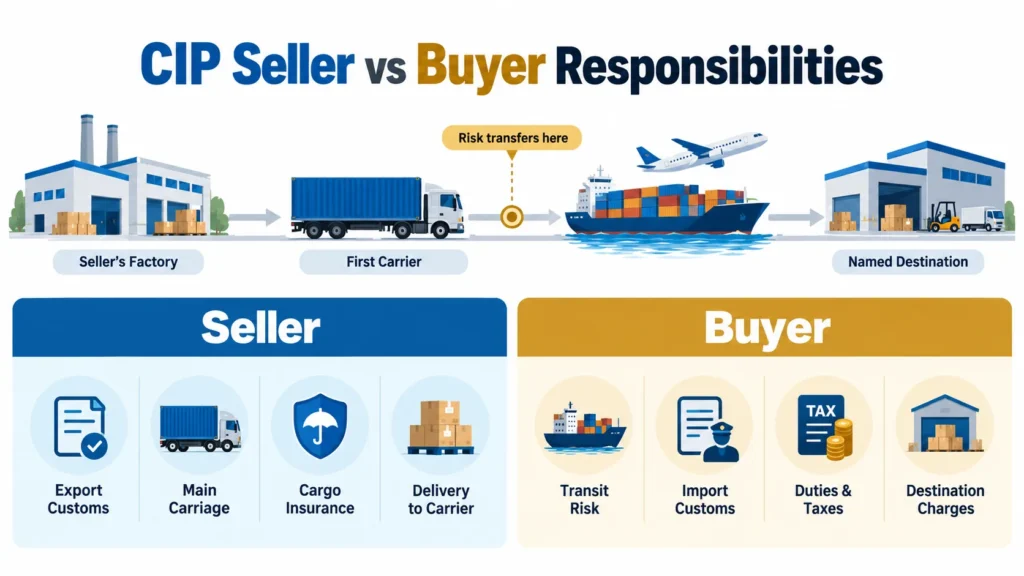
Under CIP Incoterms 2020, the seller has several obligations:
Prepare and package the goods
Complete export customs clearance
Arrange transportation
Pay freight costs to the named destination
Obtain cargo insurance according to Incoterms requirements
The buyer is responsible for:
Import customs clearance
Import duties and taxes
Local charges after arrival
Any additional insurance coverage if required
The key point of CIP is that payment responsibility and risk responsibility are separated.
The seller pays the transportation cost, but the risk transfers earlier when the goods are handed over to the first carrier.
For example, if a Chinese supplier ships machinery under CIP terms to Germany:
The seller pays the freight from China to Germany.
The seller arranges cargo insurance.
The buyer takes the risk once the machinery is handed to the first carrier in China.
How CIP Incoterms Works Step by Step
The CIP shipping process usually follows these steps:
Step 1: Seller prepares the goods
The seller is responsible for manufacturing, packing, and preparing the cargo according to the sales contract.
The goods must be ready for export and properly packaged for international transportation.
Step 2: Seller handles export procedures
Before shipment leaves the exporting country, the seller completes:
Export declaration
Export documentation
Required permits or licenses
The buyer does not normally handle export formalities under CIP.
Step 3: Seller delivers goods to the first carrier
This is the most important point in CIP.
The seller delivers the goods to the first carrier at the agreed location.
At this moment:
Delivery is completed
Risk transfers from seller to buyer
The seller may still continue paying transportation costs after this point, but the buyer bears the transportation risk.
Step 4: Carrier transports goods to destination
The seller pays the agreed transportation cost to the named destination.
Depending on the shipment, transportation may include:
Truck transport
Air freight
Multimodal transport
Step 5: Buyer handles import procedures
When the shipment arrives at the destination country, the buyer manages:
Import customs clearance
Duties and taxes
Local delivery after import clearance
CIP Seller and Buyer Responsibilities
The responsibilities under CIP can be summarized as follows:
| Responsibility | Seller | Buyer |
|---|---|---|
| Export customs clearance | Handles export declaration | Not responsible |
| Main transportation | Arranges and pays freight | Receives goods |
| Cargo insurance | Provides required insurance | Can purchase extra coverage |
| Import customs clearance | Not responsible | Handles import procedures |
| Import duties and taxes | Not responsible | Pays applicable charges |
| Risk after first carrier | No longer bears risk | Assumes risk |
CIP Insurance Requirements Under Incoterms 2020
One of the major updates in Incoterms 2020 CIP rules is the increased insurance requirement.
Under CIP, the seller must obtain insurance coverage that complies with:
Institute Cargo Clauses (A) or equivalent coverage.
This provides broader protection compared with CIF, which normally requires minimum insurance coverage under Institute Cargo Clauses (C).
The insurance must cover:
At least 110% of the contract value
The buyer as the beneficiary
The transportation period according to the contract requirements
However, buyers should understand that insurance does not change the risk transfer point.
Even though the seller purchases insurance, the buyer assumes the transportation risk after the goods are handed to the first carrier.
CIP Risk Transfer Explained
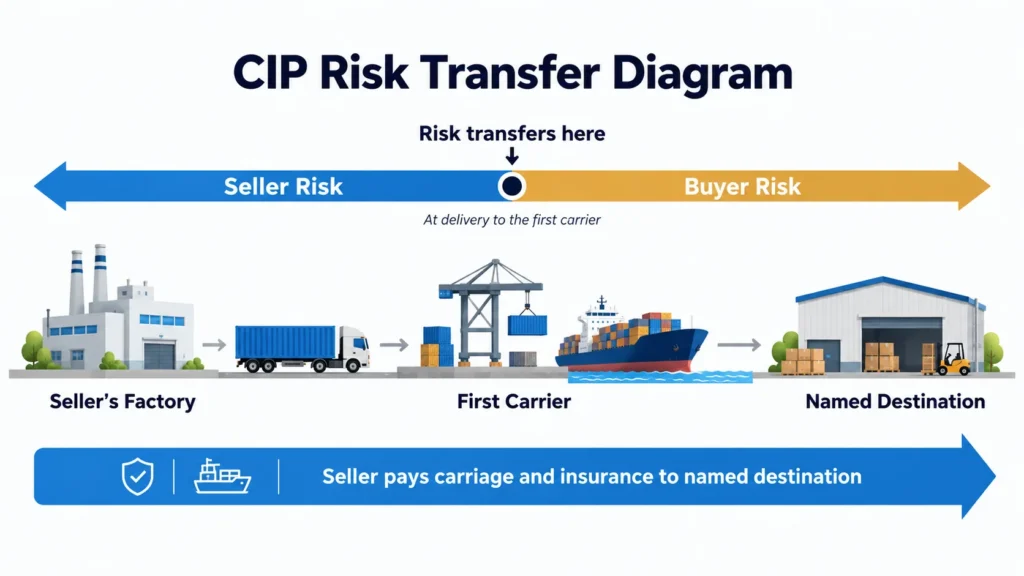
One of the most important points under CIP Incoterms 2020 is that the risk transfer point is different from the place where the seller pays transportation costs.
Under CIP, the seller arranges and pays for carriage and insurance to the named destination. However, the seller does not normally keep the transportation risk until the cargo reaches that destination.
The risk transfers from the seller to the buyer when the goods are delivered to the carrier at the agreed place of delivery. If several carriers are involved and no more specific delivery point is agreed, this is generally when the goods are handed to the first carrier.
For example, a supplier ships machinery from Shenzhen to Paris under CIP Paris. The seller may pay the freight and insurance all the way to Paris, but the risk can transfer much earlier when the machinery is handed to the first carrier in Shenzhen.
| Shipping Stage | Risk |
|---|---|
| Before handover to the carrier | Seller |
| Goods delivered to the agreed carrier | Risk transfers to buyer |
| International transportation | Buyer |
| Arrival at the named destination | Buyer |
This distinction is important because CIP separates cost from risk: the seller may continue paying transportation expenses after the buyer has already assumed the risk of loss or damage.
If cargo is damaged after the risk has transferred, the buyer would normally rely on the cargo insurance arranged by the seller under the CIP agreement.
CIP vs CPT vs CIF Incoterms
CIP, CPT, and CIF are often compared because all three can involve seller-paid transportation. However, their insurance requirements and applicable transport modes are different.
| Item | CIP | CPT | CIF |
|---|---|---|---|
| Full name | Carriage and Insurance Paid To | Carriage Paid To | Cost, Insurance and Freight |
| Freight payment | Seller | Seller | Seller |
| Insurance | Required | Not required | Required |
| Risk transfer | When goods are handed to the carrier | When goods are handed to the carrier | When goods are on board the vessel |
| Transport mode | Any mode | Any mode | Sea and inland waterway only |
| Common use | Air, rail, road, multimodal | Air, rail, road, multimodal | Ocean shipments |
The main difference between CIP and CPT is insurance. Under CIP, the seller must arrange cargo insurance, while CPT does not require the seller to provide insurance.
The main difference between CIP and CIF is the transport mode and insurance level. CIP can be used for any mode of transport and generally requires broader insurance coverage, while CIF is limited to sea and inland waterway transport and normally requires minimum insurance coverage.
For containerized cargo, air freight, rail freight, road transport, and multimodal shipments, CIP is usually the more relevant comparison term, while CIF is mainly used for traditional ocean shipments.
When Should You Use CIP Shipping Terms?
CIP can be a practical choice in several situations.
High-value cargo
Products such as:
Precision instruments
may benefit from stronger insurance requirements.
Air freight shipments
CIP is frequently used for air transportation because CIF cannot apply to air freight.
Example: A buyer imports electronic components from Shenzhen to Germany by air.
Under CIP:
Seller books air freight
Seller provides insurance
Buyer manages German import clearance
Multimodal transportation
CIP works well when cargo moves through multiple transportation stages.
For example:
Factory pickup → Truck → Rail → Ocean → Local delivery
Common Mistakes When Using CIP
CIP can look straightforward, but problems often happen when the contract does not clearly define the delivery point, insurance terms, or import responsibilities. The following mistakes are especially common in international shipments.
Confusing Freight Payment with Risk Responsibility
A common misunderstanding is that the seller remains responsible for the cargo because the seller pays the freight to the named destination.
Under CIP, this is not the case. Risk transfers when the goods are delivered to the agreed carrier, even though the seller continues to pay transportation costs to the destination.
Using an Unclear Named Place
The contract should state the named destination as precisely as possible.
For example: CIP Frankfurt Airport, Germany, Incoterms 2020 is clearer than simply writing: CIP Germany
A precise location helps avoid disputes over where the seller’s freight obligation ends and which local charges belong to the buyer.
Assuming CIP Includes Import Duties and Taxes
CIP does not mean the seller handles the entire import process.
The buyer is normally responsible for:
Import customs clearance
Import duties
VAT or other local taxes
Import permits when required
Buyers should calculate these destination costs before confirming the order.
Not Checking the Insurance Terms
Although the seller must arrange insurance under CIP, buyers should still review the policy before shipment.
Important details include:
Insured value
Coverage period
Exclusions
Deductible
Claim procedure
Insurance certificate
This is particularly important for high-value, fragile, or damage-sensitive cargo.
Not Defining the Delivery Point to the Carrier
For shipments involving several carriers, the parties should clearly identify where delivery to the carrier takes place.
This matters because that location determines when the risk transfers from the seller to the buyer. A clearly written sales contract reduces uncertainty if cargo is lost or damaged during transit.
Frequently Asked Questions
What does CIP mean in shipping?
CIP means Carriage and Insurance Paid To. The seller pays transportation and insurance costs to the named destination, while risk transfers to the buyer after delivery to the first carrier.
Who pays freight under CIP?
The seller pays transportation costs under CIP. However, the buyer assumes transportation risk after the goods are handed to the first carrier.
Does CIP include insurance?
Yes. Under Incoterms 2020, CIP requires the seller to arrange cargo insurance with broader coverage, generally under Institute Cargo Clauses (A).
Is CIP only for sea freight?
No. CIP can be used for any mode of transport, including air, rail, road, sea, and multimodal shipping.
What is the difference between CIP and CIF?
CIP applies to all transport modes and requires broader insurance coverage. CIF is mainly used for sea transport and requires minimum insurance coverage.
Related Logistics Guides
Useful freight, customs and importing resources related to this shipping guide.

Related Guide
What Is Cargo Insurance and How Does It Work?
What Is Cargo Insurance and How Does It Work? Verified & Reviewed · Last updated April 2026 Cargo insurance protects goods against physical loss...
Read guide →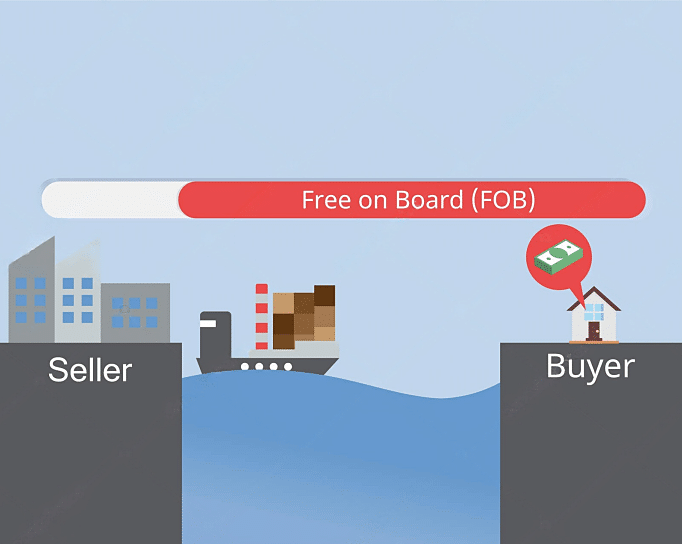
Related Guide
What Is FOB? Importing from China: A Comprehensive Guide
When importing goods from China, understanding trade terms is essential to managing logistics, costs, and responsibilities effectively. One of th...
Read guide →
Related Guide
DAP vs DDP Incoterms
DAP vs DDP: Customs Clearance, Import Duties, and Who Pays What Verified & Reviewed · Last updated January 2026 Choosing between DAP and DDP dete...
Read guide →
Useful Resource
Exw Ex Works Incoterms
Explore this related Tonlexing logistics guide for freight, customs and importing support.
Learn more → Useful Resource DDP vs CIF vs FOB: Which Incoterm Is Best for Your China Shipment?DDP vs CIF vs FOB: Which Incoterm Is Best for Your China Shipment? Verified & Reviewed · Last updated July 2026 Choosing between DDP, CIF and FOB...
Learn more →